icon

How to Objectively Evaluate Sales Manager Candidates: Scoring System or Competency Table

Sales hiring often happens based on intuition. And despite years of talk about changing approaches, the situation with hiring sales managers remains unchanged. “I like this candidate,” “he has charisma,” “he made an impression” – common phrases from hiring managers. But a likable candidate doesn’t always become an effective employee. Subjectivity in hiring costs businesses dearly – you spend time and money on adapting someone who might not show desired results after a few months.

Want a high-performing sales team without the hassle?
We’ll build it for you.
Contact Us

Key Takeaways

  • A charismatic candidate at an interview may be weak in persistence, analytics, or CRM work; impressive self-presentation doesn’t guarantee sales results.
  • A competency matrix transforms vague requirements like “communicates well” into specific indicators: asks open questions, identifies hidden needs, formulates offers in terms of benefits.
  • A point system for hiring salespeople allows comparing candidates by numbers, not impressions, and immediately seeing where a new employee will need additional training.
  • Misalignment of criteria between HR and sales manager leads to hiring the wrong people: one looks for a “team player,” the other expects an “aggressive hunter with CRM skills.”
  • A candidate’s competency profile (chart of hard and soft skills scores) helps not only make hiring decisions but also prepare a development plan for the new manager in advance.

In the article below, you’ll find a step-by-step algorithm for implementing a competency matrix, examples of interview checklists, and specific criteria for each assessment level. Read the full article 👇

The solution to the subjectivity problem is a formalized approach to candidate evaluation through a sales manager competency profile and scoring system. This isn’t just following HR tool trends, but a real way to transform your impressions of a candidate into measurable indicators. A properly designed candidate scoring system allows you to compare candidates by clear criteria, not impressions.

In this article, we’ll explore how to structure the sales hiring process so that a manager’s intuition is supported by objective data, and your sales team is filled with truly strong players.

Why You Need a Competency Matrix When Hiring a Sales Manager

A competency matrix is a structured set of criteria by which you evaluate sales manager candidates. Essentially, it’s a sales manager competency table that outlines all necessary skills, abilities, and personal qualities with their development levels. This approach makes the hiring process transparent and consistent.

The main value of a competency matrix is that it transforms vague requirements into a clear evaluation system. Instead of general phrases like “must communicate well with clients,” the matrix offers specific indicators: “knows how to ask open questions,” “identifies hidden client needs,” “formulates offers in terms of benefits.” Each skill is evaluated on a scale from 1 to 3, where 1 is basic level, 2 is confident mastery, and 3 is expert level.

A sales manager competency map solves several important tasks:

  • Standardizes requirements for candidates
  • Allows objective comparison of different applicants
  • Reduces the influence of personal likes and prejudices
  • Structures interviews and makes them purposeful
  • Helps understand where a new employee will need additional training

You can develop such a system step by step, focusing on stages of matrix creation and sales department audit to account for not only formal requirements but also real business needs.

An example of a competency model for sales managers might look like this:

Competency Level 1 (basic) Level 2 (confident) Level 3 (expert)
Active listening Listens to the client, asks simple questions Uses paraphrasing techniques, asks clarifying questions Identifies hidden needs through deep questions, manages the conversation
Handling objections Knows standard answers to typical objections Applies the acknowledgment technique, confidently handles price objections Prevents objections, transforms them into advantages
Product knowledge Knows basic characteristics Confidently describes advantages and benefits Tailors solutions to specific client needs

How do you evaluate a sales candidate with no experience?
When evaluating candidates without sales experience, focus on basic skills and personal qualities necessary for success in this field. Use role-playing and situational tasks to assess communication skills, persistence, learning ability, and general proactivity. Pay attention to examples of sales manager competencies that might manifest in other contexts – such as persuasion abilities and problem-solving skills from the candidate’s past experience.

A properly designed competency matrix becomes the foundation for the entire hiring process and subsequent employee development. Now let’s look at which competencies are important to include in such a matrix.

Is it difficult to measure a salesperson’s abilities? Most business owners evaluate sales manager candidates based on personal likability, and then wonder why their “charismatic” employee isn’t meeting targets. Objective assessment isn’t just a matter of proper hiring; it’s the foundation of a profitable sales department. At “Sales Rocket,” we’ve created a comprehensive methodology for evaluating and developing salespeople, which includes detailed competency analysis, skills auditing, and a structured training system. Over 7+ years, we’ve built 158+ effective sales departments in 14 different niches using our personnel assessment and development system. The result? Our clients experience predictable revenue growth averaging 35%, with our best case being a $1.6 million sales increase in just 4 months of collaboration.

Create a sales department that consistently achieves 150% of plan - get a free audit of your hiring and assessment system efficiency!

Which Competencies Are Important to Evaluate in a Sales Manager

The professional portrait of a successful salesperson consists of two major skill groups: Hard skills (professional competencies) and Soft skills (behavioral characteristics). Both groups are equally important and should be evaluated comprehensively.

Hard skills are technical knowledge and abilities that can be measured and are relatively easy to teach:

  • Product and market knowledge – how well the candidate understands what they’re selling, to whom, and why it’s needed.
  • Sales technique mastery (SPIN, ABC, SNAP) – ability to identify needs, present solutions, and close deals.
  • CRM system skills – experience in maintaining a client database, planning activities, analyzing the sales funnel.
  • Understanding of the sales process – whether the candidate knows the stages of a deal and how to manage the client at each stage.

Soft skills are personal qualities and interpersonal interaction skills that are more difficult to evaluate, but often determine the outcome of a deal:

  • Communication skills – ability to establish contact and maintain conversation.
  • Empathy – ability to understand client needs and pain points, to see the situation through their eyes.
  • Persistence – ability not to give up after the first rejection, to complete what was started.
  • Stress resistance – ability to maintain effectiveness even under pressure and uncertainty.

The assessment of sales manager soft skills requires special attention when evaluating 5 key competencies and understanding which questions distinguish outstanding salespeople from merely good ones:

Competency Description Manifestation Indicators
Negotiation skills Ability to find mutually beneficial solutions, manage the negotiation process • Flexibly applies different negotiation styles
• Effectively handles price objections
• Achieves deal objectives without excessive concessions
Proactivity Ability to take initiative, anticipate client needs • Independently seeks new opportunities
• Offers solutions the client hadn’t considered
• Doesn’t wait for instructions, but takes action
Analytical thinking Ability to analyze data, draw conclusions, make forecasts • Analyzes the effectiveness of their actions
• Sees patterns in client behavior
• Makes decisions based on data
Customer orientation Ability to put client interests at the center of interaction • Offers solutions that best meet needs
• Builds long-term relationships
• Gets recommendations and repeat sales
Time management Ability to effectively prioritize, focus on what’s important • Structures their working day
• Focuses on tasks with high result potential
• Closes deals in a timely manner

When selecting competencies for your matrix, consider your business specifics. For complex B2B sales with long deal cycles, analytical abilities and relationship-building skills are especially important, while in fast B2C sales, persuasiveness and work speed come to the forefront. Having formed the matrix, you have a basis for developing a scoring system.

Scoring System in Hiring: How to Build an Objective Assessment

A scoring system when hiring salespeople is a way to quantitatively measure a candidate’s competency level. It transforms qualitative assessments into numbers that can be compared. Without such a system, it’s difficult to objectively choose between two strong candidates, each good in their own way.

Building a candidate scoring system starts with determining the importance of each criterion. Not all competencies are equally significant for a specific position. For example, for a telephone sales manager, active listening skills might be more important than CRM system knowledge, while for a department head, analytical abilities might be valued higher than cold calling skills.

Each criterion is assigned a weight – a percentage of significance in the overall assessment. The sum of weights for all criteria should be 100%. Then for each criterion, the candidate is given an assessment of salespeople’s competencies on the chosen scale (usually from 1 to 5 or from 1 to 10), where 1 is the minimum level and the maximum number is perfect skill mastery.

The final score for each criterion is calculated as the product of the weight and the score. The candidate’s overall rating is the sum of all final scores. This approach significantly improves criteria for evaluating the effectiveness of a sales manager and allows making decisions based on specific indicators.

Here’s an example of such a system:

Criterion Weight Score Total
Argumentation 20% 4 0.8
Active listening 15% 5 0.75
Handling objections 25% 4 1.0
Closing deals 20% 5 1.0
Empathy 20% 3 0.6
Overall rating 100% 4.15

This system allows compensating for weakness in one area with strength in another, but only within reasonable limits. If a candidate receives low scores on critically important competencies, high scores on less significant criteria won’t save the situation.

When building a scoring system, it’s important to avoid two extremes: a too simple system that doesn’t account for nuances, and an overly complex one that makes it difficult to use. The optimal variant is 5-8 key criteria with clearly described levels for each score. This provides a sufficiently detailed picture without excessive complexity.

The scoring system should be understandable to all participants in the hiring process. Each interviewer should interpret the same way what a sales manager competency assessment of “3” or “4” means for a specific criterion. For this, it’s useful to develop a detailed description for each assessment level. Now let’s look at how to combine the competency matrix and scoring system.

How to Combine the Competency Table and Scoring System When Evaluating Sales Candidates

The competency matrix and scoring system are not two separate tools, but complementary parts of a unified approach to candidate evaluation. The matrix determines what exactly you’re evaluating, while the scoring system shows how to measure the development level of each competency.

When combining these tools, the competency matrix serves as a foundation on which the scoring system is built. Each competency from the matrix becomes a criterion in the scoring system, and the description of competency levels helps determine what score the candidate deserves.

For example, if the competency matrix includes the skill “Active listening” with three development levels, then in the scoring system you can use a 5-point scale where:
1 point – below basic level (level 1 from the matrix)
2-3 points – corresponds to basic level (level 1 from the matrix)
4 points – corresponds to confident level (level 2 from the matrix)
5 points – corresponds to expert level (level 3 from the matrix)

This approach provides a finer gradation and allows distinguishing between candidates who are at the borderline between competency levels.

When combining the matrix and scoring system, you get a powerful tool for visualizing a sales manager competency profile. Assessment results can be presented as a chart, where the axes represent competency groups (for example, hard skills and soft skills), and the points show the development level of each skill. Such a “competency profile” clearly demonstrates the candidate’s strengths and weaknesses.

An example of a sales manager professional competency profile might look like this:

Hard skills:

  • Product knowledge: 4.5/5
  • Sales techniques: 3/5
  • CRM discipline: 2/5
  • Deal process: 4/5

Soft skills:

  • Communication: 5/5
  • Empathy: 4/5
  • Persistence: 3.5/5
  • Stress resistance: 4/5

Such a sales manager professional competency profile helps not only make hiring decisions but also plan further employee training. You immediately see where the candidate has gaps and can prepare a development plan in advance. For example, if a candidate has a low score in CRM work but high scores in key sales skills, it makes sense to hire them and organize sales manager training to fill the identified deficits.

Integrating the matrix and scoring system makes the hiring process not only objective but also oriented toward further employee development. This is especially important in sales, where constant skill improvement is key to growing results. But for practical application of this system, you’ll need checklists and assessment forms.

How to Use Checklists and Assessment Forms

Checklists and assessment forms are practical tools that help standardize the interview and candidate evaluation process. They transform theoretical models (competency matrix and scoring system) into working tools for interviewers.

A good sales manager evaluation checklist should include three main blocks: questions for checking competencies, behavioral indicators for observation, and an assessment scale. A checklist isn’t just a list of questions, but an action guide for the interviewer.

For each competency in the checklist, there should be prepared:

  1. 2-3 questions aimed at identifying this competency
  2. Indicators to pay attention to in the answers
  3. Criteria for scoring

For example, to assess the skill of handling objections, the checklist might contain these items:

Competency: Handling Objections

Questions:

  • Tell me about a case when a client doubted the value of your offer. How did you act?
  • How do you react when you hear the phrase “this is too expensive”?
  • Give an example of a situation where you managed to overcome a strong client objection.

Indicators for observation:

  • Does the candidate maintain a positive attitude when discussing objections
  • Do they perceive objections as requests for additional information
  • Do they use a structured approach to handling objections
  • Do they provide specific examples from their experience

Assessment scale:

  • 1 point – Perceives objections as personal criticism, has no strategy for working with them
  • 2 points – Has a basic understanding of how to handle objections, but applies a templated approach
  • 3 points – Confidently works with typical objections, uses acknowledgment and reformulation techniques
  • 4 points – Effectively works with different types of objections, adapts approach to the situation
  • 5 points – Masterfully manages objections, often prevents their appearance, transforms them into advantages

What sales manager effectiveness criteria should be included in the assessment system? The assessment system should include not only quantitative indicators (sales volume, conversion, average check) but also qualitative criteria: ability to establish long-term relationships with clients, CRM management quality, teamwork, and adherence to corporate standards. The sales manager skill matrix should also reflect the candidate’s ability to adapt to market changes and continuously improve their skills.

For comprehensive assessment of sales manager competencies, use questions for assessing soft skills and situational tasks that help identify the candidate’s deep personal qualities. Such techniques are especially in demand among HR experts looking not only for experience but also development potential.

Assessment forms should be convenient for filling out and subsequent analysis. Many companies use electronic forms (Google Forms, Microsoft Forms) that automatically process results and calculate final scores. This simplifies comparing candidates and preserving assessment history.

It’s important that all interviewers use identical checklists and forms. This ensures consistency in assessments and allows objectively comparing candidates, even if they were evaluated by different people. Regular interviewer calibration (discussing evaluation criteria and comparing understanding of levels) helps maintain a unified approach.

A sales manager competency assessment sheet is the final document that is filled out after all assessment stages. It contains final scores for all competencies and a hiring recommendation. Such a sheet serves as the basis for making the final decision and helps document the assessment process.

Properly designed checklists not only increase assessment objectivity but also make the interview more informative for both parties. The candidate gets an opportunity to demonstrate their strengths, and the company gathers relevant information for decision-making. Now let’s look at typical mistakes in candidate evaluation.

Typical Mistakes When Evaluating Sales Manager Candidates

image

Despite all the advantages of a structured approach to evaluation, many companies continue making mistakes that reduce the effectiveness of the hiring process and lead to selecting unsuitable candidates.

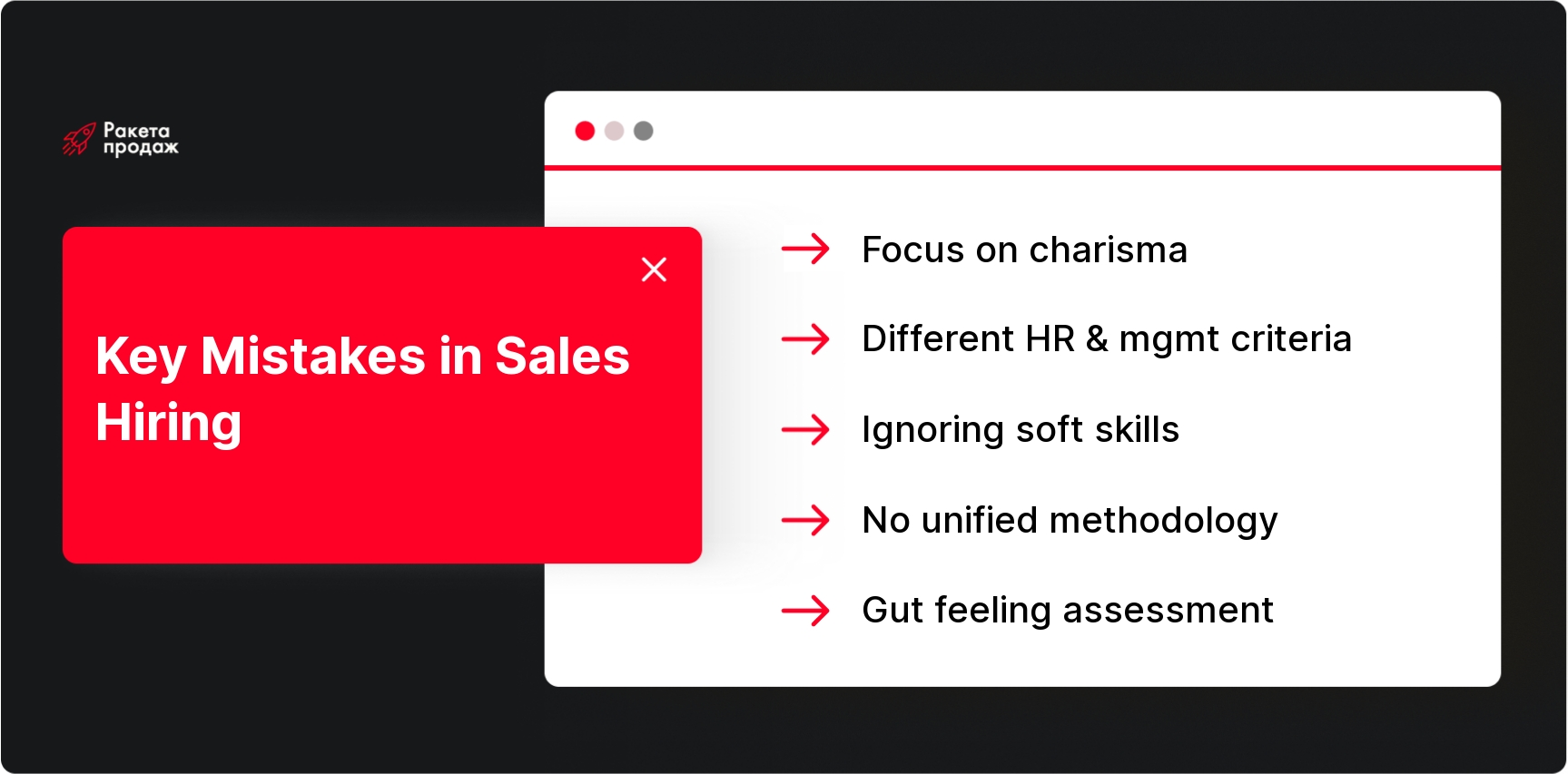
One of the most common mistakes is overestimating the candidate’s confidence and charisma. We want to hire bright, charming people, but extroversion and self-presentation skills don’t guarantee success in sales. A candidate who brilliantly “sold themselves” at the interview might be weak in other key competencies, such as persistence, analytical thinking, or attention to detail.

The second serious mistake is misalignment of criteria between HR and the sales department head. When HR is looking for a “communicative team player,” and the manager expects an “aggressive hunter with CRM skills,” it’s not surprising that selected candidates don’t meet expectations. Evaluation criteria should be agreed upon by all participants in the hiring process before posting the vacancy.

Many companies tend to ignore soft skills when evaluating salespeople, focusing exclusively on experience and results. However, it’s behavioral competencies that often determine a sales manager’s long-term success. A candidate with an impressive track record might not fit into the team or company culture due to weak communication skills or lack of empathy.

The absence of unified forms or assessment scales is another common problem. When each interviewer evaluates the candidate in their own way, comparison becomes incorrect. One looks at sales results, another at personal impression, a third at references from previous workplaces. Without a standardized approach, the final decision turns into an argument about subjective impressions.

Finally, many managers continue to rely on “gut feeling” assessment, even having structured tools at their disposal. “Intuition doesn’t fail” is a dangerous misconception that often leads to hiring unsuitable candidates and missed opportunities.

To avoid these mistakes, it’s recommended to:

  • Use structured interviews with clear evaluation criteria
  • Conduct regular interviewer calibration for unified understanding of criteria
  • Evaluate both hard and soft skills, using behavioral questions and practical tasks
  • Involve several evaluators with different perspectives
  • Base decisions on objective data, not first impressions

Another important aspect is reducing turnover in the department, which is directly related to the quality of hiring and assessment of candidates’ compatibility with corporate values and business requirements.

Implementing these recommendations requires a systematic approach and changing established hiring practices. Let’s look at how to implement an objective assessment system in your company.

How to Implement an Objective Assessment System in the Hiring Process

Implementing an objective assessment system is not a one-time event, but a step-by-step process that requires the involvement of all hiring participants and consistent execution of key steps.

Step 1: Define the competency model for sales managers. Start by analyzing successful sales managers in your company. What makes them effective? What skills and qualities do they possess? Based on this analysis and considering the strategic business goals, form a competency model. Involve sales department heads and top salespeople in this process – their experience is invaluable for creating a relevant model.

Step 2: Approve criteria and their weights. After identifying key competencies, decide which are most important for achieving results in your company. Set priorities and assign each criterion an appropriate weight. This work should be done jointly by HR and sales managers to account for both business needs and team specifics.

Step 3: Create the matrix. Format the competency model as a matrix with clearly described levels for each competency. Use concrete, measurable formulations. Save the matrix in a convenient format – it could be a table in Google Sheets, a database in Notion, or a specialized ATS (Applicant Tracking System). Develop a sales manager competency map that visually presents all necessary skills and their interrelationships.

Step 4: Conduct interviewer calibration. Organize training for all participants in the hiring process to ensure everyone understands the competencies and evaluation criteria the same way. Conduct practical sessions analyzing cases and examples of candidate responses. Such calibration helps reduce subjectivity and ensures a unified approach to evaluation.

Step 5: Use feedback templates. Develop standard forms for feedback on interview results. These forms should reflect all competencies from the matrix and provide for both quantitative assessment (scores) and qualitative comments. Such templates simplify comparing candidates and preserving assessment history.

We also recommend paying attention to sales department motivation after hiring new employees to maintain their engagement and desire for growth.

Implementing an objective assessment system brings the company a number of significant advantages:

  1. Transparency of the hiring process. Managers see why a specific candidate was selected. The hiring manager conducts final interviews with relevant candidates who meet the selection criteria.
  2. Improved hiring quality. A structured approach helps select candidates who truly meet the position requirements, not just make a good impression.
  3. Reduced subjectivity. Hiring decisions are made based on measurable criteria, not personal preferences or “chemistry.”
  4. Faster adaptation. Thanks to a clear understanding of the new employee’s strengths and weaknesses, you can immediately develop an individual development plan for them.
  5. Improved employer image. A professional, structured hiring process creates a positive impression of the company even for candidates who didn’t receive an offer.

Remember that implementing an objective assessment system is an investment in your sales team’s future. Although it will require time and effort at the initial stage, the long-term benefits from improving hiring quality and reducing staff turnover significantly exceed the initial costs.

Conclusion

Objective evaluation of sales manager candidates is not a formality or trend-following, but a necessary tool for building a strong sales team. Transitioning from subjective hiring “by feel” to a systematic approach based on a competency matrix and scoring system allows selecting not just pleasant interviewers, but effective employees who will bring profit to your business. The combination of clear evaluation criteria, standardized interviews, and balanced results analysis makes the hiring process transparent, fair, and effective. By implementing such a system, you will not only reduce hiring errors but also create a foundation for further employee development, which will positively impact the results of the entire sales department. In a world where talented salespeople are worth their weight in gold, a structured approach to candidate evaluation becomes a competitive advantage for companies in the labor market.

Implementing an objective salesperson evaluation system isn’t just an HR procedure, but a strategic decision directly affecting business profitability. But developing a competency matrix and implementing a scoring system require expertise and time that managers often lack. “Sales Rocket” offers a comprehensive solution: we not only help create a professional candidate evaluation system but also completely build a systematic sales department – from training existing employees to implementing CRM and regular analytics. Our experts audit current processes, identify weaknesses, and develop personalized development strategies for each manager. According to our clients’ data, a properly selected and trained team increases sales conversion by 5-86% and ensures stable plan fulfillment. Among our partners are companies like Mitsubishi, Yamaha, Naftogaz – leaders who trust us with their sales.

Transform the subjective hiring process into a system that guarantees attracting the best salespeople - order a comprehensive sales department build!
In this article:
See more
Book a FREE sales funnel audit
CONTACT US
FAQ
What is a sales manager competency matrix and how to create it?

A competency matrix is a structured set of skills, knowledge, and qualities necessary for successful work in sales. It includes both professional (hard skills) and behavioral (soft skills) competencies with descriptions of their development levels. To create a matrix, analyze the work of successful managers in your company, identify key competencies, describe their indicators and mastery levels. The matrix should reflect your business specifics and sales type. If you’re unsure where to start, study tips for selecting candidates from experienced recruiters.

How does the scoring system work when hiring salespeople?

The scoring system allows quantitatively measuring a candidate’s competency level. Each criterion is assigned a weight depending on its importance. The candidate is evaluated on these criteria on a scale (for example, from 1 to 5), then weighted scores and overall rating are calculated. This system provides an objective basis for comparing candidates and making hiring decisions.

How to avoid subjectivity when evaluating candidates?

To reduce subjectivity, use structured interviews with prepared questions, involve several evaluators, conduct regular interviewer calibration, apply behavioral questions and practical tasks, use unified assessment forms. It’s important to make decisions based on objective data, not first impressions or personal likability.

SUBSCRIBE TO MY TELEGRAM CHANNEL
The most valuable sales information right on your phone!
icon

LOTS OF USEFUL INFORMATION, FREE TEMPLATES, AND CHECKLISTS ON MY INSTAGRAM

Materials and practical advice on sales growth in our blog: