icon

Sales Training: Choosing the Ideal Format for Team Growth

Choosing a sales training format has become a strategic decision today, not just a matter of logistics or convenience. Modern companies are actively seeking the perfect balance between the deep immersion provided by offline trainings and the scalability of online formats. On one hand, digitalization has opened access to knowledge from anywhere in the world; on the other, nothing replaces the energy of live training and team interaction.

Want a high-performing sales team without the hassle?
We’ll build it for you.
Contact Us

Key Takeaways

  • The training format impacts results as much as the program itself. The same content in different formats yields different implementation speeds and skill retention.
  • Online sales training saves budget and time, but up to 70% of participants don’t complete them due to low engagement and lack of live feedback.
  • Offline sales training is indispensable for practicing complex negotiations, presentations, and reading non-verbal cues, but require higher costs and team synchronization.
  • The blended model combines online theory with offline practice. It reduces costs, maintains engagement, and provides better material retention.
  • Format selection should be based on team size, geography, budget, and skill type. Different tasks require different approaches, not a universal solution.

In the article below, you’ll find specific criteria for choosing a format, a comparison table of models, and implementation tips for your sales department 👇

Finding the optimal model becomes even more relevant in environments where teams work remotely and specialists are located in different cities or countries. Companies are experimenting, creating hybrid programs, and combining formats to achieve maximum return on training resources.

Different training formats solve different problems – it’s important to choose one that suits your team and business goals. What works for a corporation with thousands of managers may prove ineffective for a young company with a small sales department. Sales training types that we’ll examine have both advantages and a number of special characteristics.

Why Training Format Affects Sales Results

Not only the content of the training but also the delivery method directly determines how successfully managers will apply the acquired knowledge in their work. This is often overlooked when focusing exclusively on the training program. But we see daily how different types of sales training lead to completely different results.

The effectiveness of sales training depends on several key factors. First, participant engagement – how actively they participate in the process, ask questions, and complete assignments. Second, the quality and timeliness of feedback – whether participants receive specific recommendations for skill improvement. Third, the learning environment – whether participants are comfortable and whether the setting promotes concentration and information absorption. Fourth, regularity – a one-time training rarely leads to sustainable behavioral changes.

A revealing example is a logistics company that conducted the same objection handling training for its sales department in two formats: a two-day offline intensive and a six-week online sales course with weekly assignments. The offline group showed impressive results immediately after training, but after a month, most returned to their previous working methods. The online group demonstrated slower but steady progress and after three months surpassed the offline group’s performance. Let’s explore the advantages and limitations characteristic of each training format.

Online Sales Training: Flexibility and Scale

Online sales training has become the primary format for many companies due to its flexibility and accessibility. This has been particularly evident in recent years as remote work has become the norm. Managers can complete training at convenient times without lengthy interruptions to their work tasks, while companies save on logistics and venue rentals.

This format is ideal for distributed teams working in different cities or countries. Startups and small companies with limited budgets also choose online sales training because it provides quality knowledge without significant investment. Additionally, the online format offers the opportunity to learn from the world’s best experts without geographic limitations.

What Online Training Includes

Modern online sales training goes far beyond watching recorded lectures. Today it’s an entire ecosystem of formats and tools, each solving specific tasks.

Remote sales training allows real-time interaction with the trainer, asking questions, and receiving feedback. Full-fledged e-learning in sales training includes video lessons, tests, practical assignments, and progress tracking. Interactive video lessons with decision points help practice skills in a safe environment. Sales training videos provide the opportunity to revisit material multiple times, reviewing key points. Online negotiation simulations allow practice in conducting complex dialogues with immediate feedback.

Increasingly, gamification platforms are being used in sales training, turning the process into an engaging game with points, levels, and competitions. Feedback chatbots allow participants to receive instant answers to questions and recommendations for skill improvement. Micro-lectures lasting 5-10 minutes provide opportunities to learn during short breaks between work tasks.

Advantages of Online Training

The online format has several undeniable advantages that make it attractive to companies of various sizes. The main one is accessibility from anywhere in the world with internet access. A manager can learn at home, in the office, or in a cafe, without spending time commuting or being away from work for long periods.

Minimal organization costs are another important plus. There’s no need to rent a venue or pay for participants’ and trainers’ travel and accommodation. Additionally, online platforms usually provide detailed analytics of results: who spent how much time on training, which assignments were completed, which topics caused difficulties.

An online sales course is excellent for theoretical blocks and mass training in standard processes. If you need to quickly implement a new sales script or familiarize a team with a new product, online training will be the most effective solution. This format is also ideal for teams with high turnover, where new employees constantly need to be brought up to speed.

What training format will best suit your sales team? This question is asked by most business owners facing the need to improve department efficiency. Practice shows that choosing the right format is only part of the solution. Much more important is implementing a comprehensive approach to manager training and development that is integrated into everyday business processes. At “Rocket Sales,” we’ve developed an individual methodology for developing sales departments that combines the advantages of all training formats and adapts to your business specifics. Our trainings are conducted in both live and online formats, with practical assignments, analysis of real cases, and constant expert support. Over 7+ years, we have successfully implemented more than 157 projects in 14+ different industries, including collaborations with companies such as Mitsubishi, Yamaha, and Naftogaz. The result? Our clients’ average turnover increase is +35%, and conversions grow by 5-86%.

Turn sales training into a growth system for your business - get a free consultation right now!

Limitations of Online Format

Despite all its advantages, online training has several significant limitations. One of the main ones is low participant engagement. It’s difficult to maintain someone’s attention when they’re in front of a computer screen surrounded by distractions. Statistics show that up to 70% of online course participants don’t complete the program.

The lack of personal contact with the trainer and other participants makes it difficult to develop interpersonal communication skills that are critically important in sales. It’s more challenging to learn to read a client’s non-verbal signals or practice active listening techniques through a screen.

Practical skills in sales require repeated practice with feedback, and in an online format, such practice is easier to implement, especially when we’re talking about basic negotiation techniques. In complex negotiations, presentations, and objection handling, online may fall short.

To increase the effectiveness of online training, it’s worth breaking material into short 15-20 minute modules, including interactive elements (polls, tests, assignments), and providing curator support to answer questions and give feedback. It’s important to understand that for some, the absence of deadlines and a strict schedule is a plus, while for others, it’s a source of procrastination. These features need to be considered when transitioning to the next type of training.

Offline Training: Energy and Team Dynamics

Despite the rapid development of online technologies, live trainings still occupy an important place in the sales training system. This is especially true for developing soft skills and team interaction. The power of direct human contact and the energy that emerges when a group of people works together to solve problems cannot be underestimated.

Offline sales training creates a special atmosphere where participants can fully focus on learning, disconnected from everyday work tasks. Here they receive live feedback not only from the trainer but also from colleagues, participate in role-playing games, observe others’ work, and learn from their examples. Group dynamics contribute to deeper material absorption and the creation of professional connections.

When Offline Format is Indispensable

There are situations when offline training becomes practically irreplaceable. First and foremost, this is training in complex negotiations, where nuances of non-verbal communication, the ability to read the interlocutor’s micro-signals, and instantly adapt one’s strategy are important. A trainer in face-to-face format can directly show how to establish eye contact properly, which gestures to use, and how to work with voice.

Presentation skills are also better practiced in a live audience. The presenter can sense the audience’s reaction, learn to manage group attention, and work with space. Team sales, where several people must act as a single organism, are more effectively trained in real conditions when the team is physically in the same room.

Corporate sales training in offline format allows the trainer to instantly correct participants’ behavior, stop an exercise at a key moment, and provide targeted feedback. Such immediate correction contributes to faster formation of correct skills and elimination of errors in early stages.

Advantages of Offline Trainings

High participant engagement is a key advantage of the offline format. When someone is physically present at a training, they’re harder to distract than when learning through a computer screen. Group activities, discussions, joint case solving – all this keeps attention at a high level.

Practical skill development happens in real-time with the possibility of receiving immediate feedback. Participants can immediately apply acquired knowledge in role-playing games and simulations, while the trainer and colleagues help identify strengths and areas for improvement.

Social interaction creates a favorable environment for experience exchange. During breaks, at lunch, in informal settings, participants share their success and failure stories, discuss work situations, and find problem solutions.

Sales seminars in offline format are excellent for forming a corporate sales culture. When a team spends time together, immersed in company values and principles, it creates a sense of belonging and unity that is difficult to achieve in a virtual environment.

Disadvantages of Offline Training

Despite all the advantages, offline training has several significant disadvantages. First of all, high costs. Besides the trainer’s fee, you need to pay for venue rental, participant meals, and in the case of regional teams – travel and accommodation. As a result, the cost of one day of training can be quite significant.

Limited scale is another weakness. It’s impossible to simultaneously train hundreds or thousands of employees while maintaining high-quality interaction. The optimal group size for effective training is 10-15 people, which creates difficulties for large companies with large sales departments.

The need to synchronize schedules of all participants and organize logistics often becomes a real headache. Taking the entire team out of the work process simultaneously can be extremely difficult, especially during peak sales periods.

However, with the right program structure and clear understanding of goals, offline training demonstrates high ROI. Investments in quality training can be returned many times over through increased team effectiveness and sales growth. Now let’s consider how we can combine the advantages of both formats.

Blended Learning Models: Balance of Effectiveness and Flexibility

Blended learning represents a combination of online and offline formats, where theoretical material is learned remotely, and practical skills are developed in person under trainer guidance. This approach allows using the strengths of both formats while neutralizing their weaknesses.

For modern companies, blended learning for the sales department often becomes the golden mean. It reduces the time employees are away from work, decreases logistics costs, while maintaining the crucial element of live interaction. This approach is particularly relevant for companies with distributed teams or seasonal sales peaks when it’s difficult to remove all employees simultaneously.

How the Blended Model Works

A typical blended sales training scheme includes several stages. First, participants complete an online module where they learn theoretical foundations, sales methodology, information about products or services. This stage may include video lectures, tests, interactive assignments and usually takes from one to three weeks.

Then an in-person session is conducted, entirely devoted to skill practice and solving practical cases. At this stage, participants model real sales situations, receive feedback from the trainer and colleagues, and analyze complex cases from their own practice. Such a session usually lasts 1-2 days and is intensive.

The face-to-face meeting is followed by a reinforcement stage – coaching or online reflection. Participants apply the acquired knowledge in their work, record results, discuss difficulties with the trainer or mentor. This stage may include individual consultations, group online sessions, and homework completion.

For example, a company trains managers in a learning management system (LMS) where they study sales methodology and techniques, then conducts a two-day live training with real negotiation simulations, followed by a series of group coaching sessions to reinforce skills and analyze complex cases.

Advantages of the Hybrid Approach

image

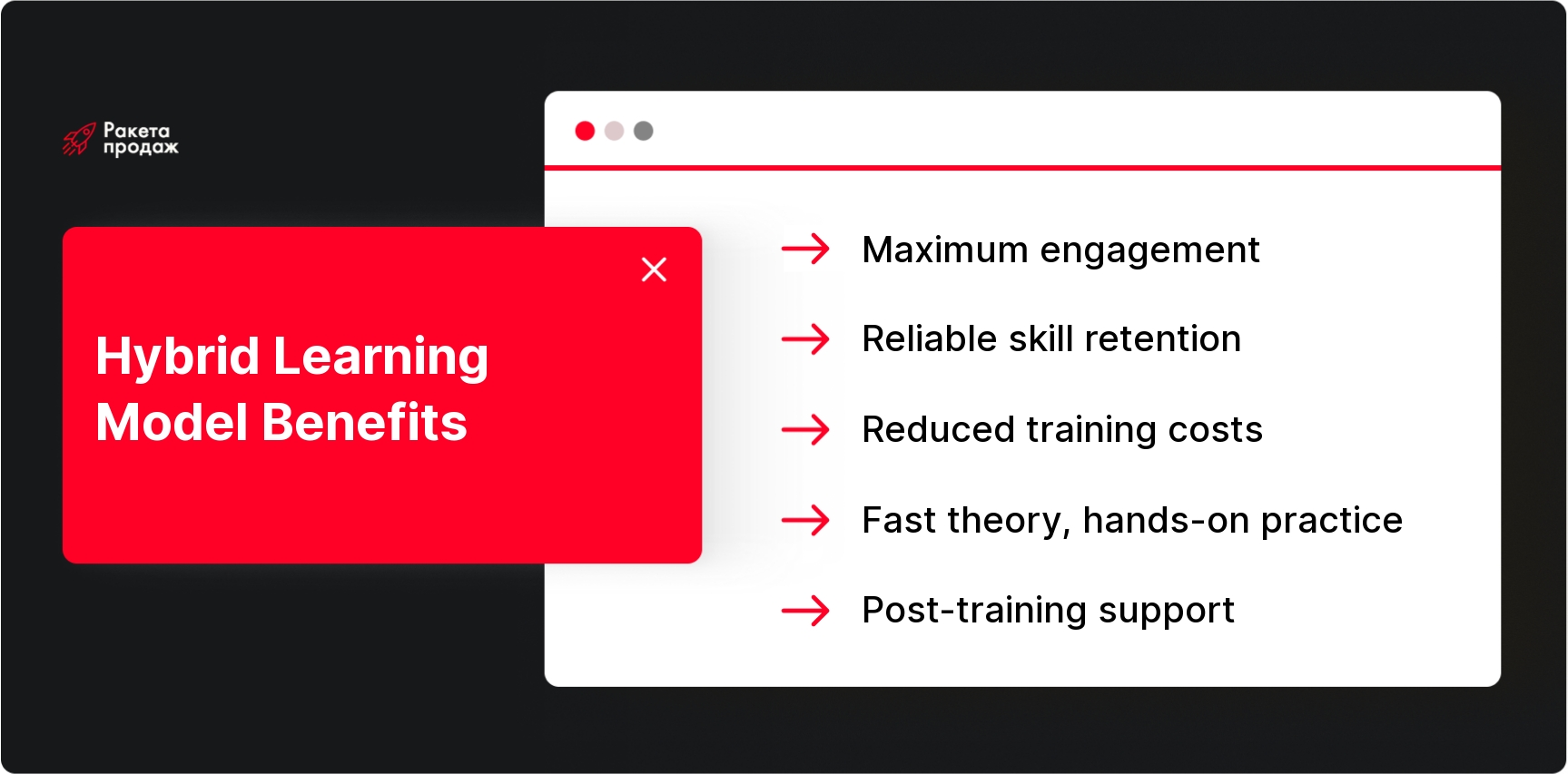
The main advantage of the blended model is that it combines the best of both worlds: the scalability and convenience of online learning with the engagement and depth of the offline format. A company can train a large number of employees in theoretical foundations simultaneously online, and then organize practical sessions in small groups with experienced trainers.

This approach allows significantly reducing costs without compromising training quality. Instead of paying for multi-day off-site trainings for the entire team, the company invests in an online platform and conducts shorter in-person sessions.

The hybrid format also ensures better material retention. Research shows that information is better absorbed when presented in different ways with opportunities for practical application. In the blended model, participants first get a theoretical foundation, then practice skills under trainer guidance, and afterwards apply them in real work with coach support.

Who Benefits from the Blended Model

The blended learning model is ideal for companies with offices in different regions, where gathering all employees in one place involves high costs and logistical complexities. Large retail chains, banks, telecommunications companies with distributed sales teams get maximum benefit from this approach.

B2B teams working with complex products and lengthy sales cycles also benefit from blended learning. They can study product information and methodology online, then hone complex negotiation and presentation skills in face-to-face sessions.

It’s worth noting that blended learning for the sales department helps build a continuous learning system, where skill development happens constantly, not just once. This is especially important in rapidly changing market conditions when salespeople need to constantly adapt to new conditions and customer requirements. With this knowledge, let’s consider how to choose the optimal format for specific business tasks.

How to Choose a Training Format for Business Tasks

Choosing a training format should be a strategic decision based on specific business goals and capabilities, not on fashion trends or leadership preferences. It’s important to understand that different tasks require different approaches to training.

For implementing new work standards or radically changing the sales approach, it’s better to choose the offline format. The trainer’s personal presence and the possibility of immediate feedback help overcome resistance to change and ensure everyone correctly understands the new requirements.

When large-scale training of many employees with different preparation levels is required, online sales training becomes most effective. It allows quick information delivery to all participants, ensuring uniformity of material presentation.

Sales trainings come in different types, and for achieving sustainable changes in seller behavior and forming new skills, the blended model is the optimal choice. It provides both theoretical foundation and practical application with subsequent reinforcement in real work.

Before choosing a suitable program, it makes sense to conduct a team competency audit to diagnose real gaps and outline development direction. For this, a detailed instruction how to conduct a sales department audit may be useful.

The course content should be directly related to the company’s business goals. If the goal is to increase average check size, the program should focus on upselling techniques and deal expansion. If the problem is in lead-to-client conversion, attention should be paid to initial negotiation skills and objection handling.

It’s important to adapt the training methodology to your market segment specifics and company features. Universal programs rarely give good results. For example, sales techniques that work in the B2C segment may be ineffective in complex B2B sales with a long cycle.

Another relevant trend is becoming sales personalization considering unique tasks, products, and audiences, companies achieve greater effect and skill reinforcement.

Tip: When choosing a training program, pay attention not only to content but also to post-training support availability. Without reinforcement and support, the training effect will quickly disappear.

Customizing the program to your business processes and products is another important aspect. Training should use real examples from your company’s practice, scripts relevant to your product, and objections your managers actually face.

Tip: When choosing a training provider, request the possibility of program customization and material adaptation to your business specifics.

The training results evaluation system should be thought out before the program starts. It’s necessary to determine which metrics will be tracked, how progress will be measured, which indicators will be considered successful. For successful training implementation and results management, sales enablement is extremely important, as well as a support system after the main program.

Selection Criterion Online Format Offline Format Blended Model
Team Size Large teams (50+ people) Small and medium (up to 15-20 people) Medium and large teams
Geography Distributed teams Local teams Distributed teams
Budget Limited Substantial Medium
Skill Type Theoretical knowledge, standard processes Soft skills, complex negotiations Complex skills
Urgency Quick launch Requires organization time Medium implementation time
Cultural Changes Low effectiveness High effectiveness Medium effectiveness
Learning Control Automated Direct feedback Combined

When choosing a training program, pay attention to trainer experience, proven cases in your industry, transparency of effectiveness metrics, and the possibility of getting feedback from previous program participants. Request references – contacts of companies that have already completed training to learn about their real experience and results.

Tip: Before large-scale implementation, conduct pilot training with a small group of managers. This will allow evaluating program effectiveness and making adjustments before investing in training the entire team.

At the same time, don’t forget about developing management competencies. For example, sales manager performance evaluation can become a driver for increasing training effectiveness for the entire team.

It’s important to remember that even a perfectly selected training program won’t produce results without management support and creating the right environment for applying new skills. Looking to the future, it’s worth considering new trends that are already shaping the sales training landscape.

The Future of Sales Training: Personalization and AI

The future of sales training is inextricably linked with artificial intelligence technology development and personalized approaches. Already today, we see how AI analyzes thousands of sales calls, identifying patterns of successful and unsuccessful customer interactions. Based on this analysis, personalized recommendations are created for each salesperson.

Adaptive learning is becoming the new norm, where the system automatically adjusts to the knowledge level and learning pace of each participant. If a manager handles a certain type of task well, the system will offer more challenging scenarios. If they experience difficulties, they’ll be provided with additional materials and exercises.

Simulations based on real dialogues allow salespeople to practice in a safe environment, developing negotiation skills with various client types. Artificial intelligence can imitate the behavior of different buyers – from enthusiasts to skeptics, from analysts to impulsive decision-makers.

It’s important to note that training is becoming a continuous process integrated into daily work, not a separate event. For example, AI can analyze a manager’s calls throughout the day and in the evening offer short exercises to improve identified weaknesses. After each important conversation with a client, the system can offer analysis and improvement recommendations.

Here’s an illustrative example: AI analyzes that a specific manager often misses additional sales opportunities in the final negotiation stage. The system automatically forms a set of five short exercises to develop the upselling skill and reminds of the need to complete them before important meetings. As a result, in a month the manager increases their average check by 15%.

Virtual and augmented reality technologies also begin to play an important role in sales training, especially when dealing with complex products or services. They allow creating immersive learning environments where salespeople can interact with virtual clients and products, gaining experience as close as possible to real. E-learning in sales training increasingly integrates these innovative technologies, making the process more engaging and effective.

Conclusion

Professional sales training remotely or in-person today requires a comprehensive approach – combining personalization, technology, and systematic results assessment. There’s no universal answer to which format – online, offline, or hybrid – will be ideal for each company. The choice depends on your business goals, product specifics, team structure, and readiness to invest in long-term development.

Corporate sales training should include developing not only technical skills but also soft skills training in sales, which are becoming increasingly important in an era of high competition. The key to success is selecting a program that not only provides knowledge but also stimulates its systematic application in work, leading to conversion growth, average check increase, and formation of a team of true sales experts.

If you’re interested in organizing training specifically for your team and products, pay attention to the possibilities of corporate sales trainings that implement modern personnel development formats.

Different types of training for sales managers, from immersive offline workshops to comprehensive online programs, all have their place in a well-rounded development strategy. The most effective companies often employ multiple sales training types throughout the year to address different skill gaps and accommodate various learning styles among their teams.

Choosing the optimal training format for your sales team is a strategic step that should take into account business specifics, team level, and your goals. But even the most thoughtful training won’t give sustainable results without a comprehensive approach to sales department development. “Rocket Sales” offers not just training, but complete immersion in an effective sales system: from diagnosing the current department state to implementing proven tools and constant support. Our methodology includes thorough audit, individual strategy development, team training, and change implementation control. For each client, we create personalized training materials, scripts, and a sales book that become the foundation for training new employees. The quality control system allows continuously improving manager skills, and our experts accompany the team at each stage of implementing changes. The best confirmation of our approach’s effectiveness is the results: a client’s record monthly turnover increase was +1.6 million dollars in just 4 months of working with us.

Create a systematic sales department that consistently achieves 150% of the plan monthly - sign up for a free sales department audit!
In this article:
See more
Book a FREE sales funnel audit
CONTACT US
FAQ
What should I choose for a new team - online or offline training?

For a new team, a blended model is optimal. Start with an online program to provide product knowledge basics and sales methodology. Then organize an intensive offline training for team building and key skill development. This will help not only train the team but also form a common sales culture and mutual understanding between employees.

How can I measure online training effectiveness?

Online training effectiveness can be measured through several key indicators: course completion percentage, test results, changes in sales metrics (conversion, average check, deal cycle) after training. It’s also important to track acquired knowledge application in work through call analysis, meetings, and customer feedback. Regular surveys of the managers themselves about applied techniques will help evaluate practical benefits.

How can I motivate managers to participate in online courses?

To increase motivation, use gamification elements – rankings, points, rewards for completing modules. Link training to career growth and bonus systems. It’s also important to demonstrate the connection between training and real sales results. Involve leaders in courses – their example motivates the team. Don’t forget about success recognition: publicly acknowledge those who actively learn and apply knowledge in practice.

SUBSCRIBE TO MY TELEGRAM CHANNEL
The most valuable sales information right on your phone!
icon

LOTS OF USEFUL INFORMATION, FREE TEMPLATES, AND CHECKLISTS ON MY INSTAGRAM

Materials and practical advice on sales growth in our blog: