Key Takeaways
- A decision maker isn’t always the CEO. Real authority often sits with department heads, chief engineers, or CFOs rather than the top executive.
- Working with the wrong person stretches the deal cycle by 2-3x. Months of presentations to an employee without budget authority kill conversion and hand the client over to competitors.
- Strong sales managers verify authority by asking direct questions about past decisions and approval processes, rather than trusting job titles on business cards.
- Your meeting with a decision maker should last 10-15 minutes and focus on ROI, risks, and numbers from case studies – not product technical details.
- LinkedIn, industry conferences, and warm intros through mutual connections open the door to decision makers faster than cold calls through a gatekeeper.
In the full article, you’ll find a step-by-step algorithm for finding decision makers, proven questions for identifying authority, and a checklist that will help you not miss a single key player in the deal 👇
The problem here isn’t the product or the price. It’s that you’re talking to the wrong person. Inside any company, decisions aren’t made by a single employee – they’re made by a whole group of people with different roles, interests, and levels of influence. One person may initiate the purchase, another may research options, a third may influence the choice, and a fourth may sign the contract.
In B2B sales, success depends on how accurately you understand who actually makes decisions at the target company. A decision maker isn’t always the CEO or owner. Often the role falls to department heads, specialized managers, or even outside consultants. A decision maker in sales plays a critically important role – this is the person who can give the final go-ahead on a purchase. What is a decision maker? It’s a key figure in any commercial process, and understanding this role determines the success of a deal. Identifying B2B decision makers, and especially the key decision maker behind any purchase, is the foundation of a winning sales strategy. Your job is to find these people, understand their motivation, and build the right communication with them. Only then will the deal start moving toward closing.
How many deals are your managers losing because they spend months working with the wrong people? Statistics show that 70% of failed B2B deals are tied to misidentifying the decision maker early on.
At “Rocket Sales,” over 8+ years of work, we’ve built a systematic approach to structuring sales departments that includes precise algorithms for identifying decision makers and working with them effectively. Our clients get ready-made scripts, checklists, and tools for quickly identifying decision makers in any company. The result? 208 sales departments built that know how to find the right people and close deals in tight timeframes.
Our clients see an average revenue increase of +35%, with conversion rates growing from 5% to 86% thanks to proper work with key stakeholders.
Turn your decision maker search into a systematic process that cuts the deal cycle by 2-3x - get a free consultation!
Who Is a Decision Maker: Definition and Meaning
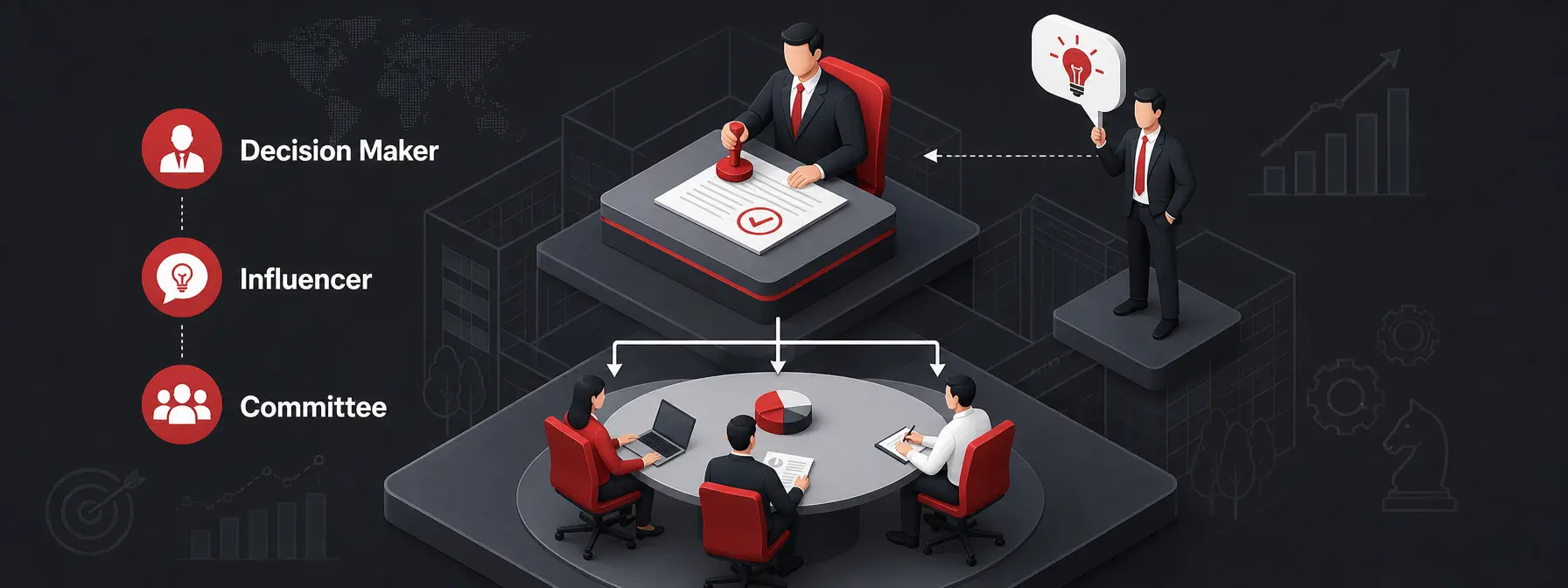
A decision maker is a person or group of people who hold the formal or actual authority to approve a purchase, allocate budget, and take responsibility for the outcome. Who is a decision maker? It’s the key figure who can say the final “yes” or “no” to a deal, unlike consultants or influencers.
It’s important not to confuse a decision maker with other participants in the buying process. An influencer is an employee whose opinion and expertise affect the choice but who doesn’t have the authority to sign a contract. An influencer can be a technical specialist, a department head, or even an outside consultant. A buying committee is a collective body where several people jointly make a decision – for example, a board of directors or a tender committee. Understanding the difference between a decision maker vs influencer is critically important for effective sales.
In reality, a decision maker isn’t always the person sitting behind the “CEO” nameplate. A decision maker in sales is the person who has real authority and responsibility for commercial decisions. At an IT company, the decision to purchase a CRM might be made by the head of sales. At a manufacturing firm, equipment choices often fall to the chief engineer. At a family business, the owner might delegate purchasing to the COO. Understanding these nuances will help you avoid wasting time negotiating with people who can’t push a deal through to the end.
Who Acts as the Decision Maker, and in What Cases:
- Owner or CEO – in strategic decisions and major investments
- Department heads – in specialized purchases (marketing, sales, production)
- CFO – in matters related to budget and ROI
- Specialized committees – in large companies, for standardized decisions
Influencer and Buying Committee: Differences in Roles:
- An influencer shapes opinion and gives recommendations but doesn’t sign contracts
- A buying committee makes decisions collectively through voting or consensus
- A decision maker takes personal responsibility for the outcome of the purchase
Now that we’ve covered the roles, let’s look at how they change depending on company size.
Types and Levels of Decision Makers in Companies of Different Sizes
Decision-making structure changes dramatically as a business grows. At a small company, the owner might personally approve buying office supplies, while at a corporation, the same decision is made by an office manager within an approved budget.
At small businesses (up to 50 employees), the decision maker is usually centered around the owner or CEO. They may combine the roles of idea initiator, selection expert, and final approver. The advantage of working with this type of decision maker is speed and understandable motivation. The downside is high dependence on one person’s mood and current priorities.
Mid-sized businesses (50-500 employees) already have a functional management structure. Here, separate decision makers in a company emerge by area: the head of sales handles CRM and pipeline questions, the IT director chooses software and equipment, the HR director approves personnel management systems. Major decisions, however, still require approval from the owner or board of directors.
Often, at companies like this, effective client work is impossible without properly building an effective team structure, where the roles of decision makers and influencers are clearly separated and each person is responsible for their part of the decision-making process.
How Decision-Making Structure Changes as a Company Grows:
- Delegation of authority from the owner to functional leaders
- Formalization of procedures for approval and sign-off
- Emergence of collegial bodies (committees, boards, commissions)
- Separation of roles among initiator, expert, approver, and signatory
Why Large Companies Develop a Group of Decision Makers:
- Risk distribution among several people
- Bringing in expertise from different functional areas
- Ensuring corporate governance and compliance proceduresї
At large businesses (500+ employees), decisions are often made by a buying committee – a group of representatives from different departments. This slows down the process but reduces the risk of making the wrong choice and increases buy-in from all stakeholders. Understanding how this decision-making machine works becomes key to successful sales.
Why It's Important to Find and Work Specifically with the Decision Maker
Working with the wrong person is like trying to start a car with the wrong key. You can keep turning it as much as you want – nothing will happen. When a manager spends months presenting to an employee without authority, they’re not just wasting time – they’re missing out on real opportunities at other companies.
Correctly identifying the decision maker gives you several critically important advantages. First, the deal cycle shortens. Instead of multi-level approvals, you get direct access to the person who can make a decision here and now. Second, the quality of communication improves. Decision makers understand the business context, financial constraints, and strategic priorities of the company better than rank-and-file employees.
Let’s look at a real case. An ERP system vendor spent six months working with the IT manager of a large manufacturer. They ran demos, technical integrations, pilot implementations. Everything went smoothly until the contract-signing stage – it turned out that the final decision was made by the CFO, who was seeing the project for the first time and didn’t understand its value. The deal dragged on for another three months until the team switched to the right decision maker and adapted the presentation to their priorities.
Benefits of Direct Access to the Decision Maker:
- Shortening the deal cycle by 2-3x
- Reducing the risk of being blocked at intermediate stages
- More accurate understanding of budget and selection criteria
- The ability to influence technical specifications and requirements
Mistakes When Working with the "Wrong" Person:
- Wasting time on detailed work with people who lack authority
- Information distortion when passed through intermediate links
- Misjudging readiness to buy and budget availability
- Risk of losing the deal to competitors who reach the decision maker while you’re stuck with the influencer
To avoid mistakes like these, it’s worth studying common sales mistakes that are most often made when identifying key players at target companies.
Understanding who really makes the decisions not only allows you to close current deals faster but also to build long-term relationships with the company. Now let’s move on to practical tools for finding these key people.
How to Identify and Find Decision Makers: Practical Tools
Finding decision makers is detective work that requires a systematic approach and patience. How to find decision makers? Start by studying the company’s structure through official sources: the corporate website, annual reports, press releases, and job postings. These documents will show the formal hierarchy and help you understand who’s responsible for what, which is the essential first step in learning how to identify decision makers in a company.
LinkedIn becomes your main reconnaissance tool. Study the profiles of employees at the target company, their connections, publications, and activity. Pay attention to job titles, work experience, and keywords in their descriptions. Someone who writes about department development strategy and budget planning likely has decision-making authority in their area. This kind of research is one of the most reliable ways of how to find decision maker contacts without relying solely on cold outreach.
Industry events and conferences are a great way to meet decision makers in person. At such events, people are more open to communication and willing to discuss business challenges. Plus, you can gauge a person’s level of expertise and influence by how they present themselves and how colleagues treat them. Finding decision makers at events often turns out to be more effective than cold calls.
To make this stage even more productive, it’s worth mastering cold calling techniques that let you establish initial contact and get information while bypassing standard filters and resistance.
Don’t ignore the “human factor” – secretaries, assistants, and administrators. They often know the real decision-making structure better than the org chart on the website. A polite conversation with an executive assistant can give you more information than hours of studying corporate materials.
Step-by-Step Algorithm for Finding Decision Makers:
- Determine the type of decision – technical, financial, strategic
- Study the company structure through the website and LinkedIn
- Identify 2-3 potential decision makers in relevant areas
- Check their activity on social media and in professional communities
- Get an introduction through mutual contacts or existing relationships
- Test their level of influence by asking about past decisions
Practical Ways to Get Past a Gatekeeper:
- Call outside business hours (before 9:00 AM, after 6:00 PM, during lunch)
- Use internal extensions from voicemail or the corporate directory
- Introduce yourself as an industry peer or a fellow event attendee
- Send short, personalized messages on LinkedIn or by email
Nuances of Finding Decision Makers in B2B/B2C/B2G:
- B2B: focus on functional leaders and owners
- B2C: work with family decision makers through research and segmentation
- B2G: study tender committees and procurement regulations
By the way, the effectiveness of various communication attempts depends directly on which effective sales channels you use when engaging with potential clients.
The next step after finding the decision maker is communicating with them the right way.
Tips for Communicating and Negotiating with Decision Makers
Negotiating with decision makers requires a special approach. These people value their time, make decisions based on facts, and bear personal responsibility for the outcome. How to negotiate with decision makers? It starts with understanding that you should forget about long product presentations – focus on business results and solving specific problems.
Preparing for a meeting starts with a deep study of the client company. Study their business model, competitors, recent news, and financial results. The decision maker will appreciate that you spent time understanding their context, rather than showing up with a one-size-fits-all presentation. Decision maker contacts need to be used as effectively as possible, which is why every meeting must be carefully prepared.
Focus on the benefits that matter to that specific decision maker. If it’s the owner – talk about profit growth and risk reduction. If it’s the CFO – talk about ROI and cost savings. If it’s an operations manager – talk about process efficiency and quality of results. The same product can solve different problems for different decision makers. Negotiations with decision makers should always be conducted in the language of business value, not technical specifications.
If you want to prepare for possible objections and learn to better manage difficult moments in the conversation, check out practical recommendations on handling objections in B2B sales.
Use the language of numbers and facts. Instead of “our system will increase efficiency,” say “clients reduce order processing time by 40% and increase conversion by 15%.” Bring specific case studies from similar companies with measurable results.
Structure of a Prepared Conversation:
- Context and problem (2-3 minutes): what’s happening in the industry and at the client’s company
- Solution and benefits (5-7 minutes): how your product solves specific problems
- Evidence (3-5 minutes): case studies, numbers, recommendations
- Next steps (1-2 minutes): what’s needed to reach a decision
How to Handle Objections:
- “It’s too expensive” – show ROI and compare it to the cost of the status quo
- “We have no experience with your company” – offer a pilot or phased implementation
- “It’s too complex to implement” – demonstrate a project plan and support
- “We need to think about it” – dig into specific concerns and decision criteria
How to Act in a Meeting to Be "On Equal Footing":
- Ask questions about the client’s business, demonstrating expertise
- Share insights from experience working with similar companies
- Don’t agree to unsuitable terms – this lowers perceived value
- Offer alternatives instead of a simple “yes” or “no”
However, even with the right communication, you can still make mistakes that undermine all your efforts.
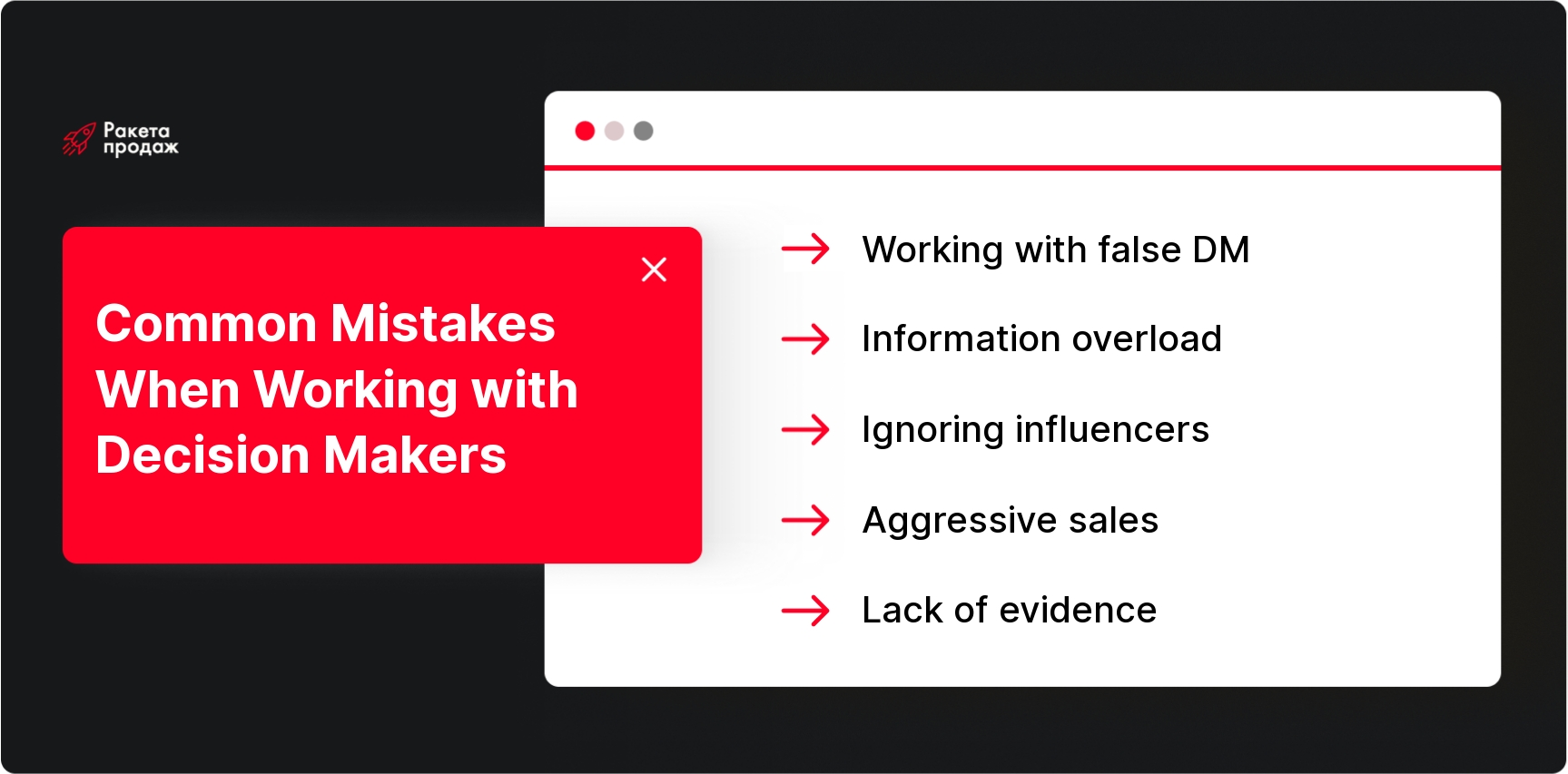
Common Mistakes When Working with Decision Makers (and How to Avoid Them)
The most costly mistake in working with decision makers is misidentification. Many managers mistake the first responsive, engaged contact – who seems knowledgeable – for the decision maker. In reality, this could be an influential employee who has no budget authority and can’t sign a contract.
Another common mistake is information overload. Decision makers aren’t interested in technical details and interface features. They need to understand the business logic of the solution, the risks, the payback period, and the impact on key company metrics. A 50-slide presentation full of feature details is a sure way to lose a decision maker’s attention.
Trying to “pressure” a decision maker with aggressive sales tactics also backfires. These people make dozens of decisions a day and are skilled at spotting manipulation. Instead of pressure, show that you understand their challenges and can help solve them. Be a consultant, not just a salesperson.
Ignoring the company’s internal politics is another serious mistake. Even after you’ve found the decision maker, they may still take colleagues’ opinions into account, especially if those colleagues will be working with your product. Trying to bypass influential employees and work only with top management can create internal resistance to the project.
A lack of specifics in proposals also turns decision makers off. Phrases like “we’ll boost efficiency,” “we’ll optimize processes,” “we’ll improve results” don’t contain useful information. Decision makers need precise numbers, timelines, guarantees, and a plan of action.
Key Mistakes and Their Consequences:
| Mistake |
Consequence |
Solution |
| Working with a false decision maker |
Drawn-out deal cycle |
Verify authority through direct questions |
| Information overload |
Loss of attention and interest |
Focus on business benefits, not features |
| Ignoring influencers |
Internal resistance to the project |
Engage with all stakeholders in the process |
| Aggressive sales tactics |
Loss of trust and reputation |
Consultative approach and problem-solving |
| Lack of evidence |
Doubts about competence |
Case studies, numbers, client recommendations |
Tools for Self-Control and Negotiation Analysis:
- Record meetings (with permission) for later analysis
- Keep a CRM with detailed notes on each contact
- Analyze objections and prepare better responses
- Collect feedback from clients on presentation quality
But what should you do if direct access to the decision maker is blocked or limited?
What to Do When the Decision Maker Is Unreachable
Sometimes direct access to the decision maker is impossible due to corporate procedures, a busy schedule, or simply an unwillingness to talk to vendors at an early stage. In this situation, don’t despair – there are several effective workarounds. How to reach decision makers in difficult cases? There are several proven strategies for how to get in touch with decision makers even when doors seem closed.
The first approach is working through an influencer as an intermediary. Find someone inside the company who has the decision maker’s trust and can convey your value upward. This could be a department head who will use your product, or a technical expert whose opinion top management values. Invest time in building relationships with these people – they’ll become your internal advocates.
The second method is finding a warm introduction through mutual acquaintances or partners. LinkedIn shows the mutual connections between you and the target decision maker. Ask a colleague or client to introduce you or pass along your contact information. A recommendation from someone the person knows opens doors far more effectively than cold calls.
The third option is sending a short, personalized message with concrete value. Write a 3-4 sentence email explaining what problem you solve for similar companies, and offer a 15-minute call. Avoid generic phrases and sales pitches – focus on insights and useful information.
Don’t try to aggressively “jump over” your current contacts. This can damage relationships and create reputational risks. Instead, show that bringing in the decision maker will help everyone involved: it will save time, provide a more accurate understanding of requirements, and speed up the decision-making process.
Checklist: How to Find Decision Makers Within a Target Company
Here’s a practical checklist to help you systematically find and reach the decision maker at any company:
- Determine what business problem your product solves – increasing sales, reducing costs, automating processes, meeting compliance requirements.
- Understand who’s responsible for that area at the company – study the organizational structure and functional responsibilities.
- Study the company website, LinkedIn, news, and job postings – find information about key employees and their roles.
- Identify possible decision makers and influencers – compile a list of 3-5 people with varying levels of influence.
- Verify roles through your current contact – ask direct questions about who makes decisions on projects like this.
- Find out the decision-making process – learn the approval stages, selection criteria, and timeframes.
- Determine who controls the budget – the CFO, the owner, or a functional leader.
- Understand who can block the deal – lawyers, technical experts, outside consultants.
- Reach the decision maker through an intro, an influencer, or a direct message – choose the most suitable communication channel.
- Prepare arguments tailored to the decision maker’s level – focus on business benefits, not technical features.
- Log stakeholders’ roles in the CRM – keep detailed records for your team and future deals.
This checklist will help you avoid skipping important steps and work systematically with each potential client.
Understanding who really makes decisions at a company is the foundation of effective B2B sales, but applying all these methods requires a systematic approach and consistent practice. At “Rocket Sales,” we don’t just teach techniques for finding decision makers – we build complete, turnkey sales departments where every process, from lead generation to closing deals, is optimized to work with the right people. Our methodology includes building sales funnels, setting up CRM systems, training the team, and implementing a control system that shows who each manager is working with and at what stage. Over 8+ years, we’ve built 208 sales departments across 14+ industries, and our clients include Mitsubishi, Yamaha, and Naftogaz. Our clients’ best result was +$10,907,403 in monthly revenue growth in 4 months of work, thanks to systematic work with decision makers and properly structured sales processes. Don’t spend months experimenting with finding key stakeholders – get a ready-made system that works.
Build a sales department that always finds the right decision maker and closes deals at 150% of plan!
A decision maker isn’t just a title on an org chart – it’s a person with real authority to influence a purchase and take responsibility for it. In modern B2B sales, success depends not only on the quality of the product or the attractiveness of the price, but also on how accurately you understand the decision-making structure within the client company. Working with influencers and other key stakeholders in B2B sales matters too, but without reaching the actual decision maker, a deal can drag on for months or never happen at all. If a manager knows how to identify the decision maker, build relationships with influencers, and understand the roles of all the participants in the buying process, they get a clear roadmap to a successful deal, can forecast timelines, and focus their efforts on the most important contacts – which ultimately leads to higher conversion and a shorter sales cycle.


 Time to read: 9 min.
 03 July 2026