Key Takeaways
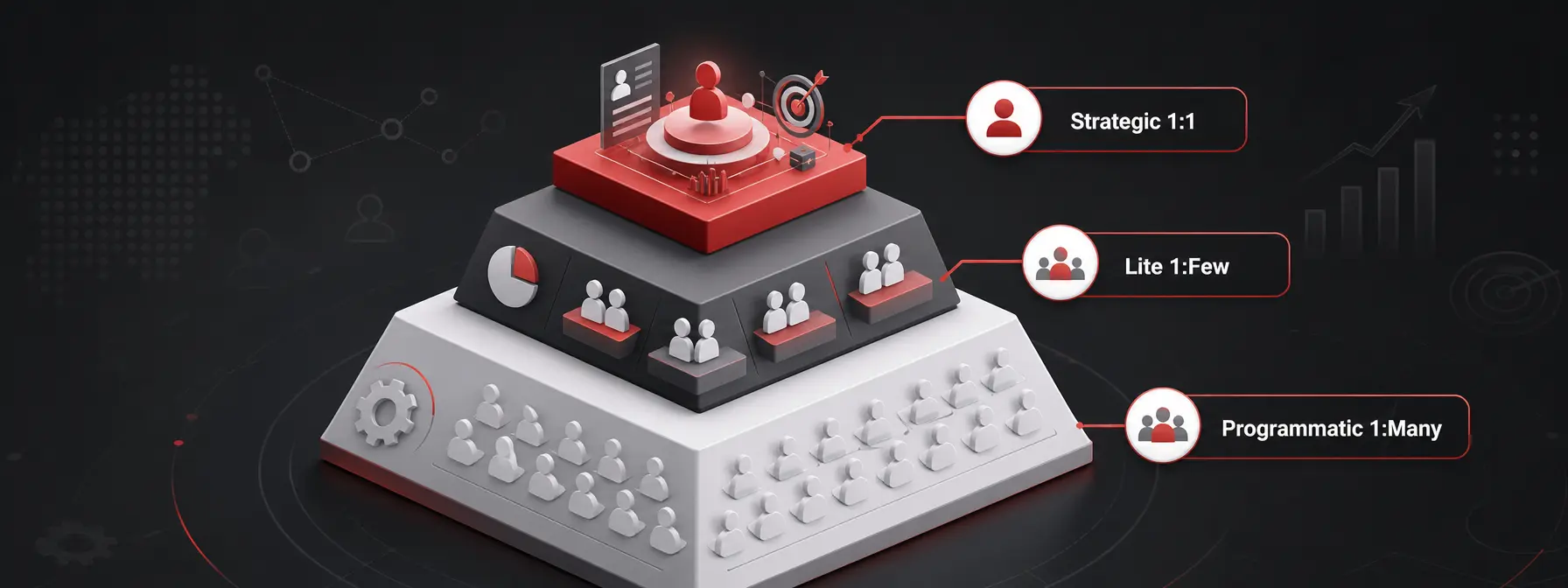
- ABM works on three levels of personalization (Strategic 1:1, Lite 1:Few, Programmatic 1:Many), and most B2B companies should start with Lite ABM on 20-100 accounts to refine processes without resource overload.
- The ideal customer profile is built on data from the best deals (closing speed, deal size, retention), not assumptions about company size or brand recognition.
- Personalization requires deep research of each account (recent hiring, press releases, technology stack) to find triggers and show understanding of business context, not just inserting the company name into a template.
- ABM fails when marketing launches campaigns without clear SLAs with sales (who transfers the account, how many hours to respond, how to qualify MQA).
- The main success metric in ABM is not the number of leads, but the depth of account engagement (engagement from multiple buying committee roles, speed of transition to pipeline, average deal size).
In the article below you will find a step-by-step algorithm for building an ABM strategy from scratch, including account selection criteria, research tools and specific tactics for launching first campaigns 👇
In a world where every lead costs money and competition grows every day, ABM allows you to concentrate resources where they will bring maximum return. This is especially relevant for Ukrainian B2B companies working with limited budgets while targeting large contracts and long-term client relationships. In this article, you’ll get how to implement ABM through a step-by-step guide to building an ABM strategy from scratch – from first steps to measuring results. If you’re wondering how to launch ABM effectively, this material will become your practical guide to ABM implementation.
What is ABM Strategy and Why B2B Companies Need It
ABM strategy for B2B is an approach where marketing and sales work as a unified team, focusing on pre-selected target companies. Instead of generating thousands of leads and hoping to find something worthwhile among them, you choose 50-100 companies and invest in each of them as a separate market.
This fundamentally changes the game. In traditional marketing, you create content for a broad audience, launch mass campaigns and measure success by the number of leads. In ABM, every interaction is personalized, every campaign is tailored to a specific company, and success is measured by the depth of relationships with key decision makers.
You’ve studied ABM principles and understand that a personalized approach to key clients can dramatically change sales effectiveness. But between theory and practice lies a huge gap. ABM implementation requires not only the right strategy, but also well-configured processes, CRM systems, trained team and constant monitoring of results. At “Sales Rocket” we help B2B companies create systematic sales departments that work like Swiss watches. Over 8+ years of work, we’ve built 208 sales departments across various industries, implemented CRM systems with full process automation, and trained teams to work with large deals and long sales cycles. Our clients get not just 5-86% conversion growth, but a system that predictably generates results month after month. ABM becomes a natural part of a well-tuned process, not a one-time campaign.
Turn ABM theory into a working sales system - get a free audit of your department!
ABM is especially effective where there’s a high average deal value, long sales cycle and complex decision-making process. If your clients buy solutions worth tens of thousands of dollars and multiple people are involved in the process, then a personalized approach to each account will pay off handsomely. ABM for B2B companies becomes a critically important growth tool, especially when traditional lead generation methods stop showing desired results. The next step is to understand at what level of personalization you should play.
By the way, if you’re planning to improve B2B sales strategies in general and want to approach them comprehensively, pay attention to approaches optimal for large deals and long cycles: B2B sales strategies.
Core Principles and Levels of ABM Strategy
ABM works on three main levels of personalization, each requiring different resources and delivering different results. Strategic ABM (1:1) is an individual approach to each account with personalized campaigns, content and even landing pages. This level suits working with 5-15 strategic accounts, each of which can bring millions in revenue.
Lite ABM (1:Few) allows you to group accounts by similar characteristics and create personalized campaigns for each segment. For example, a separate campaign for fintech startups in Germany and another for enterprise retailers in the US. This approach covers 20-100 accounts and requires fewer personalization resources.
Programmatic ABM (1:Many) uses technology and automation to work with hundreds of accounts simultaneously. Here personalization happens at the industry or role level, but still remains more targeted than mass marketing.
For most B2B companies, the optimal strategy is to start with Lite ABM, master the processes and then develop in both directions: add several Strategic accounts for the most valuable clients and Programmatic level for scaling. Now it’s important to determine exactly why you’re implementing ABM.
Step 1. Define Your ABM Strategy Goals
Without clear goals, ABM turns into an expensive experiment. Goals can vary: entering new markets, increasing average deal size, shortening sales cycle, improving retention of existing clients, or supporting outbound sales. Each goal requires its own approach to account selection and tactics. Understanding how to develop an ABM strategy begins with setting these specific, measurable objectives.
If the goal is entering the enterprise segment, then the focus will be on large corporations with corresponding budgets and decision-making processes. If the task is establishing in a new industry, then industry-leading companies that can become references get priority. To increase average deal size, focus on existing clients with expansion potential.
The goal also determines success metrics. For entering new segments, the number of closed deals and speed of building reputation matter more. For revenue growth – contract size and lifetime value. For improving sales efficiency – conversion rate and time to first meeting.
Having defined goals, you can move to describing the ideal customer – the foundation of any ABM strategy.
Step 2. Describe ICP - Ideal Customer Profile
Ideal Customer Profile (ICP) is the foundation of ABM strategy. Without a clear understanding of who your ideal customer is, you’ll waste resources on companies that will never buy or will buy but bring more problems than profit. ICP should be based on data, not assumptions.
Start by analyzing your best clients. Look at companies that closed quickly, pay full price, actively use the product and renew contracts. What common characteristics do they have? Team size, revenue, industry, geography, technology stack, business development stage – all these are important ICP parameters.
Besides firmographics, consider behavioral factors: how the company makes decisions, what their pain points are, who influences the purchase. A fintech startup and a bank may have similar cybersecurity needs, but their decision-making processes are radically different. ICP should reflect not only who can buy, but how these companies buy.
A well-described ICP includes 8-12 clear criteria, each of which can be verified through open sources or simple questions. This becomes a filter for compiling a list of target accounts.
Step 3. Compile a List of Target Accounts
The target account list is the heart of an ABM campaign. Here, balance between coverage and depth of development is important. Too large a list leads to superficial personalization, too small – to limited growth potential.
Sources for compiling the list are diverse. Start with CRM: look at lost deals that match ICP, inactive leads from past years, existing clients with expansion potential. LinkedIn Sales Navigator is a powerful tool for finding companies by industry and geographic criteria. Industry rankings, conference participants, databases like Crunchbase or local business directories also give good results.
For Ukrainian companies working with foreign markets, it’s useful to use a combination of sources: international databases for finding enterprise clients and local resources for working with regional leaders. Partner recommendations and warm contacts often give better results than cold lists.
The optimal starting list size for ABM is 50-100 accounts. This is enough to test approaches and get statistically significant results, but not so many that the team drowns in personalization. The next step is to structure this list by priorities.
Step 4. Divide Accounts by Priorities
Not all accounts are equally valuable, and not all deserve equal attention. The tiering system helps rationally distribute team resources and focus on the most promising opportunities.
Tier 1 is your “white whales,” 5-15 accounts with maximum revenue potential. Individual content is created for them, personalized campaigns, possibly even separate landing pages. Every contact with such accounts is carefully planned, and progress is tracked weekly.
Tier 2 includes 20-50 accounts with good potential but smaller budgets or more complex decision-making processes. Segmented personalization suits them: general content for industry or role, but adapted to specific segment pain points.
Tier 3 is a broader group of accounts for programmatic ABM. Here automation, targeted advertising and less personalized but still relevant content are used. This approach allows “warming up” accounts that may become relevant in 6-12 months.
Criteria for tiering should be clear and measurable: potential deal size, probability of closing, strategic importance (for example, reference in new industry), decision-making speed. Now you need to find the right people inside each account.
It’s important to remember that effective team structure building for developing and implementing an ABM approach significantly accelerates goal achievement: team structure building.
Step 5. Find Decision Makers and Buying Committee
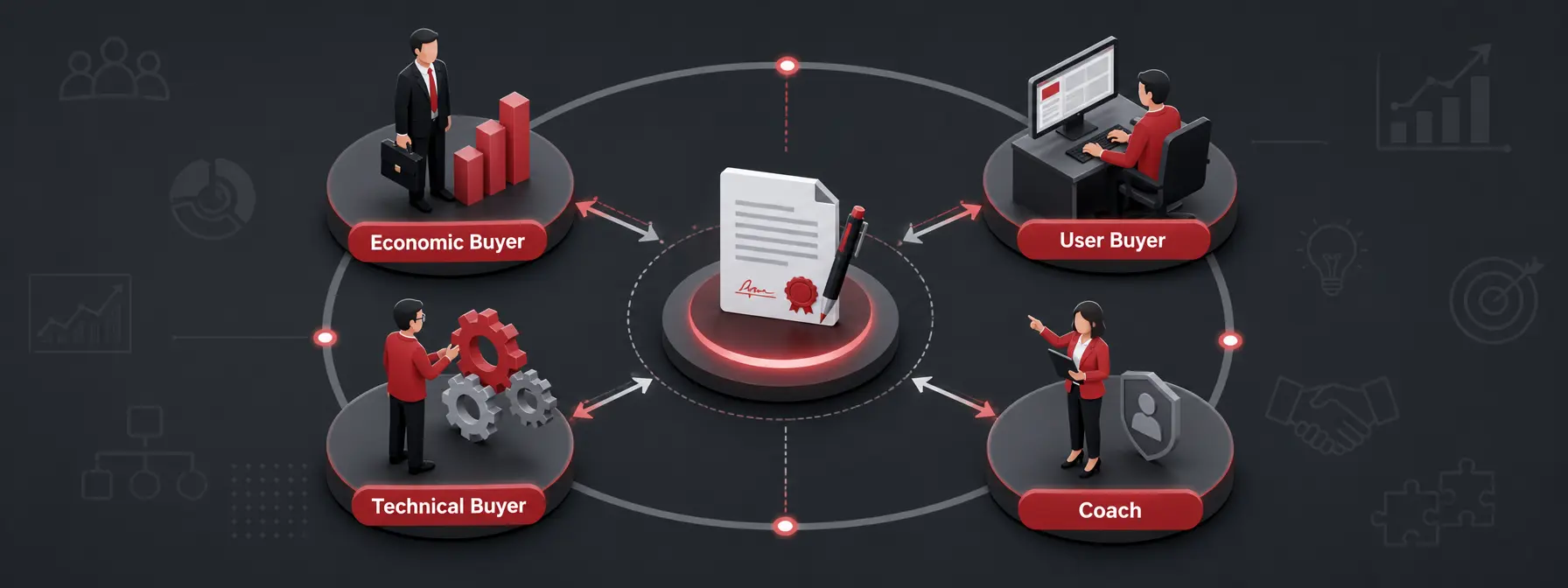
In B2B, one person rarely buys. Usually it’s a team of 6-10 people with different roles and interests. Your task is to identify all buying committee participants and understand how each influences the decision.
Economic buyer is the person who controls the budget and makes the final decision. Most often this is CEO, CFO or departmental director. User buyer is the one who will use the solution daily. Technical buyer evaluates integrations, security and technical side. Coach is your internal ally who is interested in project success.
Each role requires a different approach. CFO is interested in ROI and payback, IT directors worry about security and compatibility issues, end-users want to know how the solution will simplify their work. Personalization starts with understanding these differences.
Use LinkedIn, corporate websites, industry events, press releases about appointments to find contacts. Pay attention to recent joiners – new employees are often more open to changes and new solutions. Many large purchases happen in the first 100 days of a new manager’s work.
The goal is not just to collect contacts, but to understand decision-making dynamics in each account. Who initiates projects? Who can block the deal? How does the budget approval process work? This information will help build the right communication sequence.
Step 6. Conduct Target Account Research
Quality personalization starts with deep understanding of each account’s context. Superficial research like “Hi, [Name], saw that [Company] is growing” won’t impress anyone. You need insights that show real understanding of the client’s business.
Study the corporate website, especially about us, news, careers sections. Open vacancies tell a lot about strategic priorities: if a company is actively hiring data scientists, they likely have digital transformation initiatives. Recent press releases about partnerships, acquisitions or new products give reason for relevant contact.
Executive social media is another source of insights. What concerns them? What trends do they discuss? What events do they speak at? CEO LinkedIn posts often reveal strategic priorities better than official reports.
Company technology stack can be studied through tools like BuiltWith or Wappalyzer. If you see that a company uses outdated solutions in related areas, this can become a reason to talk about modernization. Financial reports of public companies contain mentions of key risks and opportunities.
The research goal is to find triggers and reasons for contact. These can be business challenges (entering new markets, regulatory changes), technical tasks (cloud migration, ensuring compliance) or organizational changes (leadership change, restructuring). These insights will become the basis for personalized messages.
Step 7. Prepare Personalized Messaging and Content
Personalization in ABM isn’t just inserting a company name into a template email. It’s demonstrating understanding of business context, challenges and opportunities of a specific account. Each message should answer the question: “Why is this important specifically for us right now?”
An effective ABM message consists of three parts: relevant insight about the company or industry, clear connection of this insight to your solution, specific call-to-action. For example: “Saw that you recently raised $50M Series B and plan European expansion. Our fintech clients usually face compliance challenges during international expansion – would like to share how Revolut solved this task with our platform.”
Content for ABM also requires personalization. These can be industry case studies, ROI calculators with specific segment data, short videos mentioning the company, personalized demos or even custom research reports. The higher the account tier, the deeper the personalization should be.
Each buying committee participant needs their own angle. Show the technical director architecture and integrations, the financial director – business case and ROI, users – interface and user experience. The same product can be presented as a solution for cost optimization (for CFO), digital transformation (for CEO) or operational efficiency (for COO).
Don’t forget about multi-channel approach: combine email, LinkedIn, retargeting, direct mail, even personalized gifts for top-tier accounts. Research shows that multi-channel ABM campaigns are 3 times more effective than single-channel ones. The next critically important step is team synchronization.
Step 8. Align Marketing, SDR and Sales Roles
ABM only works when marketing and sales act as a unified team with common goals. The division into “marketing generates leads, sales close them” doesn’t work here. Joint responsibility for each account at all funnel stages is needed.
Clear role division helps avoid effort duplication and communication gaps. Marketing researches accounts, creates personalized content, launches awareness campaigns and tracks digital engagement. SDR initiate first contacts, qualify interest, schedule meetings and maintain communication with buying committee participants. Sales conduct discovery, demonstrations, negotiations and deal closing.
SLAs (Service Level Agreements) between teams are critically important. For example: marketing transfers account to MQL status when there are two engagement signals in the last 30 days, SDR contacts account within 24 hours, sales give feedback on account quality within a week. Without such agreements, teams start blaming each other for low lead quality or poor conversion.
Regular sync sessions help maintain alignment. Weekly 30-minute meetings to discuss progress on top-tier accounts, monthly retrospectives on campaign results, quarterly planning sessions to update lists and strategies. Common language and metrics are the basis of productive collaboration.
Tools should also support joint work. All activities, contacts, interactions are recorded in CRM, which all team participants have access to. This ensures complete transparency in working with each account.
If sales department management in your company is relevant, pay attention – proper responsibility distribution for ABM process between departments increases overall sales effectiveness: sales department management.
Step 9. Set Up CRM and ABM Activity Tracking
Without proper CRM setup, the ABM process becomes unmanageable. The system should allow working at account level, not just individual contacts, track all interactions and connect them to business results.
In CRM you need to set up hierarchy: account → contacts → opportunities. Each account should have fields for ICP criteria, tier classification, source, responsible manager, status and next steps. Contacts are linked to accounts with buying committee role indication. Opportunities are connected to account and show financial potential.
To track engagement, create an activity system: email opens/clicks, website visits, content downloads, webinar attendance, social media interactions, meeting requests. Each activity should automatically link to the account and affect the overall engagement score.
Pipeline management in ABM requires a special approach. Standard stages “Lead → MQL → SQL → Opportunity” are supplemented with account-level statuses: “Target → Aware → Engaged → MQA (Marketing Qualified Account) → SQA → Opportunity → Customer”. This helps track progress at the entire company level, not individual contacts.
Reporting should show both activity (number of touchpoints, buying committee coverage, engagement score) and results (meetings, opportunities, revenue). Dashboards for different roles: marketing looks at engagement and MQA, sales – at conversion to meetings and pipeline, management – at ROI and revenue from ABM accounts.
To automate the process, use experience in CRM implementation for sales, which will allow clearly recording all ABM activities and building a funnel with transparent statistics: CRM implementation for sales.
Step 10. Launch First ABM Campaigns
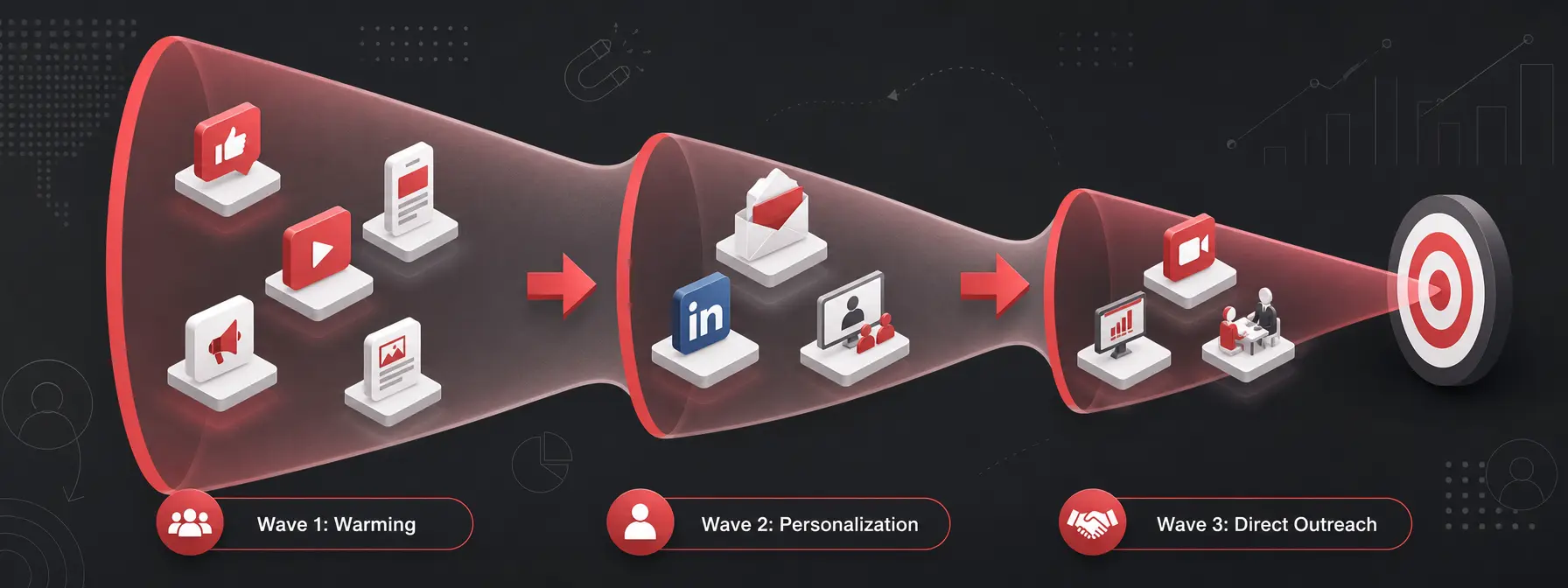
The first ABM campaign launch isn’t a “big bang,” but a thoughtful sequence of touchpoints across different channels. An effective campaign includes several contact waves with increasing personalization and different call-to-actions.
Start with “warming” touches: targeted LinkedIn advertising with educational content, retargeting visitors to target account corporate websites, social media content mentioning industry trends. The goal is to create awareness and show expertise without direct selling.
The second wave – more personalized contacts: email with relevant case study, LinkedIn message mentioning recent company news, invitation to industry webinar or closed event. Here coordination between channels is important: if you sent email, then LinkedIn contact should reference it.
The third wave – direct outreach with specific value proposition: personalized video, customized presentation, ROI calculation for specific company, audit or consultation offer. This is the level where SDR and sales actively join the process.
For tier 1 accounts you can use creative approaches: personalized gifts, VIP dinner invitation, executive briefing at their office. Such touches are memorable and distinguish you from competitors who limit themselves to email and LinkedIn.
It’s important to test different approaches and channels. A/B test subject lines, sending times, content types, call-to-actions. What works for fintech startups may not work for enterprise banks. Data will help optimize campaigns already during execution.
Step 11. Track Account Engagement
In ABM, success is measured not by the number of leads, but by the depth of target account engagement. It’s important to track how the company as a whole reacts to your efforts, not just individual contact activity.
Account-level engagement includes several types of signals. Digital engagement: corporate website visits by target company employees, content viewing, webinar registrations, downloads. Social engagement: likes, comments, shares, LinkedIn connections. Direct engagement: email responses, call participation, information requests.
Signals from multiple people from one company are especially valuable. If CEO viewed your case study, CTO downloaded white paper, and HR director connected on LinkedIn – this speaks of growing interest at organizational level. Multi-threading engagement often predicts success better than single contact activity.
Timing is also important. Burst of activity (several interactions in a short period) may signal internal discussions or approaching decision. Regular visits to pricing page or product pages show serious consideration.
For tracking use a combination of tools: Google Analytics with UTM tags for web activity, CRM for email and call tracking, LinkedIn Analytics for social engagement, specialized ABM platforms for more detailed account intelligence. The main thing is to bring all signals into a unified picture for each account.
Tip: Use modern analytics and dashboards tools to build visualizations of the entire conversion chain and see full engagement for each target company: analytics and dashboards.
Step 12. Transfer Qualified Accounts to Sales
The transition from marketing to sales in ABM requires clear criteria and procedures. An account shouldn’t be transferred just because someone opened an email or downloaded content. A company-level qualification system is needed.
Marketing Qualified Account (MQA) is an account that matches ICP, shows engagement from multiple contacts and demonstrates buying interest signals. Criteria may include: minimum engagement score, activity from 2+ buying committee roles, key page visits (pricing, product), event participation or demo request.
Sales Qualified Account (SQA) is confirmed through direct conversation: contact established with key decision maker, relevant business need confirmed, timeline for solution exists, budget or process for obtaining it determined. This requires SDR or sales work for qualification through discovery questions.
Handoff process should include not only contact transfer, but full context: what materials they’ve already seen, who they communicated with, what signals they showed, what we know about their business needs and decision process. This information is critical for sales to not start from scratch and continue conversation where marketing left off.
SLA on reaction speed is especially important: hot accounts need to be contacted within hours, not days. Research shows that companies that react to intent signals within 1 hour have 7 times more chances for qualified conversation than those who postpone until the next day.
Step 13. Analyze Results and Improve Strategy
ABM requires different metrics than traditional lead-based marketing. Instead of cost per lead look at cost per engaged account, instead of MQL volume – at account engagement depth, instead of only closed deals – at expansion opportunities and customer lifetime value.
Account-level metrics include: percentage of target accounts engaged, average engagement score by tiers, multi-threading success rate (share of accounts with engagement from 3+ contacts), velocity from MQA to meeting, conversion rate from SQA to opportunity. These indicators help understand how effectively targeting and engagement strategy works.
Pipeline metrics focus on quality, not quantity: average deal size from ABM vs non-ABM accounts, sales cycle length, win rate, expansion revenue from existing ABM clients. Often ABM shows fewer opportunities, but larger average contract value and higher win rate.
ROI calculation in ABM should consider full customer lifecycle: initial deal value, expansion opportunities, referral potential, strategic value (for example, reference in new industry). Many ABM programs pay off not in the first deal, but in long-term partnership with key accounts.
Based on results analysis, continuously optimize strategy: refine ICP criteria, test new messaging approaches, experiment with channels and tactics, adjust account tier classification. ABM is an iterative process where each campaign cycle gives insights for improving the next one.
Practical Cases and Common Mistakes in ABM Implementation
One of the most successful ABM cases is the story of a SaaS company that focused on 50 enterprise accounts in financial services. Instead of mass campaigns, they created personalized microsites for each top account, launched executive dinners with C-level participant invitations and developed industry-specific ROI calculators. Result: 180% increase in average deal size, sales cycle reduction from 9 to 5 months and 34% win rate versus 12% in control group. This is an excellent example of how to create an ABM strategy effectively.
Another case – a Ukrainian IT company that used ABM from scratch to enter the German market. They chose 30 manufacturing companies, studied their digital transformation initiatives through public sources, created personalized case studies with similar clients and launched LinkedIn campaigns mentioning specific business challenges of each company. In 6 months they got 8 qualified opportunities and closed 3 contracts totaling €450K. This case demonstrates a step-by-step plan for implementing ABM for international expansion.
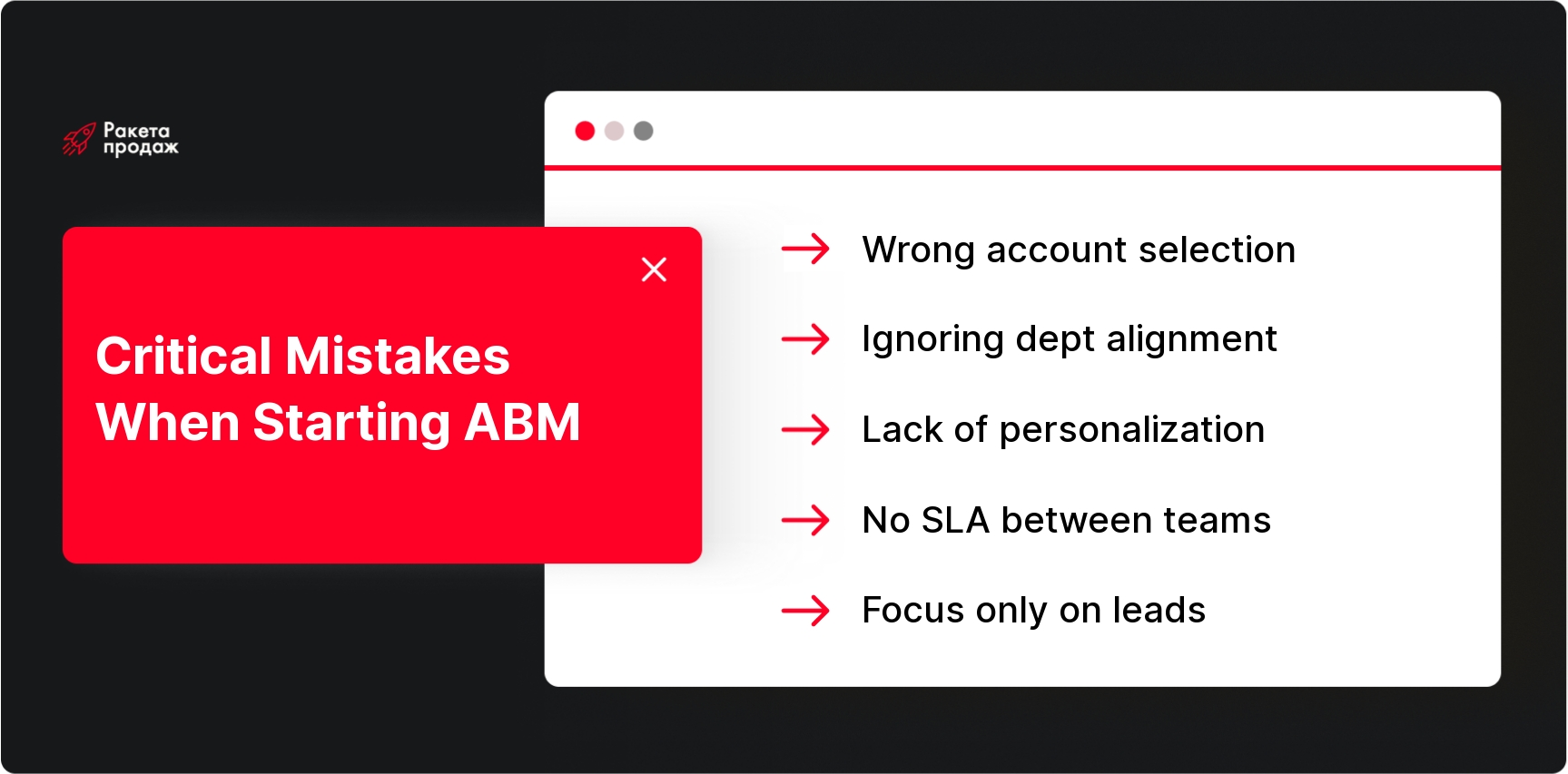
Common mistakes in ABM implementation start with wrong target selection. Many companies choose accounts based on size or brand recognition, not considering fit with their ICP or ability to win. Result – a beautiful list of Fortune 500 companies that will never buy your product or will consider purchase for 2-3 years.
The second frequent mistake is underestimating organizational alignment requirements. ABM is launched by marketing team without sales involvement or with formal agreement that doesn’t work in practice. When marketing generates engaged accounts but sales aren’t ready to react quickly or don’t understand ABM approach, the program fails regardless of campaign quality. Avoiding this helps pilot program with a small group of aligned team members and gradual scaling after proven success. Understanding how to implement ABM correctly from the beginning is critically important for program success.
Key Metrics and Analytics for ABM Evaluation
ABM measurement requires shift from quantity-focused to quality-focused metrics. Engagement Rate is a key early-stage success indicator: percentage of target accounts that show meaningful interaction with your campaigns. Meaningful means not just email open, but combination of website visit, content download, social engagement or direct response.
Pipeline Created from ABM accounts should be measured not only in number of opportunities, but in average deal size, expected close date and probability to close. ABM accounts typically show higher deal values and better qualification, even if general volume may be lower than traditional lead generation campaigns.
Deal Velocity and Win Rate are critical indicators of ABM effectiveness in sales process. Good ABM programs show shorter sales cycles due to better targeting and pre-education, plus higher win rates thanks to deeper relationship building and better understanding customer needs before first sales conversation.
ABM ROI calculation should include full customer lifecycle: initial contract value, expansion revenue potential, referral opportunities, strategic value as reference account. Many ABM programs require 2-3 quarters to show full ROI, but provide significantly higher customer lifetime value compared to mass approaches.
For tracking these metrics organize monthly ABM reviews with participation of marketing, sales and leadership teams. Create shared dashboard that shows account-level progress, pipeline development and revenue attribution. Regular review cycles help identify successful tactics for scaling and problem areas for improvement, maintaining focus on continuous optimization instead of “set it and forget it” approach. This step-by-step ABM implementation plan will help you systematically measure program success.
ABM strategy can indeed become a powerful growth tool for B2B companies, but only with a systematic approach to implementation. Personalization, deep analytics, team coordination – all this requires not just knowledge, but experience working with various business models and industries. “Sales Rocket” specializes exactly in such complex tasks: we create turnkey sales departments with full automation, implement CRM with configured analytics and dashboards, train teams to work with large clients through personalized approaches. Our methodology includes all elements of effective ABM: from proper funnel setup to training managers in buying committee work techniques. The result? Our clients’ average revenue increase is +35%, and the maximum recorded result is +$10,907,403 in 4 months. Among our partners are Mitsubishi, Yamaha, Naftogaz and dozens of other companies that received a sales system working at 150% of plan monthly.
Create a sales department that turns ABM into stable profit!
ABM strategy for B2B is not just a marketing tactic, but a fundamental shift in how you approach business growth. Instead of hunting for leads you build relationships with carefully selected accounts, investing in personalization and deep engagement. Successful ABM requires organizational alignment, quality data, disciplined processes and commitment to long-term approach. Start with clear goals, well-defined ICP, manageable account list and strong collaboration between marketing and sales. The result – higher quality pipeline, larger deals and more sustainable revenue growth from key accounts that become true partners of your business.


 Time to read: 9 min.
 01 July 2026