Key Takeaways
- A fixed base salary isn’t a gift to the salesperson – it’s a way for the company to share risk and give the person stability for long, complex deals instead of panicked closings.
- A weak compensation plan pushes a sales manager to sell through discounts and ignore long deals, because they need quick commission, not company profit.
- The base-to-bonus ratio should be calculated from the target income at plan completion, not from the maximum income mentioned in a job posting, which only happens once a quarter.
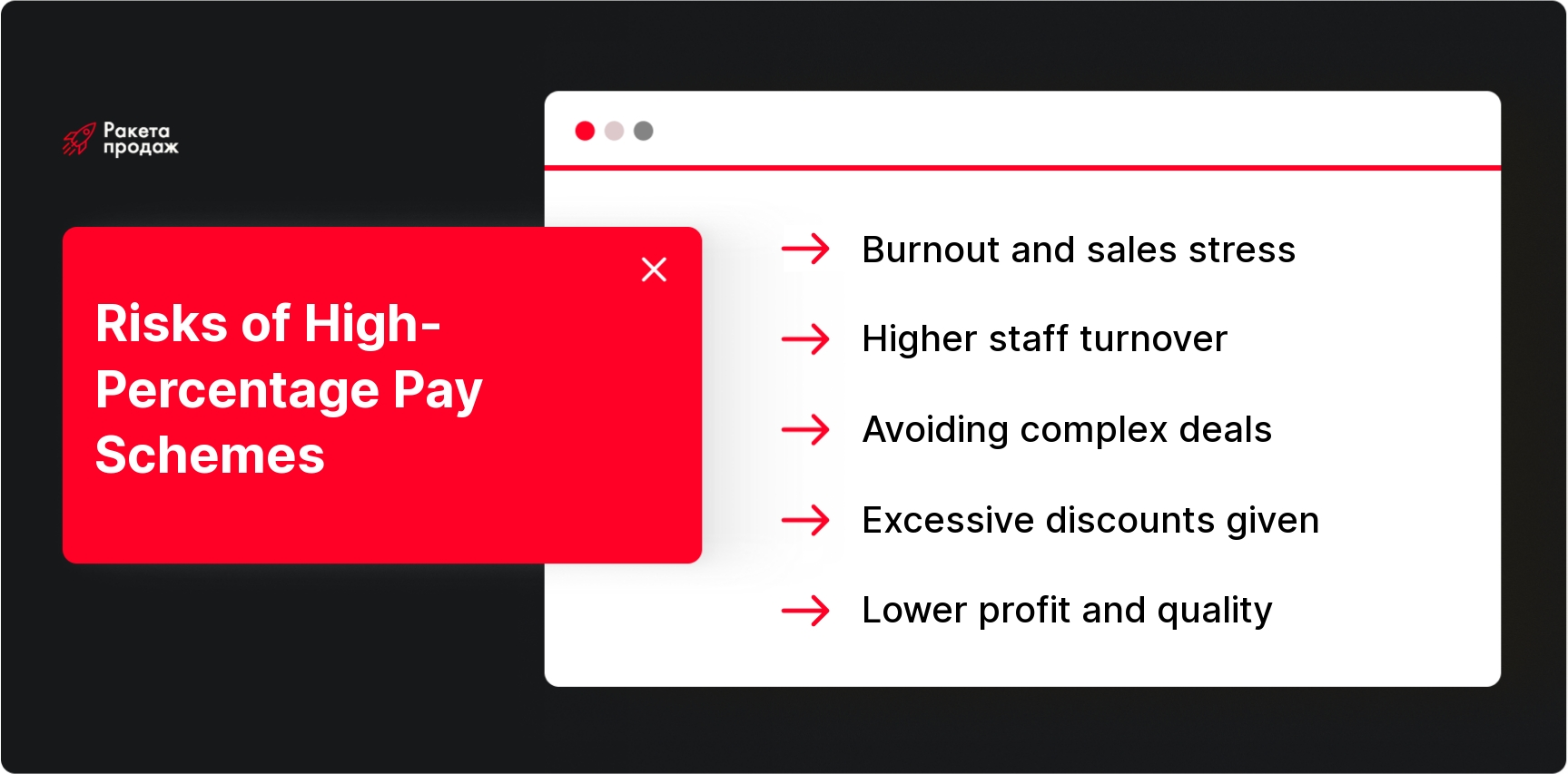
- A high bonus share without a stable lead flow creates constant stress, burnout, and high staff turnover, not motivation.
- A percentage of gross profit ties a manager’s income to the real business outcome more fairly than a percentage of revenue, where the plan can be hit through constant discounting.
In the article below, you’ll see how to pick the right ratio for your type of sales, what to check in the final compensation plan, and how to avoid common mistakes. Read the full article 👇
Too small a base and a huge commission work against the company in a different way: turnover rises, which forces a rethink of the sales team hiring plan, especially if the deal cycle is long or leads don’t come in steadily.
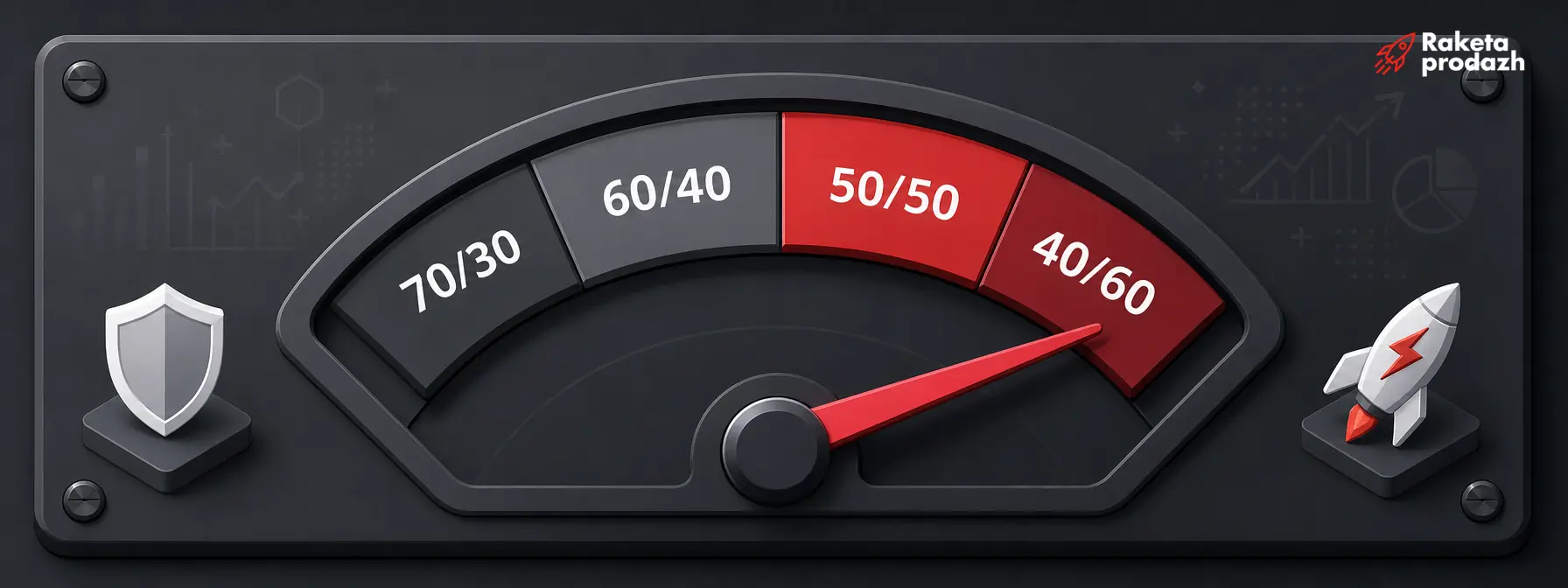
There’s no universal formula like “30% base plus 70% commission for every sales department,” and if someone offers you that formula as a standard, it’s a red flag. The answer to the question of how to build a sales department that is both stable and motivated starts with correctly calculating this ratio. It depends on what exactly the company sells, where customers come from, how strongly the manager influences deal closing, the length of the sales cycle, the margin, and the average deal size. In this article, we’ll break down how to calculate the base-to-bonus ratio, which models work in different segments, how building a motivation system in a sales department happens, and why this ratio should be decided individually for each team.
Why a Fixed Base Salary Matters: Trust and "Risk Sharing"
The fixed part of a sales manager’s salary is more than just a safety cushion. It’s a signal: the company is willing to share the risk instead of dumping it entirely on the salesperson. When an employer pays a base salary even in a month when the plan isn’t hit, they’re effectively telling the employee: we trust that you’ll keep working instead of burning out after three months with no results. That trust pays off faster than it might seem at first glance.
Even a token base salary of 5,000-7,000 UAH creates a healthy atmosphere on the team. The manager doesn’t panic over one failed deal and doesn’t grab at selling anything just to close fast. They have time to learn the product, practice negotiation scripts, and get the CRM in order. In the long run, this boosts conversion more than any panicked sprint after commission.
A base salary isn’t a gift to the manager – it’s a way for the company to say: we’re taking on part of the risk ourselves.
At one trading company, the base salary was removed entirely, leaving only commission. Two months later, real staff turnover in the sales department began – three out of five strong managers left because they couldn’t plan their personal budget. The base salary was brought back, but the lesson stuck: without risk sharing, people leave for places where they feel supported. How exactly this support affects a salesperson’s emotions and performance, we’ll cover next.
Does this feel familiar – endless experiments with sales manager compensation, where too high a base salary kills motivation, or too big a commission creates chaos on the team? You keep changing schemes, adjusting KPIs, but the sales department still works unpredictably, and plans get hit only occasionally. At “Sales Rocket,” over 8+ years we’ve built a systematic approach to designing sales team motivation that accounts for the specifics of each business – from deal cycle to product margin. Our methodology includes not just calculating the optimal sales manager’s base salary and commission ratio, but also implementing a transparent KPI system, dashboards for tracking results, and training the team to work with the new compensation plan. As a result of implementation, our clients get sales departments that consistently hit 150% of plan monthly, with an average revenue growth of +35%.
Create a motivation system that turns your department into a predictable growth machine - get a free efficiency audit now!
The Psychological Aspect: How Motivation Affects Emotions and Performance
A sales manager’s compensation structure shapes not just income, but also a person’s emotional state every single day. When income is built almost entirely on commission and the lead flow is unstable, the manager lives in survival mode. They check the CRM first thing in the morning not out of discipline, but because they’re afraid of ending the month with no money. Over time, this stress turns into burnout: call quality drops, focus on the customer is lost, irritability grows within the team, which directly reduces sales manager effectiveness.
Compare this to a situation where there’s a base salary and a clear plan bonus. The manager knows their basic living costs are covered and can focus not on survival but on developing the deal. They’re more willing to take on difficult clients, ready to run a long negotiation cycle, and don’t panic if one month turns out weaker than usual. It’s precisely this kind of stable mode that produces quality funnel work, rather than chaotic attempts to close just anything.
The balance here is simple: don’t remove the challenge from the salesperson’s job, but also don’t turn salary into a lottery. Regular feedback, transparent rules for calculating the bonus, and an honest conversation about why this particular salary vs commission ratio was chosen remove half the anxiety. Next, let’s figure out how to calculate this ratio technically, not by gut feeling.
How to Correctly Calculate the Ratio of Fixed and Variable Pay
A common mistake in calculations is basing the ratio on the maximum income mentioned in a job posting – that famous “up to 60,000 UAH” figure, which only happens once a quarter for the best salesperson. It’s more correct to calculate from the target income at plan completion, meaning the amount a manager earns for hitting the standard quota, not a record. What percentage of sales does a sales manager receive should logically be tied to this target amount, not to the maximum income that occurs once a quarter.
Example: target income of 50,000 UAH, base salary of 30,000 UAH, bonus for hitting the plan of 20,000 UAH. That works out to roughly 60% base to 40% variable. If the base is only 20,000 UAH with the same target income of 50,000 UAH, the ratio shifts to 40% base to 60% variable. This is simply the mechanics of the calculation, not a standard for the Ukrainian market – every company will have its own numbers.
As a working benchmark, we recommend keeping the base salary share in the range of 20 to 40% of total income. The lower bound, around 20% base of target income, tends to suit outsourced call center models and online stores, where the deal cycle is short and the volume of customer contacts is high. Next, let’s look at which base-to-bonus ratios can be used as a starting point for different types of sales.
Which Base-to-Bonus Ratios to Use as Benchmarks
It’s important to separate one thing from another right away: what follows below isn’t a “Ukrainian market standard,” but a few compensation design models that can be used as a starting point. Real ranges for a sales manager’s salary vary significantly by segment, and median data from work.ua shows this clearly.
At the same time, a sales manager’s salary must remain competitive with the market, otherwise even a strong motivation system won’t retain good specialists.
The ratio of base to variable pay determines exactly what a person focuses on in their work. The higher the base share, the more attention goes toward service, analytics, and long-term customer work. The higher the commission share, the more the focus shifts toward actively hunting for and closing deals here and now.
These are management benchmarks for modeling a sales manager’s compensation plan, not a statistically confirmed share of Ukrainian companies. Next, we’ll break down each of these models individually, starting with the most conservative.
When the 70/30 Model Works
A high fixed portion makes sense where a deal requires months of preparation rather than a single phone call. If a manager works with tenders, goes through technical approvals, or depends on production and logistics timelines, paying them mostly for short-term activity simply isn’t fair.
The same logic applies to work with large existing clients and account-management tasks: the employee spends a lot of time on retention and relationship development rather than closing new deals every week. This model also suits situations with few deals but a high average deal size, where one failure shouldn’t wipe out the entire monthly income.
An important point: even with a high base salary, the bonus needs to remain noticeable. If hitting or exceeding the plan barely shows up in the paycheck, the manager loses the incentive to go beyond the minimum. The next model, 60/40, is more common in classic B2B sales and balances stability with a tangible variable part.
When the 60/40 Model Fits
This model works as a compromise between stability and an incentive for results. The manager gets a predictable enough base salary to avoid monthly anxiety, but a significant part of income still depends on sales. This kind of sales manager’s compensation plan suits classic B2B teams that have a recognizable brand and a relatively straightforward product.
This model fits well with roles where the employee receives some ready-made leads from marketing but still independently develops clients, negotiates, and directly influences conversion. Essentially, this is the case where the manager is responsible for the entire commercial outcome, not just the fact of talking to a client.
It’s worth remembering that the actual ratio is still determined by the target income and sales plan, not an abstract “60 to 40” from an HR department’s presentation. Next comes a model with an even stronger variable component, where both risk and income potential grow together.
A model with equal shares of base salary and commission works where the result is easy to measure and the manager directly influences the deal’s outcome. It suits situations well where the sales cycle is relatively predictable, the company provides the product and infrastructure to work with, and the CRM transparently tracks who did what.
For this model, it’s critical that the plan be realistic and that the bonus payment happen regularly, not “whenever accounting gets around to it.” If all these conditions are met, 50/50 gives a strong manager the chance to noticeably increase their income while letting the company keep the payroll budget within reasonable limits. In this model, the sales manager’s commission becomes the main driver of income growth, so the calculation must be as transparent and clear as possible.
The problem starts when the lead flow is unstable but the model stays the same. In that case, the employee bears risk for something they physically can’t control, and that’s no longer sales department motivation – it’s unfairness. We’ll talk separately about what happens when the variable part is too large without proper preparation.
When a Large Variable Part Starts Hurting Sales
A low base salary and a huge commission look great on paper, but in practice they often work against the company itself. The manager starts closing deals at any cost, hands out unnecessary discounts to avoid losing a client, and focuses only on “hot” contacts, ignoring those who require more time.
Long deals get abandoned midway because they don’t produce quick results. CRM and analytics are seen as extra burden, since they don’t directly increase commission right here, right now. The result is high turnover: employees choose short-term personal gain over the company’s interests, and after a few months move on to somewhere with at least some stability.
This is especially sensitive in B2B, manufacturing, complex services, and project sales, where a deal requires time and the involvement of several people. One aggressive manager with a skewed sales department motivation system can damage the reputation with a key client faster than the entire marketing department can repair it. Now let’s tackle another important question – what exactly the commission should be calculated from: revenue or margin.
Commission from Revenue or from Margin: Which Is Better
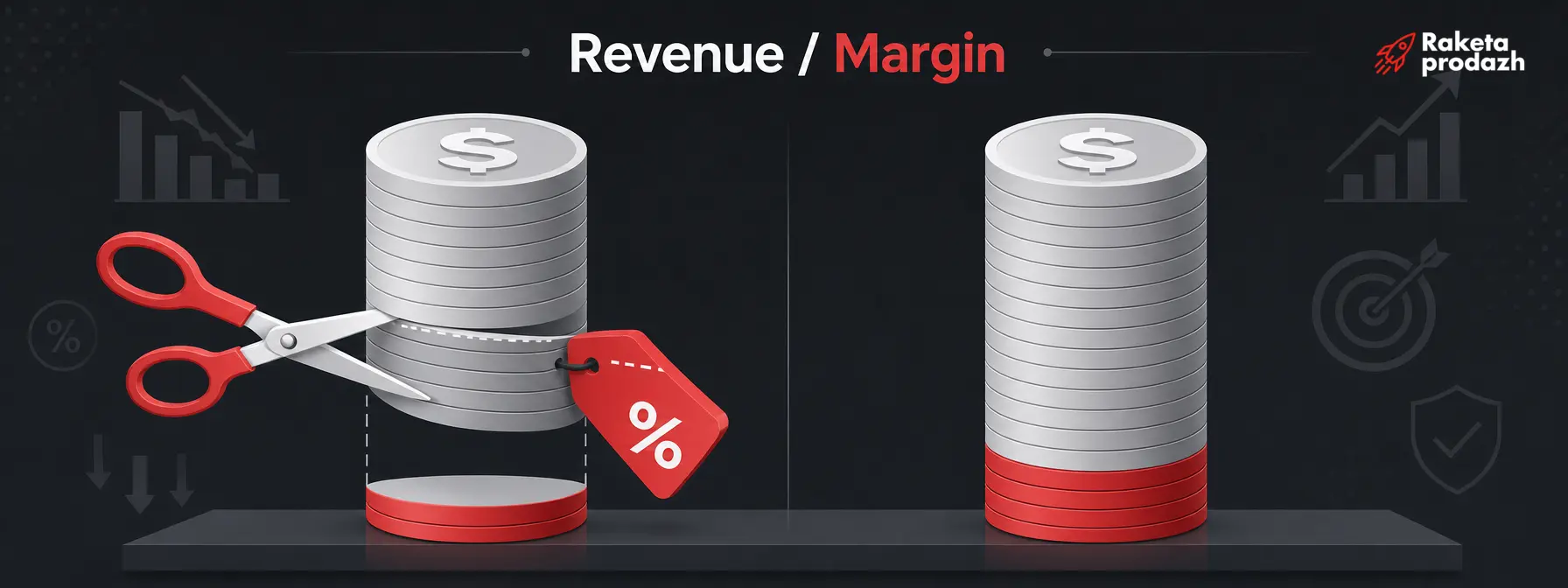
A commission on revenue is easy to calculate, and you can explain it to a manager in five minutes. The problem is that with this model, the salesperson may chase high volume through discounts, because what matters to them is the deal size, not how much the company actually earned. A commission on gross profit, i.e., margin, ties the salesperson’s income to the business’s profitability better, but requires transparent financial analytics and trust in the numbers.
Imagine two managers who both sell 1 million UAH worth of goods. One, thanks to a good product mix and terms, generates 300,000 UAH in gross profit, while the other, selling roughly the same amount but with constant discounts, generates only 150,000. From the same revenue, the company gets a completely different financial result, and paying both the same percentage of revenue is unfair to the business.
That’s why, in wholesale trade, car sales, equipment sales, and some B2B models, a margin-based bonus is often economically more logical than a revenue-based one. What percentage of sales a sales manager ultimately receives largely depends on which metric the company chose as the calculation base. Next, we’ll bring all the models together into a single table by type of sales.
Table: How to Choose the Base/Commission Ratio by Sales Type
Different types of sales require different compensation logic, and there really is no universal solution here. The balance of a sales manager’s base salary and commission always needs to be chosen based on the specifics of the segment and the salesperson’s role in the deal. Below are benchmarks for several common business models, from hot inbound leads to account management.
A sales manager’s base salary and commission should be determined based on the length of the deal cycle, the source of leads, and the employee’s influence on the final outcome.
It’s important not to present rigid percentages as facts about the Ukrainian market where there isn’t enough statistical data. It’s better to keep the ratio principle in mind and supplement it with current job postings from competitors in your segment, to understand the real sales manager’s salary on the market. The final question worth answering is simple: what’s more advantageous for the company itself – a high base salary or a high commission.
What's More Advantageous for the Company: High Base Salary or High Commission
The question, framed this way, is a bit misleading. The company shouldn’t try to minimize salary as such, but rather the cost of getting a profitable outcome. A cheap base salary paired with a weak manager can cost the company far more than a high base salary paired with a strong specialist who closes complex deals without losing margin.
A high base salary is economically justified if it helps hire and retain a strong person for complex sales where mistakes are costly.
A large commission is justified where the deal’s outcome depends almost entirely on the manager’s personal skills rather than the company’s product or brand. Base salary plus commission is always a tool for a specific task, not a universal template.
There’s only one main criterion for evaluating any compensation scheme: how much gross profit the company keeps after paying out all sales compensation, including base salary, bonuses, and incentives. If this figure grows and the team isn’t falling apart from turnover, then the ratio has been chosen correctly.
Building the right compensation system isn’t just picking percentages and salaries off the top of your head – it’s a comprehensive engineering task that requires a deep understanding of the sales funnel, niche specifics, and team psychology. Attempts to implement “market standards” without adapting them to your business often lead to turnover, lost margin, and chronic plan underachievement. “Sales Rocket” specializes in building turnkey motivation systems: from analyzing the team’s current effectiveness to fully implementing a new compensation plan with training for managers and leaders. We don’t just calculate the base-to-commission ratio – we build a complete sales management system with transparent KPIs, dashboards, and regular reporting. Our methodology has been proven in 208 companies across 14+ industries – from industrial B2B to e-commerce. The result: teams that run like clockwork, predictably generating conversion growth of up to 86% and delivering an average revenue increase of +35%. Our clients include companies like Mitsubishi, Audi, and Naftogaz.
Turn motivation chaos into a system of stable growth - build a sales department that's guaranteed to hit its plan!
The question of what percentage of sales a sales manager receives can’t be considered separately from base salary, plan, margin, and target income. Salary vs commission in sales department isn’t a choice between a “greedy” and a “generous” company – it’s an engineering task tailored to a specific business. The compensation plan must simultaneously be competitive for the Ukrainian labor market, transparent for the salesperson, and profitable for the company. If even one of these conditions isn’t met, the system will eventually fail, whether through turnover, burnout, or lost margin. Start with the target income and the manager’s real influence on the outcome, not with percentages that look nice in a presentation.


 Time to read: 9 min.
 18 September 2026