Key Takeaways
- A manager who only gets a bonus for the number of cars sold starts handing out discounts on autopilot instead of working through objections and protecting margin.
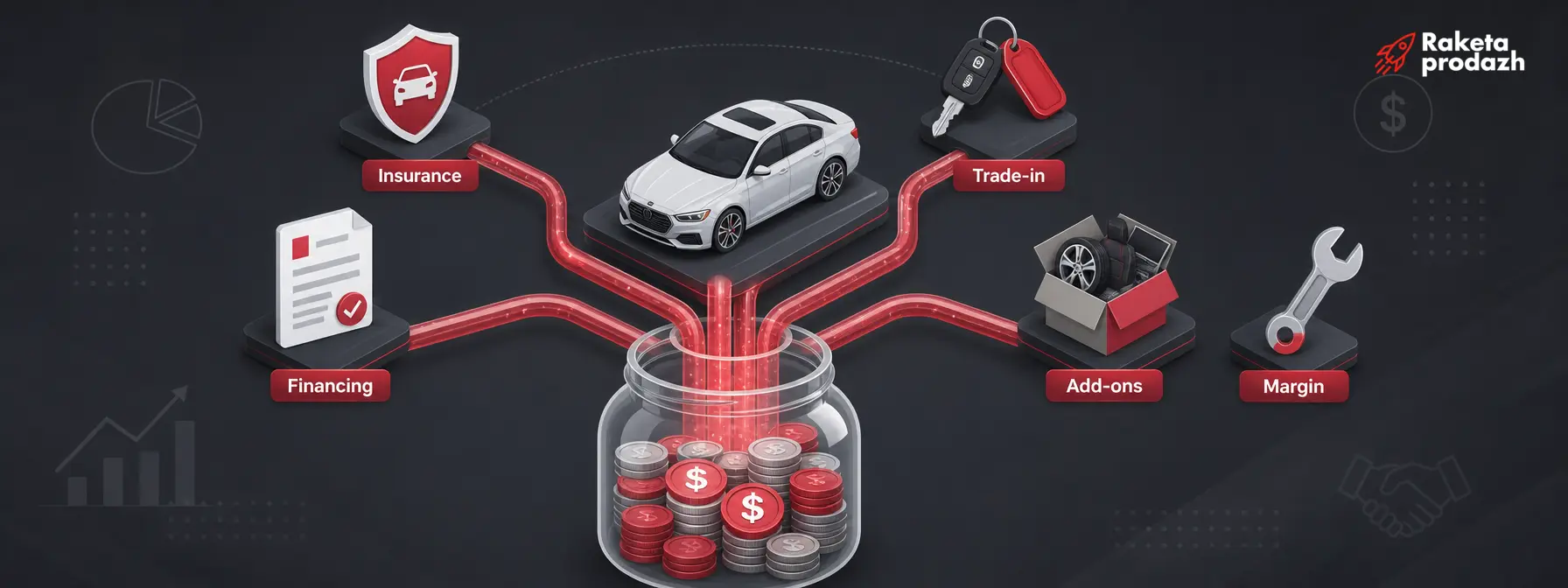
- A dealership’s profit doesn’t come from the fact of a sale itself, but from margin, add-on equipment, insurance, financing, and trade-in, and all of this should affect the employee’s bonus.
- A discount that doesn’t affect the manager’s income turns the motivation system into a weapon against your profit.
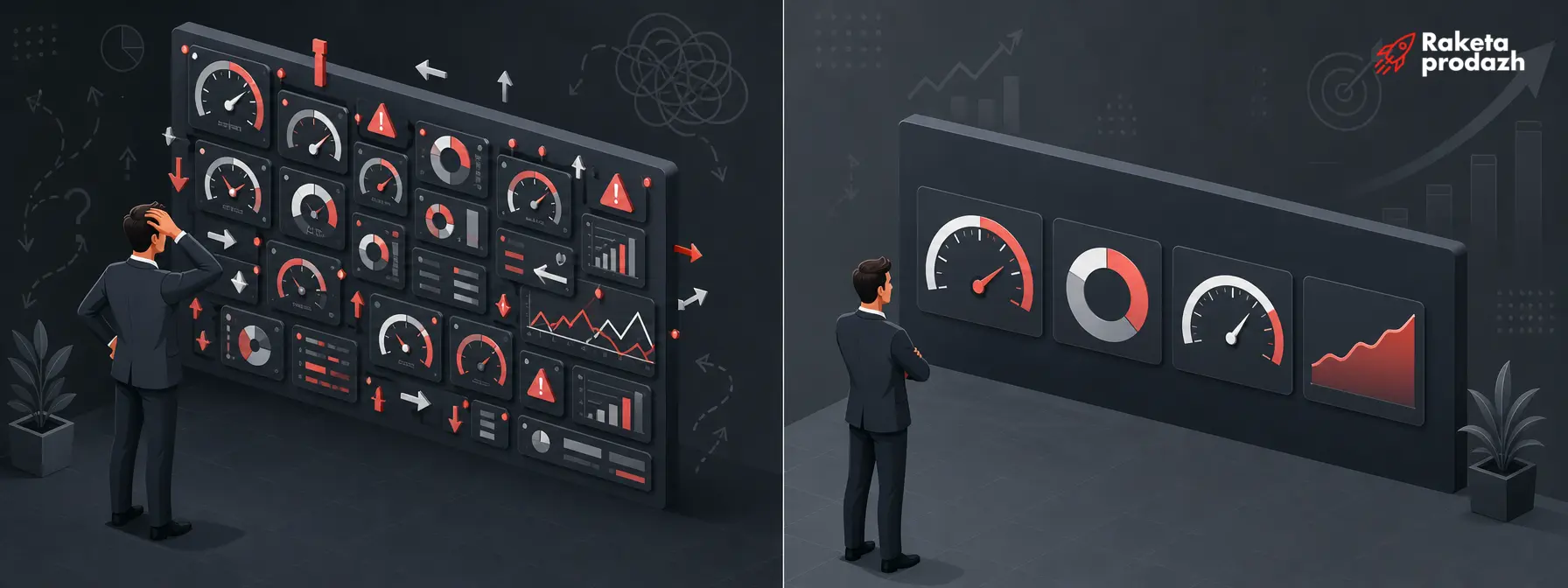
- Weak systems load the salesperson with ten or fifteen KPIs at once, while strong ones pick three or four critical metrics that are clear without a calculator.
- Your formula works if the manager can estimate their own bonus before closing the deal, not after getting the payroll sheet from accounting.
In the article below, you’ll find concrete building blocks for a motivation system, common mistakes in the formulas, and scenarios for testing the model before launch. Read the full article 👇
Car sales manager motivation shouldn’t be based on the simple fact of “closed one more car,” but on the economics of every single deal. The number of sales remains an important metric, but it needs to be tied to gross profit, margin, and the quality of the work with the customer. Otherwise, a plan measured in units turns into a pretty number that hides weak profit for your business.
Why Motivation Based Only on the Number of Cars Sold Doesn't Work
The most common motivation model looks simple. A fixed amount or a percentage for every car sold. The more cars show up in the report, the bigger the bonus. At first glance, the logic makes sense: sell more, earn more.
The problem is that this kind of car dealership sales department motivation pushes the manager toward fast decisions rather than profitable ones. It’s easier for them to approve a discount than to work through a customer’s objection. It’s more rewarding to close one more deal, even if it brings the dealership almost nothing, than to spend time on a customer with a complicated but margin-rich request.
Here’s what that leads to in practice.
- It’s more profitable for the manager to agree to a discount quickly, just to avoid losing the customer.
- Deal margin takes a back seat, while the sale itself becomes the main focus.
- Expensive-to-serve customers get closed at almost zero profit.
- Interest in add-on equipment, insurance, and financial products drops, because they don’t affect the bonus.
- Trade-in economics may not be factored into pricing at all.
The number of cars sold shows the volume of work, but it says nothing about its quality. To understand where profit is being lost, it’s worth figuring out what actually makes up the income from a single deal.
How many times have you found that managers hit their volume plan, but the dealership’s profit still came in below expectations? This is a classic problem that 70% of automotive business leaders run into when their car dealership manager incentive system is set up the wrong way. At Rocket Sales, over 8+ years we’ve helped 208 companies across 14+ industries build sales departments that focus not just on volume, but on the economics of every single deal. Our approach includes developing KPIs that account for gross profit, margin, work with add-on products, and proper discount management. Our clients see an average revenue increase of +35%, and their teams consistently hit 150% of plan every month while keeping the business healthily profitable.
Turn sales chaos into a system of steady profit growth - get a free audit of your dealership's motivation system!
What Makes Up the Profit of a Car Deal
A car deal rarely generates income through the margin on the car itself alone. Even if a vehicle is sold almost at cost, the dealership can still earn well on related products, if the manager knows how to offer them to the customer at the right time and without pressure, which largely depends on quality sales manager training.
A car dealership manager’s KPIs need to account for this entire income package, not just the fact of the sale. Depending on the dealership’s model, the profit from a deal can include the following components.
- The margin on the car itself.
- The discount given, or more precisely, its size or absence.
- Add-on equipment and accessories.
- Insurance products.
- Financing or leasing.
- Service programs and extended warranty.
- Trade-in.
- Other related products specific to a given dealership.
The manager’s job isn’t to upsell everything at any cost and annoy the buyer. The job is to put together a package that’s actually relevant to that specific customer while still protecting the deal’s economics for the business. Some customers care about an extended warranty, others benefit more from a low-rate loan, and some aren’t willing to go beyond the base trim, and that’s a perfectly fine outcome too.
One separate point: the rules for how each type of income counts toward the bonus need to be clear to the employee in advance, not show up after the fact on the payroll sheet. When a manager can see what their commission is made up of, they start thinking not just about the number of cars, but about the whole package around the deal. This brings us to a painful question: what to do about discounts, which are usually what destroys margin in the first place.
Why Discounts Should Affect Manager Motivation
If a manager’s bonus stays the same no matter what discount is given, a conflict of interest is unavoidable. Why bother working through a customer’s objections if it’s easier to say “let me approve a couple more percent off” and close the deal right now? In this kind of setup, car dealership manager motivation starts working against the dealership itself.
Doing quality work on price takes time and attention to detail. It’s easier and more pleasant for a manager to just drop the price than to figure out a few important things.
- Whether the customer is really comparing identical trims, and not apples to oranges.
- What offer the competitor actually made.
- How critical delivery timing actually is for the customer.
- Whether there’s value in the car already being in stock.
- Whether trade-in terms differ between dealers.
- What add-on products are already included in the offer.
The motivation system needs to make an uncontrolled discount unprofitable for the manager personally, not just for the dealership. At the same time, the employee needs a clear range of authority: they need to know where their decision-making zone ends and where approval from a manager is required. When these boundaries are clear, and special terms are genuinely justified by the business, a discount turns from a crutch into a working tool. From here, it makes sense to figure out exactly which metrics are worth keeping under control so that all this economics stays visible.
Which Car Sales Manager KPIs to Use
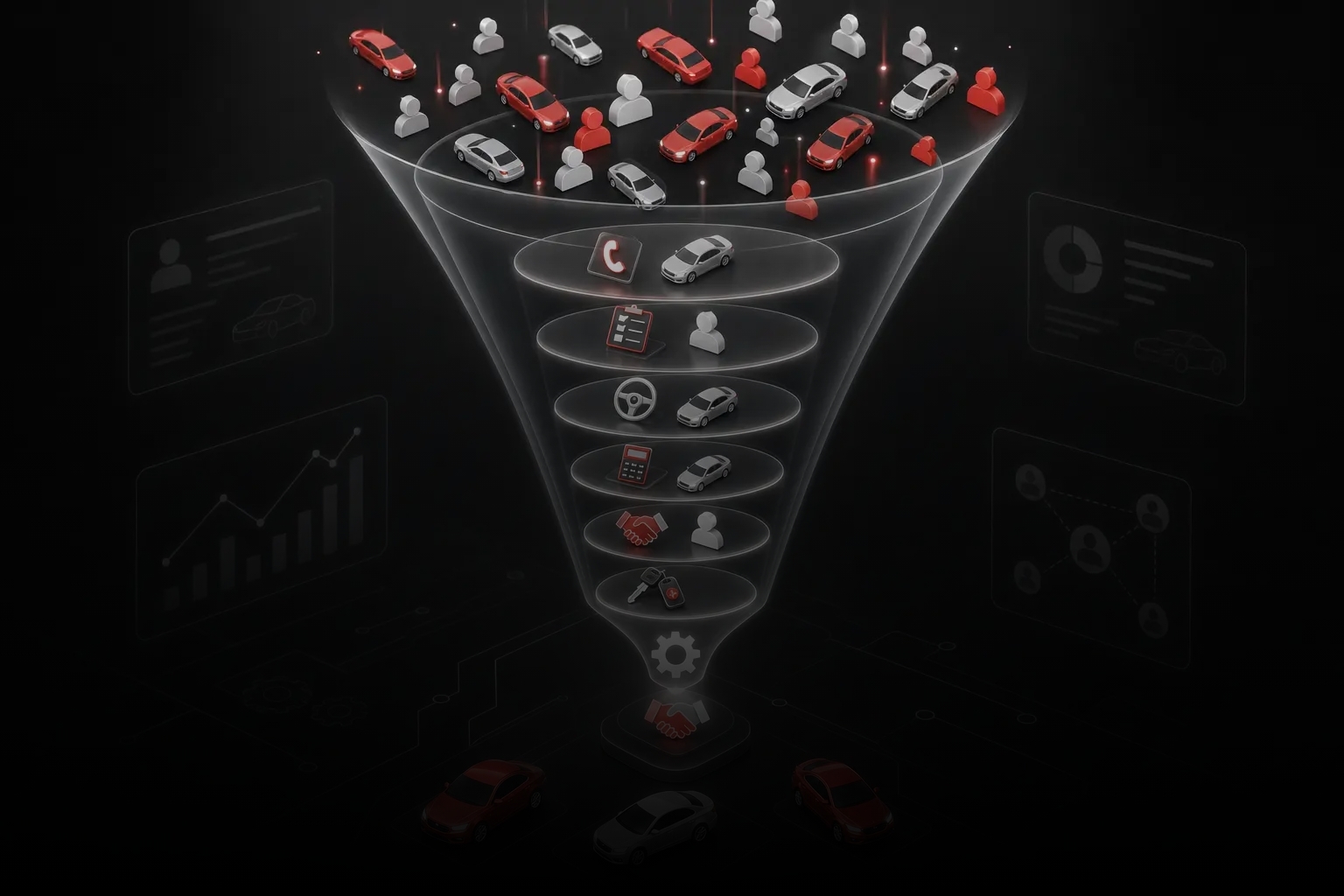
Car sales manager KPIs don’t have to boil down to a single number on a report. If you’re figuring this out from scratch, it helps to first get familiar with the general principles of sales department KPIs, and then adapt them to the automotive business. It’s useful to split them into several groups so you can see the whole picture: financial result, additional income, sales funnel, and quality of work.
Financial result reflects how much money the manager brought to the business, not just how many cars they handed over to customers.
- Number of cars sold.
- Gross profit.
- Average profit per car.
- Sales plan achievement.
- Average discount size.
Additional income shows how well the manager can work with the package around the main deal.
- Add-on equipment.
- Insurance products.
- Financing.
- Trade-in.
- Service products.
The sales funnel helps you understand where customers and deals are being lost.
- Lead response speed.
- Inquiry-to-visit conversion.
- Number of visits scheduled and completed.
- Number of test drives conducted.
- Visit-to-deal conversion and offer-to-sale conversion.
Quality of work covers discipline and consistency, without which the numbers quickly become random: CRM discipline, having a defined next step for every customer, reasons for lost deals, and adherence to work standards.
You don’t need to drag all of these metrics straight into the pay formula. Some of them work great as control and diagnostic tools, helping a manager spot a problem before it hits profit. The bonus should only include the KPIs that have the strongest impact on sales right now, and that deserves a separate conversation.
Which KPIs Are Actually Worth Including in the Bonus
Analytical metrics and motivational metrics are two different things, and they shouldn’t be confused. The first ones are for the manager to diagnose the business; the second ones directly affect the salesperson’s pay and need to be as simple and clear as possible.
A good car sales manager commission rate is built on a limited set of parameters. Usually, this is enough.
- Achievement of the unit sales plan.
- Gross profit.
- Average margin per deal.
- Add-on products (insurance, equipment, financing).
- Critical CRM and quality-of-work requirements.
If you hand a manager ten or fifteen coefficients at the same time, they’ll simply stop understanding how to influence their own income. The brain isn’t infinitely elastic, and you can’t hold sales, insurance, trade-in, CRM, and ten other metrics in your head all at once. In the end, the employee either ignores part of the metrics or focuses on the simplest one, while the rest exist only on paper in HR’s files.
A good motivation system for car dealership managers lets the employee answer, on their own and without accounting’s calculator, the question in advance: “if I close this deal this way, how much will I earn?” If there’s no answer, the formula needs to be simplified. Now it’s time to put all of this together into a concrete motivation architecture.
What a Motivation System for Car Dealership Managers Might Look Like
There’s no single formula that fits every dealership. But there is a logic to how it’s built that can be adapted to a specific business, model lineup, and market situation in your region – which, in essence, is exactly what building a motivation system for a specific sales department means.
A motivation system for car dealership managers is usually built from several blocks, each with its own job to do.
- Fixed portion. The manager’s base salary, which covers basic needs and eases the anxiety of unstable income during slow seasons.
- Volume bonus. Depends on meeting the unit sales plan and is responsible for the overall flow of deals.
- Gross profit bonus. Grows based on the profitability of the cars sold and makes uncontrolled discounts unprofitable.
- Add-on products bonus. Accounts for relevant upsells like insurance, financing, or service packages.
- Quality coefficient. Can reduce or increase the final bonus depending on CRM discipline, process violations, or other critical metrics.
This is an example of the logic, not a ready-made formula with percentages and amounts in euros or dollars. The specific weights and thresholds need to be calculated from the real economics of the specific business: brand margin, average ticket, regional competition, and quarterly goals. One dealership will focus on volume because it needs to grow its customer base, another will focus on margin because the market is already saturated.
A lot of this depends on the sales department’s effective team structure. Before putting a setup like this into practice, it’s worth checking it against the typical mistakes that show up in almost every other company.
Common Mistakes in the Motivation System for Car Dealership Managers
Even a motivation system that looks well thought out on paper can fall apart in practice if it still has holes in it. Most often, the problem isn’t the idea of paying for margin itself, but the implementation details that nobody checked in advance.
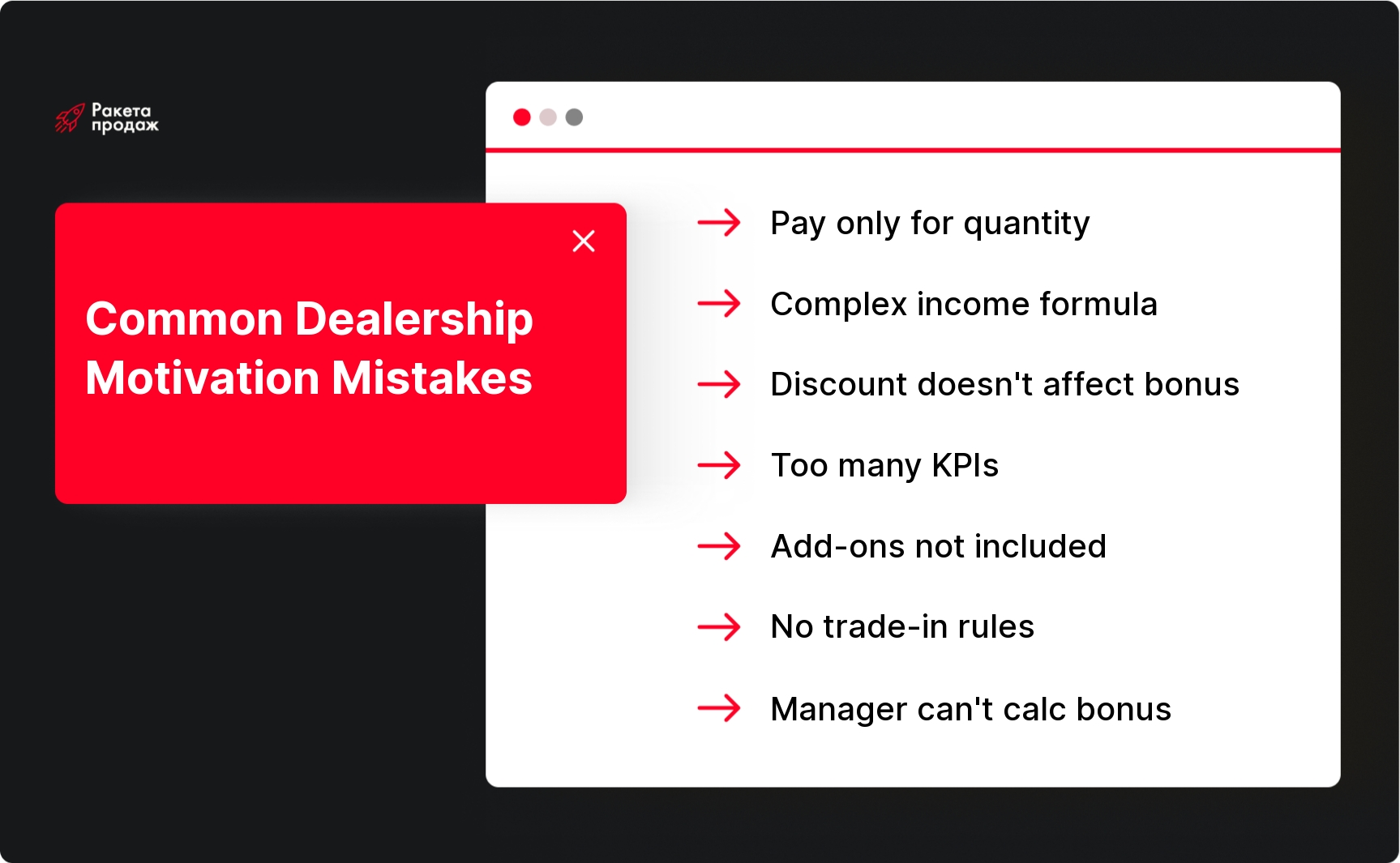
Here’s a list of the mistakes that show up most often in car dealership sales department motivation.
- They pay only for the number of cars, with no link to profit.
- The commission is calculated using a formula that the manager themselves can’t reproduce on paper.
- It’s profitable for the manager to give maximum discounts because the bonus doesn’t change either way.
- The rules of the bonus program get changed retroactively, which kills trust in the system.
- The manager gets loaded with too many KPIs at once.
- All the metrics carry the same weight, even though objectively they’re not equally important to the business.
- Add-on products aren’t factored into the bonus calculation at all.
- There are no separate rules for trade-in, and the manager under- or over-values it however it suits them.
- A loss-making deal still gives the manager a full bonus.
- There’s no minimum unit plan, and the focus on margin ends up dragging down sales volume.
- CRM data and financial reports don’t match up with each other.
- The manager simply can’t calculate their expected income from a deal on their own.
Each of these mistakes seems minor on its own, but together they turn the motivation system into a constant source of disputes between managers and leadership. You can check whether a specific formula has these holes even before launch.
How to Test the Motivation System Before Launch
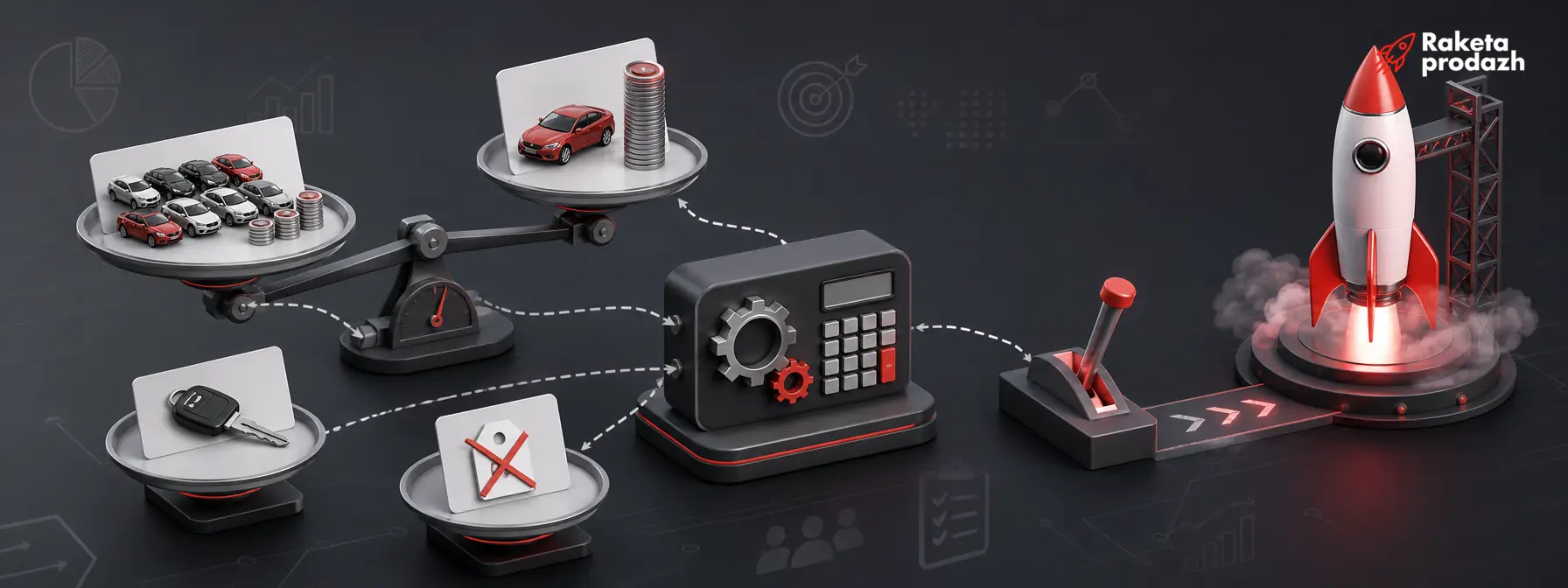
Before rolling out a new motivation system for car dealership managers, it’s worth running a small manager motivation audit, using specific recommendations for implementing KPIs, and running it through a few real-life scenarios on paper or in a simple spreadsheet. It takes a couple of hours, but it will save you from unpleasant surprises a month after launch.
It’s useful to calculate the bonus for each of these situations.
- Many cars sold with low margin.
- Few cars sold, but with very high margin.
- The manager hit the plan on both units and profit.
- High profit comes from add-on products rather than the car itself.
- A large volume of discounts across several deals in a row.
- Selling a car that’s been sitting on the lot too long.
- A deal with heavy use of trade-in.
- A deal that got canceled after a reservation was already made.
The main test is simple: if behavior that’s undesirable for the dealership brings the manager the maximum payout, the formula needs to be reworked right now, not after it’s already been running for a week in real life. If, across all scenarios, the bonus logically reflects the actual benefit to the business, the system is ready to go live.
A proper motivation system for car dealership managers isn’t just a pretty formula in Excel, it’s a comprehensive approach that requires a deep understanding of the economics of the automotive business. But implementing all the principles described here takes professional expertise and experience working across different business models. Rocket Sales specializes in building turnkey sales departments for the automotive business: we don’t just analyze problems, we completely rebuild processes, implement KPI and incentive systems, configure CRM for the specifics of a dealership, and train the team to work for margin, not just volume. Our methodology includes developing a benchmark sales funnel, a system for tracking trade-in, add-on products, and discount control. Our clients include brands like Mitsubishi and Yamaha. As a result of working together, dealerships get teams that boost conversion up to 86% and generate steady profit growth. Don’t lose money to ineffective motivation – start earning the maximum on every deal!
Build a motivation system that will grow your dealership's profit by 35%!
A car sales manager’s commission rate should reflect not just the number of cars handed over, but the real economic result of the work. Car dealership manager motivation built around a single number – “how many did you sell” – sooner or later runs into a profit problem. A good motivation system protects margin, maintains the needed sales volume, and stays simple enough that the manager themselves understands which actions grow their earnings. That’s exactly the kind of formula that turns sales into a sustainable business instead of an endless game of discounts.


 Time to read: 9 min.
 14 September 2026