icon

Sales Forecasting in Industries with Long Production Cycles

In a typical CRM, everything looks simple: you have a deal, so the money is coming soon. But if your company manufactures equipment, metal structures, or components, two to three months – sometimes half a year – can pass between the client’s first call and the shipment of the finished product. This is exactly why sales forecasting for a manufacturing company needs a different approach: you have to clarify the technical specification, prepare a quote, go through a tender, agree on the contract, purchase raw materials, put the order into production, and wait for it to come off the line.


Want a high-performing sales team without the hassle?
We’ll build it for you.
Contact Us

Key Takeaways

  • Forecasting based only on open CRM deals misleads a manufacturing company: months pass between contract signing and shipment, leaving procurement, shop floor, and finance without the data they need.
  • Manufacturing needs to forecast not a single number but a chain of events: when the deal will be signed, when the order will hit the production line, when the product will come out, and when the money will actually arrive.
  • A strong forecast separates high-volume items (historical analysis), new products (expert judgment), and large projects (causal analysis) instead of applying one method to everything.
  • The gap between departments kills accuracy: sales sees the customers, production knows the capacity, procurement knows raw material lead times, and a forecast built without their input works blind.
  • Forecast accuracy grows not from an expensive system but from regularly reconciling plan vs. actual by customer and product group with an honest breakdown of deviations.

The full article walks through a step-by-step algorithm for building a forecast, methods for different product types, and ways to integrate with ERP so you can avoid cash gaps and missed deadlines. Read on below 👇

Sales forecasting for a manufacturing company that’s built only on the number of open deals in the CRM fools itself. A mistake in a forecast like that doesn’t just hit the sales department. It turns into a shortage or surplus of raw materials in the warehouse, overloaded shops, idle production lines, missed delivery deadlines, and cash gaps that the CFO ends up covering later. Let’s look at why sales forecasting in manufacturing needs a special approach and how to build a system that actually works.

Why sales forecasting in manufacturing is harder than usual

In retail, a deal cycle might take a couple of days. In manufacturing, everything stretches out on two fronts at once: the deal itself takes a long time to close, and the product takes a long time to make once the money is almost in hand. The client sends a request, you prepare a quote, go through a tender, coordinate technical details with the customer’s engineers, and then you’re still waiting on a signature for the contract. And that’s just the beginning of the road.

Then production enters the picture. To fulfill the order, you need to purchase raw materials – and suppliers don’t work instantly either – get in line on a production line that’s already busy with other orders, and wait for the finished product to come out. Add seasonal demand, a couple of large clients who make up half your revenue, and a habit of changing shipment dates at the last minute, and you get a system where you need sales forecasting under uncertainty, and a standard CRM pipeline forecast just doesn’t cut it.

That’s exactly why a manufacturing company has to forecast not one event, but several at once: when the deal will be signed, when the order will enter production, when the finished product will come out, and when it will actually ship to the client. Next, let’s break down what exactly needs to go into a forecast like that.

Does this feel familiar: the sales department promises one number, production plans around another, and procurement works off a third? When the sales forecast exists in its own bubble, and reality keeps delivering surprises like missed deliveries, cash gaps, and idle lines? This is a typical problem for 75% of manufacturing companies trying to build forecasting on their own. At “Sales Rocket,” over 8+ years of work, we’ve created a comprehensive approach to building sales systems for manufacturing companies, where the forecast becomes a working tool for every department instead of just a report for management. We integrate forecasting into the CRM, connect it to production planning, and train the team to work with a single set of metrics. The result? Our clients get sales departments that don’t just predict the future – they actively shape it.

Turn forecasting chaos into a clear production management system - get a free sales performance audit!

What exactly a manufacturing company needs to forecast

Revenue forecast for the end of the quarter is just the tip of the iceberg. If you stop there, sales will feel calm while production and procurement are left without the information they need. Sales planning and forecasting at a manufacturing company works like a system where each metric pulls the next one along with it.

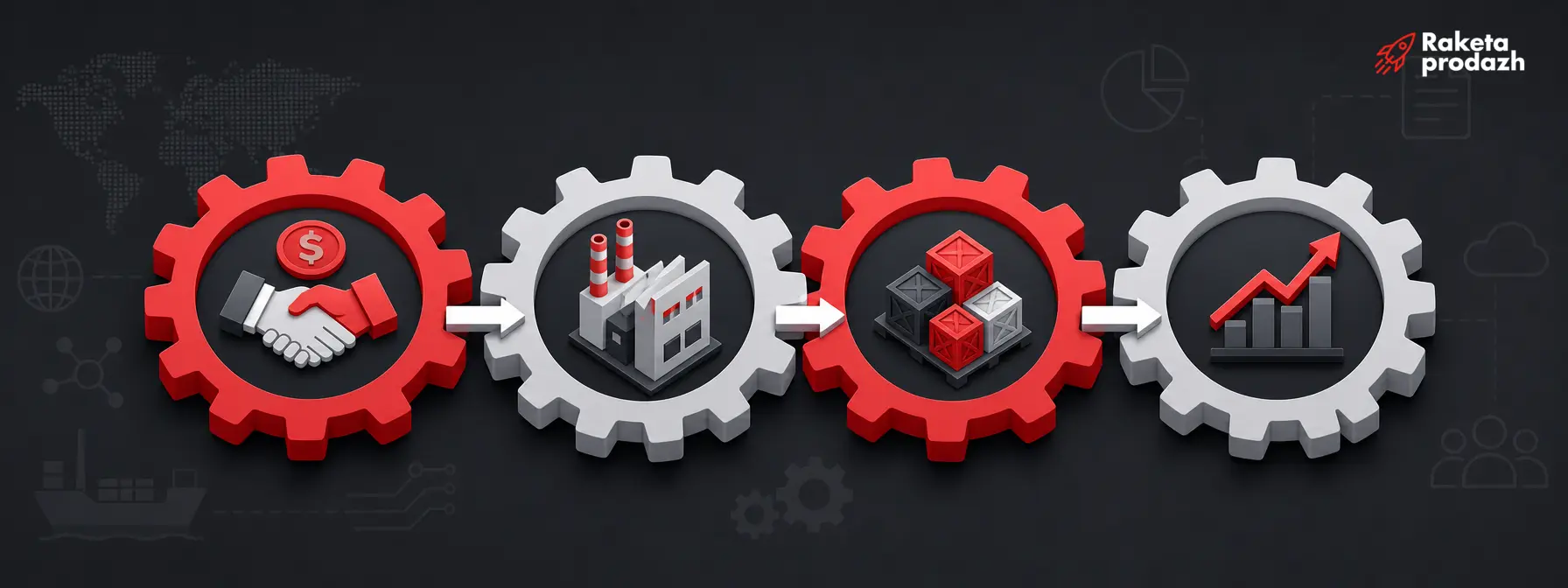
Sales promises volume in money and units, production assesses whether there’s enough capacity to make it, procurement checks whether it can secure raw materials in time, and finance estimates how it will affect cash flow. If even one link drops out, the whole chain loses its meaning.

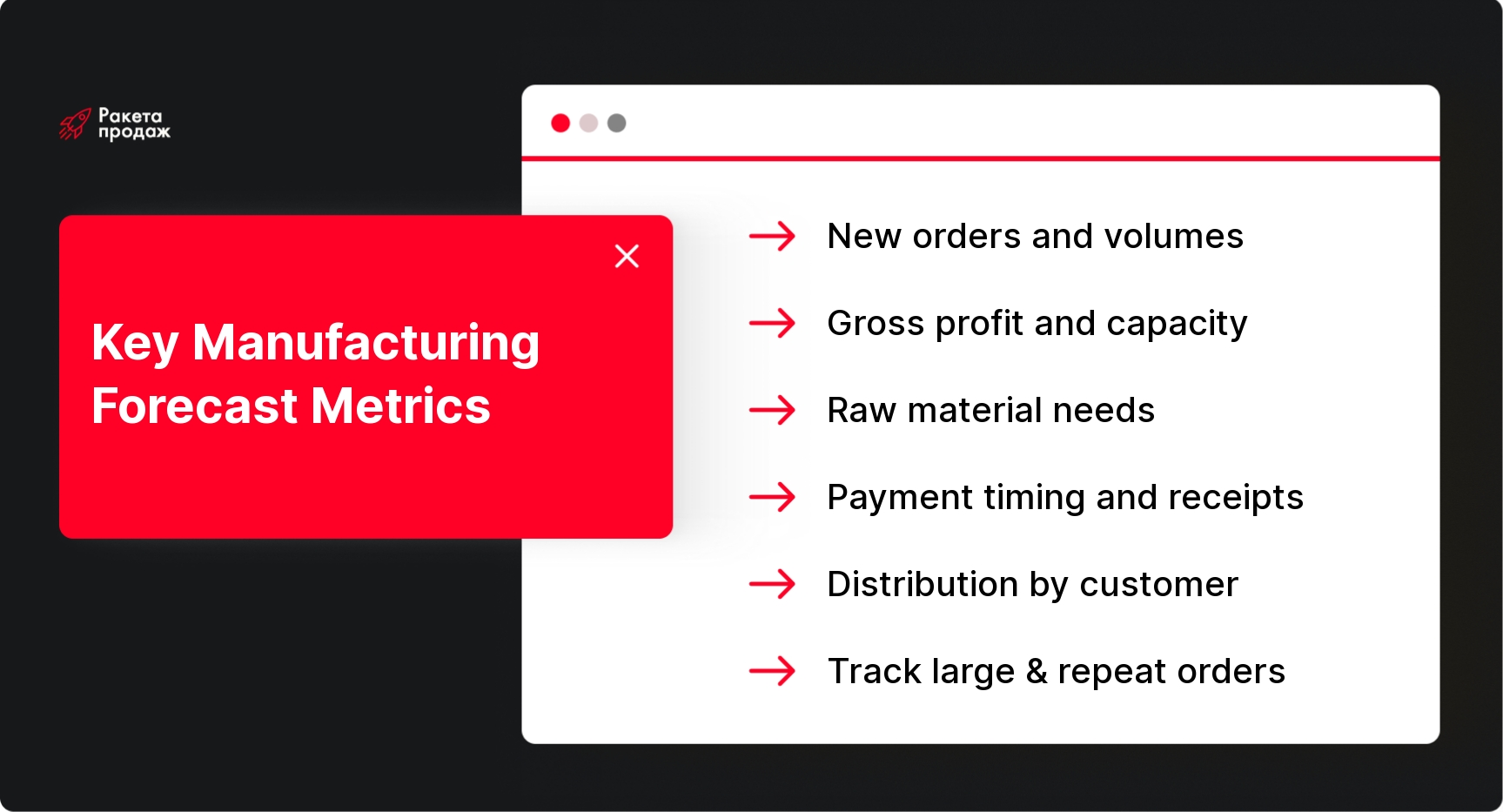
Here’s what’s worth keeping in view at all times:

  • New orders, deal volume in money and units of product. This is the base for any further calculation – without it, you can’t build the other metrics.
  • Gross margin and production capacity utilization. These show whether it’s profitable for the company to take on a given volume of orders and whether there are enough real resources.
  • Shipments and raw material needs. These link the commercial forecast to the actual production cycle and delivery timelines.
  • Cash inflow by payment terms. Critical for managing cash gaps, especially with deferred payments.
  • Breakdown by customer, product group, and region. Helps you see where risk is concentrated on a couple of large accounts.
  • Large projects and repeat orders. It’s better to count these separately, because the forecasting logic for them is completely different.

Sales volume forecasting without this level of detail leaves production and procurement in the dark. Now let’s look at how these numbers get produced in practice.

what to forecast for a manufacturing company — A chain of gears symbolizing the interconnection of sales, production, procurement and finance

Key methods for sales forecasting in manufacturing

There’s no universal method for B2B sales forecasting in manufacturing. High-volume products, seasonal lines, and one-off projects all require different approaches, and a good system usually combines several sales forecasting methods rather than picking one for every occasion.

For stable, high-turnover items, historical sales analysis works great: time-series models catch the trend and seasonality and give a fairly accurate baseline forecast. For new products without sales history, expert judgment fits better – an experienced manager’s opinion is often more accurate than any formula when data is scarce. And for large project-based deals, it’s worth looking at causal analysis – that is, how market drivers, tenders, or industry shifts affect order volume.

Briefly, on the most popular methods:

  • Historical analysis (time series) works for mass, repeat orders with enough sales history behind them.
  • Accounting for seasonality is essential for products with demand peaks, such as construction materials or packaging.
  • Expert judgment is indispensable for new products and non-standard large deals.
  • Causal and cascading analysis ties the forecast to external factors: raw material prices, tenders, market drivers.
  • AI- and ERP-assisted forecasts automate the calculation where there’s enough data, cutting down on manual work, as covered in detail on the MRPeasy blog.

Next, let’s look at how to pull these methods together into a single process, step by step.

Step-by-step guide to building a sales forecast for a manufacturing company

Building a working forecast isn’t a one-off task for an analyst – it’s a process that runs through several departments and repeats every month or quarter. If you skip one of the steps, the whole system will start breaking down exactly where you least expect it.

You shouldn’t start by picking a model – start with the data. Without a clean history of sales, orders, and seasonality information, even the most advanced model will just be crunching garbage. And the process shouldn’t end with sending a report to management – it should end with regularly checking how closely the forecast matched reality.

Here’s what the process looks like in practice:

  1. Data collection and cleaning. Gather your history of sales, orders, seasonal fluctuations, and market factors from CRM, ERP, and accounting, stripping out distortions caused by one-off large deals.
  2. Choosing a method for the specific product. Statistics work for high-volume items, expert judgment for new products, and funnel and close-probability analysis for large projects.
  3. Product categorization. Split your product range into high-volume, seasonal, and low-turnover groups – this boosts forecast accuracy without over-complicating the model.
  4. Involving other departments. Sales knows the customers, production knows the real capacity, procurement knows raw material lead times, finance knows the cash constraints. A forecast built without their input will be one-sided, and properly building a sales department for manufacturing helps make this collaboration systematic rather than a one-off initiative from a single manager.
  5. Monitoring and adjustment. Compare the forecast against actuals every month, log the reasons for deviations, and update the model instead of repeating the same mistake quarter after quarter.

Collaboration between departments here isn’t a formality – it’s a way to eliminate blind spots that only people on the ground can see. Let’s look at how production cycle length fits into this process.

How to account for production cycle length

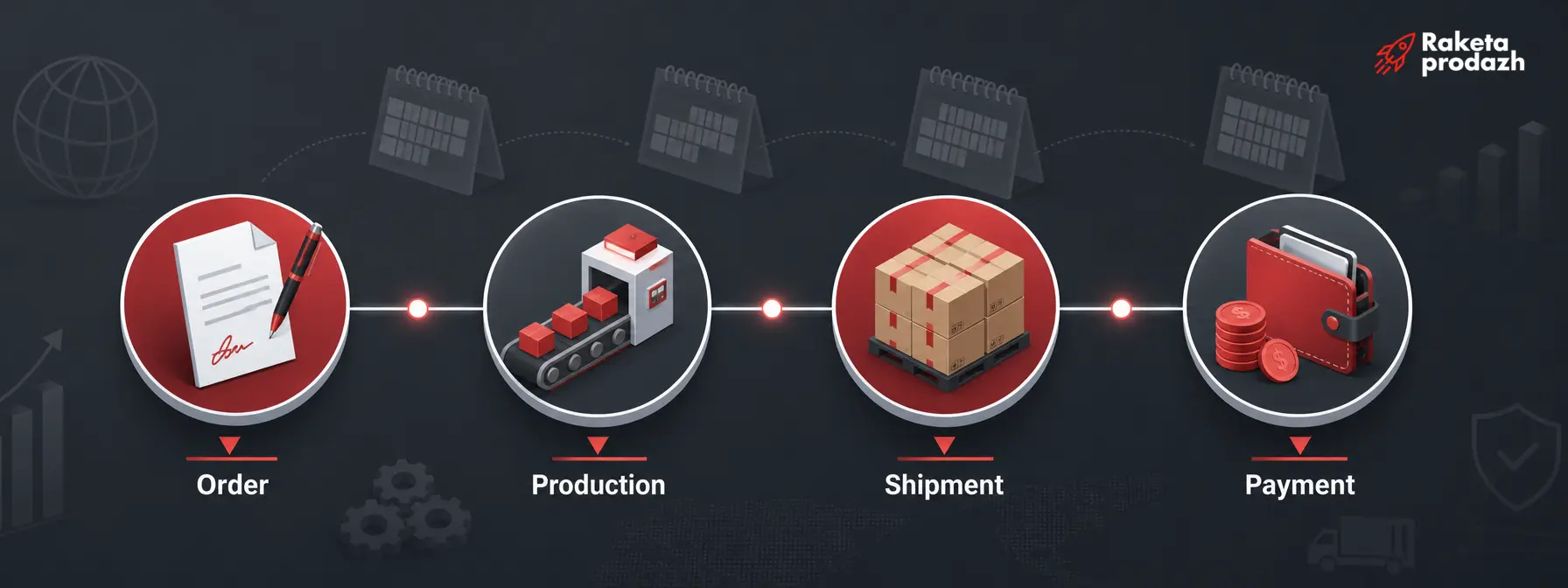
The sale date and the shipment date at a manufacturing company almost never match, and that’s the main trap for a forecast. A contract might be signed in January, but the raw materials for it won’t be purchased until February because the supplier works on deferred terms. Production takes March, shipment happens in April, and payment doesn’t arrive until May. If you count revenue by the signing date, the picture for the quarter will be distorted.

That’s why the forecast needs to be built across several dates at once, not just one. The expected order date shows commercial activity, the production start date reflects shop floor load, the completion date signals readiness to ship, and the actual payment date shows the real movement of cash. Each of these dates lives in its own department: sales watches the first one, production watches the second and third, and finance watches the last.

Without this breakdown, sales can look strong on paper while actual revenue for the period turns out weak simply because orders got stuck somewhere between production and the warehouse. This is exactly where integrating the forecast with planning systems comes in, which we’ll cover next.

manufacturing cycle duration — A timeline showing four stages: order, production start, output, payment

Integrating sales forecasting with production planning and ERP systems

A forecast that lives in a separate Excel file on an analyst’s computer is almost useless for production. The value shows up when forecasted demand automatically flows into the production schedule, the procurement plan, and inventory calculations – in other words, when the forecast is directly connected to the ERP system rather than existing separately from operational processes.

In a typical ERP system, the forecasting module pulls in sales history and open orders, builds a baseline calculation, and passes it to the MRP module, which calculates material needs and generates purchase suggestions. A sales manager or planner can manually adjust the numbers if they know about a large tender or a client delay, and the system recalculates the production and procurement schedule to reflect that adjustment.

This kind of connection cuts down on manual work, removes discrepancies between departments, and gives everyone – from sales to finance – a single, shared picture of what’s happening with orders right now. Companies running on ERP platforms with strong MRP functionality can react to shifts in demand faster than those still reconciling forecasts by hand in spreadsheets. But even the best integration won’t save you from the common mistakes we’ll cover next.

Common mistakes in sales forecasting in manufacturing

The most common mistake is confusing a plan with a forecast. A plan is what management wants to achieve; a forecast is what will actually happen given the current deals and constraints. When a plan gets passed off as a forecast, production receives distorted numbers and prepares for a volume that will never materialize.

Next comes relying only on last year’s numbers without accounting for the current pipeline, or the opposite – relying exclusively on the CRM pipeline without adjusting for the fact that not all deals are equally reliable. Managers habitually overestimate the probability of closing, forget to factor in schedule slippage, and treat a large tender as won before the contract is even signed. This creates a false sense of confidence exactly where there shouldn’t be one.

A separate group of problems stems from the gap between departments. The sales forecast exists on its own, isn’t tied to actual production load, and doesn’t account for raw material lead times from a specific supplier. As a result, sales, production, and procurement end up working from different versions of the same number. And if the forecast only gets updated once a quarter, accuracy isn’t measured at all, nobody investigates the reasons for deviations, and the same mistakes just keep repeating.

The good news is that most of these mistakes are fixable if you build the right review process. Let’s cover that in the next section.

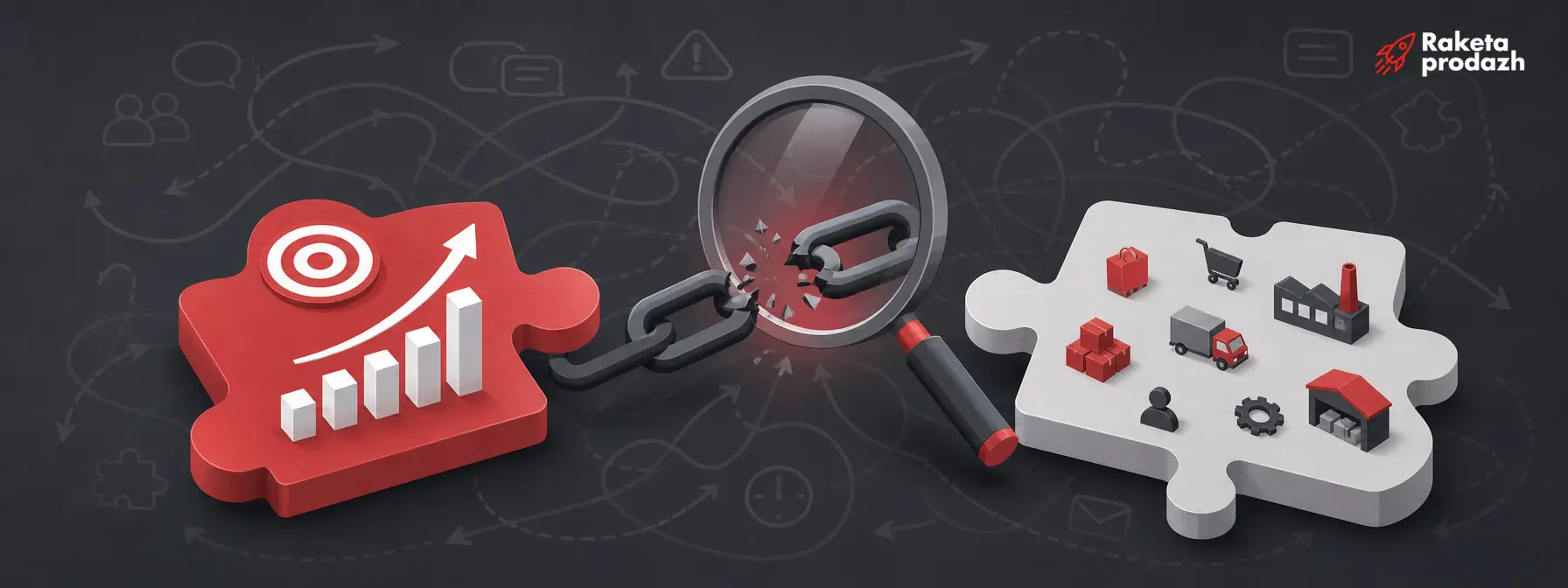
sales forecasting mistakes in manufacturing — A broken chain and scattered puzzle pieces symbolizing typical forecasting mistakes

How to improve forecast accuracy for a manufacturing company

Forecast accuracy doesn’t improve on its own just because you bought an expensive system. It improves when a company regularly checks calculated numbers against actuals and honestly digs into where and why a deviation happened, instead of blaming everything on “an unpredictable market.” Systematically improving sales forecast accuracy starts with exactly this discipline of reconciliation, not with buying new software.

Start by comparing plan vs. actual for each major customer and product group, not just the overall total. The overall number can come together by chance, from pluses and minuses that cancel each other out. Pay special attention to the tricky items: low-turnover products, one-off orders, and new customers, where historical data is scarce and the risk of error is higher. For these, expert judgment adjusted with numbers often works better than pure statistics.

Be sure to tie the forecast to actual production capacity and raw material lead times. If sales promises a volume that production physically can’t produce in time, revenue forecast accuracy doesn’t solve anything. And manual adjustments from managers shouldn’t be banned, but they need to be justified and logged so you can later check whether the intuition actually paid off. Automation and AI tools speed up the calculation, but they don’t replace a person who knows the context of a specific deal.

Quality sales forecasting isn’t just nice-looking charts in reports – it’s a system that syncs the work of sales, production, and procurement into a single growth engine. But implementing all the principles described here requires deep expertise in the specifics of manufacturing business and an understanding of how to integrate a forecast into a company’s operational processes. “Sales Rocket” specializes in building turnkey sales departments for manufacturing companies: we don’t just analyze forecasting problems, we completely rebuild the planning system, implement CRM with the production cycle in mind, and train the team to work with a unified logic. Our methodology includes building a multi-level forecast tailored to your production specifics, integration with ERP systems, and implementing dashboards to track every stage from order to shipment. As a result of working with us, our clients see an average revenue increase of +35%, with the best result being +$10,907,403 over 4 months of work. Our partners include companies like Mitsubishi, Yamaha, and Naftogaz.

Build a forecasting system that turns your production into a predictable growth engine!

Conclusion

image

The longer the deal and production cycle, the earlier a company needs to see future demand instead of reacting to it after the fact. Sales, production, and procurement should work from the same forecast, but understand that it carries different levels of probability at different stages. Quality B2B sales forecasting lets a manufacturing company not only calculate future revenue more accurately, but also manage capacity load, raw material inventory, shipment timelines, and cash flow without unnecessary surprises.

In this article:
See more
Book a FREE sales funnel audit
CONTACT US
FAQ
How do you account for the production cycle in a sales forecast?

Build the forecast across several dates at once: order, production start, completion, and shipment. That way you’ll see when a deal actually turns into money, not just when it’s signed.

How do you account for tenders in a sales forecast?

Don’t count a tender as won before the contract is signed. Assign it a realistic probability based on its stage and adjust the forecast if decision timelines shift.

How often should you update a sales forecast?

For a manufacturing company, a reasonable minimum is once a month. With high demand volatility or dependence on a few major clients, revisit the forecast every week.

Who should be responsible for the sales forecast in manufacturing?

The final number is owned by a joint team: sales provides deal data, production and procurement verify feasibility, and finance ties the forecast to cash flow.

SUBSCRIBE TO MY TELEGRAM CHANNEL
The most valuable sales information right on your phone!
icon

LOTS OF USEFUL INFORMATION, FREE TEMPLATES, AND CHECKLISTS ON MY INSTAGRAM

Materials and practical advice on sales growth in our blog: