icon

Sales Forecasting Under Uncertainty: How to Build a Working System

Remember when sales forecasting seemed relatively simple? You studied historical data, accounted for seasonality, applied standard growth coefficients – and there it was, your forecast for the next quarter or year. But what happens when the market turns upside down and familiar models stop working?

Want a high-performing sales team without the hassle?
We’ll build it for you.
Contact Us

Key Takeaways

  • Traditional forecasting methods break down during sharp market shocks because they extrapolate the past rather than prepare for disruptions.
  • A company without a forecast during crisis loses control over cash flow, inventory, and the ability to adapt marketing to new demand signals.
  • Strong forecasting is built on scenarios (base, optimistic, pessimistic, stress) rather than a single number, with each scenario including triggers and action plans.
  • Rolling forecasts and short planning cycles (monthly, weekly) allow for faster reactions to changes than annual budgets with quarterly reviews.
  • Signal metrics (website activity, deal cycle length, funnel conversion) predict downturns or growth earlier than they appear in sales reports.

In the full article, you’ll find a step-by-step algorithm for building an adaptive forecasting system, a list of specific metrics for early detection of demand changes, and ready-made scenario planning templates. Read below 👇

In today’s business environment, traditional forecasting methods increasingly fail. The culprit is growing market uncertainty: economic crises, geopolitical conflicts, pandemics, and other unforeseen circumstances. During such periods, companies face what Nassim Taleb called “black swans” – extremely rare and unpredictable events that have a colossal impact on business and completely change the rules of the game.

Imagine: you’re preparing an annual sales plan, and suddenly – a new wave of COVID, military conflict, or financial crisis. Your forecasts instantly become useless. How do you plan a budget in such conditions? How do you manage inventory? How do you understand which direction your business is heading?

Why Create a Sales Forecast During Crisis?

“If everything is so unpredictable, maybe we shouldn’t forecast at all?” – business leaders often ask this question. The logic is understandable: why spend resources on forecasts that will likely be wrong within a month?

However, abandoning forecasting isn’t the solution. Even in the most turbulent times, businesses need reference points. Sales forecasting during crisis serves several critical functions. First, it allows for cash flow management. Without understanding probable sales volumes, it’s impossible to plan expenses, determine working capital needs, or assess company liquidity. In times of uncertainty, cash flow control becomes a matter of business survival.

Second, forecasting helps adapt procurement and marketing strategies. Even an approximate understanding of which direction demand is moving gives you the ability to adjust inventory and marketing campaigns. Without this, a company risks either facing product shortages or freezing significant funds in unwanted inventory.

The third crucial goal of crisis forecasting is identifying trends and possible scenarios. In unstable times, the market often gives contradictory signals. Systematic forecasting helps separate random fluctuations from emerging trends and prepare for various situations.

Additionally, sales forecasting directly affects liquidity management. In conditions where access to external financing is limited and credit resources are expensive, it’s critically important for companies to understand how much money will come in from operational activities.

Finally, quality forecasting is the foundation for increasing business resilience. It helps identify potential problem areas in advance and take preventive measures, whether diversifying sales channels, optimizing assortment, or revising pricing policies.

So forecasting is necessary even in the most difficult times. The question is only how to change the approach to forecasting so that it works in new conditions.

Why Traditional Forecasting Models No Longer Work

Most classic forecasting models – linear, seasonal, regression – are designed to work in relatively stable conditions. They’re based on historical data analysis and the assumption that past patterns will likely repeat in the future. But what happens when the external environment changes radically?

Linear models that simply extrapolate existing trends into the future are absolutely helpless in the face of sharp market changes. For example, a company selling office furniture might have observed stable sales growth of 10-15% annually for years. But the pandemic and mass transition to remote work completely changed demand for office equipment, making previous forecasts meaningless.

Seasonal models also fail during crisis periods. Traditional seasonal patterns – such as holiday sales increases – can be distorted by changes in consumer behavior. During the 2008 financial crisis, many retailers found that pre-Christmas sales peaks were much lower than expected because consumers reduced spending on gifts.

Regression models that account for various factors influencing sales also lose effectiveness when new, previously unaccounted variables appear. For example, a model that worked well under normal conditions cannot account for the impact of lockdowns or sanctions if such events weren’t in the company’s history.

There are many examples of how reliance on historical data led to serious miscalculations. A classic case is forecasting demand for tourism services after the pandemic. Many companies, based on previous years’ data, expected gradual recovery in tourism. But reality proved different: after restrictions were lifted, there was a sharp surge in demand that many weren’t prepared for. Hotels were overbooked, airlines couldn’t handle passenger flow, and prices skyrocketed.

To work in new conditions, we need to rethink the very role of forecasting. Forecasting in times of crisis is not so much about accurate prediction of the future as it is a tool for identifying possible scenarios and preparing for them. This means we need new approaches that can handle high levels of uncertainty.

Uncertainty and "Black Swans": What's Important to Consider

The term “black swan,” popularized by Nassim Nicholas Taleb, describes an extremely rare and unpredictable event with enormous impact that is rationalized in hindsight (“it could have been foreseen”). The COVID-19 pandemic, the 2008 financial crisis, military conflicts – these are all examples of “black swans” that radically changed market landscapes and consumer behavior.

For sales, “black swans” create a double problem. First, they make historical information less valuable for forecasting. If the market suddenly changed due to an unforeseen event, past sales data might mislead rather than help. Second, they create a new reality where old relationships between variables (e.g., between price and demand) may act differently or stop working altogether.

Imagine a retailer who historically saw that a 10% price reduction increased sales by 15%. In economic shock conditions, this correlation could completely change: even with significant price reductions, consumers might refrain from purchases due to general uncertainty about the future.

Traditional forecasting models don’t handle “black swans” precisely because they focus on identifying and extrapolating patterns rather than preparing for radical changes. They assume the future will resemble the past, with some predictable deviations. But in a world of “black swans,” this assumption often doesn’t work.

Forecasting “black swan” events requires a fundamentally different approach. Instead of trying to predict a specific event, companies should focus on increasing overall adaptability and resilience. Black swan events in sales forecasting become less about precise prediction and more about a factor to consider in the overall risk management system.

To build in a “flexibility” mechanism, companies increasingly turn to scenario planning. Instead of one forecast, several possible scenarios are developed – from optimistic to pessimistic, including various “black swan” variants. Key indicators that might signal a scenario’s occurrence are identified for each scenario, and corresponding action plans are prepared.

Another approach is stress-testing business models. Companies model how various shock events (from market crashes to supply chain disruptions) will affect their sales and operations. This helps identify vulnerabilities and develop preventive measures.

Finally, more companies are moving toward working with probabilities instead of point forecasts. Instead of stating “we’ll sell 10,000 units next quarter,” they use formulations like “there’s an 80% probability our sales will be between 8,000 and 12,000 units.” This approach more honestly reflects the actual level of uncertainty and allows better preparation for various scenarios. Such a shift in thinking – from precise prediction to uncertainty management – can be key to building more flexible and resilient business models.

Key Approaches to Sales Forecasting During Crisis Periods

In highly uncertain conditions, companies need to reconsider their approach to sales forecasting. Instead of searching for one “correct” forecast, focus on creating a flexible system that can adapt to rapidly changing conditions. Let’s examine several key methods that have proven effective during crisis periods.

Many companies experience the same difficulties in unstable conditions that we described above. Forecasts become useless after a few weeks, and old models no longer work. At “Rocket Sales,” we face this problem daily while helping clients build systematic sales departments resilient to crises. Our approach is based on creating a flexible analytical system that automatically adapts to market changes: from implementing multi-level forecasting scenarios to configuring signal metrics that warn about potential problems in advance.

We develop customized KPI dashboards that allow tracking each sales funnel stage and adjusting team actions in a timely manner. Over 6+ years working with more than 158 sales departments across various industries, we’ve created a methodology that delivers consistent results even in the most turbulent times. The average revenue increase for our clients is +35%, with the best result being +$1.6 million over 4 months of work.

Turn market unpredictability into your competitive advantage - order a free audit of your sales forecasting system!

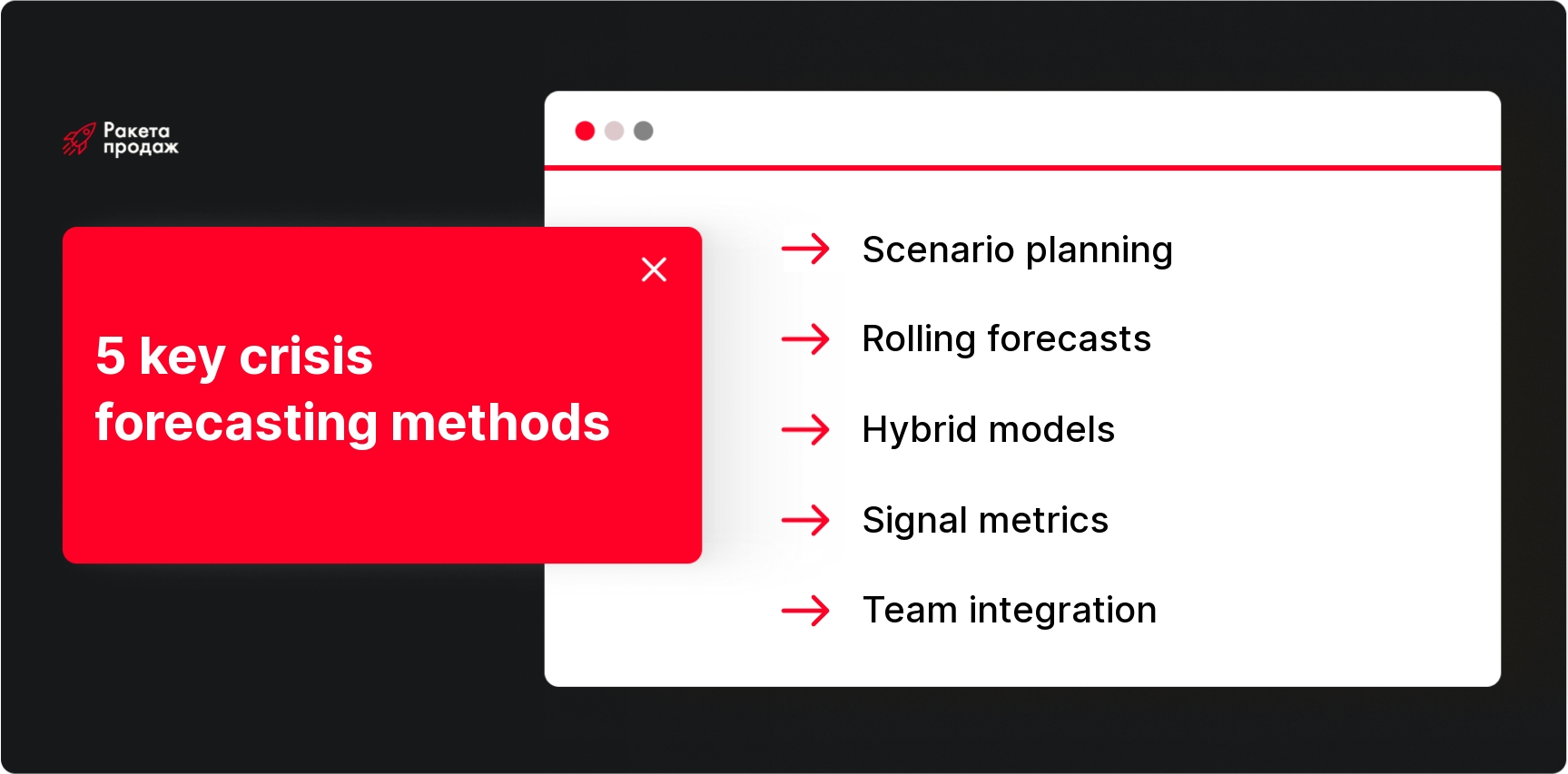
Scenario Planning becomes one of the most valuable tools under unstable conditions. The essence of this method is developing 3-5 different scenarios: from baseline (most likely) to pessimistic and optimistic. Key drivers (factors affecting sales), probable sales volumes, and necessary company actions are defined for each scenario.

Sales forecasting in times of crisis requires a special approach to data analysis and future situation modeling. In an unstable market, traditional methods can produce significant errors, so it’s important to use combined approaches that consider both historical data and current market signals to correctly formulate sales forecasts in an unstable market.

The advantage of this approach is that it helps businesses prepare for different futures, not just one “expected” outcome. For example, a company might develop a baseline scenario assuming gradual market recovery, a pessimistic scenario with a new crisis wave, and an optimistic scenario with rapid demand growth. A separate action plan is prepared for each variant, significantly increasing business adaptability.

Rolling Forecasts are another method that works well under uncertainty. Unlike traditional annual planning, rolling forecasts are constantly updated – usually monthly or quarterly. Each time a period ends, the forecast extends forward by the same period. This allows for promptly accounting for market changes and adjusting expectations.

During crisis, many companies switch to hybrid forecasting models combining expert assessments and machine analysis. Machine algorithms process large data volumes and identify hidden patterns, while experts interpret results and adjust forecasts based on their market understanding and external factors that models might not consider.

The integration of data-driven and intuitive models becomes especially valuable. A purely analytical approach might not account for new factors without existing data, while a purely intuitive approach often suffers from cognitive biases. Combining numbers with management intuition creates a more reliable foundation for decision-making.

Regular hypothesis review becomes a crucial element of the new forecasting system. Companies must constantly check whether their assumptions about the market, competitors, and consumers remain relevant. If a hypothesis stops working, the forecast should be adjusted.

Finally, close feedback between departments is necessary. Sales, marketing, finance, logistics – all these divisions should regularly exchange information and coordinate their forecasts. This helps avoid situations where, for example, the sales department plans for growth while logistics prepares for decline. In unstable times, such inconsistency can cost businesses dearly. A properly built forecasting system helps ensure unified understanding of the situation and coordinate actions throughout the organization.

How to Build a Sales Forecasting System in an Unstable Market

image

Transitioning from traditional forecasting methods to a flexible, adaptive system requires a systematic approach. Let’s look at how to practically build such a system in an unstable market.

1. Multi-level Scenarios: Baseline, Optimistic, Pessimistic, Stress Scenario

Scenario planning should be the core of the new forecasting system, where several development variants are created. The baseline scenario reflects the most likely situation based on current trends. It serves as the foundation for operational planning and budgeting.

The optimistic scenario models a situation where external factors favor the company: the market recovers faster than expected, demand grows, competitors experience difficulties. This scenario helps prepare for possible rapid growth and avoid situations where the company cannot satisfy increased demand due to production capacity or logistics limitations.

The pessimistic scenario, conversely, assumes worsening market conditions: demand decline, increased competition, rising costs. It allows early identification of vulnerability points and development of action plans to minimize risks. Break-even analysis is often conducted within the pessimistic scenario, determining the minimum sales level needed to cover fixed expenses.

Finally, the stress scenario models extreme conditions: serious crisis, complete market stoppage, critical supply chain disruption. This scenario tests business sustainability under the most unfavorable circumstances and develops an emergency action plan.

It’s important that each scenario isn’t just a set of numbers but includes cause-and-effect relationships: what factors lead to such developments, how this affects various business aspects, and which indicators will signal this particular scenario’s realization.

2. Flexible KPIs and Short Forecasting Cycles: Plan Adaptability

Under instability, traditional annual KPIs lose relevance. Instead, companies switch to flexible key performance indicators that can be adjusted depending on market condition changes. For example, if the goal at the beginning of the year was increasing market share, but preserving cash flow becomes the priority during crisis, KPIs should change promptly.

Simultaneously, forecasting cycles shorten. Instead of an annual plan reviewed quarterly, companies move to monthly or even weekly forecasts. This allows faster response to market changes and more informed decision-making.

Plan adaptability also means budgeting becomes more flexible. Instead of rigid resource allocation a year ahead, reserve funds are formed that can be quickly directed where they’re most needed. This is especially important for marketing budgets: in crisis times, the ability to quickly redistribute advertising investments between channels can provide a substantial competitive advantage.

3. Signal Metrics: Early Indicators of Demand, Customer Activity, Deal Dynamics

For effective forecasting under instability, it’s critically important to identify market situation changes before they affect sales. For this, it’s necessary to define and constantly track signal metrics – early indicators that can predict demand changes.

Such indicators may include: website visitor activity, inquiry and request quantities, existing customer behavior changes (order frequency, average check size), sales funnel dynamics (conversion at different stages), competitor activity, industry news.

To build such analytics, tools for sales funnel analysis will be useful, allowing detailed tracking of changes at each deal stage and quicker response to emerging signals – both quantitative and qualitative.

For example, in the B2B segment, an early indicator might be a change in sales cycle length: if clients start delaying decisions, this may signal future demand reduction. In retail, such a signal might be a change in the viewing-to-purchasing ratio: if people browse more but buy less, this also indicates a possible downturn.

It’s important that signal metrics are integrated into the overall forecasting system, and their analysis is conducted regularly and promptly. This will allow the company to stay one step ahead of the market and take preventive measures.

4. Team Involvement: Unified Data Space Between Sales, Marketing, and Analytics Departments

Under instability, data fragmentation and department isolation become serious problems. When marketing, sales, and analytics work with different data and use various forecasting methods, contradictions and inefficiencies arise.

The solution is creating a unified data space where all interested departments can see the same information, analyze it, and make coordinated decisions. This could be a common CRM system integrated with marketing tools and analytical dashboards.

Sales management in times of crisis requires especially close coordination between all company departments. When each department understands the big picture and sees how its actions affect the overall result, management effectiveness significantly increases. That’s why systematic sales department management becomes a key factor in business sustainability in an unstable environment.

Beyond technical integration, regular meetings between representatives of different departments are necessary to discuss forecasts and action plans. Such meetings allow combining various perspectives: marketers see changes in potential customer behavior, sales managers know current customer moods, analysts can interpret data in the context of market trends.

Team involvement is especially important in scenario planning. Each department should understand what actions are expected from it when implementing various scenarios and be ready to quickly reorganize its work.

5. Technology and Analytics: BI Systems, ML Forecasts, Reporting Automation

Technological support becomes a critically important element of forecasting systems under instability. Business intelligence (BI) helps visualize data and identify trends, machine learning (ML) allows creating more accurate predictive models, and reporting automation provides operational access to current information.

BI systems such as Tableau, Power BI, or QlikView allow creating interactive dashboards that display key indicators and their dynamics in real-time. This makes it possible to quickly identify deviations from plans and take corrective measures.

Machine learning algorithms can analyze large data volumes and identify non-obvious patterns. For example, they can determine which factors actually influence sales in different regions or segments, and how these factors interact. This allows creating more accurate and nuanced forecasts.

Reporting automation eliminates the need to manually collect and process data, saving time and reducing error probability. Thanks to this, managers and analysts can focus on data interpretation and decision-making rather than routine operations.

Under instability, systems that can integrate company internal data (sales, inventory, marketing campaigns) with external data (market trends, competitor activity, macroeconomic indicators) become especially valuable. Such a comprehensive picture allows better understanding of context and making more informed forecasts.

When choosing technological solutions, it’s important to consider their flexibility and scalability. During crisis times, business needs can change quickly, and systems should easily adapt to new requirements. Additionally, the cost-benefit ratio should be evaluated: an expensive solution may not pay off if the company is operating in resource-saving mode.

Building an effective sales forecasting system under uncertainty is a task requiring expertise, time, and resources. But what if, instead of searching for solutions independently, you entrust this work to professionals? “Rocket Sales” specializes in creating comprehensive sales management systems that not only forecast results but ensure their achievement.

Our methodology includes building a multi-level analytics system, implementing automated control tools, developing flexible KPIs, and training teams to work under new conditions. We don’t just consult but work with you until achieving real results – from identifying problem areas to fully implementing new processes and tools.

Unlike standard approaches, our system is adapted to your business and market specifics. We analyze all data, from sales funnel to customer behavior, to create a model that will work specifically in your situation. Among our clients are Mitsubishi, Yamaha, Naftogaz, and dozens of other companies that managed not just to survive crises but significantly increase their turnover.

Create a sales system that makes business predictable even in unpredictable times - schedule a consultation with our experts!

Conclusion

The business world is becoming increasingly unpredictable. Events that seemed extremely unlikely just a few years ago now occur with frightening regularity. In such conditions, sales forecasting transforms from a technical function into a key management competency that largely determines company survival and success.

The new approach to forecasting is based on three fundamental principles. The first principle – resilience is more important than accuracy. In an unstable world, the pursuit of absolutely accurate forecasts gives way to creating a system that can adapt to various scenarios. Companies that develop multi-level forecasts, define trigger points, and prepare action plans for different situations find themselves in an advantageous position even with the most unexpected market turns.

The second principle – systematicity is more important than intuition. Even the most experienced leader cannot cover all factors affecting business in modern conditions. A structured approach is needed, combining data, analytics, expert assessments, and feedback mechanisms. Such a system allows identifying hidden patterns, evaluating the probabilities of various outcomes, and making more informed decisions.

The third principle – learning is more important than control. Under high uncertainty, forecast errors are inevitable. The key to success becomes not so much minimizing these errors as the ability to learn from them and constantly improve forecasting approaches. Companies that create a culture of continuous learning, constantly analyze discrepancies between forecasts and actual results, adjust their models, and adapt to changing conditions will have a significant advantage in turbulent times.

In this article:
See more
Book a FREE sales funnel audit
CONTACT US
FAQ
Why forecast if the market is unstable and everything changes every month?

Even with high instability, forecasting remains an important business management tool. It helps manage cash flows, optimize inventory, adapt marketing strategies, and increase company resilience. The key difference – in unstable conditions, forecasting becomes not a point prediction of the future but a tool for identifying possible scenarios and preparing for them.

What are "black swans" and how do they affect sales forecasts?

“Black swans” are unforeseen events with enormous impact, such as pandemics, financial crises, or military conflicts. They make traditional forecasting ineffective because historical data loses relevance. To account for possible “black swans,” companies develop stress scenarios and action plans for extreme situations.

Which forecasting approaches work best during crisis periods?

Most effective are scenario forecasting (developing several event development variants), rolling forecasts (regular forecast updates), hybrid models (combining machine analysis with expert assessments), and probabilistic forecasting (working with ranges and probabilities instead of point estimates).

How often should sales forecasts be updated in an unstable environment?

In highly unstable conditions, it’s recommended to move from annual planning cycles to shorter periods. Many companies update forecasts monthly or even weekly. The specific frequency depends on industry specifics and the speed of market changes.

Which tools help build a forecasting system?

Key technological solutions include BI systems for data visualization (Tableau, Power BI), machine learning tools for creating predictive models, CRM systems for tracking customer activity, and integrated planning platforms that combine data from different sources.

How to account for external factors (exchange rates, sanctions, macroeconomics)?

To account for external factors, you need to: 1) identify key factors affecting your business; 2) establish monitoring mechanisms for these factors; 3) analyze historical correlations between factors and sales; 4) include various scenarios of these factors changing in forecasting models; 5) regularly review and adjust factor influence based on new data.

SUBSCRIBE TO MY TELEGRAM CHANNEL
The most valuable sales information right on your phone!
icon

LOTS OF USEFUL INFORMATION, FREE TEMPLATES, AND CHECKLISTS ON MY INSTAGRAM

Materials and practical advice on sales growth in our blog: