Key Takeaways
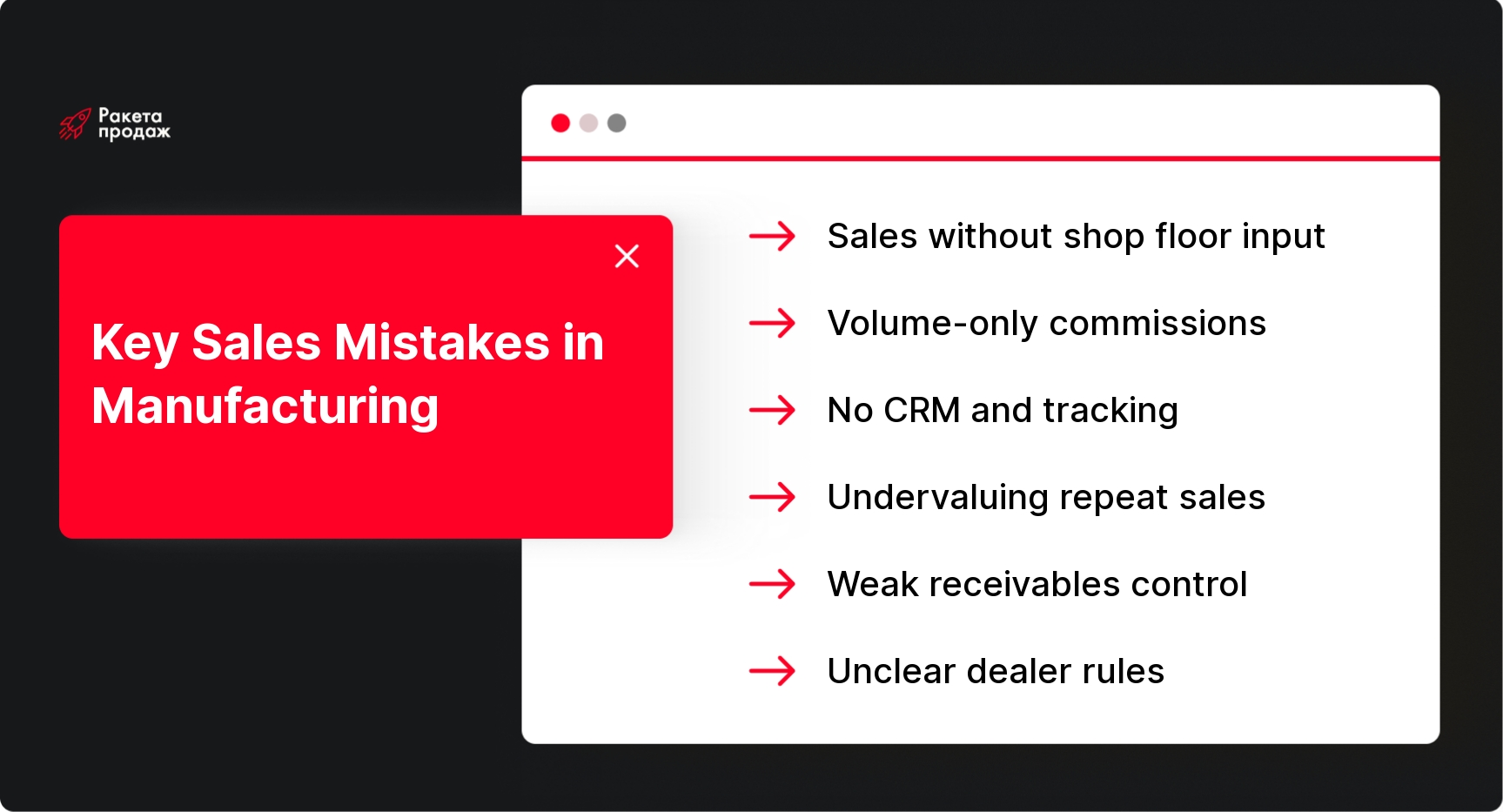
- Manufacturing sales don’t play by typical B2B textbook rules: a deal can drag on for up to a year and a half, and the decision is made by a committee of a buyer, an engineer, and a director – not a single contact.
- A hunter chasing new clients gets lost in technical negotiations, so you need a sales engineer who can talk to the customer’s engineer as an equal and isn’t afraid of tough questions.
- The standard closing commission doesn’t work when a manager only sees money a year later. Pay for stages instead: qualified lead, sample approval, first order, repeat purchase.
- Your sales department can promise impossible deadlines if it isn’t synced with the shop floor’s workload, raw material shortages, and warehouse stock levels.
- KPIs based on revenue alone push managers to sell any order just to hit the plan, including deals that are unprofitable for production and low-margin.
In the full article, you’ll find a launch checklist for building a sales department for manufacturing, motivation schemes designed for long cycles, and rules for staying connected with the shop floor. Read on below 👇
This article is a practical guide for owners and executives who want to understand how to build a sales team for a manufacturing company that doesn’t depend on the founder’s personal connections. We’ll walk through all the stages: from auditing the manufacturer’s current distribution system to team structure, motivation, and KPIs. At the end, you’ll find a checklist to help you launch the process without chaos or unnecessary losses.
Why Building an Effective Sales Department for Manufacturing Is Harder Than It Looks
Sales in manufacturing follow different laws than sales in IT or retail. A deal can drag on for anywhere from six months to a year and a half, and throughout that time, the manager needs to keep track of several people on the client’s side simultaneously: the buyer who’s counting the money, the process engineer who’s checking the specs, and the director who signs the contract. These long sales cycle deals require a completely different approach to team management than short deals in other industries. One satisfied conversation partner is not yet a guaranteed order if even one committee member objects. According to GMK Center, industrial product sales in Ukraine exceeded 3.7 trillion UAH in 2024, meaning competition for orders is only growing.
Advice from typical B2B or IT courses doesn’t work well here. There, a deal can be closed with one call and a demo, while in manufacturing you need a sample, testing, spec approval, and often a cost recalculation for a specific order. A company that bets solely on “energetic salespeople” with a smooth pitch risks ending up with beautiful presentations and no real orders. A similar risk arises when a business simply hands off sales to distributors without a strategy: the company then loses control over pricing, shelf assortment, and feedback from the end buyer.
That’s exactly why building a sales department for a manufacturing company doesn’t start with hiring outgoing managers, but with understanding who actually makes the purchasing decision and how. These characteristics of a manufacturer’s sales department should be considered from the very start, or even a strong team will stumble in the first round of negotiations.
Does it feel like your sales department is more of a lottery? Orders today, uncertainty tomorrow, and planning production workload is simply impossible. This problem is familiar to 80% of manufacturing companies trying to build sales on their own without accounting for the specifics of long deal cycles and complex technical negotiations. Over 8 years, Sales Rocket has developed a systematic approach to building sales departments specifically for manufacturing companies. We understand that hiring energetic managers isn’t enough here – you need a system that connects sales with the shop floor’s real capacity, properly motivates the team through long deals, and delivers a predictable flow of orders. During this time, we’ve built 208 sales departments across 14+ industries, including manufacturing companies of various scales – from machine tool building to the food industry.
Turn chaotic sales into a system that delivers +35% revenue growth and lets you plan production workload months ahead - get a free diagnostic of your sales department!
Key Roles in a Manufacturing Sales Department and How to Divide Them
Manufacturing companies don’t have a single universal salesperson who’s equally good at finding new clients, handling technical negotiations, and retaining the existing customer base. A sales hunter chasing new contracts needs to be persistent and skilled at opening doors at unfamiliar companies. But that same person often gets lost when it’s time to discuss tolerances, steel grades, or heat treatment timelines with the client’s engineer.
For that kind of work, you need a technical sales specialist, or sales engineer: someone who understands the product at a production level and can talk to the customer’s process engineer as an equal. Evaluate such a candidate not by eloquence, but by their ability to explain a complex thing in simple terms and their willingness to face tricky questions. A separate role is the key account manager, responsible for developing existing relationships, growing repeat orders, and preventing churn.
Separating these functions protects the business from a simple problem: a strong hunter put in charge of servicing old clients starts getting bored and loses their edge, while a good account manager thrown into cold outreach simply won’t hit their targets. A sales department for manufacturing works more effectively when each role covers its own area instead of trying to be everything at once. Once the roles are defined, the next question arises: where do you even start building a sales team structure?
How to Set Up a Sales Department in a Manufacturing Company: Where to Start
Before posting a sales manager job listing and launching professional staff hiring, you should stop and take a sober look at the business. Who’s buying your products today, through which channels do orders come in, which clients bring the bulk of the profit, and which ones only add load to production without real margin. Without these answers, a new sales department risks selling whatever’s easy to sell, rather than what’s actually profitable for the company.
It’s also worth understanding in advance which products deliver the best margins, which production capacity is sitting idle, and which is already running at its limit. If a line is running at 95 percent capacity, aggressively chasing new clients will only create a queue of unhappy customers and missed deadlines. It’s also useful to assess geography: which regions or export directions look promising, and which orders should be politely declined due to low margins or manufacturing complexity.
The main idea is simple: before you build a sales team for a manufacturing company, you need to connect commercial ambitions with actual production capacity. Otherwise, sales and the shop floor quickly turn into two camps with different goals – and we’ll cover this connection in more detail in the section on production and logistics.
Motivation Mistakes: How to Pay for Long, Complex Deals
In manufacturing sales, the classic “closed the deal – got a commission” scheme works poorly, because the deal itself can drag on for a year and pass through a dozen intermediate steps. If you copy a SaaS commission model, the manager simply won’t see any money for the first several months and will leave for competitors who pay more often and more predictably.
A sensible solution is building a sales team motivation system built on several levels. A base salary provides stability and removes the fear of going without income during a long cycle. On top of that, add bonuses for specific, measurable milestones: a qualified lead with a confirmed budget, sample approval by the client’s process engineer, signing the first order, growth in repeat purchases from an existing client. This structure turns the long deal journey into a series of small wins the employee gets paid for here and now, rather than only at the end of the cycle.
Special attention is needed when multiple people are involved in a deal or when direct sales are combined with dealer work. It’s important to spell out in advance who gets a bonus for which part of the deal, or disputes will start within the team over whose deal it actually was.
| Short cycle (SaaS, retail) |
Long cycle (manufacturing) |
| Percentage of the deal right after payment |
Bonus for stages: lead, sample, first order |
| One manager handles the deal start to finish |
Several roles share the bonus by contribution |
| Motivation based on sales volume |
Motivation based on margin and repeat orders |
Well-thought-out motivation directly affects whether a strong manager stays with the company for more than a year, and an honest audit of current sales will help you understand where to find the money in the first place.
Auditing the Manufacturer's Current Distribution System
If sales already exist in the company but the process is more chaotic than managed, start with an honest audit: assess how effectively the manufacturer’s distribution system is working today, through which channels orders arrive, and what share of revenue comes from repeat purchases. If clients leave after the first order, the problem may not lie solely with the sales department – it could be the product or the service. Next, break down the numbers for each client and product separately: where the margin is genuinely high, and where an order only looks profitable on paper because it eats up production time and raw materials. It’s useful to cross-check against shop floor workload and demand seasonality to understand whether the company can physically handle more orders during peak months. A separate audit block covers average order value and order frequency, the state of accounts receivable, the speed of processing incoming requests, and the quality of the commercial proposals currently going out to clients.
It’s also important to look at how work with dealers and partners is structured, whether client records are kept in a CRM or just in one manager’s head, and the reasons the company is losing deals. Taken together, this data shows exactly where money is leaking: weak new-client acquisition, wrong pricing, forgotten repeat orders, or overloaded production without receivables control. Once the picture is clear, you can move on to choosing the channels through which the company will keep growing.
What Sales Channels a Manufacturing Company Can Use
A manufacturing company rarely relies on a single distribution channel, and that’s normal. Direct B2B sales to large customers deliver the best margins and full control over the client relationship, but require a strong team and time to build trust. Dealers and distributors, on the other hand, quickly expand geographic reach, but take a share of the margin and require their own set of rules: minimum order quantities, payment deferrals, marketing support.
Additionally, many manufacturers work through tenders and project sales, especially if their products fit government procurement or large-scale construction. Exporting opens access to new markets but adds certification and logistics requirements. Each of these channels operates by its own rules, and trying to run them all through one universal pipeline usually ends in confusion and lost leads.
Here are the main channels worth considering when building a sales system for manufacturing:
- Direct B2B sales to corporate clients and partner plants with individual terms and long-term contracts.
- Dealers, distributors, and wholesale clients, who take on part of the logistics and regional sales.
- Tenders and project sales for government customers, construction, and infrastructure companies.
- Exports and work with foreign partners through trade shows, agents, and B2B platforms.
- Inbound requests from the website and repeat sales to the existing client base, which are often undervalued despite delivering the cheapest growth.
Each channel requires its own KPIs, terms of work, and deal-handling rules, which means the structure of the sales department itself must account for these differences.
Sales Department Structure of a Manufacturing Company
At the start, a manufacturing company’s sales department doesn’t need a complex hierarchy. Often a commercial director or sales manager plus two or three salespeople covering the main channels is enough. This simple structure lets you quickly test hypotheses about which clients and products actually make money, without getting bogged down in bureaucracy.
As the business grows, functions should gradually be separated. Key account managers take on developing large accounts, new business managers handle cold outreach, and a separate person manages relationships with dealers and distributors. If the company actively participates in tenders or large projects, it makes sense to designate a tender specialist and a project sales manager, and product complexity often calls for a technical specialist or sales engineer to support the commercial team.
The final configuration depends on the product, deal cycle length, number of channels, geography, and how often clients need technical consultation before purchasing. A possible role set for a mature sales department for manufacturing looks like this:
- A sales director responsible for strategy, planning, and coordination with production.
- Key account managers and new business managers, split by type of client work.
- A dealer and distributor manager, a tender specialist, and a project sales manager for individual channels.
- A technical specialist or sales engineer who handles client questions about specifications and tolerances.
- An order coordinator, an accounts receivable specialist, and CRM/sales operations staff, who take routine tasks off managers’ plates.
Even the most well-thought-out structure won’t work if the team doesn’t have a sufficient flow of incoming leads to work with.
Client Acquisition: How to Avoid Leaving a Strong Team Without a Lead Flow
One of the most common problems in manufacturing companies looks like this: they hired strong managers, but there’s barely anyone to call. A good sales team and a flow of quality leads are two separate tasks, and both require attention. A sales manager knows how to negotiate and close deals, but usually isn’t great at systematic cold outreach, because that’s a separate profession with a different skill set.
That’s why it’s worth carving out a separate function responsible for working through the base of potential clients, gathering contacts, initial qualification, and cold outreach via calls, emails, or LinkedIn. For smaller companies, building this function in-house can be expensive, and this is where outsourcing pre-sale work helps: outside analysts or lead-generation agencies handle the routine search, while strong salespeople get contacts that are already warmed up for negotiations. Automating email outreach and CRM database work also takes some of the load off managers.
When you combine both elements – lead flow and a strong team – the sales department for manufacturing starts working as a system: some people find and warm up interest, others carry it through to a signed contract. But even a well-established lead flow won’t deliver results if sales aren’t synced with the shop floor’s actual capacity.
How to Connect Sales with Production, Warehouse, and Logistics
The sales department of a manufacturing company physically cannot operate in isolation from the shop floor, warehouse, and logistics. A manager who promises a client delivery in two weeks needs to know precisely whether the required goods are in stock, how long producing the batch will take, and whether the order runs into a raw material shortage. Without this information, it’s easy to promise impossible deadlines and then deal with an unhappy client and late-delivery penalties.
The problem gets worse when managers sell non-standard orders or complex customizations without checking with production first. What looks like a profitable deal on paper can turn into a loss if it requires reconfiguring the line or buying a rare material in a small batch. This is where conflicts between sales and production come from: salespeople think process engineers are too slow, while production complains that sales don’t think about the shop floor’s real capacity.
There’s one solution: establish clear rules for approving non-standard orders, deadlines, discounts, specifications, and production priorities. For example, any order that deviates from the standard specification goes through a technical review before the manager quotes a price and timeline to the client. This kind of connection protects both the client and the company, and it also makes working with the KPIs discussed next much easier.
KPIs for a Manufacturing Sales Department
Evaluating a manufacturing company’s sales department by revenue alone is a dangerous habit. A manager measured purely on sales volume will quickly learn to sell anything just to hit the plan, including low-margin deals or orders that are technically inconvenient for production. That’s why the set of metrics needs to be broader and cover not just volume, but the quality of sales as well.
Besides revenue, it’s worth tracking gross margin, the number of new clients, and the share of repeat orders, which directly shows how satisfied clients are with the product and service. It’s also useful to watch average order value, the conversion rate from quote to order, and the speed of processing incoming requests, because a slow response often costs the company real money. The state of accounts receivable and the share of overdue payments deserve special attention: aggressive credit sales without control quickly turn into a cash flow gap.
For manufacturing specifics, metrics like order volume relative to current production capacity, plan fulfillment by product group and key account, the share of low-margin orders in the overall portfolio, sales forecast accuracy, and the quality of CRM data entry are also important. Ultimately, a strong sales system for manufacturing is built on a balance between volume, margin, and receivables control – not on a single number in a report. A similar logic applies to breaking down the typical mistakes manufacturing companies make when building sales.
Mistakes When Setting Up a Sales Department for Manufacturing
The most common mistake is building the sales department separately from production, as if they were two different businesses. As a result, managers promise clients deadlines the shop floor physically can’t meet, sell any order for the sake of revenue regardless of margin, and production ends up working in constant firefighting mode. The second most common problem is a lack of systematic record-keeping: without a CRM and a history of client interactions, the company loses data on who bought what, why, and who left for a competitor.
There’s also often a skew toward new clients at the expense of existing ones: the sales department chases deal count, forgetting that repeat orders from the existing base are usually cheaper to acquire and more profitable in terms of margin. Adding to the picture is weak accounts receivable control, which means revenue on paper doesn’t turn into cash in the account, and the absence of clear rules for working with dealers, with each region operating under its own unwritten agreements.
A separate group of mistakes relates to planning: without a channel-based pipeline and a production workload forecast, a manager can’t answer a simple question – how many orders will actually come in next quarter. And if KPIs are built on sales volume alone, this whole system only reinforces the problem, encouraging managers to close any deal at any cost. The result is usually the same: lost clients, overloaded production, and conflicts between departments instead of profit growth.
Checklist: How to Build a Sales Team for a Manufacturing Company
It’s useful to gather all the steps for building a manufacturing company’s sales department in one place, so you don’t lose the sequence or jump straight to hiring managers. Below is a working checklist you can use as the basis for an internal project to relaunch or build sales from scratch.
Before going through the points, it’s important to remember: the checklist only works alongside real data on margin, production workload, and the client base – not as an abstract list of tasks.
- Analyze the current distribution system and identify where the company is losing money and clients.
- Define target client segments, select sales channels, and describe the department structure with a split between new and existing clients.
- Build a sales funnel and carry out CRM and telephony implementation to track deals and interaction history.
- Connect sales with production, warehouse, and logistics by establishing rules for deadlines, discounts, and non-standard orders.
- Define pricing rules and implement KPIs based on revenue, margin, and receivables – not just sales volume.
- Set up a process for repeat orders and dealer relationships, appoint a sales director, establish sales reporting automation, and train the team.
Once every point is checked off, the company ends up not with a scattered group of managers, but with a manageable sales system ready to grow alongside production.
Building an effective sales department for a manufacturing company isn’t just about applying ready-made B2B services playbooks. It’s comprehensive work on building a system that accounts for the specifics of your production, deal length, and the nuances of technical negotiations with multiple members of the purchasing committee. Sales Rocket specializes in exactly this kind of project: we don’t just analyze the current situation – we completely rebuild sales processes to match the realities of manufacturing businesses. Our methodology includes auditing the connection between sales and production, building funnels for long cycles, properly motivating the team, and implementing KPIs that account for margin and receivables control, not just volume. As a result of our work, our clients get sales departments that generate an average revenue increase of +35%, with the best result reaching +$10,907,403 in 4 months. Our clients include companies like Mitsubishi, Yamaha, and Naftogaz, who trusted us to build systematic sales. Don’t waste years experimenting with an uncertain outcome.
Build a sales department that runs like a Swiss watch and boosts profit by 35% within the first few months!
Building a sales department in a manufacturing company isn’t about hiring charismatic salespeople – it’s about building a system that accounts for the business’s real capabilities: shop floor capacity, cost of production, warehouse, logistics, and terms of work with different types of clients. A sales department disconnected from production will sooner or later start selling whatever’s easy to sell instead of what’s profitable for the company. Auditing the current distribution system, clearly dividing roles, thoughtful motivation designed for a long deal cycle, and KPIs that account for margin and receivables turn sales from a source of chaos into a predictable growth mechanism. The more tightly the commercial team is connected to production and finance, the easier it is for the company to grow not just in volume, but in profit, while staying manageable at every stage.


 Time to read: 9 min.
 05 August 2026