icon

B2B Sales Forecasting: Long Cycles and Complex Funnels

In the B2B world, B2B sales forecasting is an entirely different game compared to B2C. While the consumer segment often deals with short purchase cycles and relatively simple decisions, B2B involves months-long negotiations, dozens of stakeholders on both sides, and customized proposals for each client. Add high contract values to the mix, and it becomes clear why a forecasting error can cost a company millions. An accurate forecast isn’t just numbers in a spreadsheet. It’s the foundation for resource planning, cash flow management, and strategic decisions. Essentially, it’s the compass that helps businesses move forward even in market uncertainty.

Want a high-performing sales team without the hassle?
We’ll build it for you.
Contact Us

Key Takeaways

  • B2B sales forecasting determines resource allocation, budgeting, and cash flows; forecasting errors can lead to cash gaps or excess inventory.
  • Subjective manager evaluations distort the picture: some overestimate closing probability due to optimism, others underestimate to “heroically” overperform plans.
  • Rolling forecast for complex markets (monthly or quarterly updates) provides flexibility and relevance instead of the illusory accuracy of annual planning in rapidly changing conditions.
  • Bottom-up forecasting (summing forecasts for individual deals) is more accurate than extrapolation but requires quality CRM data and input discipline from every seller.
  • Weekly analysis of variances between forecast and actual results identifies systemic problems in the sales process and improves the accuracy of future forecasts.

In the article below, you’ll find specific forecasting methods, scenarios for their application, and an algorithm for regular forecast updates for your business 👇

Why Accurate Sales Forecasting Matters for B2B Companies

Imagine building a house without a blueprint or budget. That’s roughly what a B2B company without quality sales forecasting looks like. Accurate forecasting isn’t just a formal exercise for reporting purposes, but a critically important business process that directly impacts a company’s survival and growth.

First and foremost, sales forecasts determine key resource allocation decisions. When you know exactly how many and which deals will close in the next quarter, you can properly plan production capacity, material purchases, and human resource distribution. For example, a manufacturer of industrial equipment, with a quality forecast, can order components in advance to avoid downtime or, conversely, prevent overstocking.

For the finance department, B2B sales forecasting forms the basis for budgeting and cash flow planning. When a CFO understands what revenues are expected and when they’ll arrive, they can make informed decisions about expenses, investments, and financing. In B2B, where deals often amount to hundreds of thousands or millions, a forecasting error can lead to serious cash gaps or missed growth opportunities.

Quality forecasting also helps identify potential problems and opportunities. If the forecast shows declining sales in a particular segment or region, the company can adjust its strategy in time. Conversely, discovering growing demand allows a business to quickly strengthen that direction with additional resources. In today’s conditions, such flexibility isn’t an advantage but a necessity for market survival.

Typical Challenges in B2B Sales Forecasting

Why does creating accurate forecasts in the B2B segment remain such a challenging task? The problem lies in several fundamental factors that lead to significant deviations from the plan. B2B forecasting specifics make this process substantially more complex than in the consumer segment.

The first and perhaps most serious problem is insufficient and low-quality data. Unlike B2C with millions of similar transactions, in B2B each deal is unique with its own history. Many companies still store critical information in disparate sources: some in CRM, some in spreadsheets, and some details exist only in managers’ heads. Often there’s no unified system for classifying deals, making historical analytics practically useless.

Consider a real example: a major IT solution provider tried to forecast sales but discovered that managers were marking deals differently in the CRM system. Some labeled a contract as “ready to close” when they had verbal agreement, others only after all documents were signed. As a result, forecasts regularly differed from reality by 30-40%, causing resource planning problems.

The second issue is the subjectivity of sales representatives’ estimates. Sales managers often tend to be overly optimistic about their deals. They may inadequately assess the probability of closing or timeframes, especially if their incentive system rewards ambitious forecasts. In other cases, experienced salespeople might deliberately underestimate forecasts to later “heroically” overperform them.

Market dynamics and external factors also greatly complicate forecasting. B2B markets can change rapidly due to regulatory changes, technological breakthroughs, or economic crises. For example, a metallurgical company might build forecasts based on stable demand in the construction sector, but the sudden introduction of new tariffs completely changed the market landscape.

Another common mistake is excessive reliance on historical data without considering new trends. Companies often extrapolate past results into the future, missing fundamental changes in customer behavior or competitive environment. A classic example is traditional office equipment manufacturers who failed to account for the rapid transition to digitization and remote work in their forecasts.

All these factors together create significant barriers to accurate forecasting, but understanding these problems is the first step to overcoming them. Now, let’s look at what methods help address these challenges.

Key B2B Forecasting Methods: Overview and Comparison

image

Modern B2B companies have several approaches to sales forecasting, each with its strengths and weaknesses. Let’s examine which methods are most effective and in which situations they’re best applied.

While many B2B companies struggle with the accuracy of their sales forecasts, 78% of executives cannot confidently predict their results even for the upcoming quarter. And it’s no surprise – long deal cycles, multiple stakeholders, and complex market dynamics turn forecasting into a real challenge. At “Rocket Sales,” we transform forecasts from guesswork into precise science, combining deep data analytics with a systematic approach to sales funnel management. Our experts create transparent systems that allow you to see every deal, track key metrics, and forecast results with high accuracy. We don’t just implement CRM systems, but build comprehensive analytical dashboards that provide a complete picture of the business – from daily manager activities to long-term trends. Over 6 years, we’ve built 158+ sales departments in various B2B niches, helping our clients achieve an average revenue growth of 35%.

Turn chaotic forecasts into a manageable sales system – order a free audit of your sales department!

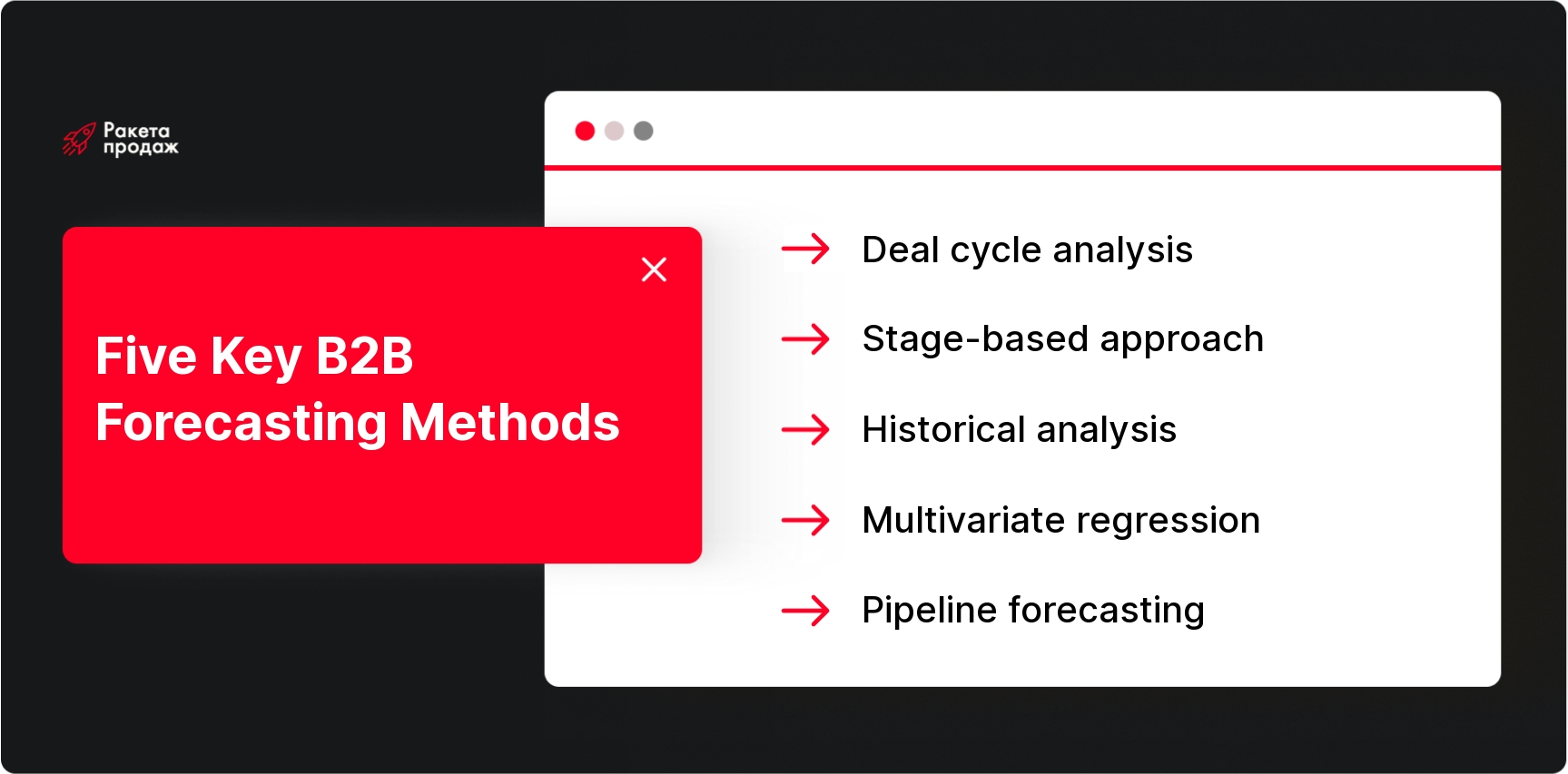
Sales cycle length analysis is based on studying the average time required for a client to progress through all stages from first contact to deal closure. This method is particularly effective for companies with predictable and relatively stable sales cycles. Its advantage lies in simplicity: if you know that on average a deal closes in 90 days, you can predict with some probability what percentage of current negotiations will complete in the next quarter. However, this approach can fail when working with heterogeneous clients or when market conditions change.

The opportunity stage forecasting approach focuses on the current position of each potential deal in the sales funnel. Each stage is assigned a specific closing probability, and the final forecast is formed by summing the products of potential revenue and corresponding probability. This method provides a more detailed view and allows quicker responses to changes in the status of individual deals. But its accuracy heavily depends on correctly defining stages and probabilities, which are often established subjectively.

For more details on effective deal status visualization and identifying bottlenecks, learn more about sales funnel analytics, which will improve the accuracy and relevance of your forecasts.

Historical analysis uses past sales results to predict future ones. It can take into account seasonality, trends, and cycles characteristic of your business. The method works well in stable industries with a large volume of historical data. However, it may be unreliable during periods of rapid change or when entering new markets.

Multivariate regression represents a more complex statistical approach that accounts for multiple factors affecting sales: from economic indicators to marketing activities. This method can provide high accuracy with quality data and proper model configuration, but requires serious analytical competencies and is often difficult for business users to interpret.

Pipeline forecasting integrates data on all active sales opportunities at different stages. This method scales well and allows assessing not only expected revenue but also potential bottlenecks in the sales process.

Bottom-up Forecasting: From Deals to Revenue

Bottom-up forecasting is an approach where the overall forecast is formed by summing forecasts for individual deals, clients, or segments. In the context of B2B sales, this method is particularly valuable as it allows accounting for the unique characteristics of each deal.

At the core of bottom-up forecasting lies a detailed analysis of the entire sales funnel. For each potential deal, its size, closing probability, expected closing time, and other important parameters are evaluated. This approach provides a much more accurate picture than simple extrapolation of historical data, especially in businesses with a small number of large clients.

If your company is just starting to structure processes, pay attention to building a sales department structure – this will help organize data accounting, which is especially important for effective bottom-up forecasting.

An important advantage of the bottom-up method is its flexibility and ability to adapt to changing conditions. If a certain deal’s status has changed or a new major opportunity has appeared, the forecast can be quickly updated. Additionally, this approach allows identifying problem areas in the sales process: if a certain type of deal systematically fails to reach final stages, it signals the need for strategy adjustment.

However, bottom-up forecasting has limitations. First, it heavily depends on data quality and discipline in entering it into the CRM system. Second, this method always contains an element of subjectivity in sellers’ assessments. To minimize these risks, many companies combine bottom-up with other approaches, for example, adjusting individual forecasts based on historical accuracy coefficients for each manager.

To minimize errors and improve processes, it’s recommended to periodically conduct a sales department audit to identify problem areas in a timely manner and update development strategy.

Rolling Forecast for Complex Markets: Flexibility Instead of Accuracy

In conditions of high uncertainty and rapidly changing markets, traditional annual forecasts quickly lose relevance. This is where the rolling forecast for complex markets methodology comes in, which involves regularly updating forecasts for a fixed period ahead.

A rolling forecast operates on a simple principle: instead of creating a detailed plan a year in advance, a company creates a forecast, for example, for 12 months, but reviews it every month or quarter, adding a new period and considering the most recent information. Thus, the organization always has an up-to-date view of the near future.

This approach is especially valuable in industries such as IT, construction, or marketing services, where conditions change rapidly and projects often have non-standard duration and structure. For example, an IT company working on custom solutions can use a rolling forecast for complex markets to promptly account for new technology trends, changes in client priorities, or the emergence of new major projects.

The key advantage of a rolling forecast is its focus on flexibility and adaptability instead of illusory accuracy. Rather than trying to predict the future a year ahead to the dollar, the company acknowledges uncertainty and creates mechanisms for quick adaptation to changes.

However, implementing this approach requires a certain cultural and organizational maturity. Clear processes for regular forecast updates, involvement of all key departments, and management’s readiness to make decisions based on constantly updating information are necessary.

Wholesale Sales Forecast: Features of B2B Markets with High Deal Volume

The wholesale B2B segment presents a special case, combining some features of both B2B and B2C markets. Here, companies usually deal with a large number of transactions and shorter sales cycles than in classic corporate B2B, but significant business client specifics remain.

Forecasting in the wholesale segment faces several specific challenges. First, accounting for seasonality and cyclical demand patterns is critically important here. For example, building material suppliers must consider not only the active construction season but also the preparation cycle when distributors and contractors form inventories.

Second, wholesale sales forecast often experiences the “bullwhip effect,” where small changes in consumer demand cause increasingly larger fluctuations at successive levels of the supply chain. This can lead to significant deviations from forecasts if the full spectrum of influencing factors isn’t considered.

For effective wholesale sales forecast, companies often combine several approaches. Statistical methods (such as ARIMA, exponential smoothing) are used for basic forecasting that accounts for seasonality and trends. Then these forecasts are adjusted based on known information about key client plans, upcoming promotions, pricing changes, and other factors.

An important element of the wholesale sales forecast system is also customer base segmentation. Different customer groups may demonstrate different purchasing patterns, and a unified approach doesn’t work here. For example, large network clients often have strict purchase schedules and can provide a plan several months in advance, while small businesses are usually more volatile and reactive.

In modern wholesale sales forecast systems, advanced machine learning technologies play an increasingly important role, allowing the identification of non-obvious patterns and relationships in data. However, even the most advanced algorithms cannot completely replace expert knowledge of the market and clients. Therefore, best practices involve integrating machine intelligence and human expertise.

Collaboration Between Sales and Marketing Departments in the Forecasting Process

Traditionally in B2B companies, sales forecasting was perceived as the exclusive responsibility of the sales department. However, modern realities show that without close interaction with marketing, it’s impossible to create a truly accurate and reliable forecast. These two departments possess complementary knowledge and data that, when combined, provide a much more complete picture.

The marketing department holds valuable information about market trends, competitor activities, marketing campaign results, and potential client behavior in the early stages of the funnel. For example, a sharp increase in a certain type of leads after launching a new campaign can serve as an early indicator of future sales growth in the corresponding segment. Without this information, the sales department may not account for potential growth in their forecasts.

In turn, the sales department has a deep understanding of real client needs, decision-making processes, and factors affecting the probability and speed of closing deals. This information is critically important for marketing when planning future activities and evaluating the effectiveness of current initiatives.

Effective interaction between sales and marketing is one of the foundations of B2B sales strategies, which help strengthen results and gain competitive advantages in the market.

For effective collaboration between departments, it’s necessary to create regular information exchange mechanisms. These can be weekly meetings to discuss the current funnel and forecasts, joint analytical sessions at the end of a quarter, or a unified information system ensuring data transparency for both departments.

It’s especially important to synchronize metrics and terminology used by marketing and sales. If these departments speak different languages and measure success differently, effective collaboration is impossible. For example, there should be a unified understanding of what qualifies as a qualified lead, what stages a deal goes through, and how its probability is evaluated.

Progress in this direction often requires changing corporate culture and motivation systems. If sales and marketing have conflicting KPIs, conflict is inevitable. Conversely, when both departments have common goals related to the business’s end result, collaboration becomes natural and productive.

In advanced B2B companies, this collaboration goes even further: cross-functional teams are created, including specialists from both departments, who work together on forecasting and achieving revenue goals. This approach helps overcome traditional silos and create a truly integrated process from first contact with a potential client to closing the deal and further relationship development.

Continuous Actualization and Adjustment of the Forecast

One of the most common mistakes in B2B forecasting is viewing the forecast as a one-time exercise performed at the beginning of a year or quarter, then remaining unchanged until the end of the period. In reality, the market constantly changes, new information emerges, and a forecast that isn’t updated quickly loses its value.

Effective B2B sales forecasting should be a continuous process with a regular cycle of updates and adjustments. For most companies, the optimal practice is weekly or at least monthly forecast reviews. This allows quickly accounting for new information: changes in key deal status, unexpected market events, competitor activities, or macroeconomic shifts.

To automate this process and improve data quality, it’s extremely important to implement a CRM system, which will help not only update deal information but also simplify variance analysis and regular forecast adjustments.

A critically important element of this process is analyzing variances between forecast and actual results. Each time reality differs from expectations, a detailed breakdown of causes is needed. Why did a deal that was considered practically closed fall through at the last moment? Why were sales in a certain segment higher than forecast? Such analysis not only helps improve future forecasts but also reveals systemic problems in the sales or marketing process.

In addition to regular updates, it’s important to develop and maintain multiple scenarios of event development. The base scenario usually reflects the most likely course of events, but the company should be ready for a pessimistic variant (what to do if key deals fall through or the market slumps) and have an action plan for an optimistic scenario (how to scale if demand exceeds expectations).

From a technological standpoint, the forecast actualization process should be maximally automated. Modern CRM systems and analytical platforms allow setting up automatic forecast calculations based on current data and alerts for significant deviations from expectations. This is especially important for companies with a large number of deals, where manual forecast updates would require too much time.

Finally, company culture should encourage accuracy and honesty in forecasting. If managers fear communicating bad news or are punished for adjusting forecasts downward, forecasting quality inevitably suffers. Instead, realistic estimates should be valued, and forecast adjustments should be perceived not as a sign of failure but as part of the normal process of business management in a dynamic environment.

Conclusion

Accurate B2B sales forecasting is not a luxury but a necessity for modern business. It provides a reliable basis for all strategic and operational decisions: from resource planning to development investments. In a world where markets change faster than ever, the ability to anticipate these changes and adapt to them becomes a key competitive advantage.

However, achieving high forecast accuracy requires a systematic approach that includes not only the right methodologies and technologies but also a certain corporate culture. Companies must invest in data quality, develop collaboration between departments, and create processes for constant update and improvement of forecasts. Only such a comprehensive approach allows overcoming the complexities characteristic of B2B: long sales cycles, numerous participants in the decision-making process, and high cost of individual contracts. Ultimately, forecasting is not just about predicting the future, but a tool for actively shaping it in accordance with the company’s strategic goals.

Transforming B2B sales forecasting from art to science is an ambitious task, but absolutely solvable. However, it requires a comprehensive approach, including work with data, processes, tools, and most importantly, with people. “Rocket Sales” offers complete support in creating a forecasting system that works in practice. We start with a deep audit of the current state and finish with the implementation of a full-fledged analytical system, including a CRM customized for your business, management dashboards, and regular reporting. Our approach is based on experience working with companies such as Mitsubishi, Naftogaz, Yamaha, and more than 150 other businesses in the B2B segment. By implementing our solutions, clients achieve conversion growth from 5% to 86%, and in some cases – monthly revenue growth of up to $1.6 million in 4 months of work. We don’t just consult, but take responsibility for the result, providing constant support and adjustment of the implemented system.

Stop guessing about future sales – implement a forecasting system with up to 95% accuracy!
In this article:
See more
Book a FREE sales funnel audit
CONTACT US
FAQ
How do you forecast sales in the B2B segment?

In B2B, the most effective approach is a combination of methods: sales funnel analysis weighted by closing probability, historical analysis accounting for seasonality and trends, as well as expert assessments. The key point is regularly updating forecasts based on current information about deal status and changes in market conditions.

When is it best to use top-down forecasting in B2B?

The top-down approach is most useful when entering new markets, launching new products, or in situations where you have insufficient detailed data about deals. It’s also effective for long-term strategic planning when it’s important to understand general market trends and your potential market share.

What mistakes are most commonly made in B2B sales forecasting?

Typical mistakes include: excessive reliance on salespeople’s subjective opinions, ignoring data quality in CRM, lack of regular analysis of variances between forecast and actual results, and applying a single approach to all deals without considering their specifics (size, client type, product).

How do you build a wholesale sales forecast?

For wholesale sales, it’s effective to combine statistical methods (to account for seasonality and trends) with analysis of information from key clients. It’s important to segment the customer base and apply different forecasting approaches to different segments. It’s also useful to integrate data about inventory and purchasing plans of your distributors.

How often should you update a B2B sales forecast?

The optimal practice is weekly updates of short-term forecasts (1-3 months) and monthly updates of medium-term ones (3-12 months). Always conduct unscheduled adjustments when there are significant changes in market conditions or the status of large deals that could substantially impact the overall result.

SUBSCRIBE TO MY TELEGRAM CHANNEL
The most valuable sales information right on your phone!
icon

LOTS OF USEFUL INFORMATION, FREE TEMPLATES, AND CHECKLISTS ON MY INSTAGRAM

Materials and practical advice on sales growth in our blog: