Checklists and assessment forms are practical tools that help standardize the interview and candidate evaluation process. They transform theoretical models (competency matrix and scoring system) into working tools for interviewers.
A good sales manager evaluation checklist should include three main blocks: questions for checking competencies, behavioral indicators for observation, and an assessment scale. A checklist isn’t just a list of questions, but an action guide for the interviewer.
For each competency in the checklist, there should be prepared:
- 2-3 questions aimed at identifying this competency
- Indicators to pay attention to in the answers
- Criteria for scoring
For example, to assess the skill of handling objections, the checklist might contain these items:
Competency: Handling Objections
Questions:
- Tell me about a case when a client doubted the value of your offer. How did you act?
- How do you react when you hear the phrase “this is too expensive”?
- Give an example of a situation where you managed to overcome a strong client objection.
Indicators for observation:
- Does the candidate maintain a positive attitude when discussing objections
- Do they perceive objections as requests for additional information
- Do they use a structured approach to handling objections
- Do they provide specific examples from their experience
Assessment scale:
- 1 point – Perceives objections as personal criticism, has no strategy for working with them
- 2 points – Has a basic understanding of how to handle objections, but applies a templated approach
- 3 points – Confidently works with typical objections, uses acknowledgment and reformulation techniques
- 4 points – Effectively works with different types of objections, adapts approach to the situation
- 5 points – Masterfully manages objections, often prevents their appearance, transforms them into advantages
What sales manager effectiveness criteria should be included in the assessment system? The assessment system should include not only quantitative indicators (sales volume, conversion, average check) but also qualitative criteria: ability to establish long-term relationships with clients, CRM management quality, teamwork, and adherence to corporate standards. The sales manager skill matrix should also reflect the candidate’s ability to adapt to market changes and continuously improve their skills.
For comprehensive assessment of sales manager competencies, use questions for assessing soft skills and situational tasks that help identify the candidate’s deep personal qualities. Such techniques are especially in demand among HR experts looking not only for experience but also development potential.
Assessment forms should be convenient for filling out and subsequent analysis. Many companies use electronic forms (Google Forms, Microsoft Forms) that automatically process results and calculate final scores. This simplifies comparing candidates and preserving assessment history.
It’s important that all interviewers use identical checklists and forms. This ensures consistency in assessments and allows objectively comparing candidates, even if they were evaluated by different people. Regular interviewer calibration (discussing evaluation criteria and comparing understanding of levels) helps maintain a unified approach.
A sales manager competency assessment sheet is the final document that is filled out after all assessment stages. It contains final scores for all competencies and a hiring recommendation. Such a sheet serves as the basis for making the final decision and helps document the assessment process.
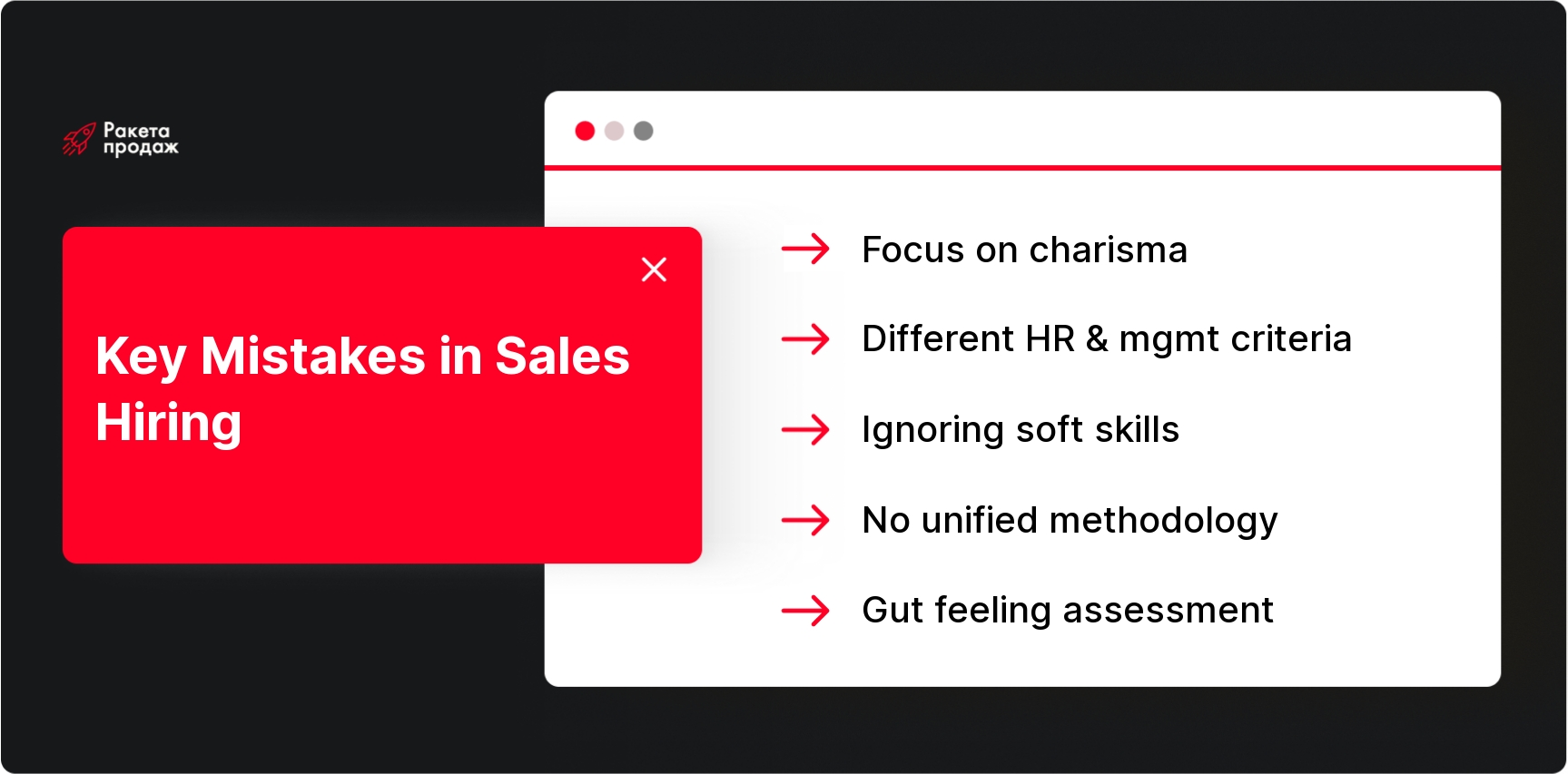
Properly designed checklists not only increase assessment objectivity but also make the interview more informative for both parties. The candidate gets an opportunity to demonstrate their strengths, and the company gathers relevant information for decision-making. Now let’s look at typical mistakes in candidate evaluation.


 Time to read: 10 min.
 25 November 2025