icon

Multi-level Negotiations in Sales: How to Work with Multiple Client Departments

In today’s world, B2B sales have become much more complex. While previously it was enough to convince one person – the decision-maker – to close a deal, everything has changed now. Today, the choice is made by an entire team of people with different interests, views, and objections.

Want a high-performing sales team without the hassle?
We’ll build it for you.
Contact Us

Key Takeaways

  • Salespeople who only work with purchasers ignore the real decision-making center and lose at the final stage due to unexpected vetoes from finance, IT or legal teams.
  • Your stakeholder map should show each person’s role, level of influence, and attitude toward your proposal, otherwise you’re moving blindly.
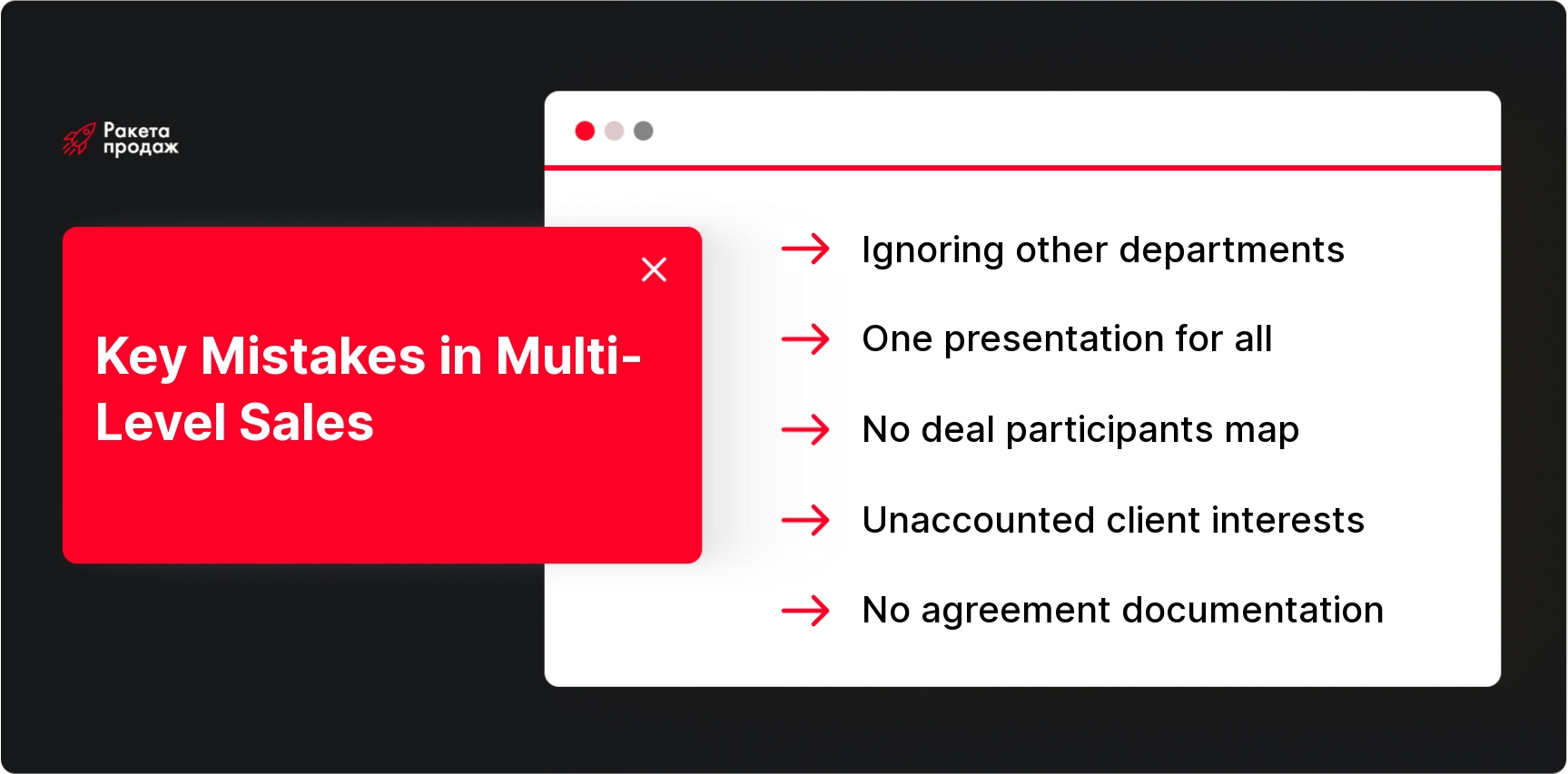
  • Finance needs ROI calculations and payback periods, IT checks integration and security, marketing cares about growth metrics. One presentation for everyone kills the deal.
  • Contradictions between client departments are solved not by pressure, but by taking a mediator position: you help find compromise rather than choosing sides.
  • Document every progress in writing and send it to all participants to prevent returning to already resolved issues and maintain momentum.

In the full article below, you’ll find specific tools for creating a stakeholder map, tactics for working with each role, and strategies for managing multilateral negotiations 👇

The key problem for most salespeople is that they continue to communicate only with the “purchaser,” considering them the only significant figure. They forget that behind this person stands an entire committee – the actual decision-making center (buying center), which ultimately determines whether a deal happens or not.

Misunderstanding the client’s internal dynamics often leads to sales unexpectedly falling apart in the final stage. The salesperson seems to have agreed with the purchaser, but suddenly a financial director, lawyer, or technical specialist appears who blocks the entire deal. Why does this happen? Because the salesperson didn’t account for the interests of all process participants.

In this article, we’ll examine a systematic approach to multi-level negotiations – a strategy that will help you build relationships with all decision-influencing individuals and significantly increase your chances of successfully closing deals.

image

What are multi-level negotiations

Multi-level negotiations are a sales process where the seller interacts simultaneously with representatives from different departments and roles within the client organization. This is much more complex than classic bilateral negotiations where you communicate with just one contact person.

In the B2B world, decisions are rarely made by individuals. Behind any significant purchase is a sales decision center – a group of people with various authorities, interests, and levels of influence. For example, when a company selects an IT supplier, the process typically involves negotiations with several departments including marketing, finance, IT department, and legal services, each with their own agenda.

Marketing is interested in functional capabilities and how the solution will affect their work. Finance evaluates return on investment and budget constraints. The IT department worries about technical compatibility and security. And lawyers focus on contract terms and risks. Each of these departments has veto power – the ability to block the decision if their requirements aren’t met.

Thus, multi-level negotiations aren’t just a series of conversations with different people. It’s a strategic process requiring understanding of the client’s organizational structure, identifying all stakeholders, and adapting your approach to each of them. The salesperson must become a kind of “conductor,” coordinating a complex symphony of interests and needs.

The complexity lies in the fact that different departments’ interests often contradict each other. What’s good for marketing might be unacceptable for the IT department. Therefore, your task is to find a solution that will satisfy everyone, or at least the majority of process participants. This is precisely why multi-level negotiations require a special approach and skills.

Many companies, even those with experienced sales managers, struggle with multi-level negotiations. Have you noticed that your deals often fall apart in the final stages due to unexpected objections from lawyers, finance professionals, or technical specialists on the client side? You’re not alone – 70% of B2B deals are blocked precisely at the department coordination level.

“Sales Rocket” company has developed a systematic approach to multi-level negotiations that helps build effective communication with all participants in the decision-making process. Our experts conduct a comprehensive audit of your negotiation processes, analyze typical scenarios, and develop personalized scripts for working with each client department. Over 7+ years, we’ve helped 187 companies build sales departments that consistently achieve 150% of monthly targets, and our clients’ average revenue growth is +35%.

Transform the complexity of multi-level negotiations into your competitive advantage - request a free consultation on negotiation strategies!

Who makes up the decision-making center and what are their interests

Understanding who makes up the decision-making center and what interests each participant has is the foundation of successful multi-level negotiations. The composition of this center may differ across companies and industries, but there are typical roles that exist almost everywhere.

Let’s look at the main roles in the decision-making center:

Decision Maker – the person who formally approves the final choice. This is usually a high-level manager, such as CEO, CFO, or department head. They focus on the strategic value of the solution and its alignment with company goals. Important questions for them include: “How will this affect the business in the long term?”, “What problem does this solve?”, “Is it worth the investment?”

User – employees who will directly work with your product or service. They’re interested in practicality, ease of use, and how the solution fits into their daily work. They evaluate: “Will this simplify my job?”, “Is it easy to learn?”, “Does it match our processes?”

Influencer – experts or specialists whose opinion carries weight with other participants. These might be technical experts, industry specialists, or simply respected employees. They analyze the product in terms of its technical characteristics, compliance with industry standards, or innovativeness.

Role What they decide What’s important Seller’s tactics
Purchaser Price, terms Savings, formality Transparency, cost arguments
Marketing Benefits, promotion ROI, implementation speed Numbers, cases, benefits
Financial Director Budget, risks Payback periods ROI, calculations
IT Integration, security Compatibility, support Technical competence, examples
Executive Final decision Strategic benefit Vision, perspective

Buyer – representative of the procurement department, formally responsible for the process. They’re interested in deal terms, compliance with company purchasing policies, and the formal side of the process. The buyer evaluates price, delivery times, payment terms, and other commercial aspects.

Gatekeeper – a person who controls information flow within the organization. This could be an executive assistant, administrator, or even an employee appointed as project coordinator. They determine what information reaches other participants and can either help you gain access to key individuals or limit it.

It’s important to understand that one person can perform multiple roles simultaneously. For example, in small companies, a manager might be both the decision-maker, an influencer, and even a user. And in large corporations, each role might be performed by several people from different departments, which complicates negotiations with multiple departments.

For successful negotiations, you need to determine who plays what role in the decision-making process and adapt your approach to each of them. Ignoring any participant can lead to unexpected resistance or even blocking of the deal in later stages.

How to prepare for multi-level negotiations

Preparation for multi-level negotiations is 70% of success. Without thorough preparation, you risk spending a lot of time and effort but never reaching your goal. Think through your strategy before the first meeting with the client.

The first and most important step is creating a stakeholder map. This is a visual representation of all people involved in the decision-making process. Start with your main contact and ask them to help identify other participants. Ask questions like: “Who else will be involved in evaluating our proposal?”, “Who will approve the budget?”, “Who will actually use the product?”

For each participant on the map, determine their role (Decision Maker, User, Influencer, etc.), level of influence on the decision, and attitude toward your proposal (supportive, neutral, against). If you don’t know someone’s position, it’s a signal that you need to meet with them.

The next step is understanding the interests and influence level of each person. What’s important to each participant? What are their selection criteria? What problems are they trying to solve? What are their concerns? This information will help you adapt your proposal and arguments to meet everyone’s needs.

A useful tool here is the power-interest matrix. It helps visualize who has more influence and who has more interest in your solution. Divide all participants into four groups:

  • High influence, high interest – key players with whom you need to work actively
  • High influence, low interest – keep them informed, but don’t overload with details
  • Low influence, high interest – can become your champions within the company
  • Low influence, low interest – just keep them updated on key points

Based on this analysis, develop a communication strategy for each participant. Who should be invited to the presentation? With whom should you hold separate meetings? What materials should you prepare for each person? How should you structure your proposal to address everyone’s needs?

For salespeople wishing to significantly improve their preparation skills and negotiation process building, specialized negotiation training will be useful, where systematic analysis techniques, stakeholder mapping, and communication with various client levels are practiced.

Finally, develop a BATNA (Best Alternative To a Negotiated Agreement) for each direction of negotiations. What will you do if you can’t agree on price? Or implementation timelines? Or support conditions? Having a plan B for each aspect of negotiations gives you flexibility and confidence.

How to build communication with multiple departments

One of the keys to success in multi-level negotiations is the ability to speak the “language” of each department. Representatives from different functions in a company look at the same solution through the lens of their own tasks, and if you communicate with everyone the same way, you won’t achieve the desired effect.

When communicating with the finance department, your conversation should be filled with numbers and specific calculations. Finance professionals want to see clear ROI (return on investment) indicators, payback periods, and impact on cash flow. They need not just promises, but models and calculations that confirm the economic efficiency of your solution.

For example, instead of general phrases like “our solution will help save money,” show specific figures: “According to our calculations, implementing the system will reduce operating expenses by 15-20% in the first year, which amounts to approximately 2.5 million hryvnias. Considering the implementation cost, payback will occur in 8 months.”

When talking to the IT department, the focus shifts to technical aspects. Here it’s important to show that you understand their infrastructure, integration challenges, and security concerns. IT specialists value technical competence, so don’t be afraid to use professional terminology. They want to know how your solution will fit into the existing architecture, what APIs are available for integration, how data security is ensured, etc.

Understanding the nuances of CRM implementation for sales also becomes significant when communicating with IT and management, as key objections are often related to system integration and data process coordination between departments.

Communication with marketing requires yet another approach. Here you need to talk about effectiveness, results, and growth metrics. Marketers evaluate solutions through the lens of impact on their department’s key indicators: customer acquisition, conversion, retention. Show them how your product will help achieve their goals, and provide examples of successful implementations at similar companies.

One common mistake is speaking to everyone the same way. If you talk to the financial director about technical details, and to the IT director about marketing metrics, you’ll lose their attention and trust. Each process participant should receive information relevant specifically to their area of responsibility.

At the same time, it’s important to ensure that your position remains consistent on key points. You can’t say one thing to the finance department and contradict yourself when talking to IT. Your task is to adapt the emphasis and depth of immersion in various aspects, but maintain the integrity of your proposal.

Remember that effective communication is not only the ability to speak but also the ability to listen. Ask open questions, clarify the needs and objections of each department. This will help you better adapt your proposal and increase your chances of success. Most importantly, it will give you a more complete understanding of the internal dynamics of the client company.

How to manage contradictions between client departments

In multi-level negotiations, you’ll inevitably encounter situations where interests of different client departments contradict each other. Marketing wants to get a solution as quickly as possible, IT insists on thorough testing, and finance tries to minimize costs. These contradictions can become a serious obstacle to closing the deal if you don’t learn how to manage them.

It’s important to understand that the role of the salesperson in modern B2B sales extends far beyond the classic “seller.” You act more as a facilitator of internal coordination between client departments. Your task is to help them come to a common solution that will take into account the interests of all parties.

One effective approach is to take a “mediator position.” Instead of taking the side of one department, try to act as a neutral intermediary. Listen to each party’s point of view, acknowledge the legitimacy of their requirements, and try to find a compromise that will suit everyone.

For example, conflicts of interest often arise between marketing and procurement. Marketing selects a solution based on functionality and capabilities, while procurement focuses on price and contract terms. In this situation, you can suggest phased implementation: first a basic functionality at a lower price (which will satisfy procurement), and then gradual addition of extra features as the solution’s value is proven (which will satisfy marketing).

Another approach is creating coalitions within the client’s organization. If you see that some department actively supports your solution, ask them to help you convince other departments. An internal champion who believes in your product can be much more convincing in conversation with colleagues than you as an external salesperson.

To strengthen your communication skills, pay attention to modern negotiation training, where facilitation of complex discussions and techniques for managing multilateral conflicts within the client company are practiced.

It’s also important not to create new contradictions with your actions. If you promise one department something that contradicts another’s interests, you’ll only exacerbate the problem. Be transparent in your proposals and make sure all process participants have the same understanding of what you’re offering.

Sometimes it’s useful to organize a joint meeting of representatives from different departments so they can openly discuss their requirements and objections. Your role at such a meeting is to moderate the discussion, help parties hear each other, and guide the discussion in a constructive direction. This can be challenging, but such an approach often helps resolve contradictions that seemed insurmountable.

How to manage the dynamics of multi-level negotiations

Multi-level negotiations rarely follow a straight line from first contact to deal closing. Most often, the process moves in “waves”: first you get approval from one department, then objections arise from another, then comes coordination, and afterward there may be a return to discussing already resolved issues. Such cyclicity is normal in complex sales, and it’s important to know how to manage this dynamic.

The first rule of successful management of multi-level negotiations is documenting progress. After each conversation or meeting, document the agreements reached and send them to all participants. This helps create a common understanding of the current status and prevent situations where someone forgets or interprets previously discussed points in their own way.

CRM tracking becomes an indispensable tool in such sales. Keep a detailed history of all interactions with the client: who said what and when, what objections were raised, what solutions were proposed. This will help you not lose important details and consistently build your strategy.

Comprehensive argument tables are another useful tool. Create a document that collects all objections, questions, and requirements from different client departments, as well as your responses to them. This helps you align your position on all aspects and avoid contradictions in your answers.

It’s also important to develop a unified commercial proposal for all parties. Even if you adapt your presentation for different departments, the basic document describing the solution, prices, terms, and timelines should be the same for everyone. This prevents misunderstandings and accusations of non-transparency.

To manage the cyclical nature of negotiations, use the technique of “checkpoints.” Identify key stages of the process (e.g., technical evaluation, commercial proposal, contract agreement) and regularly check what stage you’re at and what needs to be done to move to the next one. If you notice that the process has stalled or returned to previously discussed issues, you can more actively intervene to get back on track.

Equally important is managing the expectations of all participants regarding process timelines. Multi-level negotiations often take longer than parties expect. Be honest in your timeline estimates and regularly update them based on the current situation. This helps avoid disappointments and maintain trust.

Remember that in multi-level negotiations, you’re managing not just the sale but also the client’s internal decision-making process. The better you understand this dynamic and can manage it, the higher your chances of successfully completing the deal and building long-term relationships with the client.

Working strategies and tactics for success in multi-level sales

To succeed in multi-level sales, it’s necessary to apply specific strategies and tactics that allow you to control the complex process and achieve the desired results. The practice of multilevel negotiations shows that the methods discussed below are most effective.

B2B sales strategies involve comprehensive work not only with main but also with less formal process participants – identifying hidden opinion leaders, preparing payoff matrices, and differentiated communication scripts for different roles in decision-making.

Researching the circle of participants and their interests is a fundamental strategy to start with. Conduct a thorough analysis of the client’s organizational structure and identify everyone who might influence the decision. For each participant, find out: what tasks they solve, what KPIs affect them, what objections they might have against your proposal.

Don’t limit yourself to just the formal structure – identify informal opinion leaders too. Often in companies, there are employees who don’t hold high positions but have great influence on decisions thanks to their experience or reputation. Find such people and involve them in the process.

Structuring information becomes critically important when you’re working with multiple stakeholders. Use a payoff matrix – a table that clearly shows what benefits each department will get from your solution. This helps systematize your proposal and ensure you’ve considered the interests of all parties.

Proposal management is another important aspect. Develop several proposal versions with different combinations of functions, prices, and terms. This gives you flexibility in negotiations and allows you to adapt to different scenarios. But it’s important that all versions are aligned with each other and don’t contradict each other on key parameters.

Group brainstorming to find solutions is a powerful tactic, especially when you face serious objections or deadlock situations. Organize a session inviting representatives from different client departments, and together look for a way out of the situation. Negotiations with several departments in this format not only help find a solution but also create a sense of involvement for the client.

Assigning responsibilities by direction or issue also increases process efficiency. Your team should have specialists responsible for working with different client departments: a technical expert for communication with IT, a financial analyst for working with the finance department, etc. This allows for parallel discussions and accelerates the process.

Flexibility and persistence in lengthy discussions is perhaps one of the most important qualities in multi-level sales negotiations. Be prepared for the process to take longer than expected, unexpected obstacles to arise, and strategy adjustments to be necessary. Maintain persistence in achieving your goal, but be flexible in choosing paths to it.

To overcome resistance from different blocks faster, prepare argumentation and tactics for handling objections in advance – this will give you confidence when unexpected questions arise and allow you to professionally respond to doubts from different sides.

An excellent practice is regularly summarizing results and planning next steps. After each significant meeting or stage, send all participants a letter briefly outlining what was discussed, what decisions were made, and what is planned next. This creates transparency, documents progress, and helps maintain the pace of negotiations.

Finally, build long-term relationships, not just sell. Multi-level sales negotiations are a marathon, not a sprint. Invest time in building relationships with each process participant, even if their influence on the current deal seems small, as these approaches are embedded in professional sales department management. These relationships can be invaluable both for current negotiations and for future opportunities.

Conclusion

In modern B2B sales, the winners are not those who better convince individuals, but those who masterfully manage the entire decision-making process at the client. Multi-level negotiations are not just a sales tactic, but a strategic approach where the seller acts not as a “salesperson” in the traditional sense, but rather as an architect of agreement between different stakeholders.

We’ve examined key aspects of multi-level negotiations: from understanding the structure of the decision-making center and interests of each participant to managing contradictions between departments and building effective communications. All these elements constitute a systematic approach that significantly increases your chances of success in complex B2B sales.

Remember that in a world where decisions are made collectively, your ability to identify, understand, and satisfy the needs of different process participants becomes critically important. Develop systematic negotiation thinking – this is the key skill of future B2B sales that will allow you to successfully close deals even in the most complex situations and build long-term partnerships with clients.

Mastering the art of multi-level negotiations is no simple task, requiring a systematic approach and practical experience. Instead of spending months on trial and error, consider accelerating the implementation of proven techniques with the help of “Sales Rocket” experts.

Our business negotiation training program includes not only practical training and role-playing games but also a comprehensive quality control system – we listen to calls, analyze work in CRM, help implement checklists and communication standards. As a result, your managers receive a structured approach to working with different decision-making levels at clients, and you as a leader get a transparent system for monitoring effectiveness.

Among our clients are companies like Mitsubishi, Yamaha, and Naftogaz, which successfully apply our methodologies in complex multi-level sales. The results of our work are measurable: conversion growth up to 86% at various funnel stages and an increase in average check in corporate sales.

Transform your sales department into a team of professional negotiators - order comprehensive negotiation training from experts!
In this article:
See more
Book a FREE sales funnel audit
CONTACT US
FAQ
What is a buying center and why should a salesperson know about it?

A buying center is a group of people in the client’s company who influence the purchase decision. Knowing the composition and dynamics of the buying center allows the salesperson to work with all influential persons, not just the “contact person,” and adapt their strategy to the interests of each process participant.

Who typically makes up the decision-making center in sales?

The decision-making center typically includes: the final decision maker, end users, influential experts (influencers), procurement representatives (buyers), and “gatekeepers” who control access to other participants.

Why can't you work with just one "contact person"?

Working with just one contact person is dangerous because they may not have the authority to make decisions, may not know all the requirements of other departments, or may not have influence on other process participants. This often leads to unexpected blocking of the deal in later stages.

How can a salesperson determine who really makes the decision?

To identify the real decision-makers, ask direct questions about the decision-making process in the company, observe who participates in key meetings and who asks critical questions, find out who approves the budget and signs contracts. It’s also useful to ask your main contact who else influences the decision.

What to do if the client's departments disagree with each other?

If client departments disagree with each other, take a “mediator” position – help them find a compromise, offer flexible solutions that consider everyone’s interests, organize a joint discussion to clarify each department’s viewpoints and develop a common solution. It’s important not to take sides, but to help achieve consensus.

SUBSCRIBE TO MY TELEGRAM CHANNEL
The most valuable sales information right on your phone!
icon

LOTS OF USEFUL INFORMATION, FREE TEMPLATES, AND CHECKLISTS ON MY INSTAGRAM

Materials and practical advice on sales growth in our blog: