Key Takeaways
- ABM funnel starts not with mass outreach, but with a narrow list of priority accounts, each treated as a separate market.
- Proper selection of target companies at the Identify stage determines 80% of program success, mistakes here cannot be compensated with personalization later in the funnel.
- Account coverage shows how many key stakeholders within the account you’ve contacted, the higher the coverage, the lower the risk of deal blocking.
- Weak ABM campaigns generate scattered touchpoints, strong ones build a unified scenario from LinkedIn ads to personal meetings with synchronized marketing and sales.
- Ukrainian B2B market has narrowed, lead cost has multiplied, so targeted work with dozens of accounts is more effective than broad campaigns to thousands of contacts.
In the article below you’ll find a step-by-step algorithm for building an ABM funnel: how to select accounts, map stakeholders, coordinate touchpoints and measure results 👇
For the Ukrainian B2B market, such focus has become not just a competitive advantage, but a matter of survival. The market has narrowed, quality lead costs have multiplied, and the decision-making cycle has lengthened due to increased risks. In these conditions, the old logic of “coverage first, then selection” works increasingly poorly. ABM strategy flips this formula: you start with a clear list of priority companies and build all marketing and sales around them. When 20-50 clients form the main share of company turnover, each such account requires an individual approach and long-term account based marketing work.
What is an ABM Funnel and How It Differs from Classic Funnels
The account based marketing funnel radically changes the familiar logic of B2B marketing. If a classic funnel starts broadly – with awareness campaigns and mass lead generation – then ABM starts with narrow focus. You predetermine a list of target companies and build the entire strategy around them. Instead of hoping that several leads from thousands will turn into clients, you work with each account as a separate market.
Do you recognize the feeling when you have a list of large prospective clients, but your sales team works with them like ordinary leads – mass mailings, standard presentations, and without understanding who inside the company makes decisions? The result is predictable: long sales cycles, low conversion, and missed opportunities with enterprise accounts that could generate significant revenue. At “Raketa Prodazh” we understand that large B2B deals require a fundamentally different approach – systematic work with each account as a separate market. Over 8+ years we’ve helped 208 companies build sales departments that know how to work with enterprise clients through personalized funnels, coordinated touchpoints, and long-term relationship development. Our clients achieve an average revenue increase of +35%, and conversion for large accounts increases to 86% thanks to proper process systematization and advanced analytics implementation.
Turn every key account into a predictable revenue source - get a free audit of your large client management system!
The main difference is in the unit of measurement. In a classic funnel you count leads and their conversion, in ABM – accounts and their development. Here it’s important not just to get the buyer’s contact, but to map all stakeholders within the company, understand their roles in decision-making, and build coordinated work with each. This is especially relevant for the Ukrainian market, where large deals often involve owners, international partners, and several management levels.
Practically, the account-based marketing funnel is built around four key components. ABM stages include: Identify (determining and prioritizing target accounts), Expand (expanding coverage within the company), Engage (systematic engagement through personalized activities), and Advocate (retention, development, and turning into brand advocates). Each stage requires its own metrics, tools, and approaches, but all work toward one goal – maximizing value from each account.
Identify Stage: How to Choose the Right Accounts
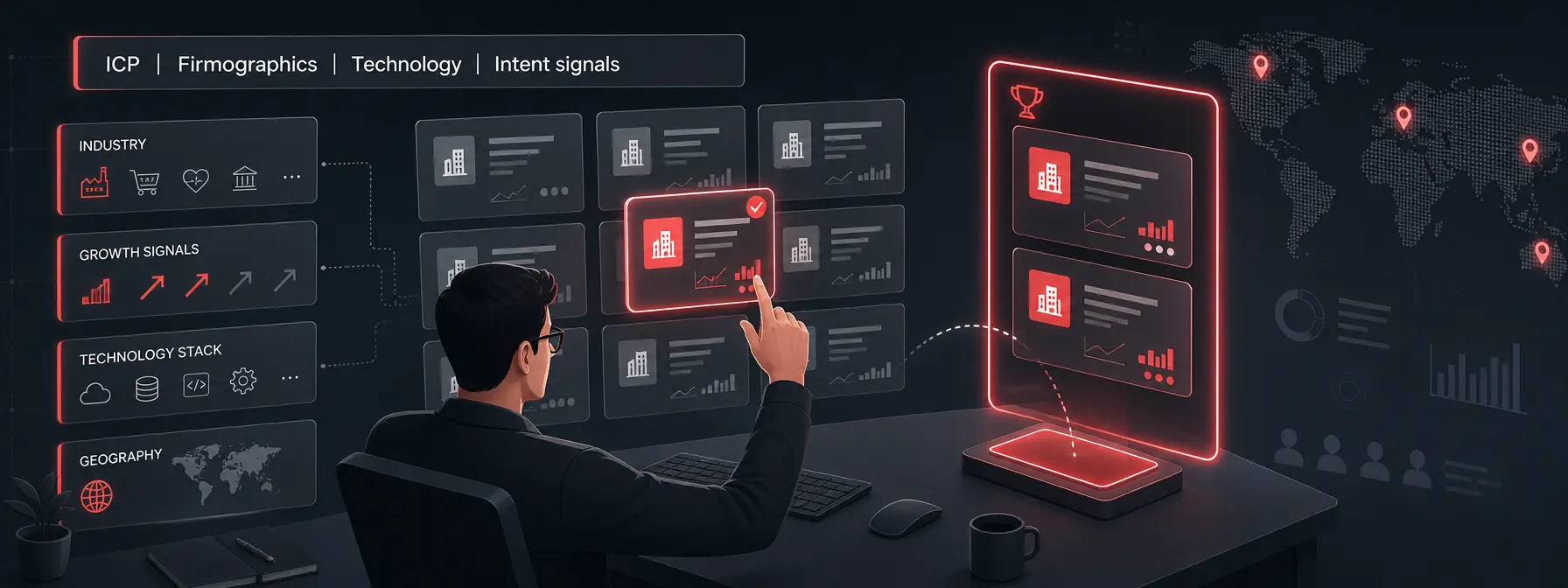
The success of the abm marketing funnel depends 80% on proper target account selection. This isn’t a list of “all major industry players,” but the result of deep ICP (ideal customer profile) analysis and business strategic priorities. For Ukrainian B2B companies, this means considering not only size and industry, but also sustainability factors: geographical diversification, access to foreign currency revenue, presence of international partners, and expansion plans.
When forming the account list within ABM process, you analyze several data layers. Firmographic parameters – industry, revenue size, employee count, geography of operations. Technological signals – what systems the company uses, level of digital maturity, automation plans. Behavioral indicators – activity in industry media, exhibition participation, hiring specialists in relevant areas. Financial metrics – growth dynamics, investment rounds, public reporting.
Special attention should be paid to intent signals – signs that a company is actively interested in your topic. This could be increased visits to relevant website pages, material downloads, participation in thematic webinars, or appearance of related vacancies. In Ukrainian realities, such signals can often be tracked through industry media, exhibition and conference participation announcements, as well as through key employees’ LinkedIn activity. A properly configured monitoring system will help not miss the moment when an account is ripe for active dialogue.
Expand Stage: Mapping Stakeholders Within Accounts
After determining the list of target companies, detective work begins – you need to understand who exactly makes decisions and influences them. In Ukrainian B2B, this is especially important because decision-making structure often includes not only top management, but also owners, board representatives, and sometimes international consultants or parent companies.
Practically, this means building a detailed “account map” for each priority company. You record economic buyers (who controls budget), technical buyers (who evaluates functionality), solution users (who will work with the product daily), and influencers (whose opinion is considered in decision-making). For each person you collect data: position, area of responsibility, professional interests, social media activity, participation in industry events.
Here one of the key ABM KPIs is formed – account coverage. This is the share of important stakeholders within the account with whom you have established contacts and regular touchpoints. The higher this indicator, the greater the chances of successful deal closure and lower risk that someone you didn’t know about will block the decision. For the Ukrainian market, good coverage level often requires combining digital channels with industry event participation and personal meetings.
Engage Stage: Coordinated Engagement Through Personalization
The Engage stage is where the abm sales funnel truly shows its power. Instead of mass mailings and universal presentations, you create personalized touchpoints for each stakeholder, considering their role, interests, and place in the decision-making process. You show CEOs impact on strategic KPIs, CFOs – ROI models and payback, CTOs – architecture and integrations.
In the Ukrainian context, the most effective channels for this stage have become LinkedIn (targeted advertising and direct messages), personalized email sequences, thematic webinars, and closed events for key accounts. It’s important to remember that many Ukrainian decision-makers actively consume international content and work with global partners, so combining local expertise with international trends and cases gives better results.
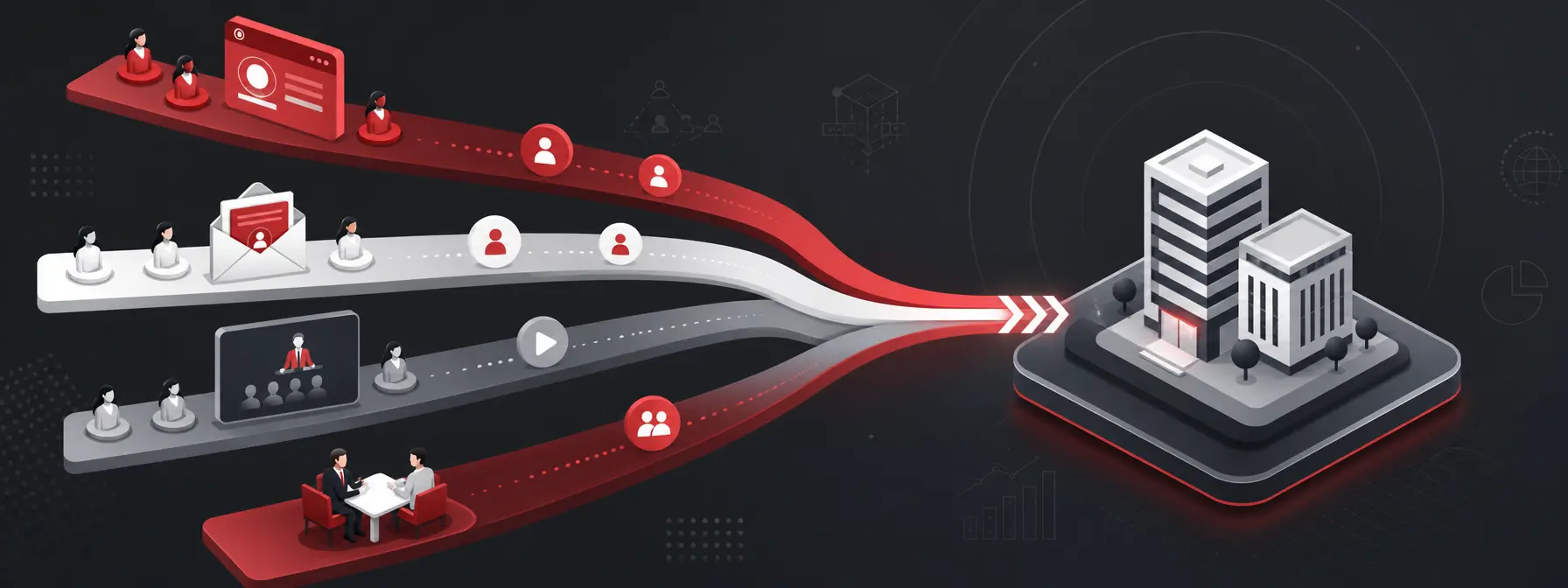
The key rule – all touchpoints must be part of a unified scenario, not scattered activities. LinkedIn ads warm up interest, email offers deeper content, webinars demonstrate expertise, and personal meetings close final objections. Each interaction is recorded in CRM and affects account engagement scoring, which helps ABM sales teams properly prioritize efforts. In a properly configured ABM funnel, marketing and sales work as a unified mechanism, not as separate departments with different goals.
Advocate Stage: Retention and Turning Into Growth Source
The final stage of the full-funnel abm approach is often underestimated, but this is where the long-term value of the program is formed. After deal closure, work with target accounts doesn’t end – it transitions to a new phase: retention, wallet share expansion, and turning satisfied clients into brand advocates. In Ukrainian market conditions, where trust and recommendations play a huge role, this stage determines revenue growth sustainability.
Practice shows that retention programs in ABM logic are built around regular business reviews, where achieved results, client plans, and further collaboration opportunities are discussed. For Ukrainian companies, such sessions are especially valuable because they allow adapting solutions to rapidly changing realities: asset relocation, logistics changes, remote work transition, integration with new partners.
Additionally, at this stage, loyalty programs and value-add services are launched: training programs, client employee certification, early access to new functionality, participation in closed events and community initiatives. Ukrainian companies that systematically invest in such programs through specialized B2B portals and loyalty management platforms demonstrate notably higher repeat sales indicators and resistance to competitive attacks. Here cases and recommendations are formed that become powerful tools for attracting new accounts at the Identify stage.
Target Account Selection: Criteria and Data Sources
Forming a target account list is not an intuitive process, but systematic analytical work. You start with current client base analysis: which companies bring the most revenue, have the highest profitability, demonstrate the best loyalty and willingness to develop relationships. These patterns form the basis for ICP – ideal customer profile, under which you’ll search for new accounts.
For the Ukrainian B2B market, selection criteria should consider specific sustainability and growth factors. Business export orientation reduces dependence on the internal market. Presence of international shareholders or partners often means access to financing and higher corporate governance standards. Participation in government or international development programs signals modernization plans and investments in new technologies.
Technological parameters are especially important for B2B companies selling SaaS, automation, or integration solutions. Use of certain ERP or CRM systems can be both an advantage (easy integration) and a barrier (high supplier switching costs). Company digital maturity level affects decision-making speed and readiness to adopt innovative solutions. Presence of internal IT teams or regular collaboration with system integrators simplifies the technical part of sales and support.
If your company is at the beginning of building systematic account work, it’s important not only to determine priority segments, but also to properly approach sales department building – because a well-coordinated team ensures quality client development at each cycle stage.
Personalization and Touch Coordination in ABM
ABM funnel requires a fundamentally different approach to content creation and distribution. Instead of universal materials “for everyone,” you create personalized messages for specific roles within specific accounts. This doesn’t mean every email is written from scratch – it’s about systematic personalization based on role, industry, and funnel stage segmentation.
For Ukrainian companies, effective personalization often includes references to local context: tax legislation peculiarities, currency regulation requirements, specifics of working with international partners, wartime impact on operational processes. Cases with Ukrainian clients resonate better than abstract international examples, especially if they’re from the same industry and solve similar tasks.
Touch coordination between marketing and sales becomes critically important at this stage, especially in a full funnel abm strategy. There must be clear agreements: who and when initiates first contact, what materials are used at each stage, how interaction results are recorded, under what conditions an account is transferred to active sales team work. Best practices show that joint activity planning and regular pipeline reviews give notably better results than isolated department work. In ABM, marketing and sales are a unified team with common account development goals.
If you’re forming a new team or transforming current processes, definitely consider the best B2B sales strategies that have proven their effectiveness for large clients and complex B2B funnels.
ABM Tools and Technologies in Ukraine
Ukrainian B2B companies often face a dilemma choosing between expensive international ABM platforms and a combination of more affordable local and global tools. Full-featured solutions like Demandbase or 6sense offer comprehensive functionality, but their cost and setup complexity are often excessive for medium-sized companies working in regional markets.
A practical alternative is building ABM funnel based on popular CRM systems (HubSpot, Salesforce, Pipedrive) with integration of specialized tools for targeted advertising, email marketing, and analytics. LinkedIn has become the main platform for B2B targeting in Ukraine, despite high cost-per-click, thanks to audience quality and precise targeting capabilities by positions, companies, and professional interests.
Local solutions for B2B relationship and loyalty management deserve special attention. Ukrainian companies like ABM Cloud develop specialized platforms for distribution automation, merchandising, and partner programs, which are especially effective in retail, FMCG, and industrial distribution. Such tools allow not only attracting new accounts but also systematically developing existing client base through personalized offers and loyalty programs.
When considering communication automation and high personalization options, pay attention to CRM implementation for sales – modern solutions open new possibilities for tracking touchpoints, resource allocation, and automating routine operations within ABM.
ABM Funnel Metrics and Analytics
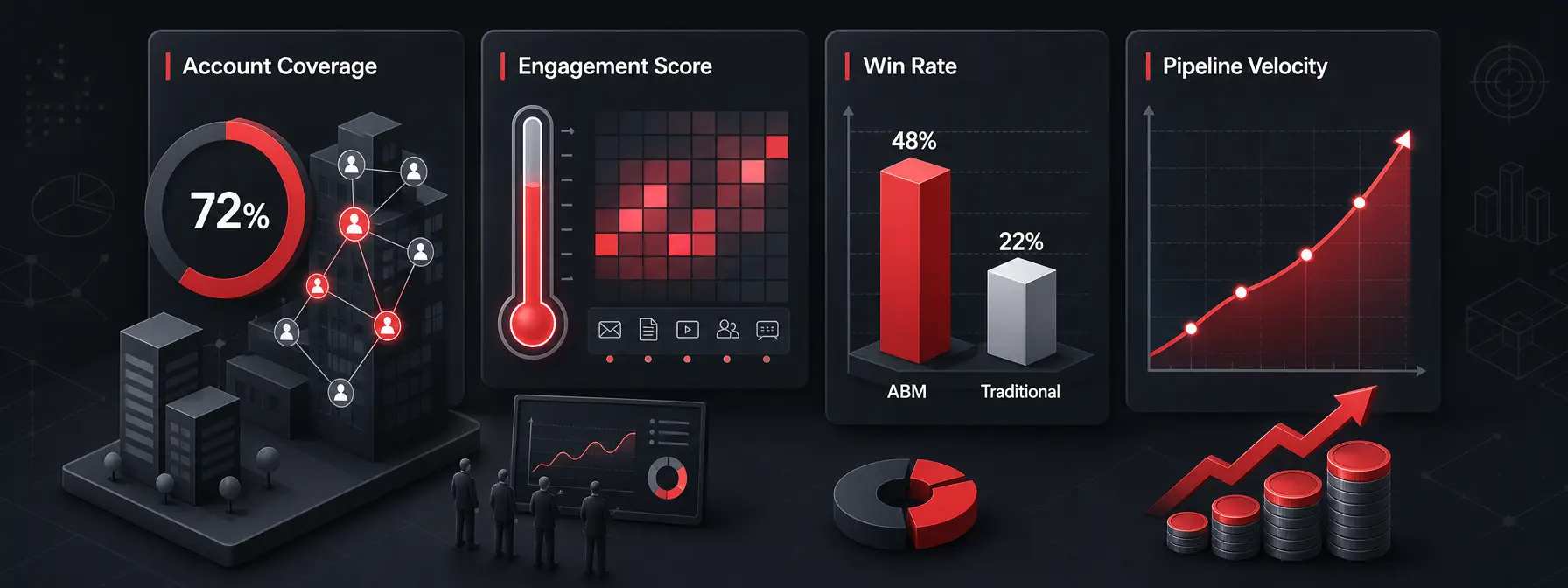
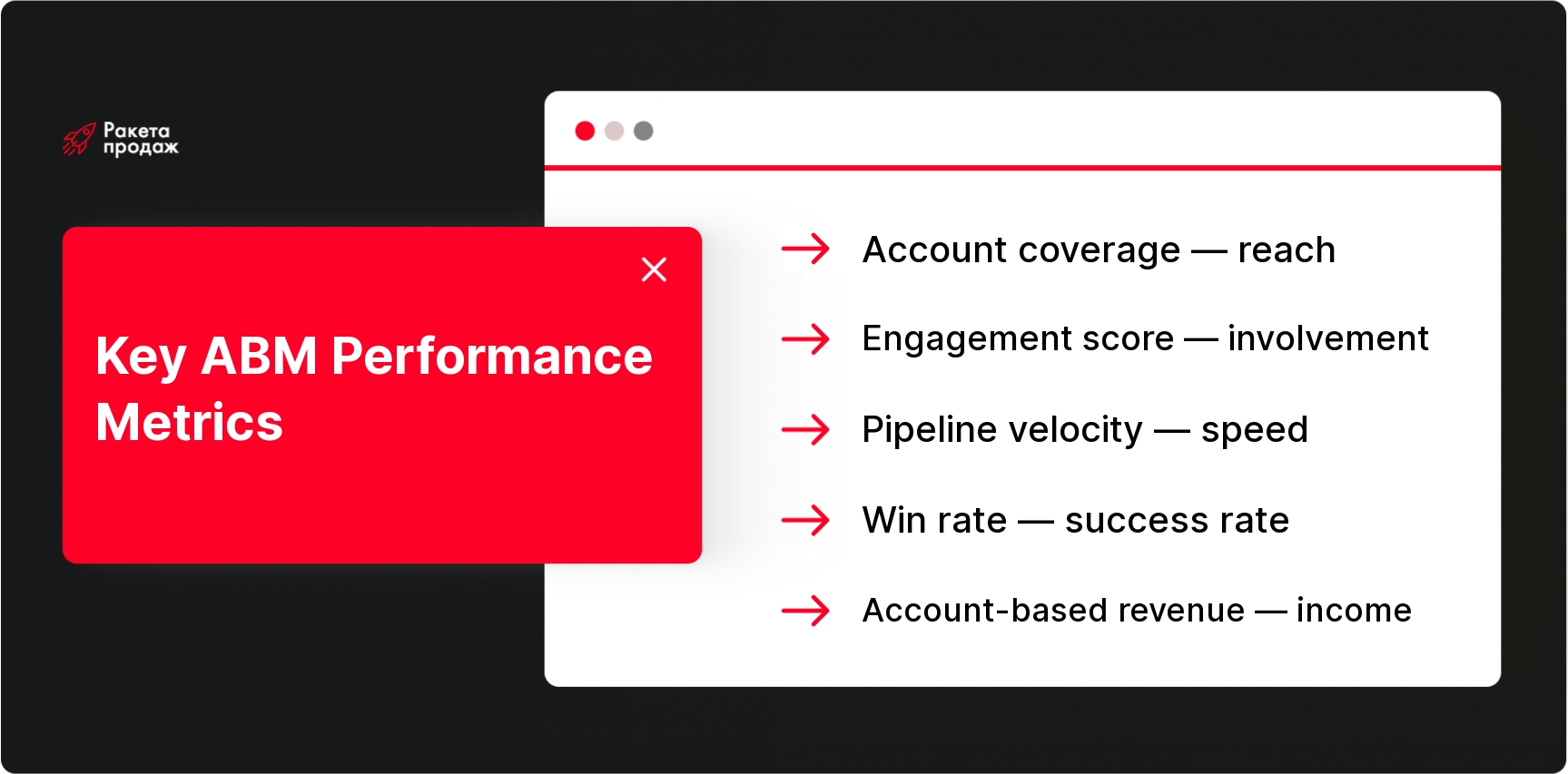
A proper metrics system is what distinguishes professional ABM from chaotic “personalized campaigns.” Unlike classic lead-generating marketing, where main KPIs are lead quantity and conversion to deals, ABM requires a set of specific metrics at the account level. Account coverage shows what share of key stakeholders within target companies you’ve reached. Engagement score reflects account involvement level through content interaction, event participation, and communication response.
Pipeline velocity in ABM is measured not only by individual deals, but also by account movement speed between funnel stages – from first contact to deal closure and further expansion. Win rate for ABM accounts is usually higher than company average, which is one of key program effectiveness indicators. Account-based revenue shows what share of revenue is generated by accounts going through the ABM process.
For Ukrainian companies, it’s also important to track sustainability and client base development metrics: customer lifetime value for ABM accounts, net revenue retention (revenue growth from existing clients), cross-sell and up-sell sales share, as well as NPS and recommendation readiness. These indicators are especially valuable in communication with investors and creditors as proof of business model predictability and manageability. Regular sales funnel analysis allows optimizing budget allocation between channels and continuously improving program ROI.
ABM Specifics for Ukrainian Market
Wartime and related instability have created a special environment for B2B decision-making in Ukraine. Companies have become more cautious in large investment projects, more thoroughly analyze risks, and more often involve owners or international partners in discussions. This has lengthened the sales cycle, but simultaneously increased the value of personalized approach and deep understanding of each account’s context.
ABM logic adapts well to these challenges because it initially focuses on long-term relationship development with key accounts, rather than quick generation of large lead quantities. Instead of standard product presentations, successful companies prepare scenarios considering each account’s specific challenges: energy independence, critical process backup, adaptation to new logistics chains, work in conditions of partial team relocation.
The limited size of the Ukrainian B2B market in most industries also favors the ABM approach. When potential enterprise clients number in dozens or hundreds of companies, personalized work with each becomes not a luxury, but a necessity. High quality lead cost in LinkedIn and contextual advertising makes targeted ABM campaigns more effective than attempts to cover the entire market with broad nets. In such conditions, each properly chosen and professionally developed account can become a source of significant revenue and long-term partnership.
ABM funnel is a powerful tool for working with enterprise clients, but its effectiveness completely depends on proper implementation and coordination of all processes. Simple understanding of principles is insufficient – systematic transformation of sales approaches, specialized analytics tools implementation, and team training for working with multi-level decision-making structures are needed. “Raketa Prodazh” specializes in creating “turnkey” sales departments that effectively work with large accounts: from proper target company selection and stakeholder mapping to setting up personalized communication scenarios and result control systems. Our methodology includes building reference funnels for B2B deal specifics, CRM implementation with advanced account analytics, team training in enterprise client techniques, and creating KPI systems for tracking all key account development stages. The result of this approach – predictable pipeline, high conversion for large deals, and stable revenue growth from strategic clients. Among our partners are Mitsubishi, Audi, Naftogaz and other market leaders who trusted us with building systematic sales processes.
Create a sales department that turns every enterprise account into a source of stable growth - our clients' average result is +35% revenue increase!
ABM funnel for Ukrainian B2B is not just a fashionable technology, but a practical answer to the challenges of a limited market, high client acquisition costs, and the need to build sustainable long-term relationships with key accounts. In conditions where every enterprise client counts, and the cost of error in target account selection is critically high, a systematic approach to their selection, stakeholder mapping, personalized engagement, and subsequent development becomes a factor of survival and growth. Companies that managed to integrate ABM funnel into their operational processes and synchronize marketing and sales work around key accounts get not only conversion growth and average deal size increase, but also a more predictable pipeline, which is critical for sustainable Ukrainian business development in the coming years.
If you’re just implementing ABM approach or scaling your team, don’t forget about sales department adaptation – quality adaptation of new employees, especially in complex B2B products conditions, directly affects the success of any personalized strategies.
For companies where the funnel begins with cold communications, effective cold calling techniques work excellently, because even first contact with a large account decision-maker requires nuances and proper personalization.


 Time to read: 9 min.
 29 June 2026