icon

What Account Based Marketing Is and Which B2B Companies Really Need It

In B2B marketing, simple logic often works: the more leads, the better. We launch ads, collect applications, pass them to the sales department, and hope that at least some convert to customers. But what if your company sells complex products worth hundreds of thousands of dollars, works with large corporations, or has a sales cycle lasting several months?

Want a high-performing sales team without the hassle?
We’ll build it for you.
Contact Us

Key Takeaways

  • ABM flips mass marketing logic: instead of collecting thousands of leads, you select 20-50 target companies and create personalized campaigns for each.
  • The strategy pays off only with average deals of $10,000 and above, complex sales cycles, and multiple decision-makers involved.
  • Synchronizing marketing and sales around a single account list eliminates the “bad leads vs. weak closing” conflict and increases ROI to 300-400%.
  • Weak ABM campaigns copy broad approaches with minimal personalization, while strong ones build separate account based marketing strategies for each key account considering their structure and needs.
  • Three ABM types (Strategic, Lite, Programmatic) differ in personalization depth and target account quantity, from 5 top clients to thousands of companies.

In the full article, you’ll find a step-by-step ABM implementation algorithm, specific channels and warming tactics, and criteria for choosing the right strategy for your business. Read below 👇

Then it’s not the quantity of applications that matters, but reaching the right companies. Account based marketing helps focus marketing and sales on specific target companies that have high deal potential. Instead of trying to “reach everyone,” you concentrate resources on working with those who can truly become your strategic clients. In this article, we’ll explain in simple terms what account based marketing is, how it works, and which B2B companies really need it.

What ABM Is and How It Differs from Traditional Marketing

Account based marketing (ABM) is a strategy where a company focuses B2B marketing and sales resources on a clearly defined set of high-value accounts. Many ask: what is account based marketing and how does it differ from regular marketing? Imagine a coffee shop with regular customers: instead of shouting about discounts to the entire neighborhood, the owner studies each regular’s preferences and offers them personal deals. Account-based marketing is exactly this principle – only in the B2B world.

What is ABM in the context of modern marketing? ABM account-based marketing is high-level personalized marketing applied to work with large corporate clients. In traditional marketing, companies often work on the “wide net” principle: attract maximum traffic, generate leads, then the sales department selects the most promising ones. Account based marketing abm flips this logic upside down. First, you select specific companies that perfectly fit your product, study their structure and needs, then create personalized campaigns for each account.

Sound familiar? Marketing brings many leads, but most are “cold” and not ready to buy your B2B product. The sales department wastes time on unqualified applications, while truly valuable clients get lost in the general flow. This problem is especially painful for companies with complex products and long sales cycles.

At “Ракета Продаж” we understand B2B sales specifics and help synchronize marketing and sales for working with target accounts. Our team builds systematic turnkey sales departments that focus on quality work with prospective corporate clients. We implement CRM systems, create personalized scripts and processes, train teams in key account work techniques.

Over 8+ years of work, we’ve built 208 sales departments in 14+ industries, including companies like Mitsubishi, Yamaha, and НафтоГаз.

Transform chaotic lead generation into systematic work with valuable B2B clients - our clients' average revenue growth is +35%!

Targeted marketing within account-based marketing for b2b is like the difference between distributing flyers throughout the city and personal meetings with each potential client. ABM doesn’t completely replace traditional lead generation – it’s better suited for companies where individual deal value is high, sales cycle is long, and several people participate in decision-making. In account-based marketing, marketing and sales work as a unified team around a specific account list, creating personalized experience for each key client. This leads us to examining specific channels used in such strategies.

account based marketing — Comparison of traditional marketing and ABM strategy

What Channels Are Used in ABM

Account-based marketing strategy builds on a combination of several channels, not just one outreach method. Personalized email outreach remains one of the main tools – but these aren’t mass emails, but carefully crafted messages for specific decision-makers. LinkedIn touches allow direct access to the right people, especially in the B2B segment where professional networks play a key role. Targeted advertising is set up not for broad audiences, but for employees of specific accounts – precisely for target companies identified as priorities.

Industry or specific segment content helps position the company as an expert in client problems. Webinars and closed events create opportunities for deeper interaction with target account representatives. Direct messages to decision makers through various channels – from LinkedIn to personal contacts – allow faster access to the right decision-making level. These account-based marketing techniques and account based marketing techniques form the backbone of successful campaigns.

Personalized landing pages are created for specific companies or industries, reflecting their specifics and needs. Retargeting helps “chase” target account representatives after first contact. For especially large accounts, even direct mail or offline activations are used – for example, sending personalized gifts or invitations to closed dinners. This multi-channel approach creates the foundation for gaining serious advantages.

Account Based Marketing Benefits for B2B Companies

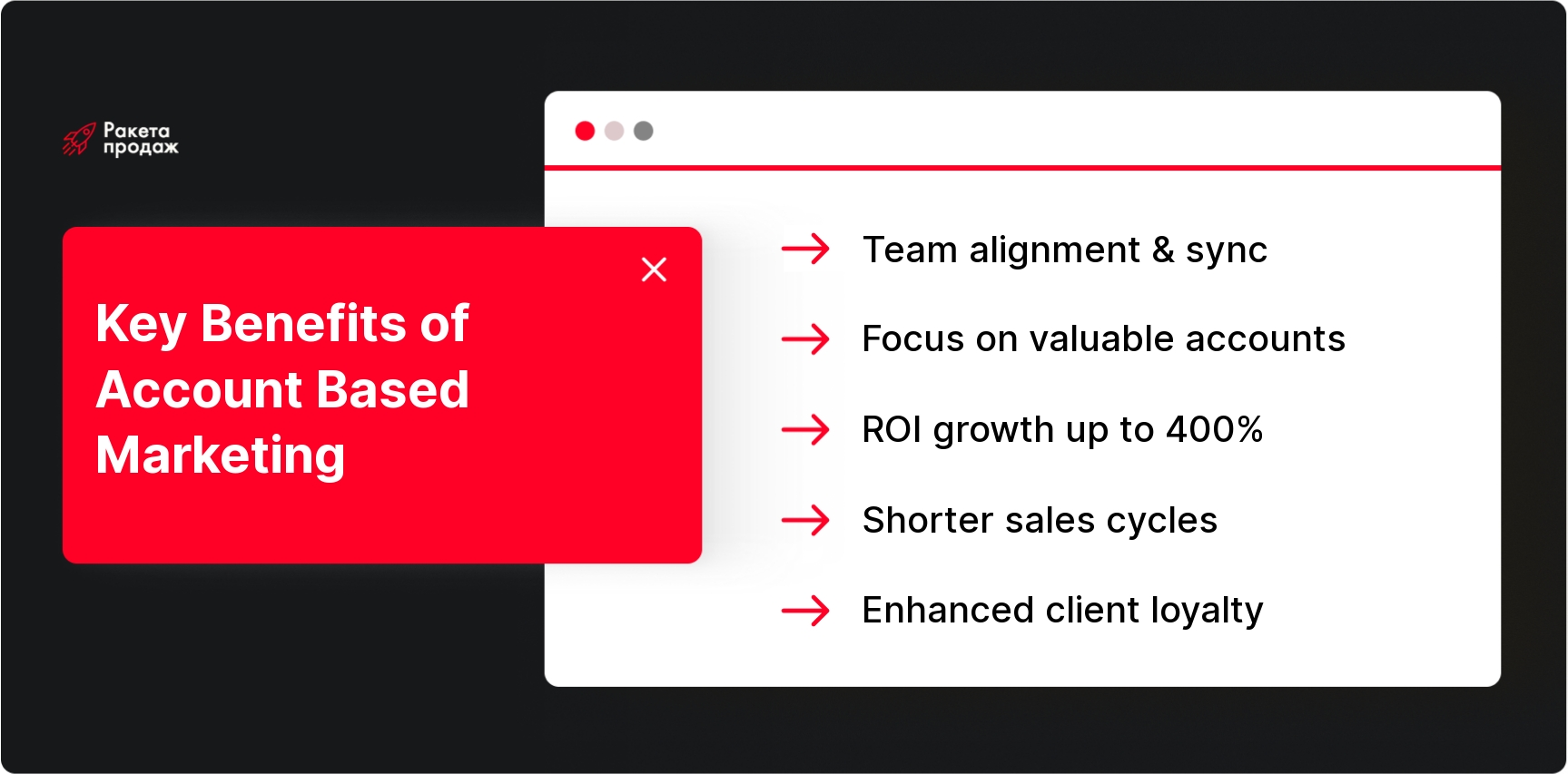
The first benefit of account based marketing in B2B is synchronizing marketing and sales teams around common goals. Instead of the traditional conflict “marketing brings bad leads, and sales doesn’t close them,” both teams work with one target account list. They have common KPIs, shared CRM, and common understanding of which companies are priorities. This eliminates internal contradictions and increases overall sales process efficiency.

Increased ROI and ROMI occurs through concentrating resources on the most promising clients. Instead of spreading budget across broad audiences, you invest in those who will likely become large clients. Research shows that ABM can deliver ROI up to 300-400% thanks to more precise targeting and personalization. Sales cycle reduction happens because key stakeholders participate in communication immediately, and content is tailored to their specific pain points and use cases.

Increased loyalty and average deal size relates to personalized approach creating more trusting client relationships. When a company demonstrates deep understanding of client business specifics, this increases its perceived expertise and value. Clients are willing to pay more for solutions that seem created specifically for them. Additionally, quality account work during sales phase lays the foundation for long-term partnership and expanded cooperation, which closely relates to how to properly implement персонализация в продажах for maximum effect. But it’s important to understand that different approaches to implementing account-based marketing strategies exist.

Three Types of ABM Strategies: From Individual Top Client to Scalable Approach

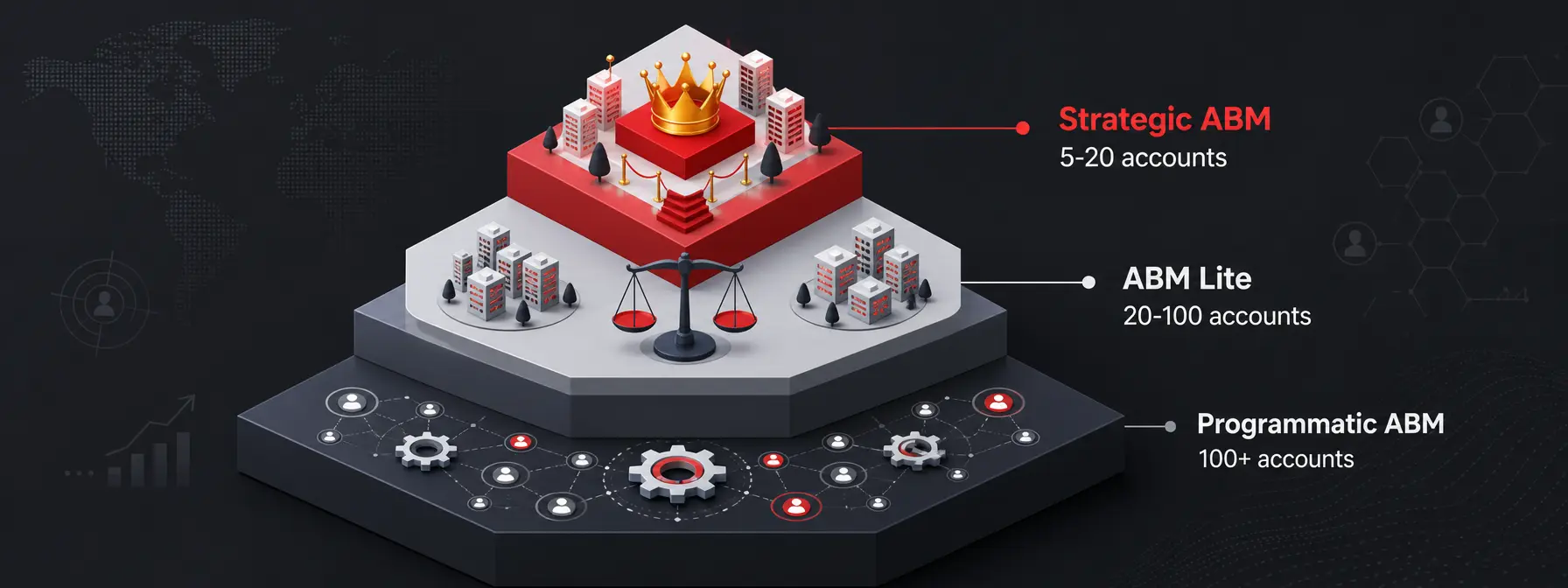
Strategic account based marketing (Strategic ABM) is designed for working with the largest and most valuable accounts – usually 5-20 companies, each potentially bringing millions in revenue. Maximum personalization is used here: separate landing pages, custom content, personal meetings with top management, even developing special offers for specific clients. A separate strategy is created for each account considering its organizational structure, business model, and current initiatives.

ABM lite is designed for working with smaller accounts – from 20 to 100 companies with average deals in tens of thousands of dollars. Personalization here is moderate: content is adapted for industry or company size, semi-automated email sequences are used, targeted advertising by company lists. The approach is more scalable but still maintains focus on specific accounts rather than mass audiences.

ABM programmatic is designed for large-scale automation of work with hundreds and thousands of potential accounts. Special platforms are used that automatically segment accounts, show personalized ads and content, track website activity. Personalization is minimal but still higher than traditional marketing – for example, ads are shown only to employees of certain companies, and the website displays content relevant to their industry. Approach selection depends on criteria that need consideration when implementing account-based marketing.

ABM strategy types — Three types of ABM strategies by personalization level

Who ABM Suits: Strategy Selection Criteria

Average deal size remains the main criterion for account based marketing feasibility. If your deal is worth less than $10,000, personalized campaigns for each client may not pay off. Account based marketing makes sense with deals from tens of thousands of dollars and above, when even several successfully won accounts cover all marketing investments. Deal complexity is also important: the more people participate in decision-making and the longer the sales cycle, the more profitable the personalized ABM approach.

Available resources determine which type of account-based marketing you can implement. Strategic ABM requires a dedicated team and significant budgets, while ABM lite can be launched by 1-2 marketers using standard tools. Market width is another key factor: if there are thousands of potential clients, classic digital marketing will be more effective; if there are hundreds or dozens, account based marketing becomes a logical choice.

It’s recommended to start with a pilot launch on 20-50 accounts to test hypotheses and refine processes. Choose one segment or industry, create personalized content, and launch a multi-channel campaign for 2-3 months. Account based marketing is not recommended in niches with low deals (less than $5,000), short sales cycles (less than a month), large numbers of potential clients (more than 10,000), or standardized products where personalization doesn’t provide advantages. Now let’s look at how ABM works in practice.

ABM in Practice: Step-by-Step Implementation Example

Let’s consider a real case of a real estate agency that decided to implement account based marketing for attracting large clients. The first stage – сегментация клиентов в продажах. The company analyzed existing clients and identified the most profitable segment: IT companies with offices of 200+ people planning expansion or relocation. From this segment, they formed a list of 50 priority companies.

Competitor analysis showed that most market players used standard approaches: cold calls, mass email campaigns, and contextual advertising. This created an opportunity to differentiate through a personalized approach. Developing a Customer Journey Map helped the company understand that office rental decisions are made by the CEO, CFO, and office manager, each of whom focuses on different aspects: strategic, financial, and operational, respectively.

Lead nurturing tactics included creating industry-specific content, such as office real estate market overviews for the IT sector and cases of successful relocations, as well as personalized LinkedIn campaigns and targeted advertising aimed at employees of target companies. Collecting dossiers on decision-makers helped create detailed profiles of key stakeholders: their professional background, the company’s current initiatives, and their personal interests on LinkedIn.

Preparing a communication plan involved step-by-step interaction: from educational content to personalized offers. CRM integration made it possible to track all touchpoints with each account, while analytics setup allowed the company to measure engagement at the company level rather than at the level of individual leads. The result: in 6 months, the agency signed 8 large contracts from 50 target accounts, compared to the usual 2-3 contracts achieved through the traditional approach. The success of this implementation also depended on the consistency and clarity of introducing key sales stages when working with such clients. The success of this implementation largely depends on proper team synchronization as well.

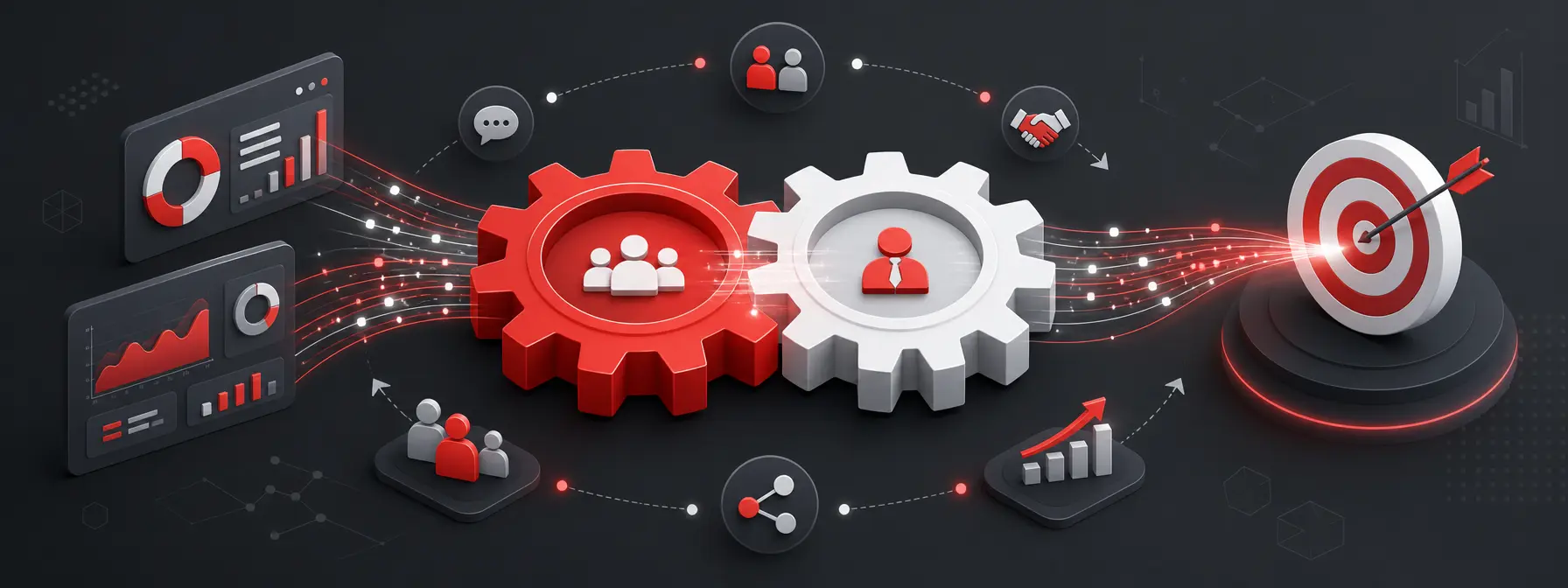
marketing and sales alignment — Alignment of marketing and sales teams in ABM

How to Synchronize Marketing and Sales in ABM

ABM success is impossible without close cooperation between marketing and sales teams, since both functions work with the same accounts at different stages of the funnel. Role definition must be clear: marketing is responsible for account research, content creation, lead nurturing, and generating interest, while sales is responsible for qualification, presentations, and closing deals. At the same time, the boundaries should remain flexible, with areas of shared responsibility.

Information exchange requires regularity and structure. Weekly meetings on priority accounts help synchronize activities: marketing reports on new touchpoints and engagement levels, while sales shares client feedback and adjusts messaging. Shared KPIs create unity of interests: instead of separate metrics for leads and deals, teams use common indicators such as revenue from target accounts, the number of engaged stakeholders, and movement through pipeline stages.

Regular meetings should include not only operational issues, but also strategic ones: reviewing the target account list, analyzing channel effectiveness, and planning long-term campaigns. CRM implementation with ABM analytics capabilities ensures transparency of all account-related activities for both teams. Joint training on key account management helps align the understanding of approaches, scripts, and value propositions for different types of stakeholders.

In addition, it is important not only to develop processes, but also to use proven B2B sales strategies that combine well with ABM capabilities, especially when working with large corporate clients and complex deals.

An ABM strategy requires more than just an understanding of the principles — it requires systematic implementation of processes, tools, and team synchronization. Most companies try to implement ABM on their own, but face difficulties: incorrect account segmentation, disconnected marketing and sales efforts, and a lack of personalized processes. “Ракета Продаж” specializes in building systematic sales departments for working with corporate B2B clients. We create a full cycle: from researching target accounts and building the funnel to CRM implementation, team training, and analytics setup. Our methodology includes international sales techniques such as BANT, MEDDIC, and SPIN, adapted to the Ukrainian market. The result is a sales department that works systematically with key clients and demonstrates stable growth. Among our clients are industry leaders, and our best result was +$10,907,403 in revenue growth over 4 months. Don’t waste months experimenting with uncertain results when you can get a proven system.

Build a sales department that systematically works with valuable B2B accounts and generates predictable revenue!

Conclusion

image

Account based marketing is an approach in which a company focuses not on mass lead generation, but on working with specific target accounts. It helps synchronize marketing and sales, increases ROI by concentrating resources on the most promising clients, and shortens the sales cycle through a personalized approach. ABM works best where there is a high deal size, a complex B2B product, a clear ideal customer profile, aligned marketing and sales efforts, and a readiness to invest in personalization. For Ukrainian companies with limited resources, it is recommended to start with ABM Lite pilot programs, gradually building expertise and scaling successful approaches.

In this article:
See more
Book a FREE sales funnel audit
CONTACT US
FAQ
Is account based marketing the same as lead generation?

No, ABM is fundamentally different from traditional lead generation. Lead generation focuses on attracting the maximum number of inquiries, while ABM focuses on working with pre-selected target companies through personalized campaigns.

What companies need ABM?

ABM is suitable for B2B companies with a high average deal size — $10,000+ — a long sales cycle, a complex decision-making process, and a limited number of potential clients

Can ABM be used in small business?

Yes, but in the ABM Lite format with limited personalization. Small businesses should focus on 20-50 key accounts and use accessible tools such as LinkedIn and email marketing.

Where should you start with ABM implementation?

Start by defining your ideal customer profile, creating a list of 20-30 target accounts, synchronizing marketing and sales teams, and launching a pilot campaign lasting 2-3 months.

SUBSCRIBE TO MY TELEGRAM CHANNEL
The most valuable sales information right on your phone!
icon

LOTS OF USEFUL INFORMATION, FREE TEMPLATES, AND CHECKLISTS ON MY INSTAGRAM

Materials and practical advice on sales growth in our blog: