Key Takeaways
- A simple percentage of turnover puts an easy sale to an old client on the same level as the labor-intensive work of attracting a new partner, so the manager picks the easier path and settles into working the base.
- Working with the base brings quick income, while new dealers need months to ramp up. Without separating these tasks in the KPI, the company gets growth on paper, not in reality.
- Strong managers grow a client’s turnover, product range, and order frequency, while weak ones turn into order-taking operators who just wait for the base to call them.
- A bonus tied only to revenue pushes managers toward generous discounts and minimal markups – the plan gets fulfilled, but margin takes a hit.
- An overloaded system with a dozen KPIs kills the manager’s focus; proper motivation keeps 3-5 metrics that genuinely reflect the area of responsibility.
In the article below you’ll find concrete metrics for working with the existing base and attracting new dealers, examples of a balanced income structure, and a list of mistakes to avoid when building a motivation system 👇
Many companies still pay their managers a plain percentage of turnover and then wonder why some clients keep growing while new dealers barely appear at all. The answer is usually simple: motivation of a wholesale sales manager doesn’t separate two fundamentally different types of work, and the employee unconsciously chooses the easier path.
In this article, we’ll break down why working with the base and attracting new dealers require different metrics, which KPIs actually work in B2B, how motivation in B2B and B2C sales differs in this respect, and which mistakes most Ukrainian wholesale companies stumble on.
What Makes a Wholesale Sales Manager's Job Different
Wholesale sales run on different rules than a one-off retail deal. Here, the manager doesn’t close a sale and forget about the client – they build relationships over months and years, because the entire value of a wholesale business lies in regular purchases. One good dealer who reliably orders every two weeks is often worth more than five one-time buyers.
That’s exactly why the scope of a wholesale sales manager’s job is much wider than it seems at first glance. It includes attracting new dealers and wholesale buyers, developing existing clients, growing the assortment in each order, increasing average order value, working with repeat purchases, and winning back clients who’ve gone “dormant.” Add to that price and discount negotiations, receivables control, meeting targets for individual brands, and the ability to forecast a client’s next order.
These tasks have different result horizons and different levels of complexity. Finding a new dealer might take a month, but bringing them up to a stable turnover comparable to long-standing clients often takes six months or more. Because of this gap, a plain commission on turnover almost never motivates correctly, since it puts an easy sale to an old client on the same level as the labor-intensive work of bringing a new partner up to volume. That naturally leads us to the main question: how do you separate these two areas within a motivation system.
Sound familiar? Managers sit on their regular clients and avoid looking for new dealers because it’s simpler and faster. New partners only show up by accident, when they call in themselves. At “Rocket Sales” we know the reason isn’t laziness on the employees’ part, but a poorly built motivation system that fails to separate work with the base from attracting new clients. Over 8+ years, we’ve helped 208 companies build sales departments where managers are equally motivated to develop existing dealers and attract new ones. Our clients get balanced teams that deliver an average turnover increase of +35% and consistently hit 150% of monthly plans. A motivation system isn’t just a set of sales percentages – it’s a tool for managing your growth strategy.
Build motivation that gets managers actively searching for new dealers without neglecting the base - order a motivation system audit!
Which Two Tasks Need to Be Separated in the Motivation System
If you look at a wholesale manager’s job with clear eyes, there are two distinct commercial directions hidden inside it, and lumping them into a single metric is a mistake. The first is working with the existing base: retaining clients, repeat purchases, growing volume, expanding the assortment, winning back clients with declining turnover, and controlling receivables. The second is attracting new dealers: finding companies, negotiations, lead qualification, the first order, the repeat order, and moving a new client into active status.
These aren’t just different activities – they’re different types of results with different speeds and different levels of risk. Working with the base delivers predictable, quick income, while attracting new dealers demands more time and energy upfront, but shapes the company’s future growth. If you pay the same for both directions, or worse, only for overall turnover, the manager will almost always take the easier path and settle into working existing clients.
Companies that want real growth, not just holding onto current positions, need to give both directions separate metrics and a separate weight in the manager’s income. Otherwise, wholesale sales manager motivation turns into motivation to “sell to those who buy anyway,” and market development stays on paper. Next, let’s look at how exactly to build incentives for working with the base.
How to Motivate a Manager to Work with the Existing Client Base
Working with the base is often seen as routine: the client calls, the manager takes the order, the money comes in. But if you only pay for the fact of a repeat purchase, the manager quickly slides into “order-taking mode” and stops developing the client. The base isn’t a static asset – it’s potential that can be unlocked over months.
Proper motivation should account not for the fact of a purchase itself, but for the client’s development dynamics. The company pays not because the dealer bought again, but because the manager managed to grow their purchases, assortment, or order frequency. That’s a fundamental difference in bonus logic.
Depending on your business specifics, the following parameters are worth building into base-work motivation:
- meeting the plan for the existing client base and growing a specific client’s turnover;
- growing gross profit and increasing average order size, not just revenue;
- the frequency of repeat orders and the number of product categories a client regularly buys;
- retaining active clients and winning back those whose turnover has started declining;
- reactivating dormant clients who haven’t ordered in two or three cycles;
- meeting assortment targets and avoiding critical overdue receivables.
This set of metrics turns the manager from an “order-receiver” into someone who actually manages client growth. A logical next question is how to build a similar system for new dealers.
How to Motivate a Manager to Attract New Dealers
A new client almost always costs the company more than retaining an old one, and this should be reflected in the bonus system. If attracting new dealers is valued the same as base sales, the manager simply has no reason to spend time on cold calls and long negotiations with a potential partner.
Here, the logic of increased value for the early stages of cooperation with a new client applies. A company can use a bonus for a new qualified dealer, a separate payout for the first paid order, and a higher rate on the first sales to a new client during the startup period. An additional bonus for a new client reaching a certain purchase volume, or a premium after the second or third order, also work well, because they keep the manager’s attention on actually securing the dealer, not just closing a one-off deal.
It’s worth singling out KPIs for the number of new active clients, new turnover, and new gross profit. This gives the company a manageable growth metric, rather than just a count of business cards in the CRM.
One important caveat here: paying only for a created contact or a formal first order is risky. Managers quickly find loopholes and start bringing in weak clients just for the one-time bonus, leaving the company with dead contracts in its reports. It’s smarter to tie the main bonus to the appearance of a genuinely active new dealer – that is, a client who places a second, third order and reaches a stable volume. The logical next step is figuring out whether you should even pay a different rate for new versus existing clients.
Should You Pay a Different Rate for a New vs an Existing Client
There’s no universal rule here, but there is a logic that often proves itself in practice. Attracting a new client requires more effort at the start, so it makes sense to give increased motivation specifically for that period. Once the dealer moves into the status of a regular buyer, the manager reverts to the standard base-work scheme.
In practice, there are different ways to implement this logic. Some companies apply a higher rate to a new client’s very first order, others stretch the higher rate over the first few months of cooperation. There are simpler schemes too: a fixed bonus for the appearance of a new active dealer, or a separate rate applied specifically to new turnover rather than to the base’s overall turnover.
You can’t just copy specific numbers from a competitor and drop them into your own system. Percentages and timeframes need to be calculated from your company’s margin, the average cost of acquiring a client, and the deal cycle in your industry. What works for a household chemicals distributor probably won’t suit a seller of industrial equipment with a long negotiation cycle. Next, let’s look at another important layer of motivation that often falls out of payment systems: working with margin.
How to Motivate for Margin, Not Just Turnover
Motivation based on pure revenue creates an understandable but dangerous risk. A manager can consistently hit the turnover plan by selling goods with minimal markup or constantly offering clients the maximum possible discount, just to close the plan faster and without pushback from the buyer.
To avoid this, wholesale companies should weave gross profit, minimum acceptable margin, average discount across the client portfolio, meeting targets for profitable product categories, and compliance with the company’s pricing policy into the bonus scheme. Some companies build the bonus directly on gross profit rather than turnover. Others keep turnover as the base metric but apply a margin-adjustment coefficient that reduces or increases the final payout.
The core idea is simple: the company should pay for profitable sales, not just for big numbers in a report. A manager who brings in lower turnover but with good margin is often worth more than one chasing volume at any cost. With that in mind, it’s logical to move on to another topic that often falls out of motivation systems: accounts receivable.
How to Build Accounts Receivable into Motivation
In wholesale trade, a sale doesn’t always mean money in the company’s account. If a manager actively sells on deferred payment terms but clients don’t pay on time, a formally impressive turnover in the reports turns into real cash flow problems for the business.
To keep motivation from encouraging uncontrolled shipping on credit, the system should include overdue receivables, compliance with credit limits per client, the base’s overall payment discipline, and possibly tie part of the bonus to the fact of actual payment rather than just the fact of shipment.
That said, fully shifting the finance department’s function onto the manager isn’t a good idea – debt collection and legal work with debtors are a separate competency. The goal of motivation is simpler: make it unprofitable for the manager to build up uncontrolled debt just to make the CRM numbers look good. The next section covers assortment, another source of hidden growth in wholesale sales.
How to Account for Assortment and Cross-Sell in Motivation
Often an existing dealer regularly buys only two or three items from a company’s large catalog, even though they could potentially purchase far more categories. That’s exactly why growth potential hides not only in new clients but also in expanding the product basket of existing buyers.
B2B sales manager motivation can account for the number of product groups a specific client buys, sales of new SKUs, meeting targets for priority categories, an assortment penetration metric, sales of new products, and the overall level of cross-sell across the client base. These KPIs are especially useful for companies with a broad product portfolio, where it’s easy to get stuck selling three bestsellers and forget about the rest of the catalog.
Expanding the assortment with an existing client is often cheaper for the company than attracting a new dealer, and the effect on turnover can be comparable. It makes sense that this metric deserves its own place in the bonus formula. Now let’s pull all these elements together into a single example of a motivation structure.
Example of Balanced Wholesale Sales Manager Motivation
Let’s look at the income structure without tying it strictly to specific figures – more as a logic you can adapt to your own company when building a sales department motivation system. The base part of income is a fixed rate that gives the manager financial stability and lets them work calmly on long deals without panicking at the end of the month.
Next comes the main sales bonus, tied to meeting the plan on turnover or gross profit. A separate block covers work with the existing base: client retention, purchase growth, assortment expansion, and winning back declining clients. In parallel, there’s a new dealers block, which counts the number of new active clients and the turnover they’ve brought in. The structure is rounded out by a financial coefficient that accounts for sales margin and the state of accounts receivable.
The specific share of each block should be calculated from your company’s commercial model, not copied from someone else’s case. But there’s one idea that works almost universally: the employee shouldn’t be able to earn the full bonus by completely ignoring either the base or the search for new clients. This exact logic is what turns scattered metrics into a single KPI system, which we’ll discuss separately.
Wholesale Sales Manager KPIs
All the metrics discussed above are conveniently grouped into a few blocks, so you don’t get lost in the details when building your own sales KPI system. The financial block includes turnover, gross profit, average margin, and overall plan fulfillment. The new clients block covers the number of new qualified dealers, first orders, new active dealers, and turnover from them.
The current base block is responsible for client retention, repeat orders, growth from specific clients, reactivating dormant contacts, and expanding the assortment within orders. A separate financial discipline block keeps an eye on accounts receivable, payment delays, and compliance with clients’ credit limits.
You don’t need to include all of these metrics at once in your bonus scheme – that’s a direct path to an overloaded, confusing formula. For each manager, pick a few KPIs that genuinely reflect their area of responsibility, whether that’s developing the base, finding new dealers, or controlling margin. Understanding these blocks helps avoid the typical mistakes worth discussing separately.
Common Mistakes in Wholesale Sales Manager Motivation
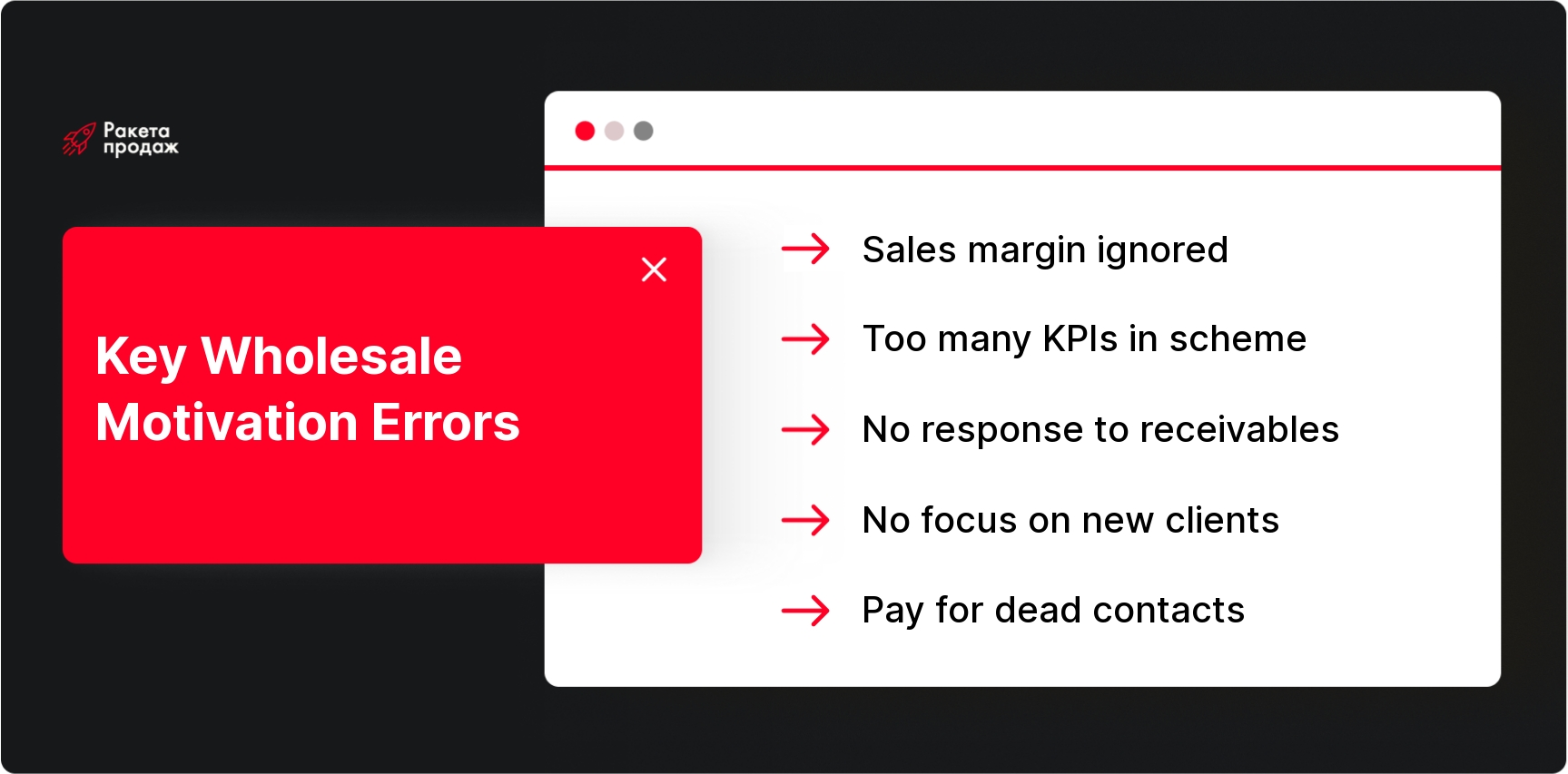
Most motivation problems in wholesale trade repeat from company to company, and almost all of them come down to oversimplifying a complex system into a single clear but flawed metric. A detailed breakdown of sales team motivation mistakes shows these patterns repeat across very different industries. A bonus based only on overall turnover puts an easy sale to an old client on the same level as the labor-intensive work of attracting a new partner, and equal motivation for old and new clients removes any incentive for the manager to look for new dealers at all.
Companies often pay for the number of contacts instead of genuinely active dealers, and count a small first order as a full-fledged acquisition, even though the client might never come back for a second one. A separate category of mistakes involves ignoring repeat purchases, not having a separate plan for new clients, and not having a plan for the existing base as its own standalone direction.
Below are the most common problems wholesale companies run into when building a motivation system:
- margin isn’t accounted for, so the manager sells a lot but unprofitably for the company;
- discounts don’t affect motivation, so the salesperson generously cuts prices just to close the plan faster;
- overdue receivables aren’t tracked, creating cash gaps despite formally good sales numbers;
- there are no rules for dormant clients, and the base slowly “dies off” without reactivation;
- motivation is overloaded with too many KPIs, causing the manager to lose focus;
- rules change mid-period, which undermines trust in the whole system.
Knowing about these mistakes is only half the work of building a healthy motivation system – the other half is being able to discuss emerging contradictions in time, since a poorly built system often triggers conflict management within the sales department that the manager then has to deal with.
Proper motivation for wholesale managers isn’t just a math problem with percentages and coefficients – it’s a strategic tool for managing your company’s growth. But building such a system on your own is hard – it requires accounting for industry specifics, sales cycle, margin, and dozens of other factors. At “Rocket Sales,” we build motivation systems as part of a complete, turnkey sales department buildout: we analyze the current situation, develop KPIs tailored to your business model, implement transparent reporting, and train the team to work by the new rules. Over 8+ years, we’ve built 208 effective sales departments for companies ranging from startups to corporations like Mitsubishi and Yamaha. The result? Our clients get teams that generate an average turnover increase of +35%, with the best result reaching +$10,907,403 in 4 months. Don’t spend months experimenting with motivation – leave it to the professionals.
Build a sales department with a motivation system guaranteed to drive 35% growth!
If you pay a manager only a percentage of overall turnover, working with the existing base will almost always seem more attractive than the complex, lengthy search for new dealers, since it delivers fast, predictable results for less effort. But swinging motivation too far in the other direction is also risky: if you focus only on new clients, retention and development of the dealers who already bring the company stable turnover start to suffer. Wholesale sales manager motivation truly works only when the payment system honestly reflects the company’s commercial strategy and clearly shows the employee exactly what they’re being paid for – developing the base, attracting new partners, profitable sales, or clients’ payment discipline. You won’t get such a system perfect on the first try, but regularly revisiting your KPIs, thoughtful non-monetary motivation for sales managers, and open dialogue with the sales team will gradually bring the income structure to a balance that benefits both the business and the managers themselves.


 Time to read: 9 min.
 07 September 2026