icon

5 Sales Manager Motivation Models - Which One to Choose?

Every sales department head knows that a motivated salesperson brings the company 3-4 times more revenue than an employee just “putting in hours.” A properly configured motivation system directly affects not only financial performance but also team loyalty, reduced staff turnover, and the overall atmosphere in the team. The problem is that there’s no universal motivation recipe – what works for B2B sales with a long deal cycle may completely fail in retail or SaaS business.

Key Takeaways

  • A motivated salesperson generates 3-4 times more revenue than an employee without drive, but no universal scheme exists: what works in B2B with a long cycle will fail in retail.
  • Purely monetary motivation loses power without recognition and development, while overloaded KPIs (more than 5-7) confuse salespeople or push them to manipulate reporting.
  • If a salesperson doesn’t believe the plan is achievable or doesn’t trust the transparency of bonuses, their motivation drops to zero, even with high rates.
  • A graded motivation system for the sales department with clear career stages (Junior, Middle, Senior, Key Account) retains talented employees and reduces turnover better than one-time bonuses.
  • The American employee motivation model (variable portion up to 70-80% of income, fierce competition, public rankings) is effective in short sales cycles but may create a toxic atmosphere in team-oriented businesses.

In the full article, you’ll find a detailed analysis of five motivation models (Maslow, Vroom, bonus schemes, KPI, grades), their strengths and weaknesses, and selection criteria for your specific needs. Read on 👇

The market has developed many approaches to motivating sales managers, but not all are equally effective. In this article, we’ll analyze the five most applicable motivation models that actually work in modern conditions. You’ll learn their strengths and weaknesses and get recommendations on which model to choose for your business, considering its specifics and current objectives.

In practice, successful companies rarely use one universal incentive scheme. Most often, combined sales team motivation models are used, combining financial bonuses, KPIs, career opportunities, and recognition elements. Such salesperson motivation models consider different types of employees and maintain sustainable team performance.

Types of Sales Department Motivation Models

Modern sales management uses various employee motivation models, each focused on specific business goals and team characteristics. Employee motivation models can differ in reward structure, KPI set, level of non-material employee support, and degree of income dependence on results. Understanding these approaches helps a manager choose a system that will work effectively in their company.

The question of salesperson motivation today goes far beyond simple “pay more – get more.” Modern approaches to sales department motivation include a whole spectrum of tools aimed at different aspects of work and employee needs.

Motivation of the sales department is still built on financial incentives, which remain the foundation of any system. It includes base salary, sales percentages, bonuses for meeting plans, and commissions. For many salespeople, the ability to directly influence their income through results is a key incentive. However, purely monetary motivation has its limits and loses effectiveness over time if not supplemented with other elements.

Motivation through KPI focuses on specific measurable indicators: conversion, average check, number of calls, proportion of successful deals. This approach makes goals tangible and allows salespeople to see a direct connection between their actions and rewards. Modern CRM systems have significantly simplified tracking such indicators, making this approach very popular.

Motivation through goals shifts the emphasis to strategic tasks and long-term results. This could be entering a new customer segment, launching a new product line, or increasing existing customer satisfaction. This approach is often used in B2B sales with a long deal cycle, where quick results are less indicative.

The bonus-based motivation system represents an addition to basic income and can be tied to individual, team, or company results. Well-designed bonuses direct salespeople’s energy to business priorities and create additional activity spikes.

Psychological motivation models address a person’s internal drivers: recognition, status, development, belonging to an important cause. These elements are especially important for long-term motivation and retention of valuable employees.

It’s important to understand that most successful companies don’t limit themselves to one approach but use combined models adapted to their business objectives and team characteristics. Next, we’ll look at five of the most effective models that will allow you to build a balanced motivation system.

Classic Motivation Theories in Sales Department Work

Although the sales world is dynamic and constantly changing, fundamental motivation principles remain relevant. Classical motivation theories, developed decades ago, still help us understand what drives people in the work environment. Let’s see how these theories can be applied in a modern sales department.

Familiar situation? Your sales managers receive the same salary but show different results? Or perhaps you have high staff turnover precisely because your motivation system doesn’t meet the team’s needs? According to our statistics, over 70% of companies suffer from ineffective motivation systems that don’t bring expected results. At “Rocket Sales,” we’ve developed a comprehensive methodology for building motivational systems that takes into account your business specifics and individual characteristics of each employee. Our approach includes analyzing motivation drivers for each manager, implementing personalized KPIs, and regularly monitoring performance. Over 7+ years, we’ve helped 187 companies from various industries build effective sales departments with transparent motivation systems, leading to an average turnover increase of 35%.

Turn your sales team into a well-coordinated mechanism with predictable results - order a free consultation on motivation systems!

Model #1. Maslow's Motivation Model

Abraham Maslow’s hierarchy of needs theory is perhaps the most famous Maslow’s motivation model. According to it, human needs form a pyramid of five levels, and for effective motivation, needs must be satisfied sequentially, starting from basic ones and moving upward.

In the context of a sales department, this model transforms as follows:

The first level – physiological needs and safety – is realized through competitive salary and stable working conditions. The base salary must be sufficient to meet basic needs, and working conditions must be predictable. Without this foundation, all other motivational tools will be ineffective. If a salesperson constantly worries about paying rent next month, they’re unlikely to be inspired by professional growth prospects.

The second level – social needs – is satisfied through teamwork, corporate culture, and an atmosphere of mutual support. Regular team meetings, celebrating successes together, mentorship – all this creates a sense of belonging to a community, which is especially important for salespeople whose work often involves rejection and stress.

The third level – recognition and respect – is realized through public recognition of achievements, “best salesperson of the month” contests, honor boards, and special statuses within the team. For salespeople, competitive spirit and peer recognition are often powerful incentives, sometimes even stronger than a cash bonus.

The highest level – self-realization – is satisfied through career growth opportunities, participation in challenging and interesting projects, and learning and developing new skills. The prospect of becoming a team leader, heading a new direction, or moving to a more prestigious sales segment can strongly motivate ambitious employees.

Practical application of Maslow’s motivation model in a sales department might look like this: the company provides a decent base salary (level 1), creates a friendly team atmosphere (level 2), uses salesperson rankings and public recognition of successes (level 3), and offers career development tracks from junior specialist to key account manager (level 4).

The key understanding that Maslow’s model provides: you can’t motivate with “higher” incentives if basic needs aren’t met. This principle explains why motivational programs don’t work in many companies – they try to inspire people with recognition and development when they’re concerned about income instability.

Model #2. Vroom's Motivation Model (Expectancy Theory)

Victor Vroom’s expectancy theory focuses not on the content of needs but on the psychological process of choice and motivation. According to Vroom’s motivation model, motivation strength depends on three key factors: the expectation that efforts will lead to the desired result; instrumentality – confidence that the result will be rewarded; and valence – the value of the reward to the employee.

In the sales context, this model works as follows:

Result expectation means that a salesperson must believe their efforts can actually lead to the desired result. If the sales plan is perceived as unrealistic or dependent on factors beyond the employee’s control (e.g., economic crisis or competitors’ aggressive policy), motivation sharply decreases. Therefore, it’s critically important to set achievable goals and provide salespeople with necessary tools and support.

Instrumentality assumes a clear connection between achieved results and promised rewards. If a salesperson isn’t sure that meeting the plan will guarantee the promised bonus (for example, due to frequent rule changes or subjective evaluation), their motivation will be undermined. Transparent bonus calculation formulas, documented rules, and timely payments are key elements for ensuring instrumentality.

Valence concerns the subjective value of the reward for a specific employee. One salesperson may highly value monetary bonuses, another – the possibility of a flexible schedule, a third – career growth prospects. Understanding individual team preferences allows for maximally effective incentive system configuration.

Example of Vroom’s motivation model application: a company sets a realistic sales plan based on historical data and market situation (ensuring expectation), uses a transparent bonus calculation formula (20% of margin when meeting 80% of the plan, 25% at 100%, 30% at 120% and above) and guarantees timely payments (ensuring instrumentality), and also offers a choice of rewards (cash bonus or additional vacation days) to account for individual preferences (valence).

Vroom’s motivation formula can be represented as:
Motivation = Expectation × Instrumentality × Valence

If any of these components is close to zero (the salesperson doesn’t believe in the possibility of achieving the result, doesn’t trust the reward system, or doesn’t value the offered reward), the overall motivation will be very low. Understanding this formula helps identify weak points in the existing motivation system and purposefully eliminate them.

Model #3. Bonus-Based Sales Motivation System

The bonus-based sales motivation system is one of the most common motivation models in sales. Its popularity is explained by flexibility and the ability to direct salespeople’s efforts to business priorities. The essence of the approach is that besides the fixed part of the salary, salespeople receive a variable part depending on the results achieved.

There are several variants of the bonus-based motivation system, each with its own advantages and suitable for certain situations:

Fix + percentage of sales – a classic scheme where a salesperson receives a base salary and a percentage of personal sales volume or margin. This model is simple and understandable, so it works well in retail sales and simple B2B deals. For example, a manager receives 20,000 hryvnias in salary and 5% of the margin on all their deals. The advantage of such a scheme is that the salesperson is always interested in increasing sales volume, and the disadvantage is that it doesn’t stimulate performing other important tasks, such as developing the customer base or promoting new products.

Bonus for meeting the plan assumes a fixed premium when certain indicators are achieved. For example, when fulfilling the monthly sales plan at 100%, the manager receives a bonus of 30% of the salary. Such a scheme works well when the company values achieving specific target indicators, not just maximizing volume. However, it can demotivate if the plan is perceived as unachievable, or, conversely, lead to relaxation after reaching the target level.

To keep the bonus system transparent and easy for the team to understand, it is important to model different quota achievement scenarios in advance. For this purpose, you can use a sales commission calculation calculator to quickly determine a sales manager’s bonus based on the results achieved.

The progressive bonus system provides for increasing the percentage of remuneration as results grow. For example, up to 90% of the plan, the manager receives 3% of the margin, from 90% to 100% – 5%, over 100% – 7%. This creates a strong incentive not only to achieve but also to overachieve the plan. Such a scheme is particularly effective in businesses with high margins, where the company can afford to share additional profit with salespeople.

When developing a bonus system, it’s important to maintain a balance between fixed and variable parts of income. If the fixed part is too small, salespeople will experience stress and uncertainty, which can lead to aggressive and unethical sales methods. If the variable part is insignificant, it loses its motivating power.

The optimal ratio depends on business specifics: in complex B2B sales with a long cycle and high uncertainty, the fixed part usually constitutes 70-80% of the target income, while in direct consumer sales it can decrease to 30-40%.

Model #4. Motivation through KPI

Motivation through KPI is an approach that links employee rewards with achieving specific, measurable goals. For a sales department, such indicators can be not only sales volume but also number of new clients, conversion of leads into deals, average check, customer retention rate, and many others.

The main advantage of the KPI system is that it allows focusing salespeople’s efforts on strategically important directions for the company. If the business needs not just to increase revenue but also to change the sales structure, increase margin, or enter new customer segments, properly configured KPIs will help achieve these goals.

The typical structure of motivation through KPI looks like this: 50-70% of the bonus depends on meeting financial indicators (sales volume, margin), and 30-50% on qualitative KPIs, such as activity (number of calls, meetings, commercial offers), work quality (conversion, percentage of repeat deals), or development (mastering new products, training).

For example, a sales manager’s KPI system may include:

  • Meeting the sales plan (weight 50%)
  • Number of new clients (weight 15%)
  • Percentage of existing client retention (weight 15%)
  • Average deal margin (weight 10%)
  • Compliance with CRM work standards (weight 10%)

Each KPI has clear threshold values: minimum (usually 80% of the target), target (100%), and excellent (120% and above).

However, motivation through KPI also has serious risks. The main one is indicator overload. If the system includes too many KPIs (more than 5-7), salespeople may get confused about priorities or focus only on the easiest indicators to meet. Additionally, excessive focus on KPIs can lead to reporting manipulations or opportunistic behavior – when KPIs are formally met, but the company’s strategic goals are not achieved.

To avoid these problems, it’s important to regularly review the KPI system, ensure it truly reflects strategic priorities, and ensure transparency and understandability of all indicators for the team. It’s also useful to supplement KPIs with qualitative feedback and discussion of not only “what” was achieved but also “how” it was done.

Model #5. Graded Motivation System for the Sales Department

The graded motivation system for the sales department is a structured approach to employee development and remuneration, based on dividing positions into levels (grades) with different requirements, responsibilities, and corresponding pay. In the sales department, this model is particularly effective as it creates a clear career path and long-term motivation for ambitious employees.

A typical graded system in a sales department may include the following levels:

1. Junior Sales Manager (entry level) – employees who have recently entered sales, working predominantly with incoming requests and simple products. At this level, there’s usually a high share of fixed salary (60-70%), and the variable part is tied to basic activity indicators and sales volume.

2. Middle Sales Manager (middle level) – experienced salespeople capable of independently conducting deals of medium complexity, actively working with the existing client base, and attracting new clients. At this level, the share of the variable part increases (40-50% of income), and KPIs are supplemented with work quality indicators and client base development.

3. Senior Sales Manager (advanced level) – highly qualified specialists capable of working with key clients and complex products, leading large deals. Their motivation includes a significant variable part (50-60%), tied to sales volume, margin, and strategic indicators. At this level, long-term bonuses for achieving annual goals are often added.

4. Key Account Manager (highest level) – elite salespeople responsible for strategically important clients and the largest contracts. Their motivation usually includes complex schemes with individual KPIs, team indicators, and long-term bonuses for the growth and development of key accounts.

Transition between grades is based on clear criteria: achieving certain sales indicators, mastering necessary skills, work experience, ability to solve more complex tasks. Importantly, these criteria should be transparent and understandable to all employees.

The main advantage of the graded system is that it creates a growth perspective within the company, which is especially important for retaining talented salespeople. Instead of looking for better conditions in other companies, successful managers can see a clear path of development and income growth in the current organization. This reduces staff turnover, preserves expertise, and ensures stability in the sales department.

The turnover issue is particularly relevant for companies, and some share real experiences, talking about victory over turnover through effective grading and career development systems.

Another advantage is the ability to flexibly configure requirements and indicators for each grade in accordance with the company’s strategic priorities. For example, if the business plans active expansion, the weight of the “attracting new clients” indicator may be increased for Senior Sales, and if the focus is on increasing margin, the corresponding KPI will get a higher priority.

The graded system also helps structure learning and development: necessary competencies and skills are defined for each level, making the employee development process more purposeful.

American Employee Motivation Model: How It Differs

The American employee motivation model in sales deserves separate attention, as it often serves as a reference point for international companies and technology startups. This approach formed in a highly competitive market and focuses on individual success and material rewards.

Key features of the American employee motivation model:

High variable part of income – while in European and Ukrainian companies, the ratio of fixed to variable part is often 70/30 or 60/40, in American firms this ratio can reach 30/70 or even 20/80. For top salespeople, bonuses can exceed base salary several times. This creates a strong financial incentive, but also a high level of stress.

Strict dependence on results – the American model usually doesn’t provide “consolation prizes” for partial plan fulfillment. The “accomplished or not accomplished” principle is applied much more often than graduated scales. This stimulates salespeople to focus maximally on achieving and overachieving goals.

Transparent KPIs and public rankings – in American companies, sales results are often openly displayed to the entire team through common dashboards, office screens, or regular reports. This creates a competitive atmosphere and additional motivation for ambitious employees.

Competition within the team is actively encouraged through various contests, salesperson tournaments, and special awards for leaders. Such an approach can create a high-performance culture, but sometimes leads to a “toxic” atmosphere and reduced teamwork.

Short-term focus – the American model is often oriented toward achieving quarterly or even monthly goals, unlike the European approach, which values long-term client base development and results stability more.

Such a motivation model is most effective under certain conditions:

In businesses with a short sales cycle and relatively standardized products, where personal qualities and salesperson efforts directly affect the result.

In companies oriented toward rapid growth and aggressive market share expansion, where high results in the short term are critically important.

In organizations with a strong corporate culture capable of balancing competition with team spirit.

On the other hand, the American employee motivation model may be less effective in the following situations:

In B2B sales with a long deal cycle, where client work quality and patient relationship building are more important.

In companies where sales require deep cooperation between different departments and specialists.

In cultures where individual rivalry is perceived negatively and can destroy teamwork.

Many Ukrainian and European companies adapt elements of the American model, softening its most aggressive aspects and supplementing it with elements of long-term motivation and teamwork. Such a hybrid approach often gives better results, especially in European market conditions.

Advantages and Limitations of Different Approaches to Motivation

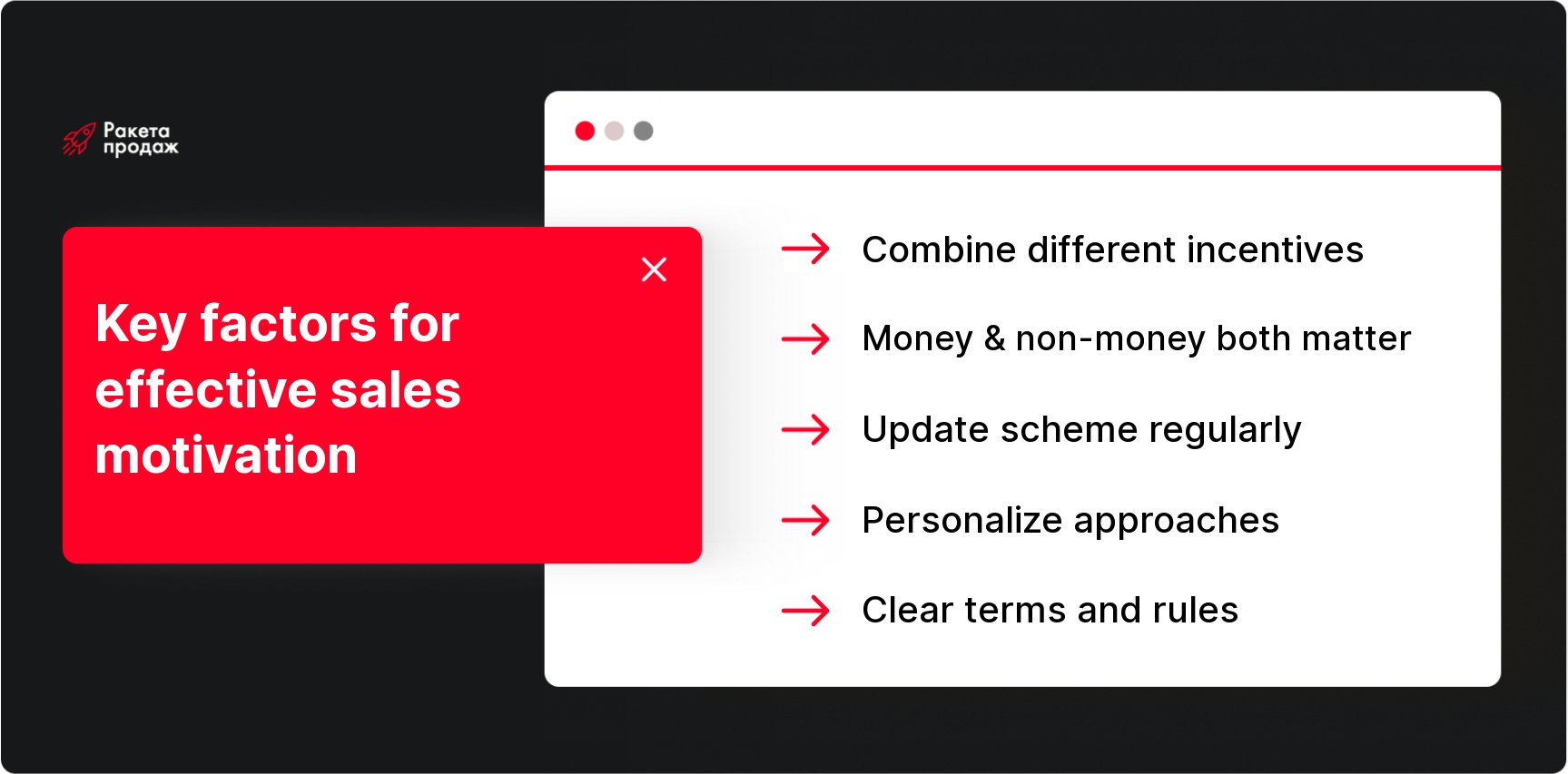
image

Choosing the optimal motivation model for a sales department is not a simple task. Each approach has its strengths and weaknesses that need to be considered in the context of your business specifics and team characteristics.

Comprehensive motivation systems combining material and non-material incentives have a number of significant advantages. First of all, they effectively target different employee needs – from basic financial security to recognition and self-realization. Such a multi-layered approach is usually more sustainable in the long term, as it doesn’t depend on just one motivation factor.

Research shows that companies with well-thought-out comprehensive motivation systems demonstrate significantly lower staff turnover. Salespeople who feel that the company invests in their development, recognizes their achievements, and offers growth prospects are less likely to leave even when receiving offers with slightly higher salaries.

Another important advantage of comprehensive systems is increased overall productivity. When motivation touches not only sales volume but also quality of work with clients, development of new skills, and team interaction, this leads to more sustainable and balanced results.

However, any motivation system has its “bottlenecks” and limitations. One common problem is the need for personalization. People differ in their motivators: for some, the decisive factor is financial reward, for others – recognition, for still others – development opportunities. Attempts to apply an absolutely identical scheme to all employees may lead to it being ineffective for part of the team.

Another limitation is related to overemphasis on material incentives. If focusing exclusively on financial stimuli, “habituation” may occur over time – employees begin to perceive bonuses as due, and ever-larger sums are required to maintain motivation. Additionally, excessive emphasis on individual financial results may undermine teamwork and lead to unhealthy competition.

There is also a risk of manipulation by employees. With too rigid a link between rewards and specific indicators, salespeople may find ways to artificially “inflate” needed metrics at the expense of real business goals. For example, if the bonus depends only on the number of new clients, managers may neglect working with existing ones, even if this leads to their outflow.

This is why it’s so important to regularly review motivational schemes and survey employees. Market conditions change, company strategic priorities evolve, and salespeople themselves, with growing experience and changing life circumstances, begin to respond differently to various incentives. Regular feedback collection, analysis of the existing system’s effectiveness, and readiness for its adjustment are necessary conditions for maintaining high team motivation.

Ideally, the motivation system should be reviewed at least once a year, with the possibility of making targeted adjustments during significant changes in the market or company strategy.

Choosing the optimal motivation model for your sales team is a complex task requiring deep understanding of not only theory but also practice in implementing various incentive systems. Many companies spend months experimenting with different models, losing valuable employees and missing growth opportunities in the process. “Rocket Sales” offers a ready solution – an individually developed motivation system that takes into account your business specifics, product, and team. Our experts will conduct a comprehensive audit of the current situation, identify key motivation drivers for each manager, and develop a personalized program with clear KPIs and a bonus system. Our clients’ results speak for themselves: conversion increases of 5-86%, stable sales plan execution at 150%, and reduced staff turnover. The most impressive case – a monthly turnover increase of $1.6 million in just 4 months of working with our motivation system.

Create a sales department that consistently brings results, not headaches - order a motivation system development from experts!

Conclusions

As we have seen, there is no universal, ideal motivation model that would work equally well in all companies and for all employees. An effective motivation system should consider business specifics, product features, sales cycle, corporate culture, and individual team needs.

Maslow’s motivation model reminds us of the importance of satisfying basic needs before moving to higher motivation levels. Stable salary, friendly atmosphere, recognition of achievements, and growth opportunities – all these elements should be present in a balanced system.

Vroom’s motivation model draws our attention to the psychological mechanisms of motivation: salespeople must believe that their efforts will lead to results, and results – to rewards they value. Transparency, predictability, and fairness of the motivation system come to the forefront here.

The bonus-based sales motivation system provides flexible tools for directing salespeople’s energy to business priorities, be it sales volume, margin, or new product development. The key is finding the right balance between fixed and variable parts.

Motivation through KPI allows making goals concrete and measurable but requires caution not to overload the system with multiple indicators and not to provoke manipulations.

The graded motivation system for the sales department offers a structured approach to development and career growth, which is especially valuable for retaining talented salespeople in the long term.

Finally, the American employee motivation model demonstrates a high-intensity approach with emphasis on individual results and competition, which can be effective under certain conditions but requires adaptation to local culture.

When choosing a motivation model for your sales department, remember that the best results are usually given by a combined approach, combining elements of different employee motivation models. It’s equally important to regularly review the system, collect feedback from the team, and be ready for changes. Motivation is not a static structure but a dynamic process that should evolve along with your business and team.

If you’re just starting or planning to build a modern sales department, we recommend thinking through a motivation system for various company growth scenarios in advance.

If you’re interested in deep elaboration of forming a motivation system considering all the nuances of your team or want to learn how to deal with such problems as staff rotation in sales and objective evaluation of manager effectiveness, you’ll find additional useful materials at these links.

In this article:
See more
Book a FREE sales funnel audit
CONTACT US
FAQ
What employee motivation models are used in the sales department?

Various employee motivation models are used in sales departments: motivation according to Maslow’s theory (from basic needs to self-realization), Vroom’s expectancy theory (the relationship between efforts and results), the bonus-based motivation system (salary + variable part), motivation through KPI (key performance indicators), and the graded system (career growth levels with various rewards). Most successful companies use a combination of these models, adapting them to their business objectives.

Which sales manager motivation system is considered the most effective?

The most effective is considered to be a combined system that includes both financial incentives (competitive salary and transparent bonus part) and non-material ones (recognition, development opportunities, career growth). The optimal ratio of fixed to variable parts depends on business specifics: for B2B with a long deal cycle, a higher share of fixed (70/30) works better, for retail and simple sales – a higher share of variable part (40/60).

When should a graded motivation system for the sales department be used?

It makes sense to implement a graded motivation system when the company has at least 10-15 sales managers, there is a need to retain valuable employees, and build a long-term career perspective. This system is especially effective in businesses where there’s a significant difference in sales complexity and required qualifications – for example, from simple retail sales to working with large corporate clients or complex technical solutions.

How often should the salesperson motivation system be reviewed?

The salesperson motivation system should be reviewed at least once a year under stable market conditions. In periods of rapid change (economic crises, entering new markets, launching new product lines), it’s recommended to conduct reviews every 3-6 months. It’s also important to regularly collect feedback from salespeople about working and non-working elements of the system and be ready for targeted adjustments at any moment if the current scheme stops bringing expected results.

SUBSCRIBE TO MY TELEGRAM CHANNEL
The most valuable sales information right on your phone!
icon

LOTS OF USEFUL INFORMATION, FREE TEMPLATES, AND CHECKLISTS ON MY INSTAGRAM

Materials and practical advice on sales growth in our blog: