icon

BATNA Technique in Sales: How to Always Have a Plan "B" and Not Fear Deal Failure

Imagine a situation: you’re conducting important negotiations with a client, and they suddenly start dictating their terms, lowering the price, and demanding additional services. Sound familiar? In such moments, many salespeople panic and agree to unfavorable conditions just to avoid losing the deal. But what if confidence in negotiations comes not from the strength of arguments, but from knowing that you have an alternative?

Want a high-performing sales team without the hassle?
We’ll build it for you.
Contact Us

Key Takeaways

  • A salesperson without alternatives clings to deals at any cost; the client senses this and extracts discounts, additional services, and unfavorable terms.
  • Your BATNA must be specific (not “someone will buy it” but “we have an agreement with Company X on similar terms”), otherwise it becomes an illusion of security.
  • Strong salespeople use BATNA as internal support, weak ones use it as a threat in negotiations, destroying the collaborative atmosphere.
  • The breakeven point shows the minimum for a deal, but a strong BATNA raises the bar higher, increasing your profit.
  • Understanding customer alternatives (their BATNA) allows you to choose arguments more precisely and not waste resources where success probability is low.

In the full article, you’ll find specific questions for evaluating your alternatives, an algorithm for preparing for negotiations, and mistakes that turn BATNA from a tool into an illusion. Read
below 👇

BATNA (Best Alternative To a Negotiated Agreement) is a key tool of the Harvard negotiation method. Simply put, it’s your Plan B in case negotiations reach a deadlock. The BATNA technique in negotiations allows you to negotiate from a position of strength, not desperation. When you know your possibilities outside the current deal, you become much more confident and can refuse unfavorable conditions using the BATNA method for negotiations.

What is BATNA and Where Did the Technique Come From

The BATNA concept was developed as part of the Harvard Negotiation Project by professors Roger Fisher and William Ury. In 1981, they presented this approach in their book “Getting to Yes,” which became a desk reference for many negotiators worldwide. According to the authors, BATNA is literally the best alternative you have if current negotiations don’t lead to an agreement.

The main purpose of BATNA is to free you from dependence on the outcome of specific negotiations. When you have no alternatives, you become a hostage to the situation, forced to accept any terms. The BATNA principle gives you freedom of choice and the ability to assess whether it’s worth continuing negotiations or better to implement another option.

It’s important to understand that BATNA is not just a compromise or concession. It’s a full-fledged alternative action plan that you will implement if current negotiations don’t yield the desired result. Unlike a compromise, which occurs within current negotiations, BATNA exists outside of them and doesn’t depend on the other party.

Let’s say you’re selling legal services to a client for 100,000 hryvnia. A compromise might be reducing the price to 90,000 hryvnia. And your BATNA is having another client willing to pay the same 100,000 hryvnia, or the ability to use that time to develop another project that will bring you comparable benefits. This approach makes BATNA in negotiations a powerful tool in the hands of an experienced negotiator.

Why BATNA is a Source of Confidence in Sales

image

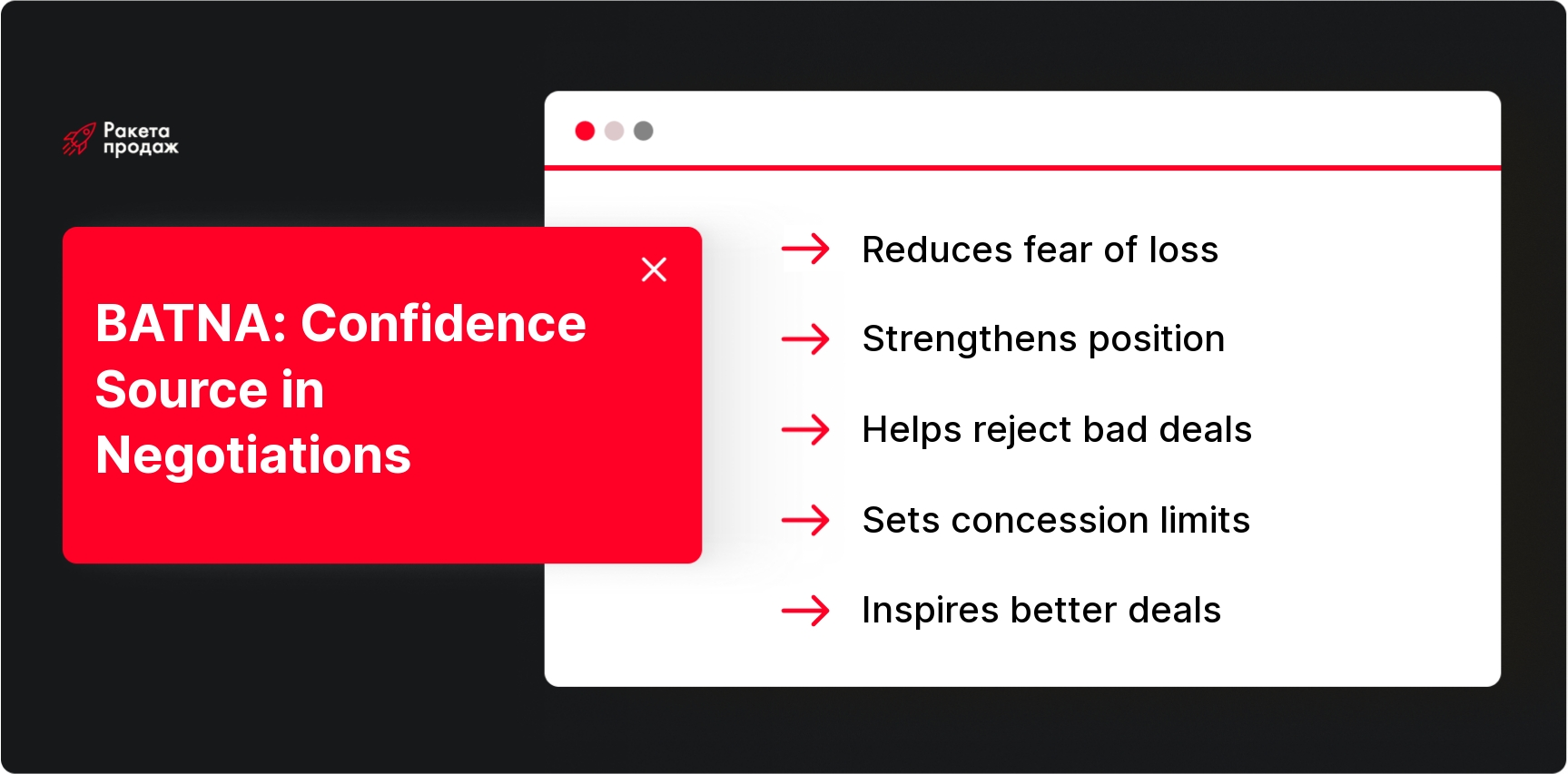
When a salesperson has no BATNA, they start clinging to the deal at any cost. The client immediately senses this and gains an advantage. A salesperson in this situation is ready to agree to ever-lower prices, additional free services, and other unfavorable conditions – just to avoid losing the deal. As a result, even if an agreement is reached, it often turns out to be unprofitable.

BATNA radically changes this dynamic by removing the fear of losing a client. Imagine: you know that if this client doesn’t agree to your terms, you have another potential buyer or an alternative way to use your resources with no less benefit. This knowledge gives you inner peace and confidence. You no longer panic at the thought of rejection.

A salesperson who knows their alternatives conducts negotiations calmly and professionally. They’re not afraid to insist on a fair price because they know: if the deal doesn’t happen, it’s not the end of the world. Such behavior earns respect from the client and often leads to more favorable terms for the seller.

For example, an IT services sales manager who knows that they have three more potential clients with similar requests in their sales funnel will behave much more confidently with the current client. If the client starts demanding unacceptable discounts, the manager can politely but firmly defend their position, understanding that rejection won’t be catastrophic for them. This inner confidence often becomes the decisive factor for success in complex negotiations.

How to Determine Your BATNA Before Negotiations

Preparing for negotiations using BATNA requires a systematic approach and careful analysis. The process of determining your BATNA can be broken down into several key steps that will help you clearly understand your alternatives and use them as an advantage in negotiations.

First, you need to clearly define the goal of the negotiations. What exactly do you want to achieve? This could be a specific sales amount, certain contract terms, or a strategic partnership. Without a clear understanding of the goal, it’s impossible to assess which alternatives will truly be valuable to you.

Next, you should establish the minimum you’re willing to accept. This is not the same as BATNA, but rather your “red line” or exit point from negotiations. For example, if you’re selling a service for 100,000 hryvnia, your absolute minimum might be 80,000 hryvnia, below which the deal becomes unprofitable.

The next stage is a detailed description of all possible alternatives. What will you do if these negotiations don’t succeed? These could be other potential clients, alternative uses of your resources, changing your business model, or even entering another market. It’s important to be as specific and realistic as possible in evaluating these alternatives.

Then you need to evaluate each alternative according to several criteria:

  1. Economic benefit (how much money this alternative will bring)
  2. Time costs (how quickly this alternative can be implemented)
  3. Risks (how likely it is that this alternative will work)
  4. Alignment with strategic goals (does this alternative help achieve long-term goals)

For example, for a software sales manager, BATNA might look like this: “If client A doesn’t agree to our terms, we have client B who is ready to sign a contract for 90% of our target amount within two weeks, with a 70% probability of closing the deal.”

It’s important to understand that BATNA is not a rejection of negotiations, but a tool to strengthen them. Knowing your alternatives, you can make more balanced decisions and not agree to unfavorable terms under pressure of fear or uncertainty.

The Connection Between BATNA, ZOPA, and WATNA: A Complete Negotiation Model

The emergence of BATNA is inseparable from other important business negotiation concepts, which together form a complete negotiation model. Understanding the relationship between these concepts significantly increases the effectiveness of your negotiations and helps make more informed decisions.

ZOPA (Zone of Possible Agreement) is the range within which both parties can find an acceptable solution. The upper limit of ZOPA is determined by the maximum price a buyer is willing to pay, and the lower limit by the minimum price a seller is willing to accept. For a deal to successfully close, these values must overlap, creating room for maneuver.

BATNA, in turn, helps determine the lower boundary of ZOPA for the seller. If the client’s offer turns out to be worse than your BATNA, you should be ready to exit negotiations and implement your alternative. A strong BATNA shifts your minimum acceptable price upward, potentially increasing your share in the final deal.

WATNA (Worst Alternative To a Negotiated Agreement) is the worst-case scenario that can happen if negotiations don’t succeed. WATNA analysis helps assess risks and prepare for the most unfavorable outcomes. For example, if your BATNA is selling goods to another client, WATNA might be that you won’t find a new buyer and the goods will remain in storage.

Together, these three elements create a comprehensive picture of negotiations. BATNA gives you support and confidence, ZOPA shows room for maneuver, and WATNA forces you to soberly assess risks. Understanding these relationships is especially important in sales, where you often have to balance between ambitious goals and real possibilities.

For example, knowing their BATNA and WATNA, a seller can more accurately determine how far they are willing to go in concessions while staying within ZOPA, and not agreeing to terms worse than their BATNA. Such a structured approach transforms negotiations from an emotional process into a calculated strategic game.

How to Use BATNA During Negotiations

Skillful use of BATNA during negotiations is an art that requires not just preparation but tactical thinking. Key point: BATNA gives you confidence, but doesn’t necessarily need to be openly presented to the opposite side.

When should you mention BATNA in negotiations? This question requires a strategic approach. If your BATNA is truly strong and specific, you can carefully hint at its existence. However, direct statements like “I’m not interested in your offer, I have better clients” may be perceived as rudeness and undermine the atmosphere of trust.

A more effective approach is indirect mention. For example: “I’m very interested in cooperating with you, but I want to be honest – we’re currently considering several partnerships with similar terms. Therefore, it’s important for us to quickly understand if we can find a mutually beneficial solution.” This wording doesn’t sound like a threat but makes it clear that you have alternatives.

BATNA helps you not to give in under pressure and remain calm during tense moments in negotiations. When a client says, “This is too expensive, we can find an offer 30% cheaper,” a salesperson without BATNA often panics and immediately offers a discount. A salesperson with a strong BATNA can calmly reply, “I understand your concerns about the price. Let’s discuss in detail what exactly is included in our offer and what value this will create for your business.”

The psychological effect of BATNA manifests in the confidence you radiate. Clients feel this confidence even if you don’t talk about your alternatives directly. They see that you’re not desperately trying to close a deal at any cost, but offering a partnership on mutually beneficial terms.

Here’s an example of a phrase that can be used when BATNA negotiations reach an impasse: “I understand your terms, but if we can’t find a balance, we have another cooperation format that’s also currently under consideration. In any case, I appreciate the time you’ve devoted to discussing our offer.” This wording shows respect for the client and at the same time makes it clear that you have alternatives.

How to Assess the Strength of Your BATNA

Not all BATNAs are equally strong, and understanding the real strength of your alternatives is critical for effective negotiations. Overestimating your BATNA can lead to breaking a potentially profitable deal, while underestimating it can lead to accepting unfavorable terms. How can you properly assess the strength of your BATNA?

There are several key criteria for such an assessment. First, the potential benefit of the alternative. How valuable will the result be to you if you choose an alternative path? This isn’t always measured only in money – also consider strategic value, development of customer relationships, and long-term prospects.

Second, the probability of successfully implementing the alternative. A BATNA that looks attractive on paper but has low chances of implementation cannot be considered strong. Be honest with yourself in assessing risks and obstacles.

Third, evaluate how the alternative aligns with your overall business strategy. Even a profitable alternative can be a weak BATNA if it distracts you from your main strategic goals or contradicts company values.

A useful tool for assessing BATNA strength can be a comparative table of alternatives:

Alternative Probability of Success Potential Benefit Implementation Time
Client A 60% 250,000 1 month
Client B 40% 400,000 3 months

Such a table allows you to visually compare different options and choose the strongest BATNA. In the given example, Client A represents a more reliable alternative with quick implementation, although the potential benefit is lower. Client B offers greater benefit, but with a lower probability of success and a longer implementation period.

It’s important to periodically review and update your BATNA assessment, especially in a dynamic market environment. What was a strong alternative a month ago may lose relevance today. Regular analysis allows you to maintain the relevance of your negotiating position and make more informed decisions.

How to Determine the Other Party's BATNA

Understanding not only your own BATNA, but also that of the opposite side gives an enormous advantage in negotiations. This knowledge allows you to more accurately determine what concessions a client might make and which arguments will be most convincing for them.

Why is it important to understand the client’s alternatives? Imagine: a client says your price is too high. If you know they have no real alternatives or all alternatives are substantially worse than your offer, you can more confidently defend your position. Conversely, if you understand that the client has a strong BATNA, you’ll need to more convincingly justify the value of your offer.

How can you learn about a client’s BATNA if they’re unlikely to tell you about it directly? Well-formulated questions can help here. For example: “What other solutions did you look at before our meeting?”, “What criteria are most important to you when choosing a partner?”, “What will happen if you decide to postpone this project?” Answers to these questions can provide valuable information about what alternatives the client is considering.

Pay attention to indirect indicators of the strength of a client’s BATNA. Haste in negotiations often indicates a weak BATNA – it may be important for the client to conclude a deal quickly because they have no good alternatives. Mentions of other suppliers can be either a sign of a strong BATNA (if the client is actually conducting parallel negotiations) or a bluff.

The terms that the client puts forward are also important. Tough demands and unwillingness to compromise may indicate a strong BATNA. Conversely, willingness to discuss details and seek mutually beneficial solutions often indicates that the client is interested in cooperating specifically with you.

The stronger the other party’s BATNA, the more creativity is required in negotiations. If you understand that a client has good alternatives, focus on the unique advantages of your offer. Use facts, figures, and cases of successful clients to demonstrate why your solution is better than the alternatives.

Understanding the client’s BATNA allows you to conduct negotiations more strategically, not wasting resources where the probability of success is low, and investing in relationships with clients where you have a competitive advantage.

BATNA and "Breakeven Point" in Negotiations

One common misconception is confusing BATNA with the “walk-away point” or minimum acceptable deal terms. These concepts are related but have important differences that need to be understood for effective negotiations.

The “walk-away point” is the minimum offer you’re willing to accept within current negotiations. It’s an internal boundary, crossing which you’ll prefer to exit negotiations. BATNA exists outside the context of current negotiations – it’s your alternative action plan if negotiations don’t succeed.

How do you determine your “breakeven point” in negotiations? For this, you need to carefully calculate all costs associated with providing a product or service, including direct expenses, overhead, time costs, and opportunity costs. To this sum, you should add the minimum acceptable profit. The result will be your breakeven point.

For example, a marketing consultant knows that conducting an audit for a client will take 40 hours of work. Given their minimum rate of 2000 hryvnia per hour, direct costs for software, and minimum acceptable profit, their breakeven point is 100,000 hryvnia. If a client offers 80,000 hryvnia, the consultant understands that this amount is below their breakeven point.

The mistake many salespeople make is confusing BATNA with a “backup plan if things don’t work out.” BATNA is not just a spare plan in case of failure, but a full-fledged alternative that you actively develop. A strong BATNA requires investments of time and resources even before negotiations begin.

In our example with the consultant, BATNA might be the opportunity to conduct a similar audit for another client for 120,000 hryvnia. Knowing this, the consultant can firmly refuse the offer of 80,000 hryvnia, understanding that they have a better alternative. Thus, a strong BATNA allows setting the exit point above the minimum breakeven point, which increases potential profit.

How to Train a Sales Team to Work with BATNA

Implementing the BATNA technique in a sales team’s work is a process that requires a systematic approach and constant practice. Proper training in this methodology can significantly increase the effectiveness of the entire sales department and improve company results overall.

BATNA should become an integral part of preparation for any deal. For this, it’s worth developing a clear algorithm that every sales manager will follow before important negotiations. This algorithm should include analyzing the current situation, evaluating alternatives, and determining the minimum acceptable deal terms.

Practical training is a key element in learning to work with BATNA. Organize team sessions where employees can model various negotiation scenarios and practice determining and using BATNA. Role-playing games are particularly effective, where some employees act as sellers and others as clients with different types of BATNA.

Regular analysis of past negotiations with a focus on BATNA helps the team learn from their own experience. Discuss both successful and unsuccessful cases. What BATNA did we have? How strong was it? How did we use it? What could we have done better? Such analysis allows the team to constantly improve their skills.

A useful tool can be the implementation of “Alternative Deal Scenarios” templates in the company’s CRM system. This will allow managers to systematically record information about potential BATNAs for each major deal and track their development. This approach makes working with BATNA part of daily routine, not a one-time exercise.

A simple but effective checklist “3 questions before the meeting” can become a useful habit for the entire sales team:

  1. What is my current BATNA?
  2. How strong is it compared to the deal under discussion?
  3. What can I do to strengthen my BATNA before or during negotiations?

Implementing such a checklist helps managers always enter negotiations prepared and confident in their position.

By the way, if you want to systematically raise the level of your team, don’t forget about preparation and development of managers – regular training, certification, and implementation of new negotiation techniques provide long-term results.

Mistakes When Using BATNA

Even knowing the benefits of BATNA, many salespeople make mistakes that reduce the effectiveness of this technique or even lead to negative consequences. Understanding these mistakes will help you avoid typical traps and maximize the potential of BATNA.

One of the most common mistakes is a BATNA based on illusions. Salespeople often comfort themselves with the thought “if this client doesn’t buy, someone else will buy anyway.” But such an abstract BATNA has no real power. A real BATNA must be specific and realistic. Not “someone will buy,” but “we have a preliminary agreement with company X, which is interested in our product on similar terms.”

The second serious mistake is using BATNA as a threat. Phrases like “if you don’t agree to our terms, we have other options” sound like an ultimatum and can destroy the atmosphere of cooperation. BATNA gives you inner confidence but shouldn’t be used to pressure the client. It’s much more effective to indirectly hint at the existence of alternatives while maintaining a respectful tone.

Lack of updating is another common problem. BATNA is not static – it changes as market conditions change, your business develops, and new clients and opportunities appear. What was a strong BATNA a month ago may be irrelevant today. Regular review and updating of your alternatives is a necessary part of working with BATNA.

Neglecting the client’s BATNA can also lead to unpleasant surprises. If you don’t understand what alternatives your potential client has, you risk overestimating your negotiating position. A client with a strong BATNA can easily reject your offer if it doesn’t exceed their alternatives. Therefore, always try to gather information about your client’s possibilities and alternatives before beginning serious negotiations.

Finally, many make the mistake of perceiving BATNA exclusively as a tool for rejecting deals. In fact, the goal of BATNA is not to reject more often, but to conclude more profitable agreements and make more conscious decisions. A strong BATNA can become the basis for more constructive and mutually beneficial negotiations.

BATNA and Technology: How Artificial Intelligence and Analytics Strengthen the Negotiating Position

Modern technologies open new possibilities for strengthening BATNA and make the process of preparing for negotiations more effective. Artificial intelligence, big data, and analytical tools are becoming powerful allies for the seller in developing and evaluating alternative options.

Artificial intelligence helps analyze market data and identify realistic alternatives that may be invisible to the human eye. For example, machine learning systems can analyze thousands of potential clients, assess the probability of successfully concluding a deal with each of them, and suggest optimal alternatives for current negotiations. Such analysis, based on real data rather than intuition, makes BATNA more reliable. You can learn more about the possibilities of artificial intelligence in sales in a separate article.

Analytical platforms also allow more accurate assessment of the potential value of each alternative. While salespeople used to rely on approximate estimates, now they can use predictive analytics to forecast not only the likely price of a deal, but also the timing of its conclusion, the resource costs for its implementation, and the potential for further cooperation. This approach is closely related to sales funnel analytics tools, which help see an objective picture of deal effectiveness and alternative prospects.

Automation of argument preparation and training of negotiation scenarios is another advantage of modern technologies. Special programs can generate response options to possible client objections, model various negotiation scenarios, and help the seller prepare for different tactics that the opposite side might use.

Virtual negotiation simulators allow salespeople to train in a safe environment, honing their skills in presenting their BATNA and responding to client actions. These simulators can use data from real negotiations to create the most realistic scenarios and offer personalized recommendations for improving skills.

The digital approach to developing BATNA provides substantial advantages in modern sales. First, it’s speed – technologies allow quickly gathering and analyzing large volumes of information, which is critically important in a dynamic business environment. Second, it’s accuracy – algorithms can identify non-obvious connections and patterns that a person might miss. Third, it’s scalability – once developed, the system can be replicated across the entire sales team, ensuring a uniform high standard of preparation for negotiations.

Companies that actively integrate technological solutions into the process of developing BATNA gain a significant competitive advantage and demonstrate higher indicators of successful sales.

Conclusion

BATNA is not just a negotiation technique, but a fundamental approach to conducting business that changes the very essence of your interactions with clients. It’s not manipulation, but a tool of awareness, allowing you to make balanced decisions and conduct negotiations from a position of confidence, not fear. The key understanding that BATNA provides: your confidence grows in proportion to the quantity and quality of alternatives you have.

A salesperson with a strong BATNA doesn’t fear rejections – they simply choose the best deals. This approach not only increases the effectiveness of each specific deal but also changes the psychological dynamics of the entire sales process, transforming it from a desperate search for clients into a strategic selection of the best partnerships. Implement BATNA analysis in preparation for each meeting, and you’ll notice how your attitude toward negotiations and their results change.

To build a truly effective sales process, it’s better to combine BATNA implementation with a comprehensive approach – for example, using a step-by-step guide to sales, so that alternatives analysis becomes a stage of each deal.

In this article:
See more
Book a FREE sales funnel audit
CONTACT US
FAQ
What is BATNA in simple terms?

BATNA is your “Plan B” in case negotiations don’t lead to an agreement. Simply put, it’s the best course of action you have if the current deal falls through. When you know exactly what you’ll do in case of failure, you conduct negotiations much more confidently and don’t agree to unfavorable terms.

Why does a salesperson need a BATNA?

BATNA gives the salesperson psychological freedom and confidence in negotiations. When you know you have an alternative, you don’t desperately cling to every client, but choose the most profitable deals. This allows you not to agree to low prices and unfavorable conditions, and helps build healthier business relationships.

Should I tell the client about my BATNA?

In most cases, you shouldn’t directly tell the client about your BATNA – this may sound like a threat or pressure. It’s better to indirectly hint at the existence of alternatives: “We’re considering several partnerships now” or “We have a limited amount of resources that we want to invest in the most promising projects.”

What is BATNA technique?

The BATNA technique in sales is a strategic approach to negotiations where you identify your best alternative options before entering discussions. This technique helps salespeople maintain leverage by knowing exactly what they’ll do if the current negotiation fails. When using the BATNA technique, you’re better positioned to walk away from unfavorable deals because you’ve already developed viable alternatives.

How is BATNA different from a "walk-away point" or minimum concessions?

The “walk-away point” is the minimum terms you’re willing to accept within current negotiations. BATNA exists outside the context of current negotiations – it’s what you’ll do if negotiations don’t take place. BATNA helps determine your “walk-away point,” but these are different concepts. A strong BATNA usually raises your “walk-away point,” making you less inclined to serious concessions.

How can I implement the BATNA principle in challenging negotiations?

To implement the BATNA principle effectively, start by thoroughly researching all possible alternatives before negotiations begin. Create detailed scenarios for each alternative and evaluate them based on financial outcomes, implementation time, and strategic value. During negotiations, maintain awareness of your BATNA without explicitly threatening the other party with it. The BATNA principle works best when it gives you internal confidence rather than serving as an external threat.

Are there any special approaches to BATNA in negotiations across different cultures?

Yes, different cultures may require adapted approaches to using BATNA in negotiations. For example, in relationship-focused cultures like many Asian countries, directly mentioning alternatives can damage trust. In such contexts, it’s better to strengthen your BATNA behind the scenes while maintaining harmony in discussions. The метод батна для переговоров (BATNA method for negotiations) may need cultural adaptation while preserving its core principles.

And to ensure your deals don’t “hang” after discussing terms, master proper follow-up in sales – this will increase conversion even when you have backup alternatives.

SUBSCRIBE TO MY TELEGRAM CHANNEL
The most valuable sales information right on your phone!
icon

LOTS OF USEFUL INFORMATION, FREE TEMPLATES, AND CHECKLISTS ON MY INSTAGRAM

Materials and practical advice on sales growth in our blog: