Key Takeaways
- Sales stages are not a random process but a structured sequence that increases system efficiency and sales predictability by 19%.
- The classic five step sales model includes establishing contact, identifying needs, product presentation, handling objections, and closing the deal.
- Salespeople often make the mistake of skipping the needs identification stage and jumping straight to product presentation without understanding the client’s real problems.
- Modern sales techniques (AIDA, SNAP, SPIN) help adapt the process to different client types and business specifics.
- Companies with a defined sales strategy increase deal volume by 10%, improve lead quality by 14%, and reduce the sales cycle by 12%.
In the full article, you’ll find a detailed description of each sales stage and practical advice on avoiding typical mistakes 👇
A Sales Management Association study published by Harvard Business Review found an 18% difference in revenue growth between companies with a formalized sales process and companies without one. Whether you sell luxury cars or consulting services, understanding the key sales stages can help turn cold contacts into engaged prospects.
So, let’s join Raketa Prodazh to investigate what a sale consists of and why following proven techniques of successful sales matters if you want to improve your metrics and stop losing clients halfway through the deal.
What are the 5 stages of sales?
Sales stages represent a structured sequence of steps a sales manager follows when working with a client—from first contact to deal completion. Think of it as a roadmap showing where you are in the journey and what actions to take next.
Consider the sales process stages as a checklist—each point addresses a specific task:
- Systematization: you won’t forget important steps or skip stages
- Control: you know exactly where a deal is stuck and where adjustments are needed
- Scalability: newcomers learn the process faster by following a proven algorithm
- Predictability: you can forecast the probability of closing deals in your funnel
It’s important to understand that sales process stages aren’t a rigid script. Rather, they form a flexible framework that adapts to your niche, product, and client type. A proper sales structure ensures consistency across your team. Statistics show that companies with a defined sales process and effective sales techniques achieve 19% more revenue goals than those without.
Even with excellent understanding of sales stages, many companies struggle with systematic implementation. Knowing the theory is only half the battle. Statistics show that 70% of results depend on a properly structured sales model and management control. At Raketa Prodazh, we’ve developed a comprehensive approach to building sales departments that considers all stages of the customer journey—from establishing contact to closing the deal. Our experts conduct a detailed audit of your sales department, identifying funnel weak points and determining exactly where clients are being lost.
With over 7 years of experience, we’ve successfully built 187+ sales departments across 14+ different niches. The average revenue increase for our clients is +35%, with the best recorded result being +$1.6 million in just 4 months. We not only implement effective processes and scripts, but also train your team to properly navigate each sales stage, from identifying needs to handling objections.
Turn your knowledge of sales stages into a system that delivers predictable results—order a free sales department audit now!
5 Stages of Sales Step by Step
The classic five-step sales model is a time-tested approach used by companies all over the world. To put you in the picture, let’s take a closer look at each stage in detail.
| Stage |
Goal |
What the Manager Does |
Example Phrase |
Common Mistake |
Control Metric |
| 0. Preparation |
Understand the customer context |
Reviews the customer, CRM, and contact history |
“Am I right that your current priority is ___?” |
Contacting the customer unprepared |
% of qualified leads |
| 1. Establishing Contact |
Start the conversation and build trust |
Introduces themselves and explains the purpose |
“Let’s first clarify your current situation. Does that work?” |
Starting with a presentation |
Contact → conversation |
| 2. Needs Discovery |
Understand needs and decision criteria |
Asks about the situation, problem, and desired result |
“What would you like to change about the current situation?” |
Asking too few questions |
Conversation → qualification |
| 3. Presentation |
Connect the solution to the need |
Presents benefits relevant to the customer |
“You mentioned that ___ is important. This solution will help you ___.” |
Listing product features |
Presentation → next step |
| 4. Objection Handling |
Remove barriers to purchase |
Clarifies the concern and responds to it |
“Am I right that price is the main concern?” |
Arguing with the customer |
% progressing after objection |
| 5. Closing |
Confirm the decision |
Agrees on payment, contract, or next action |
“Then shall we confirm the next step: ___?” |
“Think about it and let me know” |
Win rate / payment |
| Customer Development |
Retain and develop the customer |
Collects feedback and offers support |
“Are there any new needs we can help with after implementation?” |
Disappearing after payment |
Repeat sales / retention |
1. Establishing Contact with the Client
The first 30 seconds of conversation can determine the success of the entire sale. At this stage, your task is to create a positive first impression and interest the client. Key steps include:
- Preparation: learn maximum information about the client before meeting
- Greeting: use appropriate forms of address, smile (even on the phone, it’s audible)
- Networking: find common ground to establish rapport
- Attention triggers: use phrases that attract attention: “Do you know what companies in your industry most often face?”
Example: “Good afternoon, Alexander Petrovich! Thank you for making time for our meeting. After analyzing our experience with companies in your profile, I’ve prepared several solutions that have helped our clients increase sales by 15-20%. Tell me, what’s your current priority?”
2. Identifying the Customer’s Needs and Motivation
A key mistake many salespeople make is immediately jumping to product presentation. First, you need to understand what the client truly needs—their pain points and needs. At this stage:
- Ask open questions: “Tell me about…”, “How are you currently solving…”
- Use the SPIN technique: situation, problem, implication, and need-payoff questions
- Listen actively: take notes, paraphrase what you’ve heard
- Identify pain points: not just obvious issues, but hidden problems
3. Presenting the Product or Service
Now that you understand the needs, you can present the solution. But this isn’t just listing features—clients need benefits. I suggest following this algorithm:
- Feature → Advantage → Benefit: not “we have 24/7 support,” but “thanks to round-the-clock support, you can solve any issues the moment they arise, saving you up to 3 hours of downtime monthly”
- Match needs: link each function to an identified need
- Visualization: use visuals, examples, success stories
- Engagement: ask verification questions, obtain micro-agreements
Table: Effective Presentation Structure
| Presentation Stage |
Content |
Purpose |
| Introduction |
Brief summary of identified needs |
Show understanding of client’s situation |
| Solution |
Product/service description emphasizing benefits |
Connect solution with needs |
| Confirmation |
Cases, testimonials, guarantees |
Reduce perceived risks |
| Verification |
Clarifying questions |
Ensure understanding and interest |
4. Handling Customer Objections
Objections aren’t refusals but requests for additional information. Being prepared for them demonstrates professionalism. Therefore:
- Listen: don’t interrupt, let the client express themselves
- Clarify: “Do I understand correctly that you’re concerned about…”
- Acknowledge: “I understand your concern, many clients have asked this question”
- Answer: specifically, with examples and evidence
- Verify: “Have I answered your question?”
5. Closing the Deal and Next Steps
Closing the deal is the final stage of the sales funnel. Many managers get lost at this stage. To prevent this:
- Pay attention to readiness signals: notice when the client is ready to buy (detailed questions about implementation, clarifying timeframes)
- Use effective closing methods – direct closing: “Ready to proceed with the contract?”, alternative: “Would you prefer to start this month or next?” and summarizing: “Let me summarize all the benefits you’ll receive…”
Additional Sales Stages and Modern Techniques
While the classic model is effective, today’s market demands additional approaches. Let’s look at the most effective methodologies.
Additional Sales Stages: Prospecting, Upsell, After-Sales Service
The classic five-step model focuses on dialogue with the client, but in a real funnel everything starts much earlier and continues after payment. The first additional stage is prospecting. This is systematic work with lead sources: advertising, content, partner programs, referrals. It’s important not just to collect more contacts, but to set clear quality criteria: who your ideal client is, what budgets they have, what tasks they want to solve, and how ready they are for change. This is where the future conversion of all stages of selling goods and services is determined.
The second stage is upsell and cross-sell. The idea is to strengthen the main solution rather than push something unnecessary. The salesperson offers additional modules, services, training, or extended warranties – everything that increases value for the client while raising the average check without pressure. Smart upsell works when it logically follows from the identified needs, not from a desire to “sell something else.”
The third stage is after-sales service. Onboarding, support, regular touchpoints after the deal, feedback requests, and offers of updates or additional solutions build loyalty and repeat sales. Companies that build a systematic process after closing the deal achieve higher LTV, more referrals, and more stable workload for the sales team, because the client doesn’t just buy once – they come back.
Advantages of the Five-Step Sales Technique
The five-step sales technique gives managers a clear framework: what to do first, which questions to ask, and how to guide the client to a decision. It covers the main stages of selling goods and services – from establishing contact to closing the deal – and reduces the number of random “intuitive” actions that dilute funnel conversion.
A clear sequence of stages makes it easy to analyze where results are “dropping”: you can see at which step clients most often fall off and reinforce precisely that part of the process. This increases transparency in the sales department, makes it easier to set up KPIs, control the quality of calls and meetings, and link sales bonuses to specific metrics.
Another important advantage of the five-step model is scalability. New employees ramp up faster when they have a clear action algorithm instead of chaotic “just try to sell somehow” advice. A structured approach saves time on onboarding, reduces the company’s dependence on “star” salespeople, and builds a sales department where results are a pattern, not an accident.
Modern Sales Techniques: AIDA, SPIN, SNAP
AIDA (Attention-Interest-Desire-Action) is a sequential chain of emotional states the client should progress through:
- Attention: capture the client’s attention with unexpected statistics or questions
- Interest: deepen engagement by showing understanding of their problems
- Desire: strengthen emotional connection with the solution through success stories
- Action: clearly indicate what step needs to be taken now
This methodology is particularly effective in B2C sales and advertising, where emotional components play a significant role.
SNAP (Simple-iNvaluable-Aligned-Priority) is a method developed for sales in environments where clients are overwhelmed with information:
- Simplicity: maximum clarity in communication, no information noise
- Value: focus on unique advantages for the specific client
- Alignment: your offer must align with the client’s business goals
- Prioritization: creating a sense of urgency in decision-making
In current conditions, where clients face time deficits and information overload, SNAP is becoming increasingly relevant.
SPIN sales are distinguished by a deep approach to identifying needs through a system of questions:
- Situation questions: “What CRM systems have you used previously?”
- Problem questions: “What difficulties do you encounter with sales analytics?”
- Implication questions: “How do these problems affect your department’s efficiency?”
- Need-payoff questions: “If you could automate this process, how would it impact your results?”
SPIN works excellently in complex B2B sales with long decision-making cycles and large deals.
Additional Sales Strategies and Stages
Modern sales techniques rarely stop at the classic 5 steps. In real life, additional sales stages appear between establishing contact and closing the deal, and they significantly increase both conversion and average check. These may include pre-sale diagnostics, a trial period, a pilot project, a strategic session, or an audit of the client’s current situation. Such stages help reduce tension, demonstrate your expertise, and shift the conversation from “selling a product” to jointly solving the client’s business challenges.
It’s also important to highlight multi-step strategies: multichannel touchpoints (calls, emails, messengers, content), nurturing through valuable materials, and follow-up as a mandatory stage rather than a “if I remember” action. In B2B, the land & expand approach works especially well: you start with a small project and then scale to a comprehensive solution. These additional sales strategies don’t replace the main stages – they reinforce them: shortening the sales cycle, building trust, and moving the client from “I’ll think about it” to action.
Can You Skip Sales Stages?
A sales rep can always “save time” by skipping part of the conversation. But every skipped step has its price. When the stages of selling goods and services are ignored, the process becomes chaotic: the rep doesn’t have time to warm up interest, doesn’t get to the real needs, presents a solution “into nowhere,” and the client disappears without explanation. From the outside, it looks like “the market has dropped” or “clients went to competitors,” while in reality the funnel is leaking at several stages.
Sales stages are not bureaucracy, but insurance against losses. Each step has its function: establishing contact builds trust, identifying needs clarifies the task, the presentation shows how the product solves it, handling objections reduces perceived risks, and closing formalizes the agreements. If you cut out any of these elements, conversion drops and the number of “I’ll think about it” and unfinished deals grows.
That’s why the real question is not “can you skip the stages of selling goods and services,” but “how much profit are you willing to lose for such time savings.” In a systematic sales department, stages are not skipped – they’re optimized, and the team is trained to move through them consistently so that every contact has a logical next step and a clear result.
Common Mistakes Made During Sales Stages
Even strong teams and great products aren’t immune to classic missteps that can impact business revenue. Sometimes a single oversight, like an incorrectly chosen sales manager, can cost not only a deal but a long-term partnership. Let’s examine the most common mistakes that prevent closing more deals faster.
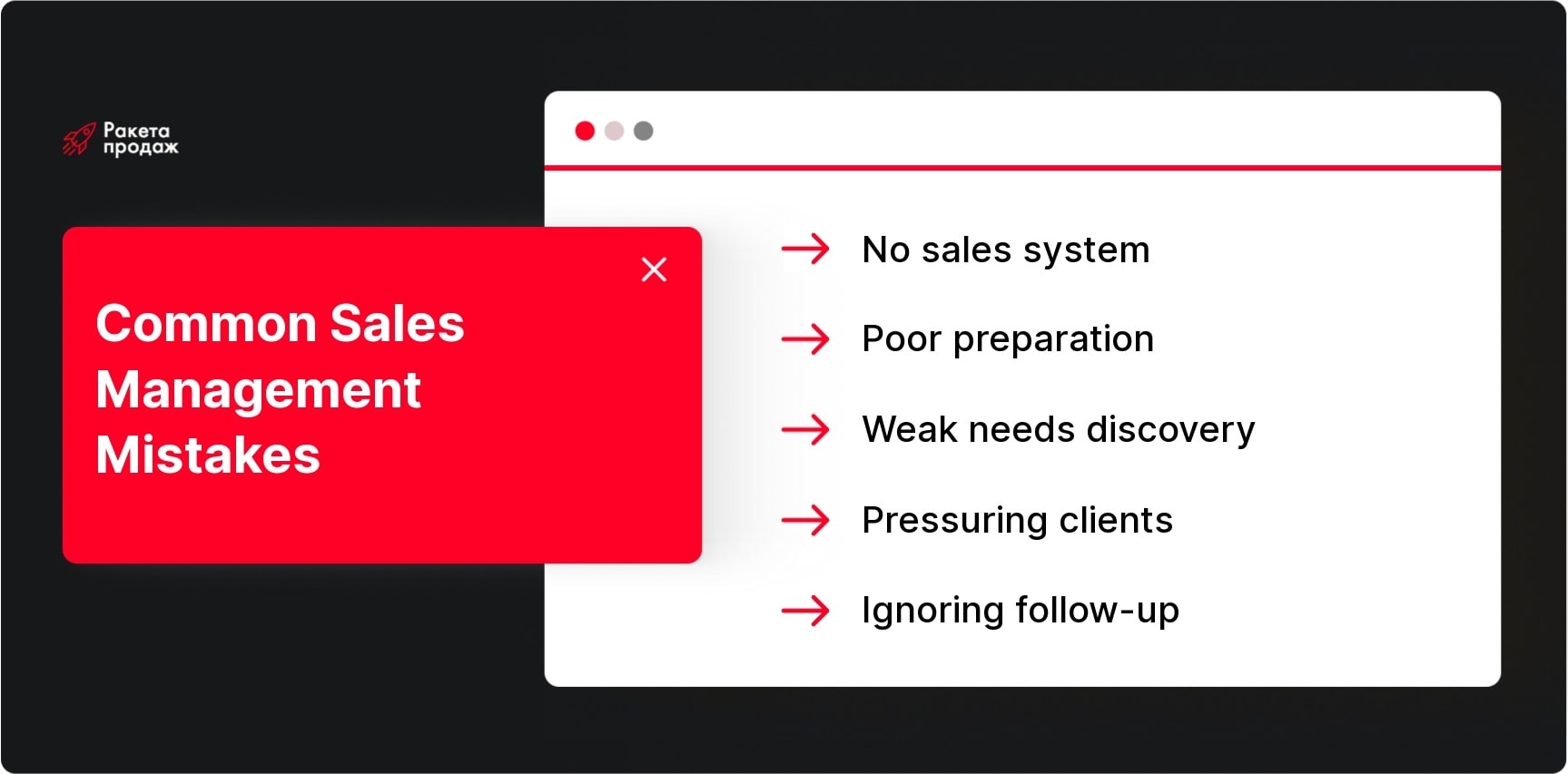
The main strategic blind spot is the absence of a sales system. When a salesperson works on “gut feeling” without a clear plan and understanding of who they’re facing and what they want—don’t count on successfully closing the deal. Another typical problem is weak understanding of the target audience. The same script for everyone? That doesn’t work.
Sales professionals often neglect preparation: entering a call or meeting without studying the market and client. And, of course, a genre classic—selling features instead of benefits. Clients aren’t interested in your characteristics; they care about what pain you solve and what they’ll ultimately receive.
Statistics show that only 37% of salespeople really understand their company’s strategy. Yet 80% of strategies fall apart at the execution stage—because systematic work is absent.
Even if the strategy is well-built, everything can break down with basic communication. For example, when instead of lively dialogue, a boring monologue begins about “we’re the best in the market” without facts, cases, and specifics, the client only hears “blah blah blah.” It can get worse: the salesperson skips stages, rushing to close the deal without properly learning the client’s needs.
Pressure and aggression represent another mistake. Nobody likes being “pushed.” And of course, many fear objections and try to avoid them, though handling objections actually demonstrates expertise.
Even with excellent preparation and competent dialogue, everything can be ruined in the final step. One of the most expensive mistakes is abandoning follow-up. How many clients disappear simply because the salesperson didn’t call back on time! Another problem is poor lead qualification: spending time on everyone instead of prioritizing strong contacts.
Another pain point is ineffective meeting closure when clear agreements and next steps aren’t established. Add to this unrealistic deadlines and promises that later fall through—and we get a classic “drain” of trust.
Why Following Sales Stages Matters?
A systematic approach and timely sales department control aren’t boring theory from textbooks, but real growth tools. If you clearly understand where each client currently is, you can predict sales rather than guess, and confidently meet targets.
Companies with documented strategy and clear sales systems achieve 19% more revenue goals. By following the structure, you grow steadily: deals become larger, leads more qualified, and the deal cycle shorter.
When you clearly understand which stage of sales each potential client is at, you can more accurately forecast sales volume. Companies with a documented sales strategy achieve 19% more revenue goals than those without one.
By following a structured approach, you can:
- Increase deal volume by 10%
- Improve lead quality by 14%
- Reduce the sales cycle by 12%
A structured methodology allows faster onboarding of new employees. Instead of training depending on personal experience, you have a proven system that can be transferred to newcomers.
Clear stages allow you to analyze exactly where failures occur. You can precisely improve problem areas rather than trying to change the entire process.
Adapting to Changing Conditions
Understanding the sales stages makes it possible to adapt the process to changing conditions while preserving its core structure. In 2026, one of the key changes is the growing adoption of artificial intelligence in business processes. According to a Top Lead study supported by Ukraine’s Ministry of Digital Transformation, 93% of surveyed Ukrainian companies already use AI, while about 64% use it in marketing and sales. Sixty-two percent of respondents report a positive impact on productivity and economic performance.
For sales teams, this creates new opportunities across different stages: AI can support customer research before the first contact, personalized communication, CRM data management, and conversation analysis. Technology does not replace the sales stages themselves; it helps salespeople move through them faster and more systematically.
A structured approach to sales stages isn’t just theory to study, but a practical tool that can radically transform your business results. However, implementing all the described methodologies requires significant expertise and understanding of your niche’s specifics. Raketa Prodazh offers not just consultations, but a comprehensive turnkey solution for systematizing your sales department. We build the entire chain—from developing scripts for each stage to implementing CRM systems, from training in needs identification techniques to creating effective control tools.
Working with companies of various scales (including Mitsubishi, Audi, Naftogaz), we’ve developed a methodology that ensures systematic sales growth. Our approach includes not only setting up processes at each funnel stage, but also training your team, implementing motivation systems and analytical dashboards for result monitoring. As a result, you get a sales department that consistently meets and exceeds plans, while your managers clearly navigate each sales stage, increasing conversion by 5-86%.
Stop losing clients at various stages of sales—implement a professional system that will guarantee increased turnover!
A structured approach to sales is a fundamental element of successful business. Whether you use the classic five-step model or modern methodologies like SPIN or Challenger, the key to success is systematization and consistency.
Effective sales isn’t the art of manipulation, but the ability to understand client needs and offer solutions beneficial to both parties. By strictly following the stages of sales, you not only improve your metrics but also build trusting relationships with clients, leading to repeat deals and recommendations.
In today’s Ukrainian market realities, with its challenges and transformation, it’s particularly important to remain flexible while not abandoning proven structures. Combine classic techniques of successful sales with digital tools, adapt to changing conditions, but always remember: a quality sales process description is the client’s journey from problem to solution, and your task is to make this journey comfortable and productive.
If you want to understand exactly where your sales system is losing profits—order a sales department audit from Raketa Prodazh. We’ll show where your funnel is “leaking,” find 3 to 5 growth points, and help take your department to a new orbit. Click “Get Audit” and see you at the launch! 🚀


 Time to read: 15 min.
 16 July 2025