icon

Negotiating with Large Companies: How to Train B2B Salespeople to Close Big Deals

Have you ever noticed how different negotiations with a large corporation are from a regular sale? It’s no longer enough to simply present a product and quote a favorable price. In corporate deals, you face an entire decision-making system – multiple meetings, different departments, numerous approvals. A single call can turn into a three-month marathon with multiple stakeholders and unexpected turns. Meanwhile, the stakes in B2B sales are much higher – we’re talking about million-dollar contracts that can either save a company’s annual plan or completely ruin it.

Want a high-performing sales team without the hassle?
We’ll build it for you.
Contact Us

Key Takeaways

  • Large corporations make decisions through a cascade of approvals, where deals can be blocked not only by top managers but also by regular specialists from related departments.
  • A salesperson who negotiates only with their direct contact and ignores IT, legal, or financial departments risks losing the deal at the final stage due to an unexpected veto.
  • Strong negotiators build an influence map before the first meeting and speak the language of business results, not product features.
  • Each concession should be part of an exchange, not a show of weakness. Determine the hierarchy of concessions in advance and use less valuable ones in the early stages.
  • Your meeting should end with a specific next step with a date and responsible person, otherwise the process will slow down and stall.

In the full article, you’ll find a step-by-step negotiation strategy, specific techniques for working with stakeholders, and methods for closing deals without pressure. Read below 👇

Such deals require not just good salespeople, but true strategic negotiators capable of thinking several steps ahead and building relationships with different levels of decision-making. Let’s examine why sales to large companies require a special approach, and how to develop these skills in your B2B salespeople.

Why Negotiations with Large Companies Require a Special Approach

Corporate deals are radically different from standard sales. Imagine: you’re selling internet marketing services. In a small company, one person (the owner or director) can make a decision in a single meeting. In a large corporation, your proposal will go through the marketing department, then IT security, legal, finance, and finally receive management approval.

The main difference is that large companies operate with a complex system of decision-makers. There isn’t a single “yes” or “no” – there’s an entire cascade of approvals, where both an executive and a regular specialist from the security department can block a deal. Additionally, corporations have an entire political map – different departments have their own interests, and decision-influencers may compete with each other. A salesperson who doesn’t understand this internal dynamic is doomed to fail.

The second important feature is risk. For a large company, implementing a new solution always involves serious risks: reputational, financial, operational. Your contact in the company risks their position by recommending your product. Therefore, corporations require much more thorough examination of security, reliability, and return on investment (ROI) issues.

The third factor is bureaucracy. Large companies have standardized procurement processes that cannot be bypassed. Often, specific procedures must be followed: tenders, collecting multiple proposals, formal presentations. In such conditions, “just selling well” is not enough – you need to navigate corporate processes and help your contact guide you through these labyrinths.

Finally, the time factor. While in small business a decision can be made in a day, in the corporate world the sales cycle can stretch over months. A salesperson must maintain interest and energy throughout this time, preventing the process from “cooling down” or getting lost among other company priorities.

Thus, successful work with large clients isn’t just about a quality presentation, but a comprehensive strategy that takes into account the client’s organizational structure, internal processes, and potential risks. Now let’s look at typical mistakes salespeople make when negotiating with large clients.

Common Mistakes in Negotiations with Large Companies

image

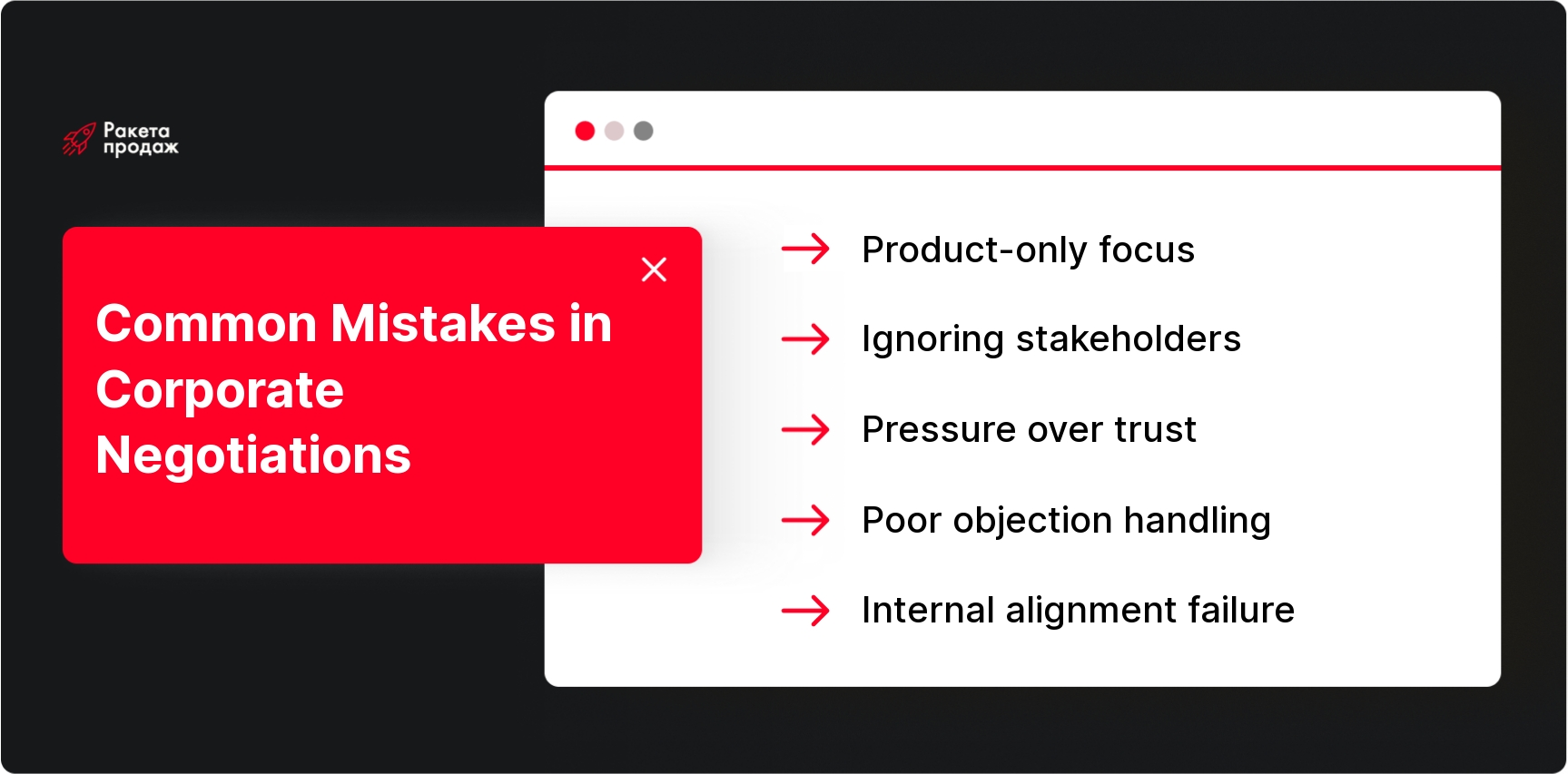
When working with large clients, even experienced salespeople often make mistakes that can cost them the deal. Let’s examine the most common missteps to consider when preparing B2B salespeople.

The first and most common mistake is focusing only on the product rather than business value. Many salespeople get caught up in describing the features and functions of their solution but forget to speak the language of business results. For a marketing director, what’s important isn’t an “innovative platform with integration capabilities” but “increasing conversion by 15% and reducing customer acquisition costs.”

For example, an IT company presented a new CRM system to a corporate client, detailing all the platform’s technical capabilities. The presentation lasted an hour, but at the end, the financial director asked just one question: “How will this affect our revenue next quarter?” The salesperson couldn’t answer clearly, and the deal was postponed indefinitely. This is why it’s so important to think ahead about how CRM implementation in sales can change key business metrics and present this effectively in negotiations.

The second common mistake is lack of understanding of the client’s political map. Many salespeople work only with their direct contact without building relationships with other influential people in the company. But in corporations, decisions are made collectively, and each process participant has their own interests and concerns.

A typical example: a logistics service provider was negotiating with the supply director of a large supermarket chain. Everything was going well, but at the last moment the deal was blocked by the IT director, who wasn’t involved in the process but had concerns about integrating the new system with the existing infrastructure. If the salesperson had identified all stakeholders in advance and involved the IT director in the discussion, the problem could have been avoided.

The third mistake is pressure and attempts to “push through” without building trust. Some salespeople, especially at the end of a quarter or year, begin to exert excessive pressure on the client, trying to force a decision. This might work in small business, but corporate clients immediately sense pressure and usually react negatively. How to close a large client without pressure? Instead of direct pressure, use the “soft close” method: 1) Summarize the discussion, highlighting all agreements reached; 2) Confirm the solution’s value for specific client business needs; 3) Propose the next small step rather than a final decision; 4) Use positive outcome assumptions: “When we start implementation…” instead of “If you decide…”; 5) Give the client a sense of control by providing choices between options (but not between “yes” and “no”).

The fourth common mistake is inability to handle business-level objections. B2B salespeople are often prepared to answer questions about product technical characteristics but get lost when objections concern strategic aspects: “how does this align with our long-term goals?” or “what are the risks to our market position?” To increase confidence in such situations, it’s extremely useful to master the techniques recommended in the expert guide on handling objections.

Complex B2B negotiations with large clients are truly a separate art form. If you recognize yourself in the situations described above, perhaps your salespeople lack a systematic approach to conducting complex B2B negotiations. At “Rocket Sales,” over 7+ years we’ve created a methodology for training managers in effective negotiations with large companies. Our approach combines the best international B2B methodologies (MEDDIC, BANT, SPIN Selling, Challenger Sale) with individual analysis of specific negotiation situations in your team.
We don’t just teach theory but build a complete negotiation system: from analyzing target clients to handling objections and strategies for closing complex deals. The results speak for themselves – our clients increase turnover by an average of 35%, and the maximum case showed +$1.6 million in 4 months of work. Among our partners are companies like Mitsubishi, Yamaha, Naftogaz and others who significantly improved the effectiveness of negotiations with key clients after working with us.

Transform complex corporate negotiations into a manageable process – get a free consultation on training your team!

Finally, the fifth critical mistake is ignoring the client’s internal approval process. Many salespeople think their job is done when the contact person says “yes.” But in large companies, this is just the beginning. Next, your contact must “sell” your solution within their organization, and if you don’t prepare them for this – don’t provide convincing materials, answers to typical questions from colleagues, ROI calculators – the entire deal can fall apart at the internal approval stage.

You can avoid these mistakes only by approaching B2B negotiations as a managed strategic process. Let’s see what such a strategy looks like in action.

Negotiation Strategy in Large Deals: Step-by-Step Logic

Successful B2B negotiations are not improvisation but a carefully thought-out process. Unlike ordinary sales, here it’s important to follow a system that will allow you to control the negotiation process and move toward closing the deal. To increase the effectiveness of individual stages, integration of B2B sales strategies will help – specializing in approaches that have proven their effectiveness specifically in working with large clients.

Let’s consider a step-by-step strategy that will help your salespeople successfully negotiate with large clients.

Client Analysis and Building an Influence Map

In large companies, there is no “individual decision” – there is a complex network of influence that must be understood and considered. Experienced B2B salespeople start by building an influence map – a visual diagram showing who formally makes the decision, who really influences this process, and who can block it.

It’s important to understand that besides the obvious process participants (such as the department head who will use your product), there are hidden stakeholders. These can be financial department employees who evaluate economic efficiency; information security specialists who check your solution against company standards; lawyers who review contract terms; or even top managers whose approval is required for large expenses.

Practical advice: use an “influence map” – a visual diagram marking all stakeholders with their roles (deciding, influencing, consulting), level of influence (high, medium, low), and personal motivation (financial efficiency, innovation, security). Such a map will help your salespeople understand who to interact with and how to advance the deal.

Formulating Negotiation Objectives

A common mistake is to think that the goal of each client meeting is to “close the deal.” In reality, in long B2B cycles, each meeting has its specific purpose, and this purpose should be realistic.

Instead of going straight for the offer to sign a contract, experienced negotiators set specific goals for each meeting: get agreement for a pilot project, clarify budget constraints, meet the technical director, address a specific objection.

Practical advice: before each meeting, fix your goal in a “minimum-maximum” format. Minimum is the result you must achieve (e.g., getting the technical director’s contact). Maximum is the optimistic scenario you’re aiming for but which isn’t critical for progress (e.g., getting preliminary agreement to launch a pilot). This approach helps maintain focus and evaluate the effectiveness of each meeting.

Diagnosing Interests and Motivations

To negotiate successfully, you must distinguish between the client’s position (“we need a 20% discount”) and their interest (“we’re afraid of budget overruns” or “I need to show management that I negotiated good terms”). Position is what the client says, and interest is the true reason behind this statement.

To identify true interests, use SPIN questions (Situation, Problem, Implication, Need-payoff). For example, instead of immediately reacting to a discount request, ask: “What specific budget constraints do you have?” or “What happens if you exceed your allocated budget?”

It’s equally important to understand the personal motives of participants: their KPIs, fears, career goals. For a marketing director, growth in conversion and brand awareness is important; for a financial director – ROI and risk minimization; for IT specialists – integration with existing systems and security.

Practical advice: ask at least three “why” questions in each contact, not just “what” questions. For example, not just “What budget are you planning?” but “Why was this particular budget allocated to this project?” Such questions will help you understand true motives and constraints.

Creating a Negotiation Position: Value vs. Concessions

Professional B2B salespeople build their value proposition around business results, not product characteristics. For example, instead of “our platform has 50 integrations” – “our system will reduce order processing time by 40%, which will increase your turnover and reduce operational costs.”

Before starting negotiations, it’s important to determine your “zone of possible agreement” (ZOPA) – a range of conditions within which an agreement will be beneficial to both parties. You also need to know your BATNA (Best Alternative To a Negotiated Agreement) – the best alternative option if negotiations fail. This is your “exit point,” which provides psychological comfort and confidence in negotiations.

Concessions in negotiations are not a sign of weakness but a tool for exchange. Each concession should be presented as part of a mutual exchange: “We can accelerate implementation if there’s confirmation of the pilot by the end of the month” or “We’re ready to provide additional licenses if you become our reference client.”

Practical advice: define in advance the hierarchy of possible concessions – from least to most valuable to you. Use less valuable concessions in the early stages of negotiations, saving more substantial ones for the final stage when they can play a decisive role in closing the deal.

Managing Meeting Dynamics

Successful negotiators actively manage meeting dynamics, building a clear structure: diagnosis → argumentation → clarification → fixing agreements. At the diagnosis stage, you ask questions to understand the situation and needs. Then you move to argumentation, linking your offer to identified needs. At the clarification stage, you work with objections and adjust the offer. In conclusion, you fix agreements and determine the next steps.

Negotiation rhythm also requires management. Sometimes you need to accelerate the process if you feel the client is ready to make a decision. In other cases, it’s worth deliberately slowing down, giving the client time to realize the value of the offer or consider a complex issue.

Psychological techniques play a big role: pauses that make the client continue the thought; mirroring (repeating the interlocutor’s last words), which demonstrates attention; generalizations that help structure the discussion.

Practical advice: after each semantic block, fix intermediate agreement using phrases like “Do I understand correctly that…” or “We agree that…”. This reduces the risk of misunderstanding and creates a sense of progress in negotiations, as well as prevents the situation when at the end of the meeting the client unexpectedly returns to already discussed issues.

Closing the Deal and Next Steps

The conclusion of negotiations is a critical moment that often determines the success of the entire process. Professional B2B salespeople don’t “push” the client but lead them to a decision through confirming the benefits and value of the offer.

The “commitment close” technique is effective – transitioning from intentions to specific actions. Instead of a general “Do you like our offer?” ask “We’re starting implementation next month. What specific steps can we already plan?” Such a question assumes the decision has already been made and focuses attention on practical implementation.

It’s extremely important to end each meeting with a clear understanding of the next step: a specific action, responsible person, and deadline. For example: “So we’ve agreed: I’ll send you the contract draft by Wednesday, you’ll pass it to your lawyers, and next Tuesday we’ll call to discuss their comments.”

Practical advice: at the end of the meeting, always propose the next specific step, even if the client isn’t ready to make a decision right now. “I suggest organizing a demonstration for your technical team in a week” or “Let’s call on Friday so I can answer any remaining questions.” This approach maintains momentum and doesn’t let the process slow down.

It would also be useful to study and implement modern deal closing techniques, which make the process of concluding negotiations more manageable and structured.

Key Techniques and Tactics of Successful B2B Negotiations

Besides a structured approach, successful B2B negotiators master specific techniques that significantly increase negotiation effectiveness. Let’s look at the most effective ones that should be implemented in your sales team’s arsenal.

Active listening and developing empathy is a fundamental skill for building trust. This isn’t just staying silent while the other person speaks, but a complex skill including full concentration, tracking nonverbal signals, rephrasing what you’ve heard, and asking clarifying questions. When you truly listen, the client feels understood and valued – this creates a solid foundation for mutually beneficial relationships.

The right concession strategy is also critically important. Experienced negotiators never make concessions just for the sake of it – each concession should be part of an exchange. They determine the limits of possible compromises in advance and don’t go beyond them even under pressure. The “sandwich” technique is particularly effective – first a small concession, then the main part of negotiations without significant compromises, and a small final concession at the end, which gives the client a sense of victory.

Avoiding anchor traps and manipulations requires constant vigilance. An anchor is the first figure or condition mentioned, which psychologically affects all subsequent negotiations. Professional negotiators try to establish their own anchor by being the first to propose deal terms, but be prepared that an experienced client may do the same. In this case, it’s important not to react immediately, but to reformulate the discussion, moving away from the established anchor toward a conversation about value.

The technique of providing multiple alternative offers (MESOs – Multiple Equivalent Simultaneous Offers) is particularly effective for increasing the chances of a deal. Instead of one offer, present the client with 2-3 options with equal value to you, but different structures for the client. For example: an option with a higher price but long-term installments; an option with a moderate price and standard terms; an option with a minimal price but a long-term contract. This gives the client a sense of choice and control while preserving your interests.

Using data, case studies, and social proof significantly strengthens your arguments. Specific figures and examples of successful implementation of your solution in companies similar to the client reduce perceived risk and build trust. “We implemented this solution in company X, which led to a 30% increase in efficiency in the first three months” sounds much more convincing than general statements about the benefits of your product.

It’s important to find a balance between persistence and flexibility. A position that’s too rigid can lead to the breakdown of negotiations, while excessive compliance undermines your interests and can be perceived as a sign of weakness. Experienced negotiators firmly defend their key interests but show flexibility in details and ways to achieve mutually beneficial solutions.Building successful negotiations with large companies is possible starting with thorough planning and preparation. Key success factors are: creating a map of decision-makers, understanding the business drivers of each stakeholder, developing a business case for your solution, preparing counterarguments for possible objections, and, especially important, forming a B2B sales strategy with step-by-step deal advancement with clear intermediate results for each interaction.

All these techniques should be applied consciously, with an understanding of the context and specifics of particular negotiations in complex deals. The sales team should regularly practice these skills and exchange experiences to constantly improve their negotiation arsenal in complex B2B negotiations. To improve the quality of interaction with existing clients, it’s also important to develop competencies in repeat sales, as successful post-sale work often directly affects long-term relationships with large companies.

Evaluating Negotiation Effectiveness and Continuous Improvement

To create a truly effective B2B sales team, it’s necessary not only to train negotiators but also to constantly evaluate their work results, identifying areas for improvement. Without objective analysis, it’s impossible to understand which approaches work and which don’t.

It’s important to track both quantitative and qualitative metrics. Key quantitative KPIs include: the share of successfully closed deals (conversion from first contact to signing), average sales cycle duration, average deal margin, and customer retention rate. For example, if a salesperson has a high closing percentage but low margin, this may indicate an excessive willingness to offer discounts to close deals.

Qualitative metrics are equally important: customer satisfaction level, quality of relationships with different decision-making levels in the client’s company, accuracy of deal forecasts. A particularly valuable indicator is NPS (Net Promoter Score) – clients’ willingness to recommend you to others.

Continuous improvement is impossible without systematic collection of feedback. After each major deal (successful or unsuccessful), conduct a detailed “post-mortem” analysis: what worked, what didn’t work, what were the key moments that affected the outcome. Everyone who was involved in the process should participate in this discussion, including not only salespeople but also employees from related departments (technical support, implementation, lawyers).

Particularly useful is the practice of “Win/Loss reviews” – analyzing the causes of victories and defeats. For this, you can even involve independent specialists who conduct interviews with clients (both those who chose you and those who rejected your offer) to identify the true reasons for their decision. Often these reasons differ from what you assumed.

Team training on real cases is another key element of continuous improvement. Regularly conduct role-playing games where one employee plays the role of a client and another plays a salesperson. Scenarios should be based on real situations your team faces. After such a simulation, all participants discuss what could have been done differently and which techniques would have been more effective.

Create a culture of sharing best practices. Regular meetings where top negotiators share their approaches, success stories, recordings of the best calls and meetings – all this should become part of the corporate culture. This approach not only improves the skills of the entire team but also creates healthy competition and a desire for improvement.

It’s also important to keep track of industry trends and negotiation methodologies. Send key employees to professional conferences, invite external trainers, provide access to professional literature. B2B sales are constantly evolving, and what worked yesterday may become ineffective tomorrow.

Remember that in developing negotiation skills, there is no endpoint – it’s an endless process of improvement. Even the most successful negotiators continue to learn and adapt their approaches to changing market conditions and customer expectations.

Methodology of Complex B2B Sales: Key Elements

Complex B2B negotiations require a clear methodology that helps structure the process and increase its effectiveness. The main elements of such a methodology include:

  1. Qualification of potential clients – determining whether it’s worth investing resources in developing relationships with a specific company
  2. Multi-level network approach – building relationships at different levels of the client’s organization
  3. Joint solution development – involving the client in creating a product or service
  4. Managing internal promotion – helping your contact person “sell” your solution within their organization

It’s especially important to highlight work with different types of stakeholders. In complex B2B negotiations, you typically face four types of participants: economic buyers (who approve the budget), users (who will work with your product), technical evaluators (who check compliance with technical requirements), and influential advisors. Each type needs its own approach, its own argumentation, and its own materials.

Negotiations with large companies are indeed a complex process requiring strategic thinking and a systematic approach. But you don’t need to spend months or years developing your own methodology for teaching salespeople this art. “Rocket Sales” offers a ready solution for transforming your B2B sales into an effective system for closing large deals.

We don’t just consult, but together build a full-fledged negotiation strategy adapted to the specifics of your business. As part of a comprehensive approach, we conduct personalized trainings for the team, implement negotiation scripts and algorithms, create checklists for different types of stakeholders, and help managers master working with influence maps in corporate deals.

Our experts have experience in 14+ B2B sales niches and have successfully trained teams at companies such as Mitsubishi, Yamaha, and Naftogaz to effectively conduct negotiations with key clients. The practicality of our approach is confirmed by numbers: the average conversion increase for clients is from 5% to 86%, and the average turnover increase is 35%.

Stop losing big deals due to ineffective negotiations! Create a team of B2B negotiators who systematically close complex deals with large clients.

Conclusion

Negotiations with large companies are an art requiring deep preparation, strategic thinking, and emotional intelligence. In today’s highly competitive B2B world, the winners are not the most aggressive salespeople, but the most prepared and attentive to client interests negotiators capable of building an influence map and finding a path to a mutually beneficial agreement. Effective B2B sales are not the work of lone wolves but the result of coordinated teamwork where everyone understands their role and strategic goal, and the exchange of experience and constant learning are built into the company’s DNA. By investing in developing complex negotiation skills, you’re not just increasing sales today – you’re creating a competitive advantage that will work for you for years.

In this article:
See more
Book a FREE sales funnel audit
CONTACT US
FAQ
What's special about B2B negotiations?

B2B negotiations are distinguished by a multi-level decision-making structure, long sales cycle, high stakes, and the need to work with multiple stakeholders simultaneously. Unlike B2C, decisions here are made not based on emotions, but through the lens of business value, ROI, and alignment with the company’s strategic goals. A deep understanding of not only needs but also the client’s internal processes is required.

Where to start negotiations with a large client?

Start with a thorough analysis of the client’s company: study its organizational structure, business model, financial indicators, strategic goals, and current challenges. Then create an influence map, identifying key decision-makers and those influencing the process. Formulate a value proposition in terms of business results and prepare a first contact strategy focused not on selling, but on identifying needs.

How to prepare for negotiations with a corporation?

Prepare a detailed understanding of your ZOPA (zone of possible agreement) and BATNA (best alternative to a negotiated agreement). Gather information about similar cases and reference projects. Prepare materials that will help your contact “sell” your solution within their company: ROI calculators, business cases, customer testimonials. Think through answers to difficult questions and objections from different decision-making levels.

How to conduct negotiations on complex deals?

When conducting negotiations on complex deals, it’s necessary to maintain a strategic approach: 1) Focus on long-term value, not quick wins; 2) Identify and work with all stakeholders; 3) Constantly check what stage the decision-making process is at; 4) Prepare convincing evidence for your claims; 5) Form champions of your proposal within the client’s company who will promote your idea when you’re not around.

Which negotiation techniques work for large deals?

Most effective are active listening techniques, SPIN questions for revealing true needs, the methodology of multiple offers (MESOs), strategic use of concessions as part of exchange rather than yielding, and “commitment” techniques for step-by-step movement toward a deal. It’s also important to be able to “read the room” and adapt your approach to different types of stakeholders in one company.

How to handle objections from a large client?

Perceive objections as requests for additional information, not as refusals. Use the “Clarify-Understand-Answer-Check” technique: first clarify the objection, demonstrate understanding of its importance, offer a structured answer with supporting data, and check if the objection has been addressed. When working with large clients, it’s especially important not to “dismiss” objections, but to treat them with respect and offer concrete steps to reduce risks.

How to train a sales team for negotiations with large clients?

Combine theoretical training with intensive practice: role-playing games, negotiation simulations, analysis of real cases. Implement a mentoring system where experienced salespeople accompany newcomers to real meetings. Regularly conduct “win/loss reviews” to analyze successful and unsuccessful deals. Create a knowledge base with best practices, scripts, and examples of successful presentations. It’s also important to develop not only technical negotiation skills but also strategic business thinking.

How to close a large client without pressure?

Instead of direct pressure, use the “soft close” method: 1) Summarize the discussion, highlighting all agreements reached; 2) Confirm the solution’s value for specific client business needs; 3) Propose the next small step rather than a final decision; 4) Use positive outcome assumptions: “When we start implementation…” instead of “If you decide…”; 5) Give the client a sense of control by providing choices between options (but not between “yes” and “no”).

How to build successful negotiations with large companies?

Building successful negotiations with large companies starts with thorough planning and preparation. Key success factors are: creating a map of decision-makers, understanding the business drivers of each stakeholder, developing a business case for your solution, preparing counterarguments for possible objections, and, especially important, forming a strategy for step-by-step deal advancement with clear intermediate results for each interaction.

SUBSCRIBE TO MY TELEGRAM CHANNEL
The most valuable sales information right on your phone!
icon

LOTS OF USEFUL INFORMATION, FREE TEMPLATES, AND CHECKLISTS ON MY INSTAGRAM

Materials and practical advice on sales growth in our blog: