icon

Top 15 Interview Questions to Determine if a Candidate Can Close Deals

In the search for the perfect sales manager, leaders often face a dilemma: a person excels in the interview, impresses with their knowledge of terminology, but then fails to deliver results. Why does this happen? The fact is that the skill of closing deals – a key competency of a salesperson – often remains unchecked during hiring.

Want a high-performing sales team without the hassle?
We’ll build it for you.
Contact Us

Key Takeaways

  • A candidate who speaks beautifully about techniques but doesn’t provide specific numbers and cases likely hasn’t closed complex deals.
  • Strong salespeople can name 3-4 clear signals of client readiness (questions about details, deadlines, payment), weak ones rely on intuition.
  • Your interview should check real actions in stuck deals, not theory about “I would wait” or “I call every day.”
  • Willingness to reject a non-target client shows a manager’s maturity, understanding of time value, and concern for reputation.
  • A professional converts the “expensive” objection into a value question, calculates ROI and breaks down cost, rather than immediately offering a discount.

In the article below, you’ll find 15 specific interview questions for sales representatives, signals of strong and weak answers, and a mini-checklist for accurately assessing the skill of closing deals 👇

Standard interview questions for a sales associate like “Tell me about yourself” or “Why do you want to work with us?” don’t provide insight into a candidate’s real ability to bring clients to payment. Meanwhile, the cost of a hiring mistake can amount to thousands of dollars in lost revenue, not to mention the time and resources spent on onboarding an unsuitable employee. You can learn more about how to avoid such losses in the article about hiring manager mistakes.

In this article, we’ll break down 15 proven questions that will help you recognize a genuine salesperson among many applicants. These questions focus specifically on the ability to close deals – a skill that cannot be faked with pretty words and memorized phrases.

Why the Skill of Closing Deals is a Key Performance Indicator for Managers

The skill of closing a deal is the manager’s ability to lead a client from interest in the product to a specific purchase decision. Essentially, it’s the final stage of the sales funnel, determining whether all previous efforts will turn into real company income or remain just pleasant communication.

Why is this skill so critical to success? Imagine two managers: both are excellent at finding clients, conducting meetings and presentations. But the first closes 30% of deals, while the second – only 10%. With the same time and resource costs, the first brings the company three times more revenue. The difference in closing skill directly affects the effectiveness of the sales manager and business stability.

Behind the closing skill lies a whole complex of competencies. This includes the ability to determine when a client is ready to make a decision, the ability to properly handle objections at the final stage, and an understanding of decision-making psychology. A good “closer” (as managers who can close deals are often called) senses when to push and when to give the client time; when to use logical arguments and when to use emotional triggers.

A typical employer mistake when evaluating this skill is believing in the candidate’s theoretical knowledge. Many applicants can beautifully describe closing techniques but are unable to apply them in practice. Another common mistake is confusing sociability with sales skills. A candidate may be very sociable and likable, but afraid to ask the client for a decision or unable to overcome final doubts.

When hiring, it’s important to remember that the skill of closing a deal is not an innate talent, but an acquired competency that develops through practice and reflection. Therefore, the situational interview questions for a sales manager are worked out based on the skills that are already built in, and this will help you identify the candidate’s real experience, not their theoretical knowledge. Let’s look at how to properly evaluate these skills during hiring.

How to Properly Evaluate a Candidate in an Interview: General Approach

An effective interview with a sales manager candidate should be as close as possible to real work situations. Theoretical questions have limited value – many candidates can talk about sales techniques they have never applied in practice. Therefore, your interview should contain practical elements: situational questions, cases from the company’s real practice, role-playing games.

The optimal interview structure includes a balance of different types of questions. Start with general questions about motivation and experience, then move on to behavioral questions about real situations from the candidate’s past experience, and finish with situational tasks where the candidate shows how they would act in specific circumstances.

When conducting interviews, it’s very important to record not only the answer itself, but also what competencies it demonstrates. For example, a candidate’s story about a complex deal can show their analytical abilities, persistence, ability to overcome obstacles, and creativity in finding solutions. Create a simple table where you note which competencies were manifested in each answer – this will help structure the evaluation.

A strong salesperson differs from a weak one in several ways. A strong candidate speaks specifically, relies on numbers and facts, gives real examples from their practice. They aren’t afraid to talk about failures and lessons learned, understanding their strengths and weaknesses. When answering interview questions for a sales manager position, a strong candidate asks clarifying questions, structures their solution, and focuses on the result, not the process.

A weak candidate, on the contrary, gives general answers, uses a lot of professional jargon without specifics, cannot provide examples from practice or provides very vague stories. They often avoid answering difficult questions or shift responsibility for failures to external circumstances. Such a candidate usually talks more about what needs to be done than about what they actually did.

Remember that an interview is a two-way process. Give the candidate an opportunity to ask questions. The questions they ask often say as much about their approach to work as their answers to your questions. Now let’s move on to specific questions that will help you assess the skill of closing a deal.

Top 15 Questions to Determine the Skill of Closing a Deal

When formulating questions to assess the skill of closing a deal, it’s important to adhere to several principles. First, give preference to behavioral questions (starting with “tell me about a case when…”) and situational ones (“what would you do if…”). Second, check practical experience, not theoretical knowledge. Third, ask clarifying questions if an answer seems too general or non-specific.

The following 15 questions will help you assess how well a candidate possesses deal-closing skills. We’ll look at which answers indicate a strong salesperson and which should raise concerns.

Describe your most difficult deal-closing case: what helped lead the client to a decision?

This question allows you to see how the candidate approaches complex situations in sales. In the answer, it’s important to hear a logical sequence of actions, not just a fortunate turn of events.

A strong candidate will tell a specific story with details: what product was involved, what the client’s objections were, what steps they took to overcome them. They will explain their strategy, show how they analyzed the client’s needs and adapted their approach. Their story will mention specific techniques they applied – for example, the alternative choice method, the “position convergence” technique, or creating scarcity.

A weak candidate will limit themselves to general phrases like “I found an approach to the client” or “I managed to convince them,” without revealing specific actions. Another warning sign will be the absence of complex deals in the candidate’s experience or attributing success to external factors.

Sounds familiar? How many times have you encountered situations where a candidate brilliantly passes the interview, impresses with knowledge of terminology, and then doesn’t show results? The cost of such a hiring mistake can cost you hundreds of thousands of hryvnias in lost profit and wasted time. That’s why “Sales Rocket” company created a systematic approach to hiring and developing sales managers, which has already been successfully implemented in 158+ sales departments across 14 different industries. Our methodology includes not only professional selection through multi-level interviews, but also creating a detailed adaptation plan, test assignments, and deep analysis of candidate motivation. We don’t just analyze problems, we completely rebuild processes, implement CRM systems, train the team, and ensure constant monitoring of results. Our clients receive an average of +35% turnover growth, with the best result being +$1.6 million in 4 months of work.

Turn the process of hiring salespeople from a lottery into a predictable system – get a free consultation today!

How do you know when a client is ready to close?

This question tests the candidate’s ability to read signals of a client’s readiness to make a decision – a critically important skill for effective closing.

An experienced sales manager knows that a client rarely says directly: “I’m ready to buy.” Instead, they send certain signals: they start asking questions about the details of cooperation, are interested in payment and delivery terms, discuss implementation, ask about discounts, or clarify technical compatibility.

A strong candidate will list specific signals they track, explain how the client’s body language and nature of questions change when ready to close. They will also explain how they check this readiness – for example, through trial closings or clarifying questions: “If we solve this issue, are you ready to move forward?”

A weak candidate will speak in general terms or rely only on intuition without specific signs. If a candidate cannot name at least 3-4 specific readiness signals – this is reason to doubt their experience in closing deals.

What do you do if a client is "thinking" for too long?

This question helps understand how well the candidate masters soft push techniques and knows how to move a deal forward when it’s stalled.

A strong sales manager knows that the phrase “I’ll think about it” often means there are hidden objections or insufficient value in the client’s eyes. They will explain that in such a situation, they first find out the real reasons for the delay: “What exactly do you need to think about?” or “What questions remain unresolved?”.

An experienced salesperson will talk about techniques they use to advance stuck deals: creating a sense of urgency (limited offer or price increases), offering a pilot project or test period, breaking the decision into smaller steps, additional value for a quick decision.

A warning signal would be a passive approach (“I wait until the client decides on their own”) or, conversely, too aggressive (“I call every day until I get an answer”). Answers in which the candidate does not try to understand the true reasons for the delay should also raise concerns.

Tell me about a client you brought back after a refusal

This question checks the candidate’s persistence and their strategy for working with clients who initially refused the offer.

A successful sales manager understands that a refusal is often not a final decision, but just a stage in negotiations. In their answer, a strong candidate will tell a specific story of returning a client, explaining how they analyzed the reasons for the initial refusal, what strategy they developed for re-contact, and what arguments they used the second time.

It’s important to hear in the answer that the candidate didn’t just “wait for a better moment,” but actively worked to change the situation: perhaps they offered new conditions, found additional value for the client, provided more evidence of the product’s effectiveness, or involved other decision-makers in the negotiations.

A weak candidate will either not be able to provide an example of a returned client, or will describe a situation where the return happened without their active actions. Answers in which the candidate says they never return to refusing clients because they “don’t waste time on those who don’t want to buy” should also raise concerns.

How do you evaluate the probability of closing a deal in percentages?

This question checks the candidate’s analytical approach and their understanding of the sales funnel. The ability to forecast correctly is an important competency for planning work and resources.

A strong candidate will explain their methodology for evaluating the probability of closing, naming specific criteria and signs. For example: “I evaluate a deal at 70% when the client has approved the commercial proposal, confirmed the budget, and we are at the stage of final agreement negotiation.” They will explain how they adjust their estimates as the deal develops and how they use this data to predict their results.

An experienced salesperson also understands that different stages of a deal have different predictability: initial stages are more uncertain, while final ones are more predictable. They can explain how their percentage estimates correlate with the statistics of their personal sales funnel.

A weak candidate will either not be able to explain their evaluation methodology (“it’s intuitive”), or will use overly optimistic estimates that don’t correspond to the real state of the deal. For example, if they evaluate at 80% a deal where there hasn’t been a meeting with the decision-maker yet, this indicates a lack of critical thinking.

What closing technique do you use most often?

This question is aimed at identifying the candidate’s practical skills and their methodical arsenal for completing a deal.

An experienced sales manager masters several closing techniques and adapts them to a specific client and situation. In their answer, a strong candidate will name specific techniques (for example, alternative close, presumptive close, concession close), explain in which situations they apply them, and provide examples from their practice.

It’s important that the candidate not only list techniques, but show understanding of how they work psychologically and why they’re effective. For example, the “closing with summarizing benefits” technique is effective because it reminds the client of all the advantages they will receive and connects them to their needs, creating motivation to buy.

A weak candidate will either not be able to name specific techniques, or will talk about them theoretically, without linking to practical experience. Answers in which the candidate says they always use only one technique with all clients should also raise concerns, as this indicates an inflexible approach.

What do you do if a client compares you with a competitor and chooses cheaper?

This question tests the candidate’s ability to defend the value of the offer and work in a competitive environment. Strong salespeople don’t give up at the first mention of competition.

A professional sales manager knows that price is rarely the only reason for choice. In their answer, a strong candidate will explain how they shift focus from price to value, how they identify the client’s real selection criteria, and how they demonstrate the advantages of their offer even at a higher price.

An experienced salesperson can share specific strategies: calculating the total cost of ownership (TCO) instead of the initial price, highlighting unique advantages that competitors don’t have, emphasizing reliability and quality of service, breaking down the price into components to show fairness of evaluation.

Warning signals would be answers in which the candidate immediately offers a discount without trying to increase value, or tries to convince the client that “quality can’t be cheap” without specific proof of this quality.

Give an example of a deal where you deliberately refused a client

This non-standard question helps assess the candidate’s business thinking and their ability to work on the quality of the sales funnel.

A mature sales manager understands that not every client is a good client. They know how to determine when a potential deal requires too many resources with a low probability of success, or when the client doesn’t match the company’s ideal buyer profile.

In their answer, a strong candidate will give a specific example of when they qualified a client as non-target, explain the criteria for this decision, and describe how they correctly ended the interaction. Perhaps they even directed the client to competitors who are better suited to solving their problems.

Such an answer shows that the candidate thinks strategically, understands the value of their time and company resources, and also cares about the brand’s reputation (it’s better to honestly refuse than to sell an unsuitable solution). If you want to learn more about what questions to ask a sales candidate during an interview for competent selection of a sales manager, refer to specialized materials.

A warning signal would be the absence of such examples in the candidate’s experience or answers showing that they are ready to sell to anyone, without evaluating the client’s prospects and the product’s suitability for their needs.

What do you do if a client goes silent after a presentation?

Such questions for salespeople in an interview check the candidate’s skill in managing communication and getting out of awkward situations that often arise in the sales process.

Silence after a presentation can mean different things: the client is thinking about the information, is not impressed, didn’t understand the value of the offer, or just got distracted by other thoughts. An experienced salesperson knows how to interpret this silence and work with it productively.

A strong candidate will explain that in such a situation, they first give the client time to think (a comfortable pause of 5-7 seconds), and then proactively take the initiative: ask open questions to elicit a reaction (“How do you evaluate what I told you?”), check understanding of key points, or suggest the next step.

A professional manager will also explain how they determine the reason for silence through the client’s non-verbal signals and adapt their strategy: if the client looks interested – move towards closing, if doubtful – identify objections, if distracted – regain focus of attention.

A weak candidate will either demonstrate discomfort with silence (“I’ll continue talking to fill the pause”), or show passivity (“I’ll wait until the client speaks first”).

How do you handle the "expensive" objection?

This is a classic objection that every salesperson faces. The candidate’s answer shows their skill in working with value and cost.

A professional sales manager knows that “expensive” is not an absolute assessment, but a relationship between price and perceived value. When a client says “expensive,” it often means “I don’t see enough value for this price.”

A strong candidate will explain that first they clarify what exactly seems expensive and what the client is comparing it to (“What exactly in our offer seems expensive to you?”). Then they work on increasing the perceived value: reminding of all advantages, recalculating the cost over a longer period of use, demonstrating ROI or reducing total expenses. It’s precisely for effective handling of such situations that it’s important to develop skills in working with objections.

An experienced salesperson can also share specific strategies: breaking down the price into components, offering installment or phased payments, comparison with alternative expenses or consequences of not using the product.

Warning signals would be either immediately offering a discount without trying to increase value, or trying to convince the client that “quality can’t be cheap” without specific proof of this quality.

Describe your process of preparing for a deal

This question allows you to assess the systematic approach of the candidate and their understanding that successful closing begins long before the final conversation.

A professional sales manager knows that thorough preparation significantly increases the probability of closing. In their answer, a strong candidate will describe a structured process: gathering information about the client and their business, studying their needs and pain points, preparing an individualized presentation or proposal, thinking through possible objections and answers to them.

It’s important to hear that the candidate analyzes the decision-making process in the client’s company: who makes the decision, who influences it, what criteria are important for different stakeholders. A strong salesperson also prepares evidence for their claims: cases, ROI calculations, testimonials from similar clients.

Warning signals would be a superficial approach to preparation (“I just repeat information about the product”) or a complete lack of preparation (“each deal is unique, I improvise”). Answers in which the candidate doesn’t mention studying the needs of a specific client should also raise concerns.

What conversion from lead to deal did you provide at your previous job?

This direct question checks how results-oriented the candidate is and their understanding of their performance indicators.

An experienced sales manager knows their metrics and can clearly articulate them. In their answer, a strong candidate will name specific conversion figures, explain factors affecting these indicators, and possibly compare their results with the department or industry average.

It’s important that the candidate understands the entire customer journey: they should know what percentage of leads moves to each next stage of the funnel (from first contact to product demonstration and from demonstration to contract signing). This shows that they analyze their work and understand at which stages there are losses and why they occur.

Warning signals would be unclear answers without specific numbers, implausibly high conversion rates without explanation of how they were achieved, or lack of knowledge of standard industry metrics.

Which deal did you learn the most from? What would you do differently?

This question checks the candidate’s ability for reflection and continuous improvement – qualities necessary for professional growth.

A strong sales manager constantly analyzes their successes and failures, extracting lessons for future deals. In their answer, an experienced candidate will tell a specific story, explain what mistakes were made or what unexpected factors affected the result, and share the lessons learned.

It’s important that the story is detailed and reflects a deep analysis of the situation. Even more important are the specific conclusions that the candidate made: changing the approach to a certain type of client, a new technique for overcoming objections, a better understanding of the decision-making process.

Warning signals would be superficial answers without specifics, inability to acknowledge their mistakes, or a tendency to explain failures exclusively by external factors. Answers in which the candidate cannot name what specifically they changed in their approach after this experience should also raise concerns.

How do you lead a client who is hesitant but shows interest?

This question checks the candidate’s skills in developing relationships with clients and the ability to balance between pressure and support.

A professional sales manager knows that doubts are a natural part of the decision-making process, especially for significant purchases. In their answer, a strong candidate will explain how they work with a hesitant client: identifying specific reasons for doubts, providing additional information and evidence, reducing risks through guarantees or a test period.

An experienced salesperson will also explain how they maintain communication with such a client: regular but non-intrusive contacts, providing useful information, invitations to company events, introducing them to current clients. They understand that trust builds gradually and know how to balance between persistence and respect for the client’s space.

Warning signals would be answers demonstrating either too passive an approach (“I just periodically remind them about myself”), or overly aggressive (“I call every day until I get an answer”). Answers in which the candidate doesn’t try to understand the individual needs and concerns of a specific client should also raise concerns.

Imagine: a client is ready to buy, but asks for an additional discount. Your actions?

This situational question tests the candidate’s skills in negotiations and defending the deal’s margin.

A professional sales manager understands that a discount request is often part of the client’s negotiation tactic, even when they’ve already decided to buy. In their answer, a strong candidate will explain how they assess the situation: is the discount really a decisive factor or is the client just testing boundaries?

An experienced salesperson will explain what alternative strategies they use instead of directly reducing the price: offering additional value for the same price (bonus service, extended warranty), discussing other deal conditions (payment terms, volumes), maintaining price for long-term cooperation.

If a discount is really necessary, a strong candidate will explain how they ensure reciprocity: “I can provide a 5% discount if you sign the contract by the end of the month” or “We’re ready to lower the price with an increase in order volume.”

Warning signals would be answers in which the candidate either immediately agrees to a discount without trying to defend the price, or categorically refuses to discuss any discounts, even if it could lead to losing the deal.

How to Interpret Candidate Responses

Proper interpretation of a candidate’s answers is no less important than formulating questions. A professional recruiter or manager should be able to see real competencies and experience behind the words.

Strong sales skills usually manifest in several key characteristics of answers. First, specificity: an experienced manager talks about real situations, names numbers, dates, company names (even if they don’t fully disclose them for confidentiality reasons). Second, structure: a strong candidate presents thoughts sequentially, highlights causes and effects, shows the logic of their actions.

Another sign of a strong salesperson is results orientation. In their stories, the emphasis is not on the process (“I called, met, presented”), but on the achieved results (“increased average check by 30%”, “reduced deal cycle from 3 months to 1.5”). Additionally, a professional manager speaks the language of the client’s business, not the language of their product’s characteristics.

Warning formulations that indicate a lack of experience include excessive use of professional jargon without understanding its essence, vague generalizations (“always”, “never”), shifting responsibility to external factors, and excessive focusing on process rather than results.

When interpreting answers, it’s important to correlate what is said with real KPIs. For example, if a candidate claims they “excellently work with key clients,” ask about specific indicators: what was the average check, what was the client retention rate, how many additional sales did they make to existing clients.

Remember that real experience is always more valuable than hypothetical reasoning. If a candidate answers situational questions theoretically (“I would do this”), clarify: “Can you give an example of when you actually faced such a situation? What specifically did you do?” This will help distinguish theoretical knowledge from practical skills.

Finally, pay attention not only to the content of the answers, but also to how the candidate presents them: whether they speak confidently, how they react to clarifying questions, whether they acknowledge their mistakes, whether they know how to listen. These behavioral aspects can also tell a lot about their skills in communicating with clients.

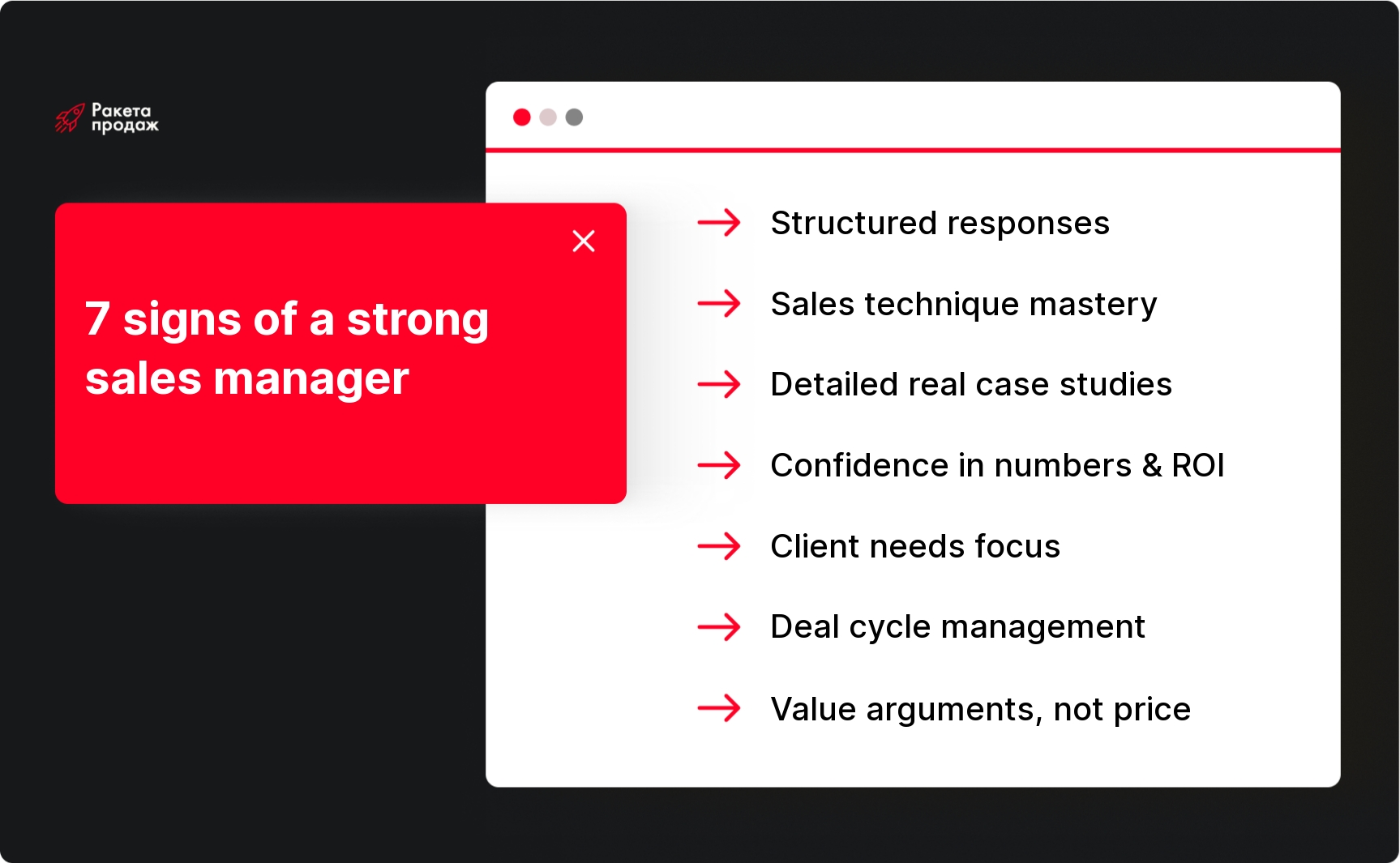
Mini-checklist: signs of a candidate who really knows how to close deals

image

To systematize the evaluation of candidates for a sales manager position, we suggest using the following checklist of key signs of a strong “closer” – a specialist who knows how to effectively close deals.

First of all, pay attention to how the candidate structures their speech. A strong salesperson speaks logically, consistently and purposefully – exactly as they lead a client to closing a deal. Their answers have a clear structure: problem statement, solution options, chosen action, result.

The second key sign is confident mastery of sales techniques. The candidate not only knows the names of techniques, but can explain how and why they work, in which situations they are applicable, and provide examples from their practice. They talk about techniques not as theoretical concepts, but as practical tools of their daily work.

The third sign is the ability to provide specific cases with details. An experienced manager remembers their deals in detail: client characteristics, their objections, arguments used, timeframes and results. They can tell the story of a deal as an engaging narrative, not as a dry report.

The fourth sign is confidence in discussing numbers and financial aspects. A strong salesperson feels comfortable talking about budgets, ROI, cost savings, margins. They understand the business logic of their product and can explain its value in financial terms.

The fifth sign is demonstration of a client-oriented approach. In the candidate’s answers, the client and their needs are always the center of attention. They don’t talk about “how I sold,” but about “how the client solved their problem with our help.”

The sixth sign is the skill of working with the deal cycle. A professional manager understands that closing is not an event but a process, and knows how to manage this process, moving the deal from stage to stage. A comprehensive view of personnel adaptation in sales will allow developing this skill in the team right from the start.

The seventh sign is the ability to argue value, not price. A strong salesperson does not compete at the price level, but demonstrates the unique value of their offer, which justifies the cost.

Conclusion

Properly selected interview questions for the sales department are a powerful tool for identifying sales managers who are truly capable of closing deals. Unlike standard questions about motivation or work experience, targeted questions about closing techniques, handling objections and specific cases allow you to see the candidate’s real competencies.

Remember that the main thing is not so much the answers themselves, but how the candidate arrives at them. A true sales professional demonstrates structured thinking, results orientation, deep understanding of client psychology and the decision-making process. They speak specifically, provide examples from their practice, and clearly articulate their contribution to business results.

Ultimately, a quality interview saves the company time and resources by allowing you to choose employees who will not just fill vacancies, but will actually bring profit. Use the questions and checklist of strong salesperson signs proposed in this article, adapt them to the specifics of your business – and you will significantly improve the quality of hiring in the sales department.

Finding the perfect sales manager isn’t just about reviewing resumes and asking standard interview questions. As you’ve already understood from our article, it requires a systematic approach and deep understanding of which skills are truly important for successful sales. “Sales Rocket” company specializes in creating turnkey sales departments, where we work with you from developing the ideal candidate profile to complete adaptation and training of new managers. Our methodology includes detailed process auditing, creating a hiring funnel, implementing adaptation and training systems, developing motivational models and control systems. Thanks to this, our clients receive teams that consistently achieve 150% of the plan monthly. We work with market leaders such as Mitsubishi, Yamaha, and Naftogaz, helping them solve complex sales challenges. Don’t risk time and money on experiments with unprepared candidates when there is a proven path to success.

Build a sales department that guarantees 150% plan overperformance — order professional recruitment and training of managers!
In this article:
See more
Book a FREE sales funnel audit
CONTACT US
FAQ
3 main qualities of a sales manager?

The key qualities are: goal orientation and persistence (ability to overcome rejections and continue working), empathy and communication skills (ability to understand client needs and build trust), analytical thinking (ability to analyze the situation and adapt the sales strategy). It’s this combination of qualities that allows effectively leading a client from first contact to closing a deal.

What questions to ask a sales candidate during an interview?

In a sales manager interview, questions almost always ask about past sales experience, specific achievements and indicators (KPIs), techniques for handling client objections, and methods for closing deals. Often include situational interview questions for a sales manager: “How would you handle it if a client says your product is too expensive?” or behavioral: “Tell me about the most difficult deal you closed.”

What should a good sales manager know?

A good manager should know their product and its competitive advantages, client decision-making psychology, needs identification methods, objection handling techniques, and deal closing. Equally important is understanding of the market and competitive environment, as well as basic knowledge in business analysis for calculating ROI and demonstrating economic benefits to the client. To pass a sales manager interview successfully, the candidate needs to master these skills.

Can you model a mini-deal in an interview to test the candidate in action?

Yes, this is a very effective evaluation method. You can offer the candidate a role-play where you act as a potential client. For example, give them 10 minutes to prepare and ask them to conduct a presentation of your product, intentionally raising objections. Or model a specific stage – for instance, the first call or handling a price objection. This will allow you to see the candidate’s real skills, not just their theoretical knowledge. A case interview for a sales manager is an excellent way to assess practical skills.

What interview questions for the sales department are most informative?

The most informative questions reveal the candidate’s real experience and achievements: “Tell me about your largest deal,” “How did you bring back a client who initially refused?”, “What closing techniques do you use and why?”. Tricky interview questions for sales managers, such as “What would you do if a client suddenly cancels a meeting at the last minute?”, also help assess the candidate’s reaction in stressful situations. Questions about specific metrics and KPIs that the candidate tracked at their previous workplace are useful.

What questions are definitely asked in an interview?

In a sales manager interview, ask questions that check the real skill of closing “Describe the most difficult case and what you personally did,” “What 3/4 signals show the client’s readiness for a decision?”, “What do you do if a client is ‘thinking’ for too long?”, “How do you handle the ‘expensive’ objection and choosing a cheaper competitor?”, “What was your conversion rate and how do you evaluate the probability of closing in percentages?”. A strong candidate always answers with specific numbers, stages, ROI, demonstrates a flexible arsenal of closing techniques and readiness to segment clients. A weak one resorts to general phrases, doesn’t name metrics and often talks about discounts.

SUBSCRIBE TO MY TELEGRAM CHANNEL
The most valuable sales information right on your phone!
icon

LOTS OF USEFUL INFORMATION, FREE TEMPLATES, AND CHECKLISTS ON MY INSTAGRAM

Materials and practical advice on sales growth in our blog: