icon

How to Test Sales Skills During Recruitment: Test Assignments, Role-Playing, Calls

Why do some salespeople turn every contact into a deal, while others can’t sell even the most in-demand product? It’s not just about speaking eloquently. An effective sales manager possesses a complex set of skills that are difficult to evaluate in a single standard sales manager interview.

Want a high-performing sales team without the hassle?
We’ll build it for you.
Contact Us

Key Takeaways

  • Classic interviews with questions about past experience don’t show how a candidate will handle real sales in your company.
  • Charisma and verbosity are often mistaken for professionalism, but strong salespeople know how to listen and ask the right questions rather than just talk.
  • Role-playing games for salespeople and call simulations reveal how candidates structure dialogue, respond to objections, and close deals, not just talk about their achievements.
  • A standardized evaluation scorecard with points for each competency and multiple interviewers reduces subjectivity and personal bias.
  • Soft skills (empathy, stress resistance, adaptability) determine up to 70% of a salesperson’s success and are verified through behavioral questions and intentionally complex assignments.

In the article below, you’ll find specific test formats, examples of situational questions for a sales manager, and evaluation criteria that will help you hire effective salespeople. Read on 👇

Classic interviews with questions like “Tell me about your experience” or “Why do you want to work with us?” don’t show how a person will behave in a real sales situation. A candidate can excellently describe their achievements and even provide impressive numbers, but this doesn’t guarantee they’ll work effectively in your company with your product and your clients.

The solution is using practical assessment tools: test assignments, situational cases, and role-playing games. These allow you to see candidates in action and evaluate their real skills rather than just hearing them talk about their abilities. This approach helps predict how people will handle tasks for sales managers and how successfully they’ll be able to sell your product.

Why Use Tests to Evaluate Sales Managers

Most often, hiring a sales manager is based solely on a standard interview and resume. The candidate makes an excellent impression: speaks confidently, demonstrates knowledge of the product and market, talks about achievements at their previous workplace. You hire them, but after a month you realize the person can’t close deals and generate revenue.

Test assignments and practical exercises help avoid such situations. They let you see how candidates respond to objections, structure dialogue with clients, and find creative solutions in difficult situations. This is much more informative than any stories about past achievements or answers to theoretical questions.

Properly organized sales manager tests reduces the subjectivity of evaluation and minimizes the influence of the interviewer’s personal preferences. When you have clear criteria and structured assignments, you can objectively compare candidates with each other and with your company’s model of a successful employee. This is especially important if several people are involved in the hiring process – the sales department manager, HR specialist, and possibly the CEO. A unified evaluation system helps bring their opinions to a common denominator.

Comprehensive assessment of a sales manager during recruitment also reduces staff turnover. When you know exactly what a person can do and how they handle typical tasks for a sales manager, the likelihood of disappointment on both sides is significantly reduced. The new employee clearly understands what is required, and the company gets a specialist who can actually achieve set goals.

Which Sales Skills Need to Be Tested

A successful sales manager must possess both professional skills (hard skills) and personal qualities (soft skills). In modern sales, the importance of soft skills is constantly growing – by some estimates, they determine up to 70% of a salesperson’s success.

The hard skills of a sales manager include: product knowledge and its technical characteristics, understanding of the market and competitive environment, mastery of sales techniques and ability to handle objections, negotiation skills, and ability to analyze performance indicators. These skills are relatively easy to check using test assignments, cases, and professional questionnaires for sales managers.

How to assess sales skills? Soft skills include communication skills, empathy, emotional intelligence, stress resistance, adaptability, proactivity, and initiative. These qualities are better assessed through role-playing games for salespeople, simulations of real situations, and behavioral interviews. For example, stress resistance is well demonstrated when you deliberately create a tense situation during a role-playing game or complicate a task during its execution.

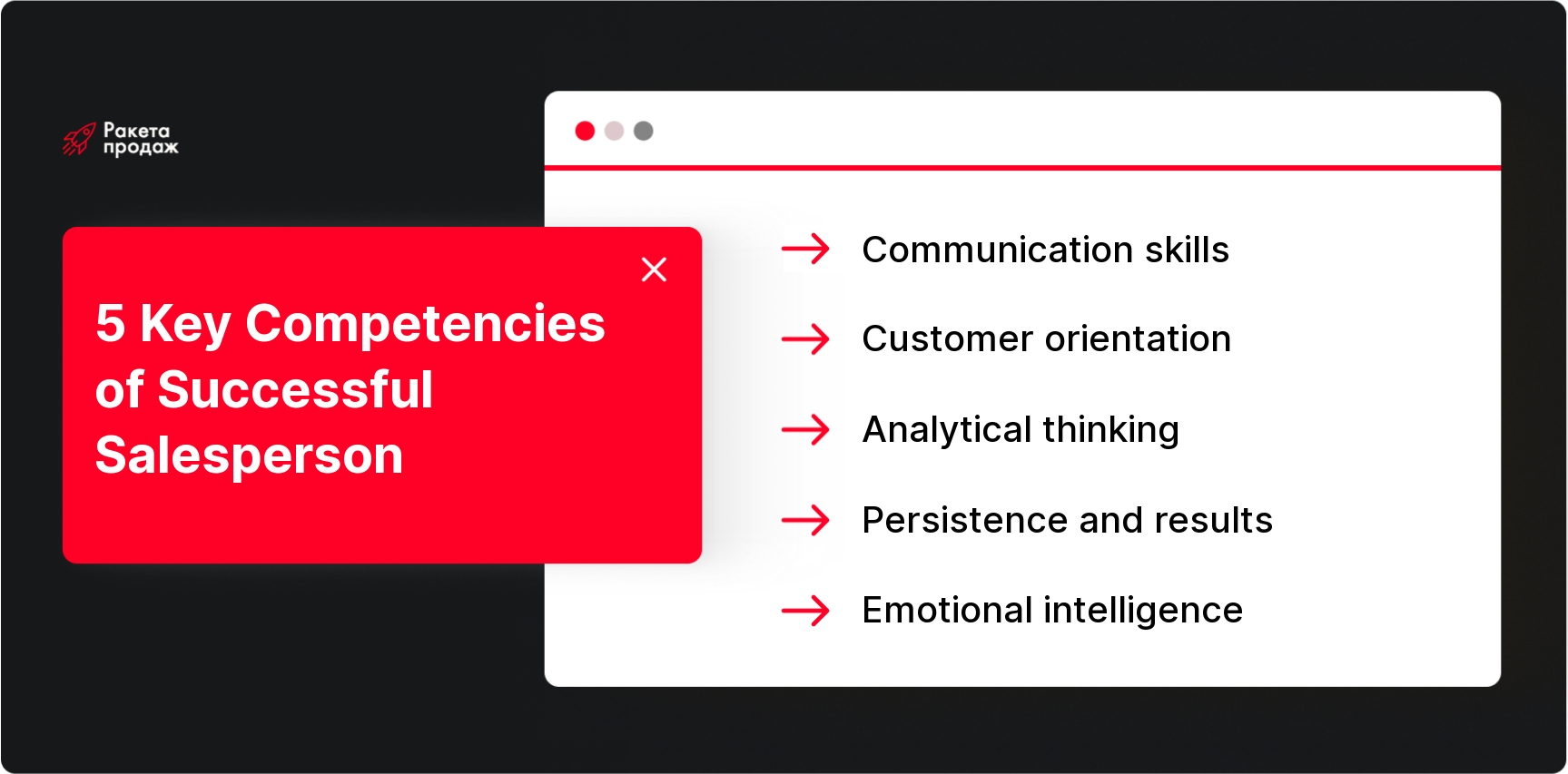
5 Key Sales Competencies

image
  1. Communication Skills – the ability to structure dialogue, ask the right questions, listen actively, and provide convincing arguments.
  2. Customer Orientation – the ability to understand customer needs and offer solutions that truly meet their requests.
  3. Analytical Thinking – the ability to collect and analyze information, identify patterns, and make informed decisions.
  4. Persistence and Results Orientation – willingness to overcome obstacles, follow through, and achieve set goals.
  5. Emotional Intelligence – understanding one’s own and others’ emotions, ability to manage them in communication and decision-making processes.

It’s important to understand that the optimal skill set may vary depending on the specifics of your business, product, and target audience. Therefore, before starting the salesperson skills assessment, you should determine which competencies are critically important for success in your company. Read more about decision-making criteria in sales recruitment in the article choosing a sales manager.

Methods for Testing Skills When Hiring Sales Managers

To get a complete picture of a candidate’s professional capabilities, it’s not enough to use just one assessment method. A comprehensive approach that includes various types of assignments and testing formats allows you to thoroughly evaluate the potential of a future sales manager and predict their effectiveness at work.

1. Test Assignments and Questionnaires

Testing often becomes the first stage of evaluation after a preliminary interview. It allows you to quickly and relatively objectively measure a candidate’s basic knowledge and skills, as well as some personal characteristics.

Sales managers should take tests to evaluate various aspects of their work. Logical tests help assess a candidate’s analytical abilities, their ability to process information quickly and find optimal solutions. This is especially important for sellers of complex products or services where deep analysis of customer needs and formation of individualized offers is required.

Communication tests aim to assess a candidate’s ability to interact effectively with customers and colleagues. They may include questions about how a person would behave in various communication situations and what communication strategies they prefer.

Questionnaire for sales manager and psychometric tests help understand how a candidate’s character matches the requirements of the position and the company’s corporate culture. For example, the DISC test helps determine a person’s behavioral style and predict how they will interact with customers and colleagues.

When interpreting results, it’s important to remember that tests provide only approximate information, which needs to be supplemented and verified by other assessment methods. Don’t make hiring decisions based solely on test scores – it should always be part of a comprehensive evaluation.

Finding the perfect salesperson is a long and complex process. Perhaps you’re already tired of endless interviews and disappointments, when a candidate speaks excellently in an interview but then can’t close a single deal? This is a typical problem faced by over 70% of business owners who rely only on traditional evaluation methods.

“Sales Rocket” has created a comprehensive methodology for evaluating and hiring sales managers over 6+ years of work, including testing sellers and their real skills rather than just interviewing. We’ve developed a system for evaluating salespeople based on practical assignments, role-playing games, and detailed analysis of communication skills. Using this methodology, we have successfully built more than 158 sales departments in 14+ different industries.

Our clients see an average increase in turnover of 35%, with a record result of +$1.6 million in 4 months of work. All this becomes possible thanks to a systematic approach to recruitment, training, and adaptation of salespeople.

Stop wasting time on inefficient recruitment – create a hiring system that will bring you real sales professionals!

Stop wasting time on inefficient recruitment - create a hiring system that will bring you real sales professionals!

2. Situational and Case Tasks

Case assignments allow you to see how a candidate applies their knowledge and skills in specific, reality-approximating situations. They provide an opportunity to assess not only theoretical preparation but also a practical approach to problem-solving.

Situational questions for a sales manager might be formulated like this: “A client says your product is too expensive compared to competitors. How will you handle this objection?” In this situation, you’re assessing the candidate’s ability to identify the real reasons for objections, their knowledge of the product’s competitive advantages, and their ability to convincingly argue the value of the offer. Read more about techniques in the article on how handling objections in sales helps increase conversion without additional investment in discounts.

Tasks for a sales manager interview should also include more complex cases, for example: “A potential client has shown interest in your product but has been postponing the final purchase decision for six months. What actions would you take to speed up the process and close the deal?” Here, you’re evaluating the candidate’s persistence, their creativity in finding approaches to the client, and their ability to manage a long sales cycle.

Situational tasks for a sales manager allow you to assess not only the final solution but also the logic of reasoning, the structure of the answer, the adequacy of proposed actions, and how customer-oriented the candidate is rather than just focused on closing the deal at any cost.

Sales manager interview cases should be as close as possible to real situations in your company to more accurately predict the future effectiveness of the candidate.

3. Role-Playing and Sales Simulations

Role-playing games are one of the most effective methods for evaluating a salesperson’s skills, as they are maximally close to real working conditions. During such a simulation, you can directly observe how a candidate builds dialogue, responds to objections, and how convincingly they present the product.

A classic example is the “sell me this pen” task that many find triggering. However, to make it truly informative, you need to clearly define what exactly you want to evaluate and structure the task accordingly. Instead of an abstract pen, it’s more effective to ask the candidate to sell your company’s actual product or a similar item. The interviewer plays the role of a client with specific characteristics, needs, and objections.

Another role-playing option is simulating a cold call. The candidate is given brief information about a potential client (company, position, possible needs), and they must build a phone conversation with the goal of arranging a meeting or presentation. This task evaluates the ability to quickly establish contact, generate interest, overcome the secretary or assistant barrier, and achieve a specific result.

Cases for group interviews with sales managers can also be very effective. They allow you to see how a candidate works in a team, demonstrates leadership qualities, and builds communication with colleagues.

Tasks for a sales manager example may include various objection-handling simulations. For instance, you might say: “I don’t need your product; I already have a similar solution from another supplier, and I’m completely satisfied with it.” A good salesperson won’t immediately list the advantages of their product but will first ask clarifying questions, try to understand the client’s needs and pain points, and only then offer a solution.

When evaluating a role-playing game, pay attention to the dialogue structure, ability to ask open questions, active listening, ability to identify hidden needs, objection handling, persuasiveness of argumentation, and of course, closing skills. The confidence, enthusiasm, and naturalness of the candidate’s behavior are also important.

4. Call Checks and Shadow Interviews

This assessment method involves analyzing real work situations and provides an opportunity to see candidates in the most natural conditions. If a person already has sales experience, you can ask them to provide recordings of successful calls or allow you to listen to how they communicate with clients at their current workplace (in compliance with all ethical and legal norms).

An example of a sales manager’s call can tell a lot about their professional skills. When analyzing calls, pay attention to the conversation structure, voice and intonation, ability to manage the conversation, and reaction to unexpected questions or objections. A good salesperson speaks confidently but doesn’t dominate the conversation, knows how to listen and ask the right questions, and their speech is free from filler words and excessive technical terms.

Another option is to organize a “test day” at the company, where the candidate works alongside an active sales manager, observing their work and even participating in some activities. This allows you to assess how quickly a person orients themselves in a new environment, how they interact with potential colleagues, what questions they ask, and how they perceive information.

Checking sales skills during an interview through shadow interviews gives you the opportunity to see the candidate in action and evaluate their real skills, not just theoretical knowledge. This is especially valuable for positions with a high level of client interaction, where the salesperson’s personality plays a key role in success.

Read more about comprehensive verification and regular employee assessment in sales in the article on how sales manager certification helps managers regularly keep their finger on the pulse.

How to Evaluate Results: Checklist and Scale

To make candidate evaluation objective and consistent, it’s necessary to use a standardized system of criteria and scores. An effective scorecard allows you to structure the process and minimize the influence of the interviewer’s personal preferences.

Criterion Description Score (1-5)
Communication Skills Speech clarity, active listening, ability to ask questions, convincing argumentation
Objection Handling Ability to maintain a positive attitude, identify true causes of objections, offer solutions
Customer Orientation Ability to identify needs, focus on client benefits, individualized approach
Product Knowledge Understanding of characteristics, advantages and limitations of the product, usage scenarios
Closing Skills Ability to lead to decision-making, determine readiness signals, suggest next steps
Analytical Abilities Quick thinking, logical arguments, ability to work with information
Stress Resistance Maintaining calm in difficult situations, positive reaction to criticism and rejections

For objective assessment, it’s recommended to involve at least two interviewers who independently complete evaluation cards. This helps minimize subjective factors and get a more balanced opinion about the candidate.

It’s important to determine weight coefficients for various criteria in advance, depending on their significance for the specific position. For example, for a seller of complex technical equipment, product knowledge may have more weight than for a manager selling standardized services.

For the evaluation system to work effectively, it’s necessary to train all participants in the hiring process. They should clearly understand what each criterion means, how to interpret various behavioral manifestations, and how to avoid typical evaluation errors (such as the halo effect or confirmation of personal biases).

Equally important is providing correct feedback to candidates, regardless of the result. Constructive feedback helps maintain the company’s reputation as an attractive employer and creates the possibility for repeated interaction with talented candidates in the future.

Interpreting Results: How to Make Decisions Based on Tests and Role-Playing Games

When all tests have been completed and all assessments made, the most crucial stage begins – interpreting results and making the hiring decision. Here, it’s important to consider not individual indicators but the candidate’s holistic profile, taking into account the interrelation of various competencies.

When analyzing results, consider both quantitative indicators (test scores, scale ratings) and qualitative observations (behavior in role-playing games, communication style, stress response). Compare data from different sources and look for patterns – they will give a more complete picture of the candidate’s strengths and weaknesses.

Compare the candidate’s results not only with other applicants but also with reference models of successful employees in your company. If you have data on what qualities your best sales managers possess, use this information as a benchmark when evaluating new candidates. Additionally, to form your own understanding of successful results, evaluating sales manager effectiveness may help.

Checking a salesperson during an interview should be comprehensive. Remember that some skills can be developed during work, while basic personality traits and attitudes are much harder to change. Therefore, all else being equal, give preference to candidates with suitable personal characteristics and motivation, even if they lack some technical knowledge.

Test assignment for sales manager and sales manager interview scenario should take into account the specifics of your business and corporate culture. It’s equally important to assess how well the candidate matches this culture and company values. Even the most talented salesperson won’t be effective if their personal values and work style contradict the organization’s accepted norms.

Typical Mistakes in Testing Salespeople

When evaluating candidates for a sales manager position, many companies make the same mistakes that reduce the effectiveness of the hiring process and lead to incorrect decisions.

One of the most common traps is equating charisma with professionalism. Undoubtedly, a good salesperson should be communicative and able to build rapport, but this is just part of the necessary competencies. A charismatic candidate can make a strong impression at the interview but may lack the analytical abilities or persistence needed to achieve results.

Another common misconception is believing that a person who sincerely believes in the product will necessarily be able to sell it successfully. Enthusiasm for the product is important, but it doesn’t replace the ability to identify customer needs, handle objections, and close deals.

How to check a salesperson? Verbosity is often mistakenly taken for persuasiveness. In reality, the best salespeople know not only how to speak but also how to listen – asking the right questions, understanding customer needs, and only then offering a solution. A candidate who talks more than listens during an interview will likely apply the same approach with clients.

Typical mistakes of HR specialists and managers when evaluating candidates include: inconsistency of evaluation criteria between different interviewers, use of unstructured questions that don’t allow objective comparison of candidates, and lack of systematic result recording.

To avoid these mistakes, use standardized evaluation forms, focus on the candidate’s actual behavior rather than general impression, and conduct joint assessment by several interviewers. This approach significantly increases the objectivity and quality of decisions made.

Implementing the methods for testing salespeople’s skills described in this article is an important step towards creating an effective team. However, independently developing and implementing a comprehensive evaluation system requires significant resources, experience, and time.

“Sales Rocket” offers a ready-made solution – a comprehensive system for hiring, training, and developing sales managers. We don’t just help select salespeople but create a complete infrastructure for their effective work: developing sales books, scripts, templates, adaptation plans, and motivation systems.

Our approach includes a deep audit of existing processes, development of individualized test assignments and evaluation methods, as well as continuous quality control of managers’ work. We work with companies from various industries, including market leaders such as Mitsubishi, Audi, Ford, Mazda, and Naftogaz.

Among our clients are businesses that have managed to increase sales conversion by 5-86% and ensure a stable influx of major clients. Our team of experts uses proven international sales methodologies (BANT, MEDDIC, SPIN) and adapts them to the specifics of your business.

Don’t waste time on experiments – trust building a systematic sales department to professionals!

Don't waste time on experiments - trust building a systematic sales department to professionals!

Conclusion

Comprehensive tests and role-playing assignments during interviews for sales manager positions are tools that allow you to predict the effectiveness of a future employee with high accuracy. A well-thought-out evaluation system not only reduces the risks of unsuccessful hiring but also helps form a strong, motivated team capable of achieving outstanding business results. Implementing structured tests in the selection process is an investment in the company’s development, allowing you to compete for the best specialists in the market and build a culture of successful sales.

Tasks for the sales manager and checking sales skills during an interview, when properly organized, will help you assemble a team of professionals who will effectively solve business tasks and contribute to company growth. For sustainable employee engagement, sustainable sales department motivation is necessary.

In this article:
See more
Book a FREE sales funnel audit
CONTACT US
FAQ
What should I include in a test assignment for a sales manager?

An effective test assignment for sales manager should check key competencies: communication skills, ability to identify needs and handle objections, closing skills. Include situational questions for a sales manager, role-playing games (e.g., “sell me this product”), and written assignments to evaluate analytical thinking. Be sure to add an element that tests knowledge of your product or the ability to learn it quickly.

How can I standardize the assessment of salespeople to avoid subjectivity?

Develop a clear system of criteria and scores for evaluating each competency. Use standardized tests and assignments for all candidates. Involve multiple evaluators who independently complete assessment forms. Conduct regular training for interviewers so they understand how to objectively apply criteria and avoid typical evaluation mistakes.

When should test assignments be conducted: before or after the interview?

It’s optimal to use a multi-stage approach: basic tests (logic, personality traits) are better conducted before the face-to-face interview – this helps screen out obviously unsuitable candidates. More complex assignments (cases, role-playing) should be conducted during or after the main interview, when you already have a general impression of the candidate and can focus on testing specific skills.

How can I adapt role-playing games for different types of sales?

For B2B sales, create scenarios with a long deal cycle, multiple decision-makers, and an emphasis on business value. For B2C, focus on emotional triggers, quick decision-making, and handling personal objections. For telephone sales, emphasize voice, ability to quickly interest and maintain attention. For complex technical products, include elements that require deep product understanding and the ability to explain complex things in simple language.

How do I evaluate a salesperson's soft skills during an interview?

Use behavioral questions (“Tell me about a situation when…”) and observe the candidate’s reactions during the interview. Role-playing and call simulations reveal emotional intelligence, communication skills, and stress resistance well. Ask unexpected questions or create artificial obstacles during task performance to assess adaptability. Pay attention to how the candidate interacts with different people during the interview process – this shows their flexibility in communication.

SUBSCRIBE TO MY TELEGRAM CHANNEL
The most valuable sales information right on your phone!
icon

LOTS OF USEFUL INFORMATION, FREE TEMPLATES, AND CHECKLISTS ON MY INSTAGRAM

Materials and practical advice on sales growth in our blog: