icon

How to Use AI Analytics for Sales Process Auditing

Modern business is characterized by daily, rapid growth in competition. Customers are becoming more selective and demanding. In such conditions, traditional sales control methods are no longer able to cope with the tasks of effective management. This is where AI sales audit comes into play – a fundamentally new approach to process analysis that allows companies to control, anticipate, and optimize every aspect of customer interaction.

Want a high-performing sales team without the hassle?
We’ll build it for you.
Contact Us

Key Takeaways

  • An AI audit processes 100% of customer communications vs ~5% with traditional sampling, surfacing root causes of loss and missed opportunities in every call and email.
  • Companies that implement AI auditing see a 20–30% lift in conversion and a 25% shorter sales cycle; the system spots bottlenecks faster than a manager can physically review.
  • Underperforming reps lose deals due to “stop words” and skipped script steps; AI detects these patterns across thousands of dialogues and flags the phrases that kill conversion.
  • Dirty CRM data (duplicates, empty fields, inconsistent formats) corrupts any analytics. Preprocessing and cleansing must come before model training, or forecasts will be wrong.
  • A pilot in a single segment with a clear success metric is safer than a company-wide rollout. Start by testing the hypothesis and scale only the elements that are proven.

Find the full implementation playbook, integration tools, and practical use cases in the article below 👇

How AI Sales Process Analysis Works

AI sales audit is a multi-faceted inspection, a continuous analytics process where every customer interaction becomes a source of valuable data. The entire system works on the “Data → Insight → Action → Feedback” principle. Algorithms collect and analyze information, form conclusions, help the team make the right decisions, and then learn from the results obtained, constantly improving.

This cyclical process allows not only diagnosing the current state of sales but also predicting future results, helping businesses stay one step ahead of competitors. Each stage of this process has its own characteristics and requires a specific approach.

1. Data Collection and Integration

The foundation of any AI system is quality data. For a comprehensive sales process auditing, artificial intelligence must receive information from various sources: CRM systems, IP telephony, email correspondence, messengers, ERP systems, and BI analytics. Only with comprehensive information collection will AI analytics in sales auditing create a complete picture of the process.

The key point is the completeness of context. It’s not enough to just see that a deal is closed or lost. The system must understand the entire path: which managers interacted with the client, the stages of the deal, how long each stage took, how the client reacted to offers. Without this context, it’s impossible to identify the true causes of successes and failures.

Integration is usually carried out through AI tools for sales analysis, API interfaces, or specialized ETL tools (extract, transform, load data). Popular solutions include Microsoft Power Automate, Airbyte, Zapier, Google BigQuery. These tools create “bridges” between different systems, ensuring a continuous flow of data into the AI platform.

One of the main problems solved by AI is “data silos” or isolated data. In many companies, customer information is scattered across different systems: contact information in CRM, purchase history in ERP, communications in email and messengers. AI helps collect these fragments into a unified system, creating a holistic view of each customer and the sales process as a whole.

2. Data Preprocessing and Cleaning

Even the most advanced AI system cannot give accurate results if the source data is of poor quality. The problem of “dirty” data is familiar to almost all companies: duplicate customers, empty fields in CRM, different phone formats, incorrect meeting dates – all of the above distorts analysis results and leads to wrong conclusions.

The data cleaning process includes several key stages. Deduplication helps identify and merge duplicate customer or deal records. Normalization brings heterogeneous data to a single format – for example, phone numbers to the format +3 (XXX) XXX-XX-XX. Lexical analysis corrects typical errors in text fields, for example, converting abbreviations like “mgr” to “manager” or correcting typos.

Modern AI systems can automatically detect anomalies in data. For instance, if the CRM indicates a customer age of 150 years or a meeting date scheduled for last year, the AI sales manager will flag these records as suspicious and suggest checking them. This significantly improves the quality of analytics, excluding the influence of “outliers” on general conclusions.

An important aspect of preprocessing is data unification. When information is collected from different sources, it needs to be brought to a unified form: coordinate references, establish correspondence between customer IDs in different systems, synchronize deal statuses. After this work, the AI system will be able to correctly link data and identify patterns.

3. Modeling and Analysis

At this stage, machine learning algorithms come into play, building models based on prepared data. The key task is to identify patterns between sales team actions and end results, determining factors that influence deal success.

AI uses various types of models for sales analysis. Classification helps predict binary outcomes: whether a deal will close or be lost, whether a certain product is suitable for a specific customer. Regression models predict numerical indicators: the likely sales volume in the next quarter, the estimated deal amount, time to closure. Clustering groups customers by behavioral patterns, identifying segments with different needs and approaches to decision-making.

A particularly valuable function is AI sales analysis of correlations between manager actions and results. The system can discover that managers who call a client within an hour of receiving a request close 40% more deals than those who delay the first contact. Or find that using certain phrases in a product presentation significantly increases the likelihood of a successful closure.

An important role of AI is finding anomalies in the sales process. The system flags unusual patterns: a sharp drop in manager activity on certain days, abnormally long deals for individual employees, strange communication patterns. It allows managers to quickly respond to problems and prevent losses.

4. Interpretation and Visualization

Even the most accurate analytics is useless if it cannot be understood and applied. Leaders don’t read complex machine learning models – they need clear insights and recommendations for action. A critical stage is turning AI analysis results into understandable and practically applicable formats.

Modern AI systems offer various data visualization formats. Interactive dashboards display key performance indicators: conversion by funnel stages, average deal duration, customer lifetime value (LTV). Users can “drill down” into the data to understand the causes of deviations from the plan or identify success factors.

Automatic reports and notifications help respond promptly to changes in the sales process. For example, the system sends a warning that the Facebook channel is showing signs of “overheating” – the cost of lead acquisition is growing while quality is decreasing. Or reports that a specific manager has an abnormally low conversion from demonstration to offer, requiring manager attention.

Modern artificial intelligence-based systems use the principles of Explainable AI. It provides a forecast or recommendation and shows what they are based on. For example, the system predicts the probability of closing a deal (82%), while explaining the factors influencing the forecast: history of interactions with the client, their website activity, similarity to other successfully closed deals.

Have you ever wondered how much more effective your sales department could be with artificial intelligence? In practice, most managers analyze only 5% of all customer interactions, missing critically important insights. This is where “Rocket Sales” offers a revolutionary approach – a comprehensive audit that identifies all “bottlenecks” in your sales funnel based on analysis of 100% of communications, as well as the development of automated analysis of all deals, a so-called quality service that works 24/7.

With more than 7 years of experience, we have built 187+ systematic sales departments in 14 different business niches, from IT to the industrial sector. Our methodology includes not only diagnosing problems but also completely rebuilding processes: from implementing CRM systems to creating personalized sales scripts and KPI systems. “Rocket Sales” clients note an average turnover increase of 35%, and in some cases, conversion increases up to 86%.

Transform an unmanageable sales process into a transparent, measurable system - get a free consultation on auditing your sales department!

Main Areas of AI Application in Sales Auditing

Artificial intelligence in sales is transforming all aspects of the sales process, from evaluating employee effectiveness to forecasting future revenues. Let’s look at the main areas where AI has already proven its effectiveness.

1. AI for Analyzing Manager Effectiveness

Traditional evaluation of manager work is often based on subjective criteria or a limited set of KPIs, which don’t always reflect the real picture. Sales department KPIs are the most important metrics with which AI can integrate for a more objective assessment.

The AI sales manager offers a fundamentally new approach, analyzing not only the results but also the work process of each employee.

The system compares the real actions of managers with established KPIs and best practices in the company. How many calls an employee makes, how quickly they respond to requests, how well they prepare commercial offers. AI evaluates both quantitative and qualitative indicators.

One of the main advantages of AI is the ability to analyze speech and the emotional background of calls. Modern systems determine how confidently a manager conducts negotiations, whether they ask open questions to identify needs, whether they properly handle objections. AI voice analytics evaluates the emotional dynamics of conversation – when the client was interested, and when tension or dissatisfaction arose.

It’s also important to consider manager effectiveness: AI automatically identifies weaknesses in each individual’s work – low activity, prolonged deals, problems with certain types of clients or products. Based on the analysis, the system forms individual recommendations for improvement. For example, if a manager experiences difficulties handling price objections, AI can suggest additional training specifically in this area or provide scripts of successful negotiations from the company’s best sellers.

2. AI for Evaluating Lead Quality and Forecasting Conversions

Not all leads are created equal – some have a high probability of conversion, others will never become customers. Correctly assessing lead potential is critically important for the effective allocation of sales department resources.

For these tasks, lead quality analysis is applied, where AI automatically classifies them by purchase probability, analyzing dozens of factors: demographic data, website behavior, interaction history, social signals, similarity to existing customers. This allows businesses to focus on high-potential leads without wasting time on unpromising contacts.

A particularly valuable function is recognizing “dirty” leads before they are transferred to a manager. The system identifies test registrations, duplicates, non-existent contacts, or requests from companies that clearly do not fit the target audience. This saves a huge amount of sales team time and increases overall efficiency.

Based on historical data, AI forms a forecast of the probability of closing each deal and recommends optimal actions to increase conversion. The system determines what information a specific client lacks about the technical aspects of the product and suggests organizing a meeting with an engineer to demonstrate functionality.

3. AI in Customer Journey Analysis

The modern customer path to purchase is rarely linear – potential buyers interact with a company through multiple touch points before making a decision. AI helps understand this complex journey and optimize each stage.

The system determines the channels and touchpoints that have the greatest impact on the purchase decision. For example, it discovers that clients who attended a webinar and read at least two email messages convert three times more often than others. This allows for optimal distribution of the marketing budget and sales team efforts.

AI also provides a deep understanding of processes that answer the question of how to build a sales funnel more effectively, through analysis of thousands of customer journeys. Based on the analysis, AI builds a probabilistic model of transitions between touch points, showing which interaction sequences are most effective. It helps build optimal communication scenarios for different customer segments.

A critically important function is identifying “friction points” where customers most often interrupt the path to purchase. The system analyzes at what stages and why potential customers are lost, and suggests specific measures to eliminate these obstacles. For example, if many customers leave at the stage of filling out a long application form, AI recommends simplifying the form or breaking it into several steps.

4. AI Sales and Revenue Forecasting

Accurate sales forecasting is the foundation for effective resource planning and strategic company development. Traditional forecasting methods, based on expert estimates or simple extrapolation, often give significant errors. AI offers a fundamentally new level of accuracy.

AI sales analytics forms detailed forecasts across various sections: acquisition channels, customer segments, product lines, individual managers. It allows identifying the most promising directions and focusing company resources on them.

An important advantage of AI is the ability to recognize seasonal trends and cyclical patterns in sales, even if they are not obvious with superficial analysis. For example, the system discovers that sales of a certain product increase two weeks before public holidays, allowing marketing activities and sales department resources to be planned in advance.

In addition to forecasting absolute values, AI assesses the likelihood of achieving the plan and risks of non-fulfillment. It signals potential problems long before the end of the reporting period, giving management time to adjust course. For example, if in the middle of the month plan fulfillment is forecast at only 70%, management can decide to launch additional promotions or redistribute resources.

5. AI Audit of Communications and Interactions

The quality of customer communications directly affects sales results. AI offers unprecedented opportunities for analyzing and improving all forms of interaction – from phone conversations to email correspondence.

Artificial intelligence analyzes various aspects of negotiation quality: voice tone, speech tempo, use of professional vocabulary, ratio of speaking and listening time. It allows evaluating how confidently and professionally a manager conducts a conversation and offers specific recommendations for improvement.

AI automatically identifies template errors in sales scripts. For example, the system discovers that certain phrases or approaches cause negative reactions in most clients. Based on the analysis conducted, it’s easy to adjust scripts, replacing ineffective elements with more successful ones.

A particularly valuable aspect is identifying correlations between dialogue type and deal outcome. AI analyzes thousands of conversations and determines which communication patterns more often lead to successful sales. For example, it discovers that deals where the manager asked the client at least five open questions during the needs identification stage close 30% more often. Such insights become the basis for team training and improvement of communication strategies.

AI Tools and Technologies for Sales Auditing

The AI solutions market for sales is actively developing, offering various tools for different tasks. Here are the key categories of systems helping companies implement intelligent sales auditing:

AI CRM Assistants (HubSpot AI, Zoho Zia, Salesforce Einstein) integrate into existing CRM systems and expand their capabilities. They automate routine tasks (data entry, lead classification, reminders), analyze manager activity, and offer recommendations for optimizing the sales process.

AI Analytics Platforms (Tableau AI, Power BI Copilot, Qlik Sense) help visualize sales data and identify hidden patterns. They transform complex arrays of information into intuitive dashboards and reports, allowing for informed decision-making.

AI for Communications (Gong.io, Refract.ai, Ringostat, Unitalk) specialize in analyzing negotiations with clients. These AI tools for sales analysis transcribe and analyze calls, evaluate script effectiveness, identify successful speech patterns, and offer personalized recommendations for managers.

Custom ML Models (Python + AutoML + BigQuery) are designed for companies with unique needs or advanced analytics requirements. They allow creating individual solutions precisely tuned to the specifics of a particular business and integrated with existing infrastructure.

How to Implement AI Audit in a Sales Department

image

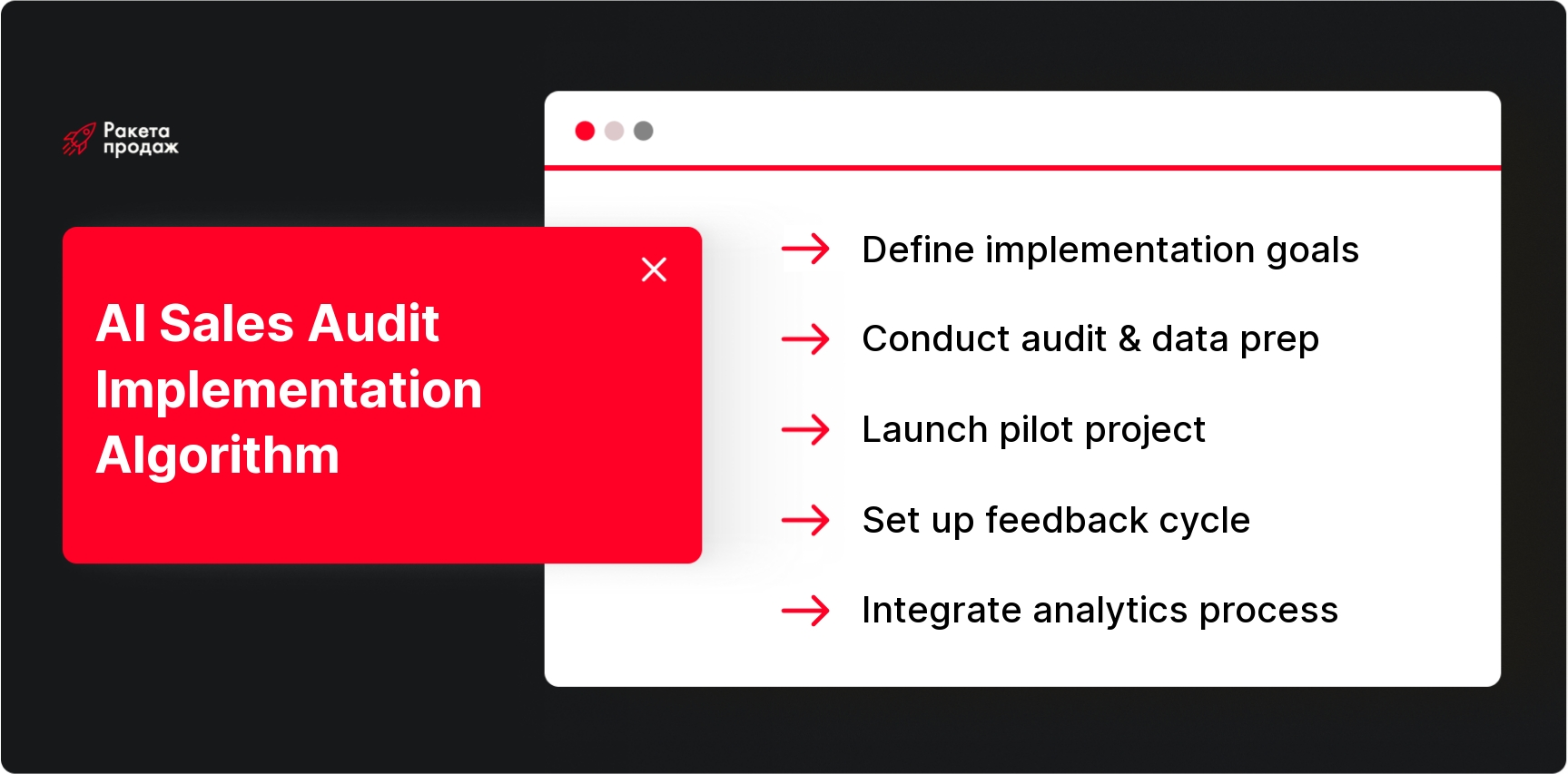
Implementing an AI audit is installing new software. Changing the management logic of the company requires a systematic approach and consistent implementation. Let’s look at the key stages of the process in more detail.

1. Define Audit Goals

Implementing AI without a clear understanding of goals is a sure path to disappointment. First, you need to honestly identify the main problems facing the sales department: lack of transparency, low lead conversion, prolonged sales cycle, gap between marketing and sales, unpredictability of results.

If you don’t know where to start, read the guide how to conduct a sales department audit, after which you will be able to determine priority areas for improvement and better structure the stages of implementing changes.

It’s important to understand that it’s impossible to solve all problems simultaneously. You need to choose specific improvement directions and formulate measurable goals. For example:

  • improve revenue forecast accuracy by 20%;
  • reduce lead processing time by 30%;
  • increase conversion from demonstration to deal by 15%;
  • reduce customer churn by 25%.

An effective approach is to follow the principle of “1 goal – 1 hypothesis – 1 metric.” For example: “We assume we can increase sales conversion by 20% if we implement AI lead scoring and prioritize contacts with the highest potential. The key success metric is the conversion rate from qualified lead to customer.”

2. Prepare Data

AI is not a magic wand but a tool that works with data. The quality and completeness of information directly affect the effectiveness of analysis and forecast accuracy. Before implementation, it’s necessary to audit existing data and improve its quality if needed.

Effective AI auditing requires data from various sources:

  • CRM system: deals, leads, contacts, manager activities;
  • communications: call recordings, email correspondence, chats, meetings;
  • marketing information: acquisition channels, campaigns, UTM tags, acquisition cost;
  • financial data: revenues, margins, repeat sales.

Data preparation includes several important steps. First of all, you need to check the data structure – whether the CRM has all the necessary fields to track the sales funnel and manager activities. Then clean and normalize the data – remove duplicates, correct errors in contact information, unify date formats and phone numbers. Finally, enrich the data by adding additional information – for example, customer NPS or their website behavior data.

3. Start with a Pilot Area

Implementing artificial intelligence for auditing across the entire company at once is a risky approach that can lead to employee resistance and low efficiency. It’s much more reasonable to start with a small pilot project that allows testing the technology, adjusting the approach, and demonstrating the value of AI to the rest of the organization.

When choosing a pilot area, focus on several criteria. First, a sufficiently representative segment – a separate region, product line, or team of managers. Second, stable and quality data for previous periods. Third, clear success metrics to evaluate the effectiveness of implementation.

A typical pilot project includes several steps: collecting and loading historical data for 3-6 months. Training a basic artificial intelligence model (for example, to predict the probability of closing deals). Checking forecast accuracy on a test sample. Analyzing results and adjusting the approach. Scaling successful elements to the entire organization.

4. Set Up Feedback Loop

The key difference of modern AI systems is their ability to learn and improve based on new data. It’s necessary to set up an effective feedback cycle that ensures constant updating and refinement of models.

The Feedback Loop principle is simple: “AI learns only from data that is updated and contains results.” It’s not enough to load historical information and launch the algorithm. You need to establish a constant flow of new data, including prediction results and decisions made.

For example, if the system predicts a high probability of closing a specific deal, the manager acts based on this forecast. Then information about the real result enters the system – whether the deal was closed or lost. Based on this, AI adjusts its algorithms, increasing the accuracy of future forecasts. It’s important for managers to record the fact of the result, and the reasons – why the deal was won or lost. Especially the factors influencing the client’s decision.

5. Develop Analytics as Part of Corporate Culture

Even the most perfect technology will be useless if employees are not ready to accept and use it. It’s critically important to develop a culture of data-based decision-making, where AI audit becomes an integral part of daily work.

Often companies go from “collecting data for the sake of reporting” to “data for decisions.” In the first stage, information is collected formally, in accordance with management requirements. In the second, data becomes the basis for making strategic and tactical decisions at all levels of the organization.

Developing an analytics culture includes several key elements. First, regular data-based discussions – weekly or monthly meetings. The team analyzes AI audit results and makes decisions based on them. Second, combining AI analytics with human expertise – technologies complement, not replace, the experience of managers. Third, training employees in the basics of working with data – the ability to read reports, interpret forecasts, apply AI recommendations in daily work.

It’s important to position AI as a partner, not an overseer. If managers perceive the system as a tool for control and punishment, they will begin to resist and look for workarounds. If AI is presented as a helper making work easier and more productive, employees are more likely to accept the technology and actively use it.

Practical Scenarios of AI Application for Sales Increase Auditing

The theoretical advantages of AI are impressive, but business leaders are primarily interested in practical results. Let’s consider real scenarios where implementing AI for sales process auditing brings quick and tangible benefits.

One of the most effective applications is quickly identifying anomalies in sales. In a large B2B company, an AI system discovered a sharp drop in conversion from demonstration to offer for a certain customer segment. Traditional analysis might have identified this problem after several weeks or months, but AI noticed the pattern change after just a few days. In-depth analysis showed that the main competitor had launched an aggressive price campaign targeting exactly this segment. The company promptly adjusted its pricing policy and regained market positions, minimizing losses.

Sentiment analysis in dialogues helps prevent negative customer experiences. In an internet retailer, an AI system monitored the emotional tone during customer chats. When the level of negativity in the conversation exceeded a certain threshold, the system automatically warned the supervisor, and they could intervene and resolve the situation before the client became completely disappointed. This approach reduced the number of negative reviews by 42% and increased the customer satisfaction rate by 18%.

Monitoring manager actions helps ensure compliance with standards and processes. In a financial company, an AI system analyzed how strictly managers followed regulations for selling complex products. It turned out that a significant portion of employees skip the important step of identifying the client’s financial goals. After targeted training and changing scripts, conversion increased by 23%, and the average check increased by 15%.

AI for auditing sales processes and optimizing scripts gives amazing results. A telecommunications company used artificial intelligence to analyze thousands of sales department calls. The system found that managers who asked an open question about the client’s current internet connection problems in the first 30 seconds of the conversation achieved a 37% higher conversion. Implementing this approach in the standard script led to a 28% growth in additional services sales.

Automatic identification of “stop words” and undesirable topics also helps avoid typical mistakes. In a company selling software, the AI system discovered that mentioning certain technical characteristics in the early stages of negotiations correlates with an increased probability of losing the deal. It turned out these technical details confused clients and created an impression of excessive product complexity. After adjusting presentations and training managers, conversion increased by 17%.

Identifying template objections and preparing effective answers is another valuable application of AI. In an insurance company, the system analyzed thousands of calls and found that 76% of potential clients expressed the same objection: “I need to think and compare offers.” Additionally, AI determined the most successful answers to this objection. After implementing an optimized script to handle the analyzed objection, conversion from an initial call to an application increased by 31%.

Conclusions

Today, AI sales audit is becoming an indispensable tool for businesses striving for leadership in their niches. Artificial intelligence in sales automates routine checks, provides a scalable, transparent, and objective view of the sales department’s work and customer interaction. Thanks to artificial intelligence, it’s easy to identify subtle bottlenecks, analyze lead quality, test marketing effectiveness, and quickly respond to market changes. In the long term, integrating AI audit contributes to sales growth, improving customer orientation, and increasing profits. Therefore, don’t miss the chance to use the full potential of artificial intelligence in auditing and developing your sales.

Implementing AI sales audit is not just a fashionable trend but a necessity for companies wishing to remain competitive in modern conditions. However, independent integration of such solutions requires significant resources, time, and expertise that not all organizations possess.

“Rocket Sales” offers a ready-made solution – a comprehensive systematization of the sales department using advanced data analysis technologies. We don’t just diagnose problems but completely transform your business processes: develop an optimal sales funnel, implement effective control tools, create a sales book with detailed scripts, and train the team in new working methods.

Our approach is based on experience working with 187+ companies in various industries, including giants like Mitsubishi, Yamaha, and Naftogaz. We guarantee not just technology implementation but measurable financial results – the average turnover increase of our clients is +35%, and the record indicator reached +$1.6 million in just 4 months of work.

Transform your sales department into a high-tech system that consistently generates profit - order comprehensive systematization right now!
In this article:
See more
Book a FREE sales funnel audit
CONTACT US
FAQ
How does AI analysis help in sales?

AI analyzes 100% of customer communications, identifying patterns of successful sales and problem areas. It automatically evaluates lead quality, predicts the probability of closing deals, analyzes manager effectiveness, and offers specific recommendations for improvement. Unlike manual analysis, AI works continuously and processes all data, not missing potentially important insights.

How to use AI for sales analysis and improvement?

Start by defining specific goals (increasing conversion, reducing sales cycle). Prepare quality data from CRM and other sources. Conduct a pilot project in a limited area. Set up a feedback loop so the system constantly learns from new results. Integrate AI conclusions into the daily work of the sales department and train the team to use the system’s recommendations.

Will AI replace a sales auditor?

AI will not replace but will enhance the capabilities of auditors and sales managers. The technology will automate routine data analysis and pattern identification, but interpretation of results, strategic decision-making, and team work will remain with humans. The most effective approach is a combination of AI analytics in sales auditing with human expertise, where technology identifies patterns and humans make decisions based on them.

How to understand that AI analysis is working correctly?

The key indicator is the accuracy of forecasts and recommendations. Compare system predictions with actual results (for example, conversion or revenue forecast). Track business indicators before and after implementing AI – if conversion is growing, the sales cycle is shortening, and the average check is increasing, then the system is working effectively. It’s also important to collect feedback from managers about the usefulness of AI recommendations.

SUBSCRIBE TO MY TELEGRAM CHANNEL
The most valuable sales information right on your phone!
icon

LOTS OF USEFUL INFORMATION, FREE TEMPLATES, AND CHECKLISTS ON MY INSTAGRAM

Materials and practical advice on sales growth in our blog: