icon

Why Sales Managers Fear Management

Remember how the most successful students were often chosen as class representatives in school? The problem was that a brilliant straight-A student didn’t always become a good leader. The same happens in business: the best salesperson gets promoted to sales manager, but then everyone is surprised when performance drops. The root of the problem often lies in the fear of management – a common syndrome where sales managers avoid leadership responsibilities by retreating into familiar operational work. Instead of working systematically with the team, they continue closing deals themselves, avoid difficult decisions, and literally fear being a leader. This isn’t just an individual’s personal problem – it’s a systemic phenomenon that undermines business effectiveness. Let’s explore the causes of this fear, its signs, consequences, and methods to overcome it.

Key Takeaways

  • The best salesperson on the team rarely becomes a strong leader because selling and managing people require different skills.
  • A sales manager who continues to personally close deals instead of building a system becomes a bottleneck and blocks department scaling.
  • Fear of conflict pushes managers to avoid firing underperforming employees, penalties for lateness, and strict requirements, which destroys team discipline.
  • The absence of clear KPIs, regular meetings, and control systems turns management into chaos and increases the sales manager’s anxiety.
  • An insecure leader loses strong managers who value clarity and learning opportunities, leaving only mediocre performers on the team.

In the article below, you’ll find concrete steps on how to embrace the leadership role, implement a regular management system, and overcome the fear of responsibility. Read the full article 👇

Why Sales Managers Fear Management: Key Reasons

The fear of management rarely relates to a leader’s personal weakness. Most often, it results from a complex set of psychological and organizational factors. Even successful and self-confident people can experience serious discomfort when transitioning to a management role. This is a systemic problem that requires deep understanding and comprehensive solutions, not just a motivational talk with the sales manager.

It’s important to recognize that the roots of management fear can be embedded in both the corporate culture and the specifics of an individual’s career path. Let’s examine the most common causes of this phenomenon to understand how to address them.

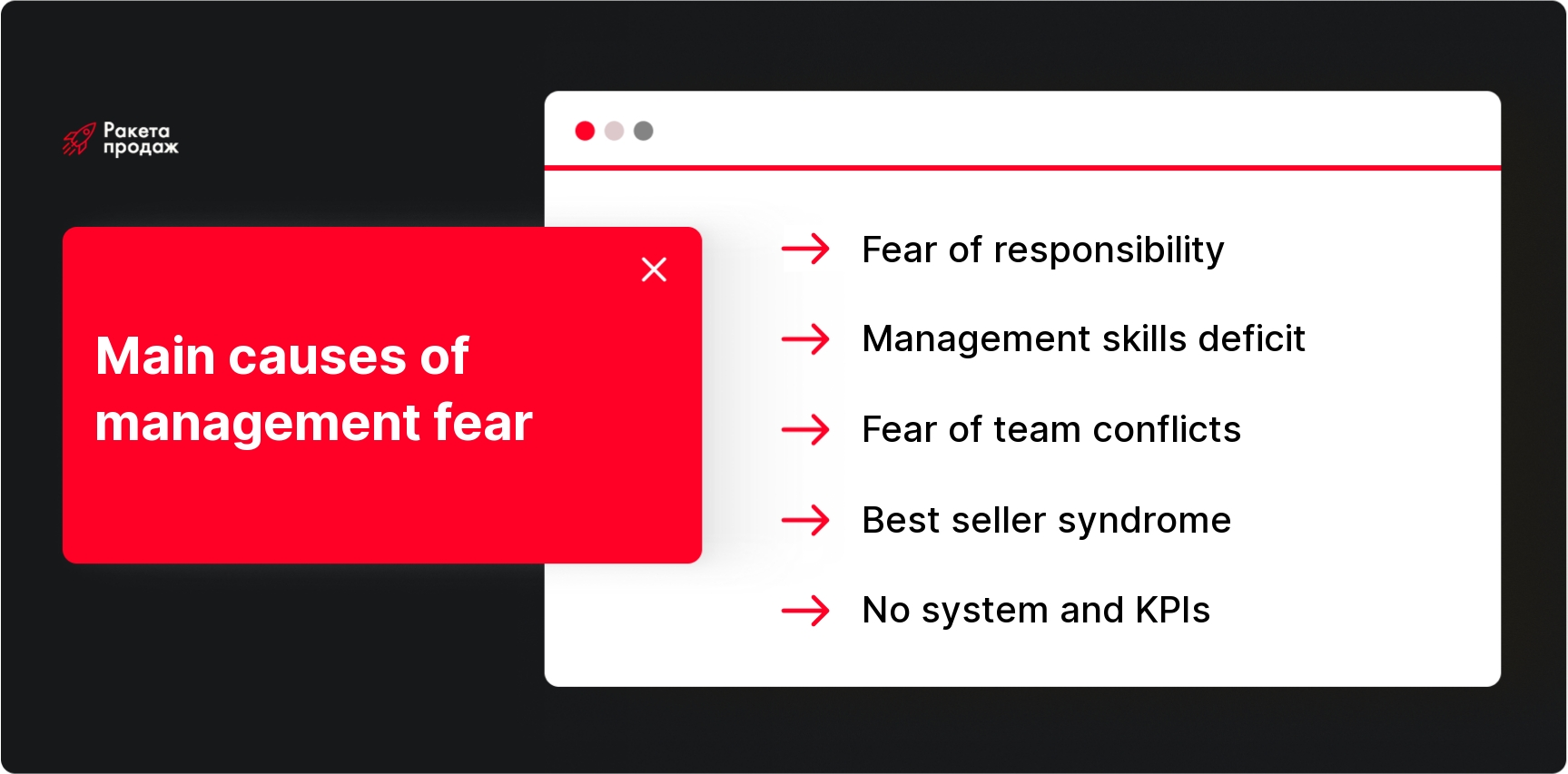
Fear of Responsibility for Team Results

image

For many sales managers, the most frightening aspect of their job is the responsibility for overall results. The fear of responsibility in the Head of Sales is especially evident when it comes to collective performance. While previously, as a salesperson, they were only responsible for their personal metrics, now they carry the burden of meeting targets for the entire department.

This is a fundamentally different level of responsibility. The sales manager understands that they’ll now be evaluated not on personal contribution but on the collective achievements of the team. Here’s the paradox: the larger the department, the less personal control the manager has over the final result. Yet they remain fully accountable.

This situation causes significant discomfort. The fear of responsibility in a manager manifests in avoiding tough decisions – not firing underperforming employees, not implementing new control mechanisms, not raising targets. Instead, they hope things will somehow work out, that the team will manage on its own, or they take on additional work just to avoid making difficult management decisions.

Does this situation sound familiar? Your sales manager is technically good, but the team under their leadership doesn’t show stable results? Are you seeing a “rollercoaster” in sales instead of predictable growth? At “Sales Rocket,” we deeply understand this systemic challenge – for over 8 years, we’ve been helping businesses overcome the fear of management in sales leaders and build transparent sales systems. Our experts conduct comprehensive department diagnostics, identifying “bottlenecks” in processes and managerial competencies, then implement a clear management structure with regular reporting, KPIs, and control tools. We don’t just consult but work alongside your sales manager, teaching modern team management methods through individual consultations and training. Thanks to our approach, clients see an average 35% increase in turnover, and in some cases, up to +$10,907,403 in additional revenue over 4 months of work.

Transform your sales manager's fear of management into systematic leadership - order a free sales department audit right now!

Lack of Confidence in Management Skills

The classic career growth story in sales looks like this: the best salesperson gets promoted to department manager. The logic is clear – the person knows how to sell, so they can teach others. But selling skills and people management skills are completely different competencies.

Many sales managers feel a serious deficit in management skills. The lack of confidence in the Head of Sales often stems from not knowing how to properly conduct meetings, provide constructive feedback, motivate different people, or build control processes. This causes internal discomfort and impostor syndrome: “I’m an excellent salesperson, but who am I to lead others?”

As a result, the Head of Sales is not confident in their skills and often avoids leadership tasks. They conduct formal meetings without real value, give vague feedback, don’t establish clear KPIs, and prefer to solve problems manually instead of creating a system. This creates a vicious cycle: the less management practice, the greater the insecurity.

If you notice a lack of competencies in key management skills, consider training and developing the relevant competencies for further growth.

Fear of Conflicts with the Team

Relationships with subordinates are another powerful source of fear for sales managers. It’s especially difficult if the manager was promoted from within the team, and yesterday’s colleagues have become today’s subordinates.

The leader fears damaging relationships and becoming “the bad guy” in the team’s eyes. The fear of unpopularity and rejection proves stronger than the drive for results. The sales manager begins to avoid any actions that might cause discontent: doesn’t penalize lateness, turns a blind eye to unmet targets, doesn’t enforce compliance with regulations.

Often such a leader strives to maintain friendly, informal relationships with subordinates, blurring the boundaries between roles. As a result, the team begins to manipulate the manager rather than the other way around. This leads to a decline in discipline, decreased results, and loss of the manager’s authority in the eyes of both the team and senior management.

"Best Salesperson" Syndrome

Many sales managers continue to behave as if they’re still just the best salespeople on the team. They actively work with key clients, personally close major deals, and devote most of their time to operational activities instead of management.

This happens because sales is a familiar, comfortable zone. The sales manager knows exactly how to sell, has done it for years, and has succeeded at it. Management, on the other hand, seems complex, unclear, and risky. Leadership problems of the Head of Sales often arise from reluctance to leave this comfort zone. It’s easier to close another deal than to deal with a department conflict or analyze process effectiveness.

Moreover, personal sales provide quick reinforcement – close a deal, get a commission and recognition. Management results, however, are delayed in time and less obvious. As a result, the sales manager becomes a “super-salesperson” rather than a leader. They don’t develop the team, don’t build processes, and ultimately become a bottleneck in the department’s development.

Absence of a Management System

Often, the fear of management intensifies due to the lack of a clear system and structure. When a company has no clear regulations, KPIs, properly configured CRM, and work standards, the sales manager finds themselves in a vacuum.

Without a system, all responsibility for results falls on the personal charisma and efforts of the sales manager. They have to reinvent the wheel, rely on intuition and personal influence, which multiplies the psychological pressure and fear of mistakes.

Without clear metrics and regulations, the manager cannot objectively evaluate employee performance, doesn’t see intermediate results, and doesn’t understand exactly where failures occur. In such a situation, they either avoid control altogether or fall into micromanagement, which further increases fear and inefficiency.

In this case, studying modern principles of sales department management will help create a solid foundation for systematic work.

Signs That a Sales Manager Fears Management

How do you recognize when a sales manager is experiencing fear of leadership responsibility? There are quite specific behavioral markers that signal the presence of this problem. Such behavior may be unconscious, but it always negatively affects the work of the entire department and business as a whole.

Pay attention to the following signs that often indicate a sales manager is afraid to take on a full management role. If you notice several of these signs, it’s highly likely your sales manager is acting from a position of fear rather than strength.

The first and most obvious sign is that the sales manager continues doing the work of salespeople instead of managing the team. They personally conduct negotiations with clients, prepare commercial proposals, solve logistics issues. Meanwhile, management functions – planning, analysis, team development – remain secondary or are ignored altogether. The manager literally “gets stuck” in operations because that’s where they feel confident.

The absence of regular control and systematic meetings is another warning signal. The fear of managing a team manifests in the manager often avoiding regular meetings with employees. Meetings either don’t happen at all or are conducted formally, without real benefit. The sales manager doesn’t require detailed reports, doesn’t analyze the sales funnel, doesn’t track managers’ activities. Instead, they only react to crisis situations.

Particularly indicative is the avoidance of tough decisions. A manager paralyzed by fear doesn’t fire employees even if they systematically fail to meet targets. They don’t review sales plans when the market demands changes. They don’t raise difficult questions with senior management. All conflicts and problems are hushed up in the hope they’ll somehow resolve themselves.

In severe cases, you can observe the team beginning to manage the leader. Salespeople manipulate the sales manager, negotiate exceptions to rules, sabotage innovations. Why the Head of Sales does not manage in such situations? Because the leader makes concessions just to avoid confrontation. They don’t defend their position but try to please everyone, which leads to chaos and a decline in discipline.

If you recognize your situation in these descriptions, don’t rush to hasty conclusions. The fear of management isn’t a verdict but merely an indication of areas for development that require conscious work and support.

The Consequences of Management Fear in Sales Managers

The fear of management doesn’t remain a harmless personal problem for the sales manager – it has very concrete and measurable consequences for the business. A leader’s inability to fully perform their management role inevitably affects all aspects of the sales department’s work and the company as a whole.

Let’s look at the main consequences of this phenomenon and their impact on business metrics. Understanding these risks will help recognize how critical it is to identify and address the problem of management fear in a timely manner.

The most obvious consequence is revenue decline and unstable sales. When a manager doesn’t build a system, doesn’t control and develop the team, sales results become unpredictable. Instead of stable growth, the company observes a “rollercoaster” in performance indicators. One month may be successful thanks to the heroic efforts of individual salespeople or the sales manager themselves, while the next is a failure. Such instability makes long-term planning and investment in development impossible.

Weak discipline among salespeople becomes the norm in a department where the manager fears leadership. Employees are late for work, don’t follow regulations, avoid difficult clients, don’t update the CRM system. Without clear rules and consequences for breaking them, the team quickly loses organization and efficiency. The culture of doing work “half-heartedly” spreads like a virus, infecting even initially disciplined employees.

Another common consequence is increased turnover in the sales department. Paradoxically, a “soft” leader who avoids conflicts and requirements often loses more employees than a demanding one. Strong salespeople leave, seeing no prospects for growth and development in a chaotic environment. They value clarity, fairness, and the opportunity to learn from a strong leader. Often, mediocre employees who are comfortable with low standards remain. For companies wanting to reduce staff turnover, it’s important to study overcoming sales turnover and implement these approaches in their practice.

Finally, the sales manager themselves becomes overloaded and burns out. Trying to compensate for management deficiencies through personal sales and manual crisis resolution, the leader works to exhaustion. They take on subordinates’ tasks, constantly “putting out fires,” and ultimately lose energy and motivation. Burnout leads to even greater avoidance of management, closing a vicious circle.

All these consequences ultimately affect business profitability, sustainability, and growth potential. A company cannot scale if the sales department works inefficiently due to the manager’s fear of full leadership.

How Sales Managers Can Overcome the Fear of Management

Overcoming the fear of management is not just a personal task for a specific sales manager, but a strategic direction for the company as a whole. The development and results of the sales department directly depend on how ready the manager is to accept the full management responsibility and act from the position of a leader, not just a performer.

The absence of leadership at the sales manager level blocks the formation of a strong team and the achievement of ambitious goals. Only a leader who is ready to step out of their comfort zone and develop management muscles can take the department to a new level. Let’s consider specific steps that will help overcome the fear of management.

The first and most important step is to accept the role of a leader, not a salesperson. This is an internal decision that every sales manager must make. It’s necessary to honestly admit to yourself: “My job now is not to sell myself, but to create conditions in which my team will sell as efficiently as possible.” This identity shift must happen not only in words but in daily actions.

A practical way to overcome the fear of management and reinforce this new identity is to openly announce your role and authority to the team and management. Hold a special meeting where you clearly state what you expect from the team and what changes will be happening. This will help both you and your employees adjust to the new interaction dynamics.

The second step is implementing a regular management system. Instead of chaotically responding to problems, create a clear rhythm of management actions:

  • daily 15-minute meetings to discuss current tasks;
  • weekly meetings to analyze results and adjust plans;
  • monthly reviews of key indicators and strategy.

Such rhythm reduces anxiety and creates a sense of control, allowing you to gradually build management confidence.

The third important step is defining clear KPIs and areas of responsibility. Clearly establish exactly what you expect from each employee, what indicators will be tracked, and how they will affect performance evaluation. Transparency of requirements reduces subjectivity and, consequently, the fear of conflicts when evaluating results.

Be sure to learn how to provide quality feedback. This is simultaneously the most difficult and most important skill for a leader. Regularly discuss with each employee their strengths, growth areas, and specific development steps. Use structured feedback models, such as “Situation – Behavior – Impact – Recommendation.” This approach makes communication constructive and reduces emotional tension.

Start with simple management actions, gradually increasing complexity. First implement basic reporting and regular meetings, then move on to more complex tools such as individual development plans, coaching, process reorganization. Each successful step will strengthen your management confidence.

If you don’t know how to implement regular management tools and build systematic work with your team, refer to practical management steps for leaders who are just transitioning to this role.

Remember that working on overcoming the fear of responsibility is an investment not only in your professional development but in the future of the entire team and company. A strong, self-confident leader creates space for their subordinates’ growth and becomes a catalyst for positive changes throughout the organization.

The fear of management in sales leaders is not just a personal problem for a specific employee, but a systemic challenge for the entire business. You now know the symptoms and consequences, but how do you move from understanding to real changes? “Sales Rocket” offers a comprehensive solution to this challenge through our “Sales Department Systematization” service. Our team will not only conduct a deep audit of existing processes and identify inefficiencies but will also develop a complete package of tools for you: work standards, scripts, sales playbooks, reporting systems, and KPIs. We’ll train your sales manager in effective management methods and implement a transparent control structure that will remove expert and operational pressure. Over 8+ years, we’ve successfully built 208 sales departments across 14+ different industries – from automotive to IT. Our clients, including Mitsubishi, Audi, and Naftogaz, receive not just sales growth but a stable, reproducible system that works regardless of manager moods and market fluctuations.

Create a sales department that consistently meets targets and scales your business - order a comprehensive sales management system!

Conclusion

The fear of management is not just a personal problem for a sales manager but a systemic challenge affecting the efficiency of the entire business. Understanding the causes of this phenomenon – from fear of responsibility to a deficit of management skills – is the first step to overcoming it. It’s important to remember that this fear is a normal stage in a sales manager’s career path, a kind of transition period from the role of performer to leader. A strong leader is not one who closes the most deals themselves, but one who creates a system allowing the team to achieve outstanding results. The process of overcoming the fear of management requires time, awareness, and support, but the result is worth the effort – it’s not only the personal growth of the leader but also the qualitative transformation of the entire sales department.

In this article:
See more
Book a FREE sales funnel audit
CONTACT US
FAQ
Why do sales managers fear management?

The main reasons include fear of responsibility for collective results, lack of management skills, reluctance to damage relationships with former colleagues, and psychological comfort from the familiar role of salesperson rather than leader. Often, the sales manager doesn’t receive sufficient support when transitioning from specialist to leader, which increases uncertainty and avoidance of management functions. To strengthen your management foundation, leadership training and coaching programs can be very helpful.

What to do if the sales manager is not managing the department?

Start with an honest conversation to identify the true causes. Then develop a plan to improve management competencies, implement a regular management system with clear KPIs, and provide training and support. Sometimes it’s useful to involve an external coach or mentor who can help the sales manager develop confident management behavior. Additionally, pay attention to current methodologies covering sales department motivation to increase team engagement.

How to tell if a sales manager lacks confidence?

Key signs include focusing on personal sales instead of team development, avoiding conflicts and difficult decisions, irregular meetings, and a lack of clear requirements for subordinates. An insecure sales manager is often overloaded with operational tasks and tends toward micromanagement in some areas while completely avoiding involvement in others.

How does fear of responsibility affect sales?

Fear of responsibility leads to unstable results, lack of a systematic approach, and increased turnover in the department. The sales manager doesn’t develop the team, implement effective processes, or make timely decisions about underperforming employees. As a result, the department often works below its potential, sales become unpredictable, and the company loses opportunities for scaling and increasing market share. A detailed look at building an effective management process is presented in the material sales department management, which will help systematize your actions.

SUBSCRIBE TO MY TELEGRAM CHANNEL
The most valuable sales information right on your phone!
icon

LOTS OF USEFUL INFORMATION, FREE TEMPLATES, AND CHECKLISTS ON MY INSTAGRAM

Materials and practical advice on sales growth in our blog: