Key Takeaways
- Manual reports become a barrier when reps spend half their day on spreadsheets instead of working with hot leads.
- Different systems show different numbers, and by the time the “post-mortem” happens, the market has already shifted and the window to make adjustments is gone.
- A drop in conversion or longer deal-closing times only becomes visible in monthly reports, when it’s already too late to adjust the sales team’s work.
- It’s time to launch automation when preparing a report takes two days, and the numbers in the CRM don’t match accounting or distributors.
- Start by automating reports on marketing, the sales funnel, and plan fulfillment – these deliver the biggest impact for the least effort.
Below you’ll find a checklist of 10 signals showing when you can no longer put off automation, along with a list of reports to start with 👇
Modern Ukrainian businesses face the need to make decisions faster than ever before. In times of instability, it’s crucial to see the real picture of sales rather than guess based on week-old numbers. Automated reporting isn’t just a “nice-to-have” anymore – it’s a survival tool that helps manage sales in real time and keeps you from losing control over growing volumes of data. Knowing when to automate reporting helps leaders act before small inefficiencies turn into serious losses.
Why Manual Reporting Becomes a Barrier to Growth
Manual reporting seems simple enough – as long as data volumes stay manageable. But once the team grows, new sales channels get added, or the number of SKUs increases, putting together reports turns into a bottleneck. Managers spend hours copying data from different systems, and the final numbers regularly end up full of errors and discrepancies.
Picture this: a distributor sends a report with one set of numbers, the CRM shows different data, and accounting has a third version. The manager tries to figure out where the truth lies, but by the time they get an answer, the market situation has already changed. These “post-mortems” eat up time that could be spent growing the business. And the subjectivity of manual data processing makes it hard to objectively compare the performance of reps and sales channels.
When data is processed manually, it’s impossible to react quickly to changes in the funnel. A drop in conversion, longer average deal-closing times, or issues with a specific lead source only become noticeable in monthly reports. When the market shifts weekly, that kind of delay can cost serious money.
Several Key Signs: When It's Time to Automate Sales Reporting
There are several clear signals that show when automating reporting becomes a necessity rather than a luxury. These signs help you understand that manual processes can no longer keep up with your current business needs.
The first sign is lost or delayed processing of leads and customer inquiries. When reps spend half their day filling out reports instead of working with customers, that’s a direct signal to automate. If hot leads are left waiting for a response while a manager is buried in spreadsheets, the company is losing money.
Automation of sales reports becomes critically important when too much time goes into routine tasks. Preparing a weekly report turns into a two-day ordeal. The lack of a unified standard for evaluating reps’ performance creates conflict and demotivation within the team.
Frequent errors and difficulty controlling results are another red flag. When the numbers in the CRM don’t match the numbers in reports, and fixing errors takes longer than creating a new report from scratch, it’s time to think about automation. Problems with visualizing and comparing metrics across periods make it hard to spot trends and make informed decisions.
A lack of transparent analytics for leadership turns management into guesswork. When an owner or investor asks about sales trends and the answer takes several days to prepare, that points to problems with automated reporting. Difficulties motivating and developing employees due to subjective evaluations create an unhealthy atmosphere on the team.
Growing data volumes combined with slower processing speed is a classic symptom. If a report used to take an hour to prepare two years ago and now takes an entire day for the same task, something in the system has broken down. High operating costs and the risk of team burnout from routine spreadsheet work also point to the need for change.
The lack of data for forecasting and quickly reacting to changes is especially painful in an unstable economic environment. When a business can’t predict next month’s revenue or quickly figure out why sales dropped in a certain region, that’s a direct threat to the company’s survival.
How many hours does your team spend preparing reports that are already outdated by the time they’re delivered? If your reps are copying data instead of selling, and key funnel problems only surface at the end of the month, you’re losing money every single day. At “Rocket Sales” we know how to turn chaotic data collection into a transparent, real-time sales management system. Our experts implement automated reporting that gives leadership full control over the funnel – from lead processing to revenue forecasting. Over 8+ years, we’ve systematized sales departments in 208 companies. As a result, our clients see an average revenue increase of +35% and teams that consistently hit 150% of plan.
Get transparent sales analytics that works around the clock - order a free reporting audit for your department!
Which Reports Should You Automate First
You don’t need to automate every possible dashboard and metric right away. It’s better to start with the reports that answer key management questions and deliver the most value for the least setup effort. Choosing the right priorities helps you get quick results and convince the team of automation’s value.
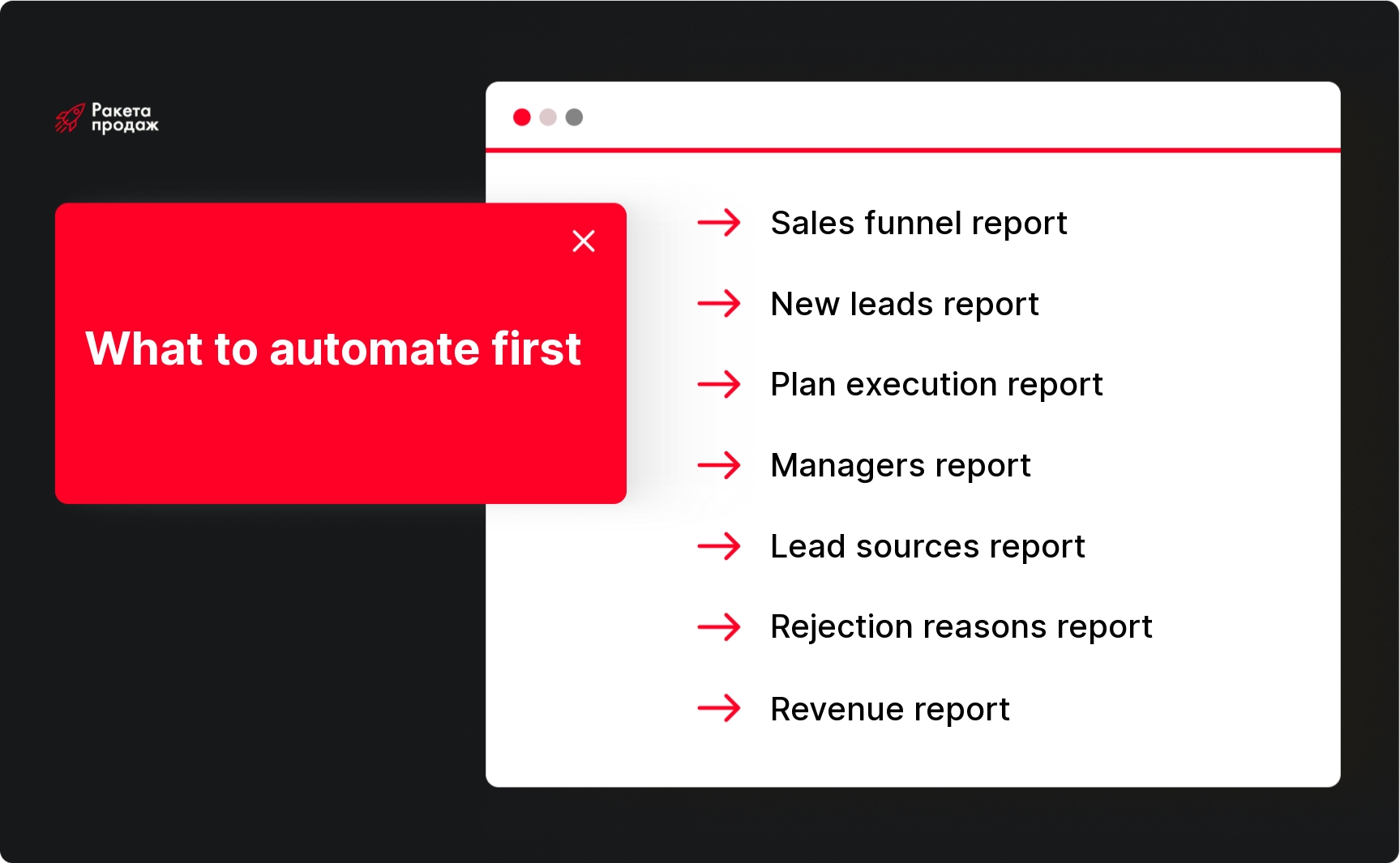
Sales analytics automation should start with the basic reports used every day. For example, implementing sales department analytics and dashboards helps you see key metrics right away and respond quickly to changes. The new leads report shows how effectively acquisition channels are performing and whether there are traffic quality issues. The lead response speed report helps make sure hot leads don’t go cold while waiting for a manager to follow up.
The sales funnel report is the heart of the management system. It shows where customers are dropping off, how many deals moved through each stage of the funnel, and how likely the team is to hit the monthly plan. The rep performance report lets you objectively compare team performance and identify best practices (read more here – evaluating sales manager performance).
The lead source report is critical for allocating marketing budget. Without it, there’s no way to know which channels bring in quality customers and which ones are just burning money. The lost deal reasons report helps identify weak spots in the product or sales process.
The overdue tasks and lead response speed report ensures discipline stays in check. It shows what might slip through the cracks and needs immediate attention. The sales forecast and plan fulfillment report gives leadership a clear sense of whether targets are within reach or whether urgent measures are needed.
The revenue report closes the loop, showing real money rather than just movement through the funnel. If you’re planning to integrate new tools, consider CRM and telephony implementation – it will significantly speed up automated reporting and increase control over your processes. These reports cover the core needs of sales management and will form the foundation for further analytics development.
Checklist: When Is It Time for Your Sales Team to Automate Reporting
A simple checklist can help you objectively assess whether your company is ready to switch to automated reporting. If most of the items describe your current situation, you can’t afford to delay automation any longer.
Reports are collected manually – this is the first and most important signal. If managers or analysts are spending hours copying data from different systems, it’s time to change something. Numbers don’t match across different systems – a classic sign that there’s no single source of truth.
Problems only become visible at the end of the month, when it’s too late to fix anything. It’s hard to pinpoint where the funnel is leaking because detailed analysis takes too much time. Reps manage the CRM differently, which creates chaos in the data.
Marketing and sales argue about lead quality because there’s no objective data to evaluate it. There’s no clear sales forecast – leadership is planning “by feel.” The team or number of channels is growing, but the reporting system isn’t scaling with it.
The manager spends time collecting data instead of making decisions – a direct drain on management efficiency. There’s no regular tracking of overdue tasks and unprocessed leads, leading to losses. It’s hard to compare reps, sources, and segments because the data is inconsistent.
If more than half the items on this checklist apply to you, automated reporting isn’t a luxury anymore – it’s a necessity for keeping your business manageable.
Automating reporting isn’t just a technical upgrade – it’s a critically important management tool for any modern sales department. That said, implementation requires a deep understanding of your business’s specifics, proper CRM setup, and a KPI system that motivates the team rather than demotivating it. “Rocket Sales” offers a comprehensive solution: from auditing existing processes to fully implementing automated reporting with team training included. We set up dashboards for daily monitoring and implement a management reporting system that shows the real picture of the funnel. Our clients get not just process transparency, but concrete results: conversion increases of up to 86%, shorter deal cycles, and predictable revenue growth. Don’t waste months on DIY experiments with uncertain outcomes.
Turn reporting from a headache into a competitive advantage - get turnkey automated sales analytics!
Automated reporting isn’t just for large companies closing thousands of deals a month. It becomes relevant for any sales department where manual data collection gets in the way of management and decisions get made too late. The signs are clear: if preparing reports eats into selling time, numbers don’t match across systems, and funnel problems only become visible after the fact, delaying automation is risky. The sooner a business builds transparent reporting, the easier it becomes to scale sales, control the funnel, and find growth opportunities. In today’s environment, automated sales reporting isn’t a technological novelty – it’s a basic management tool, and without it, staying competitive is an uphill battle.



 Time to read: 9 min.
 13 July 2026