Key Takeaways
- A star salesperson with ready-made scripts gets lost in a new market; you need researchers who can sell without case studies and teach clients why they need your product.
- Copying a structure from a mature market kills flexibility; a new market requires different KPIs (learning speed, quality of insights), not just conversions.
- Strong candidates bring hypotheses and feedback; weak ones wait for ready instructions and panic in chaos.
- Your team at the start should consist of two to three full-cycle managers; hire a leader only when transitioning to expansion (5+ people).
- Localization for a new market is not translating a presentation; it’s rethinking arguments, scripts, and negotiation culture for the target market.
In the article below, you’ll see exact signals for hiring, team structure for each market entry scenario, and mistakes that break sales in a new market. Read the full article 👇
The first mistake is copying the old model. The company takes a structure that worked in a mature market and tries to apply it to a new one. But selling in a market where you’re known and in a market where you’re nobody are two different stories. The second mistake is hiring “universal” salespeople. You think an experienced manager can handle any task, but sales in a new market require completely different competencies. The third mistake is relying solely on the product. You believe that if the product is good, it will sell itself. But in a new market, clients don’t know your brand and don’t understand why they should trust you.
Forming a sales team for entering a new market is not just hiring a few managers. It’s a strategic process where every decision affects your ability to gain a foothold in new territory. You need people who can work under uncertainty, educate the market rather than just sell the product, and bring feedback that helps adjust the strategy. Without the right team, even the strongest product won’t break through the barriers of a new market.
How a sales team for a new market differs from a "regular" sales department
Sales in a mature market and sales in a new market are two different sports. In a mature market, you have brand recognition, clear scripts that have worked for years, and clients who already know why they need your product. You work in a predictable environment where you can plan quarterly metrics with precision. Your managers are executors who guide the client through a well-established funnel. They know every objection by heart and have a ready answer for any question.
In a new market, everything is different. You have no brand recognition, and every first contact starts with the question “Who are you anyway?” Clients don’t understand what problem your product solves because in this market either they don’t recognize the problem or they solve it in other ways. Your task is not just to sell but to educate the market. You explain to clients why they need your product, how it fits into their processes, and why they should risk working with a newcomer. This requires completely different skills.
Entering a new market is always a challenge, and most companies face similar problems: the old sales structure doesn’t work, and universal managers prove ineffective in a new environment. Have you already noticed that forming the right sales team is a key success factor? Rocket Sales specializes in building systematic sales departments that work like clockwork even in new, unexplored markets. Over 7+ years, our experts have implemented more than 158 effective sales departments in 14+ different niches, including international companies like Mitsubishi, Yamaha, and Naftogaz. We don’t just help hire personnel – we create a comprehensive system: from diagnostics and auditing to script development, team training, and automation implementation. This approach allows our clients to achieve an average increase in turnover of +35%, and in some cases – up to +1.6 million dollars in additional monthly income in just 4 months of work.
Create a sales team that turns uncertainty into opportunities – order a free audit of your sales department!
Sales for a new market is research work. The sales team for market expansion becomes a source of hypotheses and feedback for the entire company. Managers communicate with clients, hear their objections, understand what works and what doesn’t, and pass this information back to product and marketing. Without this feedback loop, you’ll be selling blindly. KPIs and management approach should also be different: in a mature market, you measure sales volume and conversion; in a new one – learning speed, lead quality, and depth of market understanding. These differences determine how you build your team.
If you want to learn more about how a modern sales department is built and what nuances to consider when organizing it, we recommend checking out the material on forming a sales department structure.
Market entry strategy and how it affects team structure
Before forming a team, you need to understand exactly how you plan to enter a new market. Entry scenarios vary, and each requires its own team structure. Pilot entry is when you test the market with minimal resources, verify hypotheses, and gather feedback. Expansion is gradual growth with a focus on sustainability and process quality. Aggressive growth is a rapid market share capture with high investments. Niche entry is focusing on a narrow segment where you can become a leader. Each of these scenarios affects what kind of people you hire and in what quantity.
To learn more about choosing the optimal strategy for entering new markets, approaches, and related team formation specifics, read our separate article.
For pilot entry, you need a small team of two or three researcher-sellers who can work independently and adapt quickly. These people should be able to sell without ready-made scripts, communicate with clients at different levels, and collect quality feedback. You don’t hire a department head at this stage because a founder or commercial director can manage a couple of people. Your task is to understand if the model works before investing more resources.
Building a sales department for a new market requires a more structured approach. You need a sales leader who can build processes, train the team, and scale what worked in the pilot. The team grows to five to seven people, and you start dividing roles: someone works with inbound leads, someone handles cold sales. Aggressive growth means dozens of salespeople, a clear structure with department heads, trainers, and analysts. You hire quickly but risk quality, so a system of training and control is critically important. Niche entry allows you to work with a small but highly effective team of experts who deeply understand the segment’s specifics. Without clear go-to-market logic, you’ll form a team randomly, wasting time and money.
Who to hire for launching sales in a new market
Here’s the key question: who to hire in a new market? Logic suggests looking for stars – those who showed excellent results in your old market or at competitors. But practice shows that “stars” often don’t work in a new market. Why? Because their success was built on knowledge of a specific market, established scripts, and brand recognition. When these supports are gone, they get lost. A star salesperson from a mature market is used to predictability, while a new market requires constant improvisation.
Other competencies prove more important than experience. First – adaptability. The person must calmly accept uncertainty and quickly change approach when the old one doesn’t work. Second – research thinking. A good salesperson for a new market asks the right questions, listens to clients, and draws conclusions that help the entire company. Third – the ability to sell without case studies. In a mature market, you show clients dozens of successful implementations; in a new one – you have nothing to show and need to sell through expertise, trust, and vision of the future.
Balance between experience and flexibility is critical. You don’t need a novice who can’t sell at all, but you also don’t need an expert who knows only one way of working. The ideal candidate is someone with two to four years of experience in B2B or complex sales who has already gone through basic training but hasn’t become rigid in one model. Such people learn more easily according to your specifics and are willing to experiment. They understand the basics of sales and can adapt as sales agents when needed. This is the golden mean that works in a new market, and precisely this selection of salespeople for a new market ensures maximum effectiveness.
The role of the leader: do you need a separate sales leader for a new market
A sales leader for expansion is not a classic sales manager who manages an established team and monitors plan fulfillment. This is a person who builds a system from scratch. Their tasks include forming hypotheses about how to sell in a new market, creating processes that don’t yet exist, and providing feedback between the sales team and the rest of the company. They don’t just manage salespeople but actively participate in negotiations with key clients, test approaches, and adapt strategy on the go.
Such a leader must be ready to work in conditions where there are no ready-made solutions. They create the first scripts, train the team, analyze why deals close or fail, and adjust the approach. This requires an analytical mind and willingness to experiment. A classic sales manager is used to working with established processes and stable indicators, while an expansion leader is an entrepreneur within the company who builds a business unit from scratch.
When to look for such a person depends on your strategy. If you’re doing a pilot, the founder or commercial director can manage a team of two or three people. When you transition to expansion and hire five to seven managers, you need a dedicated leader. An internal candidate works if you have someone who deeply understands the product and business model but is ready to learn management. External hiring gives you experience and a fresh perspective but requires adaptation time. The choice depends on what’s more important to you: speed or expertise.
Researcher-sellers vs executor-sellers
In a new market, there are two types of salespeople, and understanding the difference between them is critical for success. Researcher-sellers are people who work under uncertainty. They’re not afraid of cold calls without a script, are ready to experiment with different approaches, and analyze what works. These salespeople ask clients open-ended questions, listen more than they talk, and bring valuable insights to the team. They don’t wait for someone to give them a ready process – they create it themselves.
Executor-sellers, on the contrary, are effective in a stable environment. Give them a proven script, a clear funnel, and precise KPIs – and they will show stable results. But in a new market where scripts don’t yet exist and each client requires an individual approach, they get lost. Executors are good for scaling but not for finding first clients. If you hire only executors at the start, they’ll wait for instructions you don’t have.
At the start of entering a new market, you need researchers. These people lay the foundation: find first clients, test hypotheses, create first case studies. When you understand what works and start to scale, the team profile changes. Now you need executors who will repeat the successful model in larger volumes. The mistake many companies make is hiring executors too early. They come in, don’t understand what to do, and leave, thinking the product doesn’t sell. In fact, the product may sell excellently, you just hired the wrong people.
Localization for a new market: why the team won't fly without it
Localization for a new market in sales is not just translating a presentation into another language. It’s adapting the entire sales approach to the cultural, linguistic, and business specifics of the new market. Language matters not only in terms of linguistics but also in terms of terminology used by your target audience. Arguments that work in one market may not resonate at all in another. Decision-making culture also differs: in some countries, decisions are made quickly and individually; in others – slowly and collectively.
Why doesn’t “script translation” work? Because scripts are built on a deep understanding of what’s important to the client, what pains they experience, and how they formulate their needs. If you simply translate a successful script from one market to another, you get text that sounds strange and doesn’t fit the context. The client will feel that you don’t understand them. Localization requires rethinking all communication considering market specifics.
If you want to make internal sales as efficient and technologically savvy as possible, pay attention to the possibilities of implementing CRM and telephony, which increase process transparency and improve client interaction.
Local employees and consultants play a critical role at this stage. A person who grew up in the target market understands subtleties that will never be obvious to you as an external company. They know how negotiations are typically conducted, which topics are appropriate in business communication and which are not, which arguments are perceived as convincing and which as intrusive. Consultants help avoid typical cultural traps: for example, in some markets directness in negotiations is valued; in others – it’s perceived as rudeness. Understanding these nuances makes the difference between success and failure.
Sales agents or in-house team: what to choose for a new market
Sales agents are external specialists or companies that sell your product on a commission basis. They already work in the target market, have a client base, and understand local specifics. When is using agents justified? If you’re testing the market and aren’t ready to invest in a full-fledged team, agents provide a quick start with minimal fixed costs. If the market is geographically distant and opening an office is impractical, agents become a logical choice. If the product requires high expertise that you don’t have internally, experienced agents can fill this gap.
The advantages of the agent model are obvious: you pay only for results, gain access to an existing client base and local expertise, reduce hiring and firing risks. But there are disadvantages too. First – control. Agents work with several companies simultaneously, and you can’t control exactly how they present your product. Second – motivation. An agent is focused on quick deals, not long-term client relationships. Third – brand. Clients communicate with the agent, not your company, and may not perceive you as a serious player.
Hybrid models are a compromise between agents and an internal team. You can use agents for initial entry and lead generation, then transfer clients to internal managers for large deals. Or hire one or two internal managers for key clients and use agents for broad market coverage. A hybrid approach allows you to balance between speed and control, testing what works better and gradually building internal resources as you grow in the market.
Forming a sales department for a new market
The minimum viable structure for launching sales in a new market includes just a few key roles. At the very start, you need two or three researcher-sellers who will look for first clients and test hypotheses. These managers need support – someone who will manage the process, analyze results, and adjust the approach. In the pilot stage, this role can be played by the founder or commercial director. You also need minimal marketing resources for lead generation, but at the start, this can be one person or a contractor.
Which roles are needed right away, and which later? Immediately – salespeople and someone who manages the process. Later, when you start to scale, add a dedicated sales leader who builds the system, a training specialist who transfers proven approaches to new managers, an analyst or operations manager who works with CRM and tracks metrics, and additional executor-sellers to process the growing lead flow. The sequence is important: if you hire everyone at once, you’ll overload the structure and waste resources.
It’s also worth thinking about technological equipment. For example, modern solutions for follow-up automation help not to lose hot contacts and optimize manager work, especially in small-sized teams.
Structure examples differ for B2B and B2C. In B2B with a long deal cycle, you need full-cycle managers who lead the client from first contact to closing, plus a pre-sale specialist for technical presentations. In B2C with a large lead flow, it’s more effective to separate into qualifiers who process incoming requests and pass quality leads further, and closers who focus on closing deals. At the start, don’t overload the team: better three focused managers than ten who don’t understand what to do.
Typical mistakes in selecting salespeople for a new market
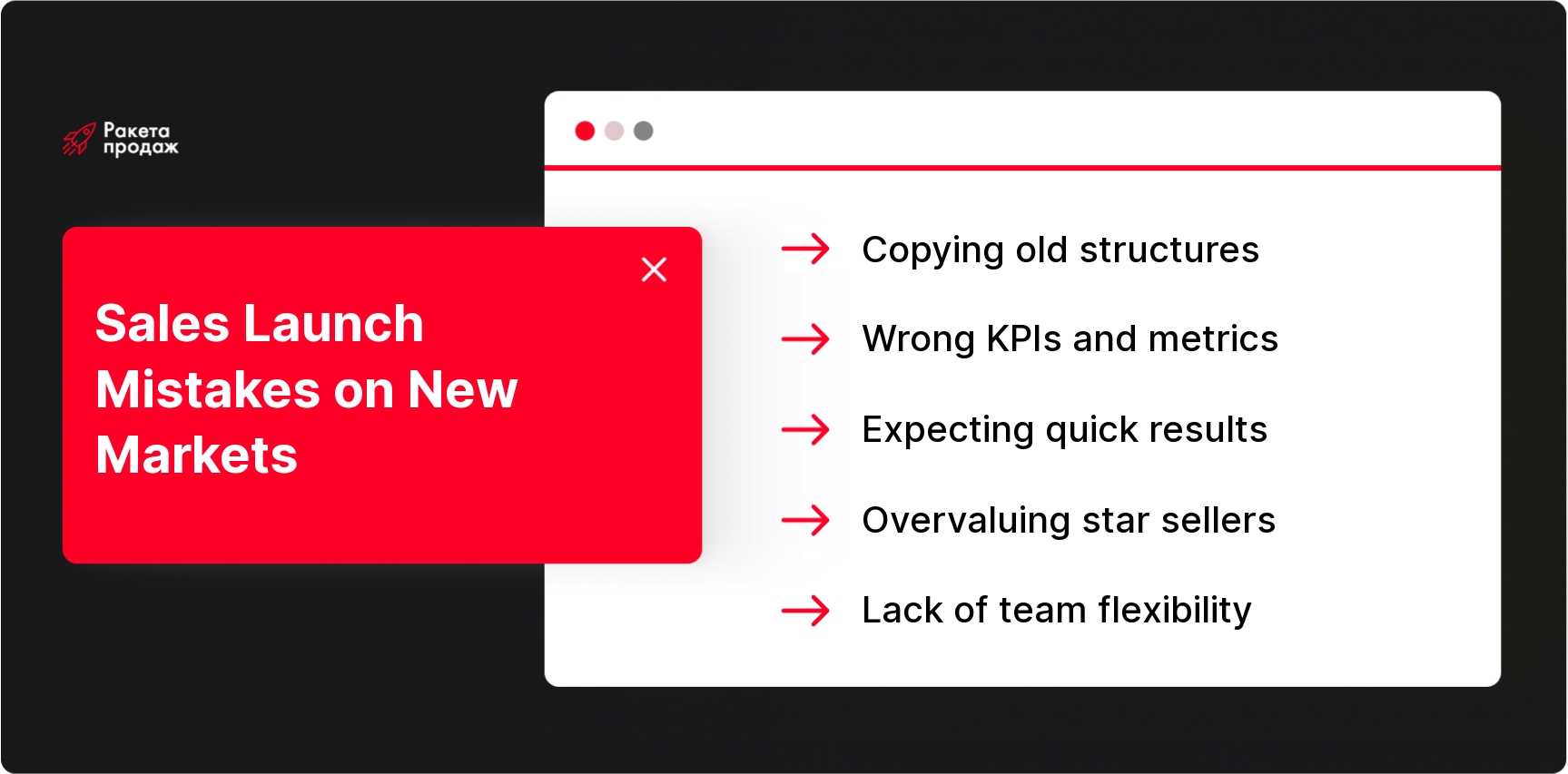
The first mistake is copying the old sales model. You take the structure, processes, and KPIs that worked in a mature market and apply them to a new one. But a new market requires a different approach: more flexibility, more research, different success metrics. If you demand from the team the same conversion rates as in the old market, you’ll demotivate people and miss valuable feedback that would help adjust the strategy.
The second mistake is the absence of KPI adaptation. In a mature market, you measure sales volume, conversion at each stage of the funnel, and deal closure speed. In a new market, these metrics are also important, but qualitative indicators are equally important: how many hypotheses the team tested, what feedback they collected from clients, how deeply managers understand market pains. If you focus only on sales figures, the team will close quick but wrong deals, not creating a foundation for long-term success.
In this situation, it’s important to understand how manager effectiveness evaluation is built and what additional parameters should be included in your approach at the start of entering a new market.
The third mistake is overestimating entry speed. You expect the team to start bringing results in a month, as in the old market. But in a new market, the first few months are about learning, testing, and building processes. Expecting quick results leads to panic, frequent strategy changes, and firing good people who simply weren’t given time to figure things out. Give the team three to six months to educate the market and themselves before judging effectiveness. This is an investment that will pay off if you have patience.
Forming a sales team for entering a new market is a strategic process that requires a special approach and expertise. You can experiment with recruiting for a long time, spending months and significant resources, or turn to a proven solution. Rocket Sales offers a comprehensive service for creating a systematic sales department that works effectively even in new, unexplored markets. We don’t limit ourselves to recommendations – we take on the full cycle: from deep audit and business process design to creating a sales book with training materials and implementing a motivation system, KPIs, and regular reporting. Our clients don’t just get a team of salespeople but a true systematic mechanism that consistently meets and exceeds plans. We understand the specifics of working in new markets and select exactly those people who can effectively work under uncertainty – researcher-sellers with the right competencies. Thanks to our approach, the average turnover increase is +35%, and sales conversion increases by 5-86%.
Don't waste time and money on experiments – trust building a sales department for a new market to professionals with proven results!
Forming a sales team for a new market is not just about hiring the right people. It’s a strategic process that begins with understanding your go-to-market strategy and ends with constantly adapting your approach based on feedback from the market. A sales team for market expansion should be a research tool, not just a revenue source. These people lay the foundation for your presence in new territory, test hypotheses, educate the market, and gather insights that help the entire company adjust its strategy. Without the right team, even the best product will remain unnoticed because no one will be able to convey its value to clients. Invest time in selecting people with the needed competencies, adapt processes and KPIs to the specifics of the new market, ensure localization at all levels of communication, and give the team time to learn. These are the principles that separate successful entries into new markets from failed attempts that end in disappointment and lost resources.


 Time to read: 10 min.
 09 March 2026