icon

AI Deal Scoring: Forecasting Deals and Closing Sales with AI

A familiar scenario for many sales leaders: the quarter is ending, the team confidently forecasts 110% plan completion, but only 60% of expected deals actually close. The problem isn’t that your managers are lazy or incompetent. It’s much deeper-traditional methods of evaluating deals simply don’t work in today’s environment.

Want a high-performing sales team without the hassle?
We’ll build it for you.
Contact Us

Key Takeaways

  • Traditional “eyeball” deal assessment has a 30-50% margin of error, while AI scoring reduces it to 10-15% and identifies risks 45 days earlier than managers.
  • Strong deals include at least two involved senior executives, a clear business problem, and ROI discussions-without these elements, closure is unlikely.
  • Your system should explain predictions and suggest specific steps (meeting with CFO, pilot project, ROI calculation), not just provide percentages.
  • Companies implementing AI deal scoring increase win rates by 15-28% and save up to 30% of managers’ time on evaluation and prioritization.
  • Poor CRM data, “black box” systems without explanations, and lack of team training kill results before you even start.

In the article below, you’ll find specific signals to check, technological system components, and a checklist of what to verify before implementing AI deal scoring 👇

Classic “eyeball assessment” often leads to catastrophic consequences. Managers overestimate deals where clients show visible activity but ignore quiet warning signs-lack of real progress or involvement from decision-makers. They focus on large deals with low closure probability, missing smaller but almost guaranteed ones.

The result? Unrealistic forecasts, disappointed investors, improper resource allocation, and constant end-of-quarter stress. Fortunately, automation with artificial intelligence-AI deal scoring-can radically change forecast accuracy and the effectiveness of the entire sales process.

How AI Deal Scoring Works: Key Principles and Stages

AI deal scoring is a system for evaluating deal closure probability based on machine learning algorithms that analyze historical sales data and identify hidden success patterns. Unlike traditional scoring where rules are manually set, automated sales forecasting independently determines which factors actually influence deal outcomes.

The working principle of AI scoring is based on multidimensional data analysis from various sources. The system collects information from CRM (contact data, interaction history, deal stages), analyzes communications (email correspondence, call records, meetings), integrates data from ERP systems (purchase history, payment discipline), and even considers external factors (company news, social media activity, market trends).

What makes AI sales forecasting truly powerful is its ability to account for both quantitative and qualitative indicators. The system evaluates not just the fact of meeting with a client, but the depth of participant engagement-whether they asked specific questions, how long the meeting lasted, who attended. AI analyzes communication tone, frequency of competitor mentions, presence of key signal words (“budget,” “decision,” “timeline”).

Machine learning allows the model to constantly improve. With each new closed deal (both successful and lost), the system receives feedback and adjusts its predictions. For example, if the algorithm initially considered that a technical director’s participation in negotiations increased deal probability by 15%, but new data shows this influence has decreased, the model will automatically recalibrate.

Data Used for AI Scoring

Data Type Examples Significance for Prediction
CRM Data Deal size, pipeline time, contact history Basic information reflecting deal stage and dynamics
Communication Data Email correspondence, call records, meeting history Allows assessment of interaction quality and client interest
Behavioral Signals Email response time, message tone, engagement in demonstrations Reflects real client interest regardless of formal steps
Team Dynamics Decision-maker structure, executive involvement Helps assess support at different organizational levels
Historical Patterns Data on similar successful and failed deals Reveals non-obvious success and risk factors
External Data Company news, financial indicators, market trends Provides context for assessing potential risks and opportunities

The result of deal forecasting with AI is not just a probability assessment of deal closure, but a detailed explanation of why the system reached such a conclusion. For example: “75% closure probability, key positive factors-CFO involvement, quick email responses, specific implementation questions; risks-competitor mentions in the last three conversations.” This approach transforms sales forecasting AI from an art to a science, making the sales process more predictable and manageable.

Benefits of Implementing AI Scoring in Sales

Implementing AI scoring in your sales system isn’t just a trendy technological upgrade. It’s a tool that solves fundamental B2B sales problems and brings measurable business benefits. Companies that have already implemented such systems note significant growth in key performance indicators and qualitative changes in sales management processes.

The main advantage of AI for deal probability assessment is its ability to see the complete picture, considering thousands of factors and their interactions. While even the most experienced manager can hold a limited number of variables in mind, algorithms can analyze the entire history of interactions, identify hidden patterns, and draw conclusions based on large volumes of data. Let’s look at the main effects of implementing AI scoring.

Increased Forecast Accuracy

Traditional sales forecasting methods often have a 30-50% margin of error. This means a company might end the quarter with results half of what was expected, critically affecting business planning and investment decisions. Implementing AI in sales forecasting can reduce this margin to 10-15%.

Research conducted by Forrester Research showed that companies using AI predictive analytics for sales assessment improve forecast accuracy by 82%. In practical terms, this means that if you forecast quarterly revenue of $10 million, your error decreases from a potential $3-5 million to $1-1.5 million-a difference that can determine the fate of investment projects or new hires.

If you’ve ever dealt with inaccurate sales forecasts, you know how exhausting it is: managers’ promises fall through, plans fail, and leadership loses trust in the sales department. Sound familiar? You’re not alone-statistically, up to 50% of forecasts in traditional sales departments turn out to be wrong. “Rocket Sales” has developed a comprehensive solution to this problem, combining modern AI technologies with deep expertise in building predictable sales systems. Our specialists implement not only technical deal scoring tools but also set up management analytics, KPI dashboards, and funnel control systems. We work with your CRM data, train your team, and help build processes that transform sales from a “black box” into a transparent, manageable system. The result? Our clients achieve an average revenue increase of 35%, and the most successful cases demonstrate growth of up to +$1.6 million in 4 months of work.

Turn uncertainty into a predictable sales system-order a free audit of your sales department right now!

Increased Deal Closure Rate

When managers can accurately determine which deals have high closure potential, they can focus their efforts on these. This leads to a noticeable increase in the overall percentage of successfully closed deals (win rate).

According to SiriusDecisions, companies implementing AI for sales evaluation increase their win rate by 15-28%. One mid-sized technology company recorded growth from 22% to 38% in just the first six months of using the system-almost doubling their effectiveness!

Time Savings and Productivity Growth

Sales managers spend a significant portion of their working time on administrative tasks and evaluating deal potential. Automatic deal scoring automates this work, allowing them to focus on what matters most-building client relationships and closing deals.

According to McKinsey, automating deal assessment saves up to 30% of managers’ working time. In a company with 10 salespeople, this is equivalent to freeing up 3 full-time positions that can now be directed toward attracting new clients or deepening work with existing ones. Moreover, the algorithm never tires and can analyze deals 24/7, identifying opportunities even outside working hours.

Early Risk Identification

One of the most valuable properties of AI probability prediction for deals is its ability to notice early signs of problems long before they become obvious to humans. The system can detect when a client starts responding more slowly to emails, begins mentioning competitors, or stops asking specific questions about implementation.

Salesforce’s case shows that implementing predictive analytics allowed them to identify problematic deals 45 days earlier than managers did on their own. This gave the team enough time for corrective actions and saved a significant portion of deals that would otherwise have been lost.

Together, all these benefits create a serious competitive advantage. Companies that have implemented AI scoring don’t just forecast better-they fundamentally change the sales process, making it more efficient and less susceptible to subjective factors.

By the way, you can learn more about the specifics of working with large clients and how to build an effective interaction strategy in the article about B2B sales: effective strategies.

Key Elements of Effective AI Scoring: What the System Analyzes

To truly understand the power of AI scoring, it’s important to consider what specific elements the system pays attention to when assessing deal prospects. Unlike simplified systems that might only consider basic parameters like company size or industry, advanced AI scoring analyzes a multidimensional picture of client interaction.

Modern algorithms don’t just count activities or time in the funnel-they evaluate the quality of interaction, depth of engagement, and real signs of readiness to buy. Let’s look at the key dimensions that an effective AI scoring system analyzes.

Of primary importance is the structure of decision-makers (DMUs) and their level of involvement in the process. Deal scoring with AI tracks who participates in communications from the client’s side-whether it’s just low-level executors or managers with signing authority. The system considers whether decision-makers ask specific questions about the product, share internal processes, discuss implementation timelines. Research shows that deals with active participation from at least two senior executives close 40% more often.

Equally important is understanding the client’s business problem and economic justification for purchase. The system analyzes how clearly articulated is the problem that the client is trying to solve with your product. Does the client mention specific business indicators they want to improve? Do they discuss return on investment? If communications don’t show a clear connection between your product and the client’s business goals, this is a serious risk for the deal.

Financial aspects of the deal are also under AI’s close attention. The system tracks whether the budget was openly discussed, formally approved, and whether the finance department is involved in negotiations. If the client avoids talks about money or constantly tries to lower the price without objective reasons, the algorithm might reduce the deal probability assessment.

Key Dimensions of AI Scoring

Dimension What’s Analyzed Why It’s Important
DMU Structure Client team composition, management involvement, real authority presence Without support from management with authority, a deal cannot close regardless of executor enthusiasm
Business Problem Clarity of problem formulation, connection to KPIs, ROI discussion A client won’t buy a solution if they don’t understand or can’t justify its business value
Finances Budget discussion, approval process, finance department involvement Absence of allocated budget or process to obtain it is a common cause of deal delays or failures
Technical Readiness Presence of technical conditions for implementation, resource allocation, timeline reality Even with desire to buy, a client may not have the practical ability to implement the solution
Risk Factors Competitors, external constraints, client’s internal politics Hidden risks often remain unnoticed until the deal collapses

Special attention is paid to the client’s real “readiness” for implementation. Here AI analyzes whether technical requirements were discussed, whether the client allocated resources for the project, whether specific implementation timelines were discussed. Even if the client wants to buy but has no ability to actually use the product, the deal may be delayed or fail.

Finally, the system accounts for various risk factors: competitor mentions in conversations, sudden changes in client team structure, cancellations or postponements of meetings, delays in providing requested information. Each signal might be insignificant in isolation, but together they form a picture of growing risks.

The power of AI for evaluating deal probability lies precisely in its ability to simultaneously consider all these dimensions and their mutual influence. For example, senior decision-maker involvement usually increases deal probability, but if there’s no budget discussion-this could be a sign of “strategic interest” without real intention to buy in the foreseeable future.

If you’re still at the stage of building or reorganizing your sales system, pay attention to the article on how to build a sales department-it will help establish the right foundations for implementing any modern tools, including AI.

From Forecast to Action: How AI Scoring Helps Decision-Making

AI scoring isn’t just a tool for getting nice probability figures. Its true value lies in transforming forecasts into specific actions that help sales teams work more effectively. An intelligent system not only reports that a deal has, for example, a 65% closure probability, but also suggests concrete steps to increase this indicator.

One of the key advantages of AI scoring is identifying gaps in data and processes. The system might notice that a potentially promising deal lacks information about the client’s budget or has no contact with the financial director. Instead of simply stating a low closure probability, the system will suggest: “Organize a meeting with the financial director to discuss the economic justification for implementation. This could increase deal probability by 15%.”

In practical B2B team work, such prompts are invaluable. Managers receive not just assessments but actionable insights-specific recommendations about what to do next. For example, if the system notices that technical specialists from the client side aren’t involved in the deal, it might recommend organizing a technical demonstration or workshop, based on analysis of thousands of similar successful cases.

Imagine this scenario: Company Alpha is negotiating a CRM system implementation. AI scoring assesses the deal probability at 40% and identifies problem areas: negotiations only with the IT department, no ROI discussion, no clear decision timeline. The system proposes a specific plan: organize a meeting with the sales department head, prepare an ROI calculation, offer a pilot project with limited implementation. Two weeks after implementing these steps, the system reassesses the deal at 75% closure probability.

For more practical advice on CRM implementation and optimization, check out the material CRM system implementation, which forms the foundation for effective AI scoring.

Another scenario: the system suddenly reduces the assessment of a promising deal from 80% to 50%. Analysis shows the client has started responding more slowly to emails, twice rescheduled a planned meeting, and began mentioning a competitor in correspondence. These are alarming signals that might escape a manager’s attention, but AI identifies them and recommends immediate clarification-perhaps through a personal meeting with the project manager from the client’s side or by offering additional value.

This approach transforms AI scoring from a passive forecasting tool into an active assistant directing sales team actions. The system doesn’t just predict the future-it helps create it by suggesting optimal steps to maximize success probability.

To evaluate sales department performance and identify process bottlenecks, don’t forget about the importance of sales funnel analysis, which also affects AI scoring effectiveness.

The Human Role in AI Scoring Process

Despite the powerful capabilities of artificial intelligence, the human role in the AI scoring process remains critically important. The system doesn’t replace the sales manager but enhances their capabilities, creating a symbiosis of technology and human experience. It’s a partnership where each side brings unique advantages.

Humans add context that may be inaccessible to the system. The manager knows about the client’s internal politics, informal relationships between departments, personal preferences of decision-makers. This information is rarely recorded in CRM but can be decisive for deal outcomes. An experienced salesperson can interpret non-verbal signals in meetings, “read between the lines” in correspondence, understand the client’s emotional state-all things that remain beyond AI’s capabilities for now.

An important human function is verifying and adjusting system recommendations. AI might suggest increasing pressure on the client to accelerate decision-making, but the manager, knowing this particular organization’s specifics, might understand that such an approach would backfire. Or conversely, the system might consider a deal unpromising based on historical data, but the manager sees unique circumstances making it special.

For sustainable results, training the team to work with AI scoring is critically important. Salespeople must understand how to interpret system assessments, what factors influence them, and how to properly enter data to increase forecast accuracy. Regular sessions analyzing specific cases where the system and human reached different conclusions help improve both algorithms and team skills.

The most effective approach is teamwork, where AI and humans enhance each other. The system provides objectivity, analyzes large data volumes, identifies non-obvious patterns. Humans add context, emotional intelligence, and creative approaches to non-standard situations. Together they create a much more powerful decision-making system than either could achieve separately.

AI Sales Forecasting: Key Technological Components

Modern AI sales forecasting systems include several key technological components that ensure accuracy and effectiveness of assessments. Understanding these components helps sales leaders better navigate when choosing an appropriate solution.

The foundation of any AI system for evaluating deal probability is a multi-level machine learning model. Unlike simple statistical tools, modern AI models use a combination of algorithms, including decision trees, neural networks, gradient boosting, and other methods. This allows the system to handle different data types and adapt to your business’s unique characteristics.

Natural language processing (NLP) is another important component of sales forecasting AI. This technology allows analysis of unstructured data from correspondence, call recordings, and manager notes. The system can identify key phrases, determine communication tone, and even recognize client intentions, significantly improving the accuracy of AI deal scoring.

The integration layer ensures data collection from various sources-CRM, email, calendars, telephony, document management systems. The more data enters the system, the more accurate predictions become. It’s critically important for companies to choose solutions with broad integration capabilities matching their technology stack.

The decision explanation subsystem (Explainable AI) ensures that predictions are not just accurate but also understandable. This is especially important for building trust in the automated sales forecasting system. Managers need to understand why AI reached a certain conclusion and what actions can be taken to improve indicators.

The technological infrastructure of AI forecasting must ensure data security, scalability, and performance. It’s especially important to pay attention to these aspects when choosing cloud solutions, which are becoming the standard for implementing AI in sales forecasting today.

To learn more about the future and trends of sales, read the analysis from experts: new technologies, digital tools, and changing client expectations.

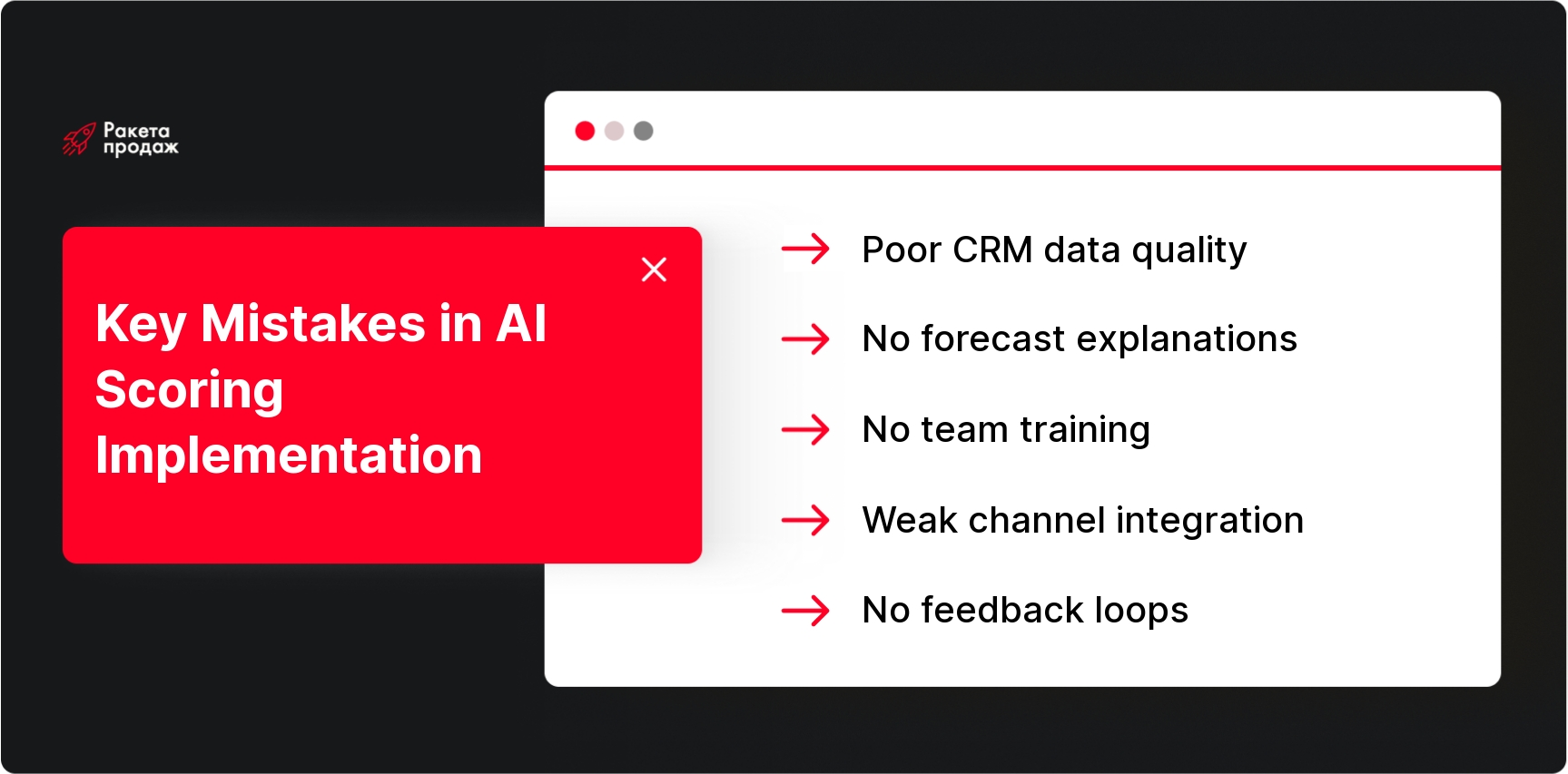
Mistakes in AI Scoring Implementation

image

Despite its obvious benefits, implementing AI scoring is associated with several typical mistakes that can significantly reduce system effectiveness or even lead to team rejection. Understanding these mistakes and preventing them is key to successful implementation.

The first and most common problem is poor-quality source data. Even the most sophisticated algorithms cannot make accurate predictions if trained on incomplete, contradictory, or unstructured data. Many companies rush to implement AI scoring without putting their CRM system in order, leading to disappointment. For example, if client communication history is stored partly in CRM, partly in email, and partly in messengers, the system only receives a fragmentary picture.

To solve this problem, start with data auditing and standardization. Define which fields are mandatory, create unified formats for information entry, integrate all client communication channels. Only after this preparatory stage does it make sense to start configuring the forecasting system.

The second serious mistake is creating a “black box” where the system provides forecasts without explaining reasons. Managers see that deal probability is assessed at 30% but don’t understand why this assessment was made or what can be done to increase it. This causes distrust and resistance to using the system.

The solution is choosing a transparent AI model that not only provides assessment but also shows key factors that influenced it, and offers specific recommendations for improving the situation. Managers should see, for example, that low assessment is related to lack of contact with the financial director and uncertainty about decision timelines.

The third common mistake is insufficient team training. After implementing a technically perfect system, leadership assumes managers will intuitively understand how to use it. In practice, even the most intuitive system requires training-not so much on the interface as on the philosophy of working with AI recommendations. Managers need to understand when to rely on system recommendations and when to trust their own experience.

Checklist "What to Check Before Starting"

  • CRM data quality: completeness, relevance, structure, absence of duplicates
  • Integration of all client communication channels (email, telephony, meeting calendars)
  • Sufficient history of closed deals for system training (minimum 50-100 completed cycles)
  • Transparency and explainability of AI model: ability to see reasons for specific assessments
  • Team training: not just technical aspects, but methodology for working with forecasts
  • Feedback process: how managers can correct and supplement system assessments

The fourth problem is lack of regular work with feedback and improvements. AI scoring isn’t a static system configured once and forever. It must constantly learn from new data, adapt to market changes and product line evolution. It’s necessary to regularly analyze discrepancies between forecasts and actual results, identify error causes, and adjust the model.

Effective AI scoring implementation requires a systematic approach where technological issues are addressed in parallel with organizational and cultural ones. Companies that pay equal attention to data quality, staff training, and improvement processes get maximum return on investment in this technology.

Conclusion

Implementing AI scoring isn’t just a technological upgrade but a strategic step that can transform your company’s entire sales system. The transition from subjective assessments to data-oriented decision-making allows not only increased forecast accuracy but also fundamentally changes the approach to sales funnel management. Companies that have already implemented such solutions gain tangible competitive advantages: they identify promising deals faster, allocate resources more efficiently, and are more likely to achieve financial goals.

Using AI deal probability forecasting allows sales leaders to make more informed decisions and focus team efforts on the most promising opportunities. AI deal scoring also gives managers valuable feedback and specific recommendations for improving their work.

Deal forecasting with AI is becoming an integral part of modern business. AI in sales forecasting allows companies to stay a step ahead of competitors, respond faster to market changes, and use their resources more efficiently.

Ultimately, AI deal scoring isn’t so much a question of technological leadership as a necessary condition for sustainable business growth in modern conditions where data-based decisions are becoming the market standard.

As you can see, AI deal scoring isn’t just a fashionable technology, but a powerful tool for transforming your entire sales system. However, it’s important to understand: simply buying software isn’t enough for successful implementation. A comprehensive approach is required, including process setup, team training, and creating a culture of working with data. This is where “Rocket Sales” offers a unique solution-we handle the full implementation cycle, from auditing current processes to training managers and leaders. Our experts will configure not just technical scoring aspects but also help create a system of predictable sales with KPI control, management dashboards, and clear deal processing procedures. For over 7 years, we have successfully built 187 effective sales departments in various industries that consistently achieve planned indicators and generate predictable revenue. Instead of subjective assessments, you’ll get accurate analytics; instead of nervous end-of-quarter anticipation, confidence in results; instead of chaotic activities, a systematic approach to closing deals.

Implement AI scoring and increase your sales forecast accuracy to 85%-sign up for a strategic session with our experts!
In this article:
See more
Book a FREE sales funnel audit
CONTACT US
FAQ
What is AI deal scoring?

AI deal scoring is a system for evaluating deal closure probability using artificial intelligence and machine learning algorithms. Unlike traditional methods where assessment is based on fixed rules, AI analyzes historical deal data and identifies non-obvious factors influencing sales success.

How does AI assess deal closure probability?

AI analyzes multiple factors: client interaction history, decision-maker involvement, communication tone, financial aspects, technical implementation readiness parameters, and potential risks. The system identifies patterns in successful and lost deals and applies this knowledge to evaluate current opportunities.

How quickly are results from AI scoring implementation visible?

First results are usually noticeable within 1-2 months after implementation-forecast accuracy and deal prioritization quality improve. The full effect, including increased closure percentage and reduced sales cycle, appears after 3-6 months when the system accumulates enough data for more accurate predictions.

Can AI be used for forecasting and closing complex deals?

Yes, AI is especially effective for complex B2B deals with multiple participants and long cycles. The system’s ability to analyze large data volumes and identify non-obvious patterns makes it ideal for working with complex corporate sales.

Where should I start implementing AI scoring in a sales department?

Begin with auditing and organizing data in your CRM system-this is the foundation for successful implementation. Then choose a transparent AI system that not only provides assessments but also explains reasons. Conduct a pilot implementation on a portion of deals, compare results with a control group, train your team, and gradually scale the solution.

How do I measure AI scoring effectiveness for my company?

Key metrics for evaluating effectiveness: increased revenue forecast accuracy, higher deal closure percentage (win rate), reduced average sales cycle, increased average deal size, and time savings for managers. Compare these indicators before and after implementation, as well as between groups using and not using the system.

SUBSCRIBE TO MY TELEGRAM CHANNEL
The most valuable sales information right on your phone!
icon

LOTS OF USEFUL INFORMATION, FREE TEMPLATES, AND CHECKLISTS ON MY INSTAGRAM

Materials and practical advice on sales growth in our blog: