icon

8 Reasons Why Wholesale Customers Don't Place Repeat Orders

A familiar story. The sales team brings in a new wholesaler, the manager squeezes everything possible out of the negotiations, and the warehouse makes the first shipment. And a couple of months later, the customer goes silent. You replace them with a new one, then another, and so on in circles. That’s not growth, that’s running on a treadmill. Let’s break down why wholesale customers do not make repeat orders. It’s not always the manager’s fault. Repeat business is affected by assortment, price, availability, logistics, the quality of the first delivery, payment terms, complaint handling, and how regularly you stay in touch. Below are eight reasons why repeat orders from wholesale customers sag, plus a clear way to find the point where you lose them. The goal is simple: build a manageable system in which B2B repeat sales don’t depend on luck or the department’s mood.

Want a high-performing sales team without the hassle?
We’ll build it for you.
Contact Us

Key Takeaways

  • A wholesale customer doesn’t leave for a competitor because of a bad product, but because the supplier went quiet after shipment.
  • A repeat order that takes a few steps beats a pretty offer if the customer has to dig up old emails and double-check prices.
  • A message a few days before the expected purchase date works better than a call “in a month,” because every customer has their own cycle.
  • A customer with an open complaint shouldn’t be flooded with promos; they read “buy more” as mockery.
  • If follow-ups depend on a manager’s memory, the process breaks at the first vacation, so every account needs an owner and a backup in the CRM.

In the article below, you’ll find specific steps, checklists, and scenarios that will help you find where you lose customers after the first delivery and build a repeat-order system. Read on 👇

1. Insufficient Communication After the Deal

While the deal is in progress, the manager calls, sends price lists, and keeps the customer engaged. Once the money arrives, silence sets in. For a wholesaler, the relationship is only just beginning. The goods need to be received, checked, put on the shelf or sent into production. If the supplier isn’t around at that moment, the customer feels they were only needed until payment.

When the need comes up again, they’ll open a messenger and write to whoever is top of mind. Most often, that’s a competitor. So one of the main answers to why customers don’t place repeat orders is simple. The company disappeared right after shipment. The cure is a post-sales cycle. Confirm receipt, ask how the goods are doing, send something useful like a seasonal selection, and prepare a tailored offer before the customer starts looking for a replacement. The format shouldn’t be intrusive. A new large buyer needs personal contact; for a stable one, an automatic status update and a reminder are enough.


Mini-case (hypothetical example). A wholesaler sells household goods to stores. After the first shipment worth 40,000 UAH, the manager writes on Viber a week later and asks how the goods are selling. The customer complains that one SKU turned out larger than expected. The manager immediately offers a replacement on the next order, and three weeks later gets a repeat purchase worth 55,000 UAH.

One attentive question after delivery works better than ten promotional mailings, and it leads smoothly to the second reason. If you want to dig deeper into the topic, check out repeat sales strategies.

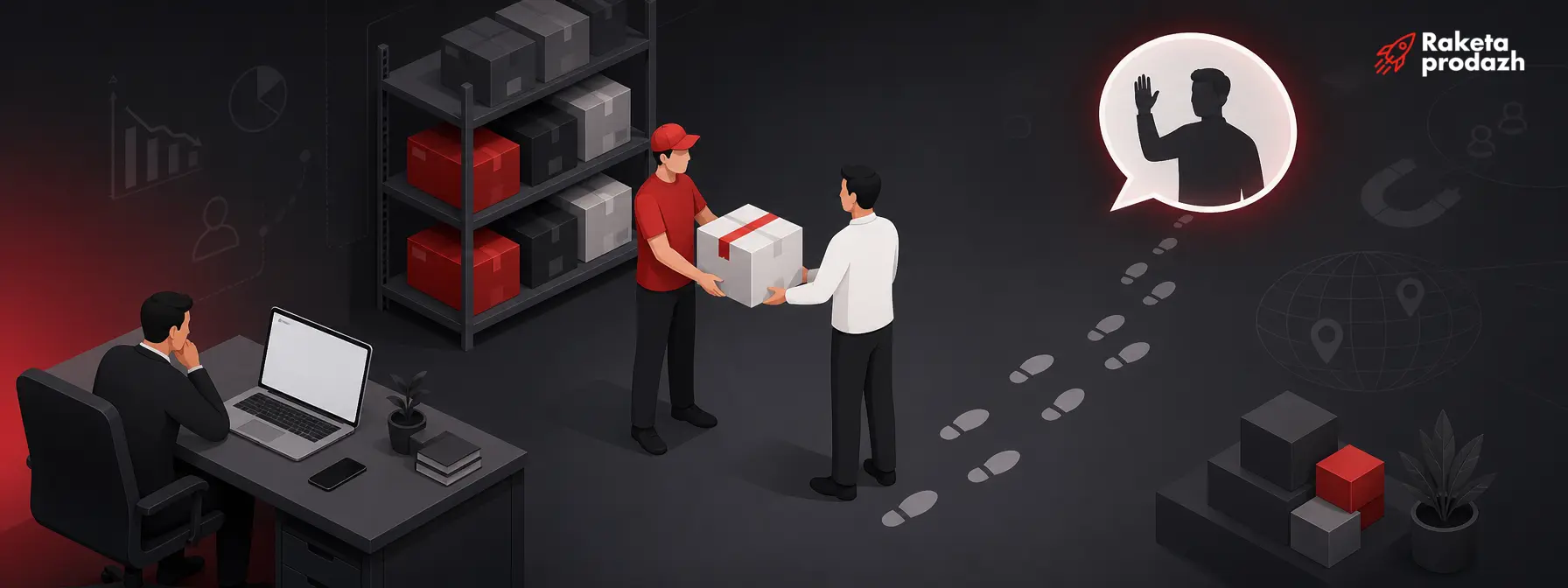
wholesale repeat orders — Silence after shipment: the client is left without attention and drifts toward a competitor

Sound familiar? A customer goes quiet after shipment, and the manager finds out only when a competitor has already taken the order. Building a post-sales cycle, personalization, and CRM reminders on your own is hard when the sales team is already overloaded with current deals. At “Ракета Продаж” (Sales Rocket), we solve exactly this problem systematically: we audit your wholesale-base processes, implement a CRM with automatic repeat-purchase triggers, and build post-sales communication guidelines. Over 8+ years, we’ve built 208 sales departments across 14+ industries, and our methodology covers the entire cycle, from customer segmentation to training managers in handling complaints and upselling. The results for our clients are measurable: an average revenue growth of +35%, and in the INGVART case, implementing systematic cross-selling raised the average check by 40%. This isn’t a one-off consultation but a comprehensive system that makes repeat orders predictable, not accidental.

Build a system where wholesalers come back on their own - get a free sales department audit!

2. Ignoring Individual Needs and Personalization

Imagine you receive an offer that was clearly written for everyone at once. You wouldn’t even finish reading it. Wholesale customers get such emails all the time. They contain no order history, no business specifics, no past agreements. Personalization in sales in wholesale isn’t about addressing someone by name. It’s about the supplier remembering what you buy, in what volume, and at what price.

The gap here is huge. According to a Salesforce study, 86% of business buyers are more willing to buy from a supplier that understands their goals, yet 59% believe salespeople don’t understand their needs. For B2B customer retention, this means one simple thing. Segment your base by assortment, buyer role, and consumption cycle, and turn CRM data into concrete actions. A procurement manager cares about availability and lead times, an owner about turnover and margin, an accountant about documents. One email for everyone won’t work well.

Here are three examples of personalized offers. For a store that buys the same pack size, send a ready-made cart of the previous order with current prices. For a growing dealer, offer to expand the range with related products that turn over well. For a customer celebrating a company anniversary, send congratulations and a trial-batch offer on a new product.

When the offer is on target, one obstacle remains, and that’s the ordering process itself.

3. Inconvenient Reordering and Interaction

To the supplier, their process seems simple, because the manager knows all the shortcuts. The customer sees something different. They have to find the old correspondence, request a price list, check the stock, wait for price confirmation, get an invoice, and separately find out where the parcel is. Each step is small, but together they eat up time and nerves. Few companies have a convenient system in place yet, so it becomes a noticeable advantage.

B2B buyers are already used to flexibility. According to McKinsey, they use around ten channels on average along the buying journey, and more than half are ready to switch suppliers if moving between channels is inconvenient. For repeat sales to wholesale customers, the conclusion is obvious. A routine order should take a few actions, and the manager steps in where advice is needed, not where they have to dictate bank details for the hundredth time.

Here’s a short checklist of technical improvements.

  • A “repeat previous order” button or bot command that checks current prices and stock.
  • Saved product lists, entry by SKU, or spreadsheet upload for large product matrices.
  • Order, invoice, and document history in one place, so no one has to hunt for email attachments.
  • The ability to add to an already placed order before shipment without a new request.
  • Delivery status and waybill number that reach the customer automatically.

But even a perfect process won’t work if the customer simply has nothing to be reminded of, and that’s where reasons to reach out come in.

4. No New Reasons to Get in Touch

A satisfied customer isn’t obliged to come back. If they have no reason to write, they won’t, and then they’ll buy from whoever reminded them of themselves. Many wholesalers receive only an invoice and a waybill from their supplier. They learn about new products, related items, seasonal promotions, and service changes by accident, or not at all.

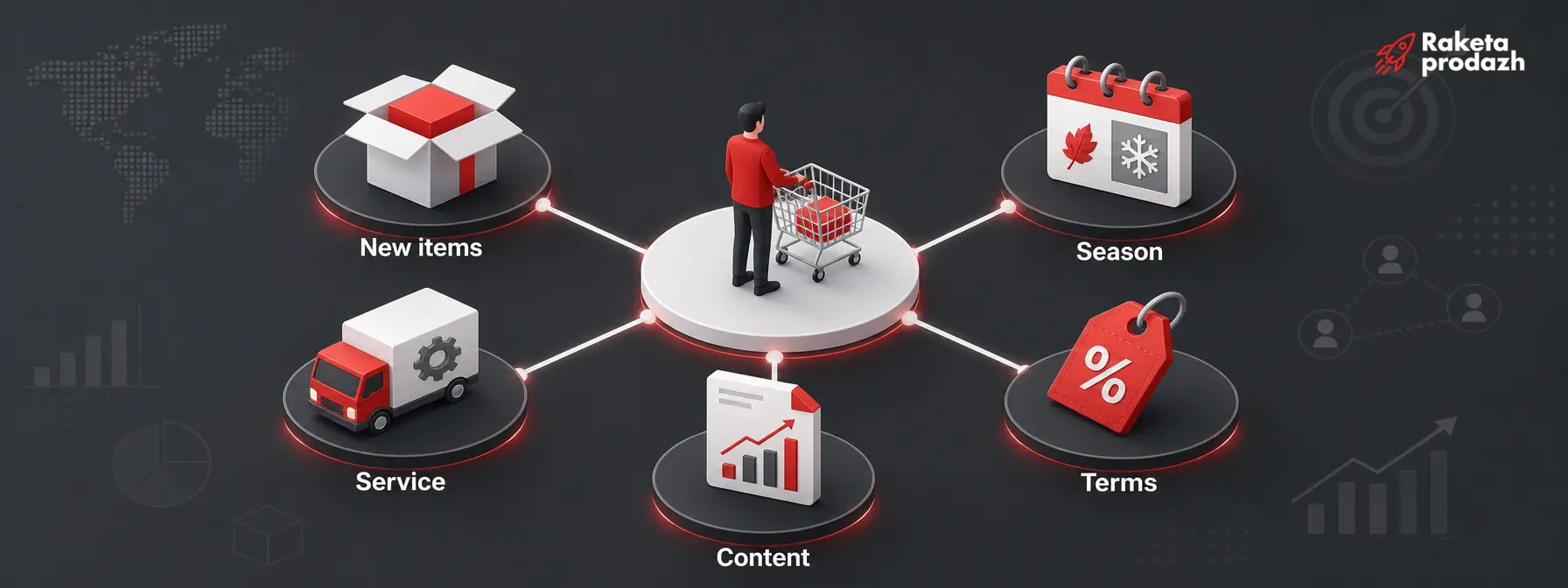
Repeat customer orders are born from reasons. A new product in a category you already buy. A season when demand grows. An item that was out of stock showing up at the warehouse. Favorable terms on a volume the customer has already taken. If you draw an infographic called “Possible reasons for a customer to return,” the customer sits in the center with five rays around them. They are a new assortment, a seasonal offer, a service update (for example, a new delivery service or online document signing), special terms, and useful content like a trend overview. Each reason should connect to what the customer has bought before. Then the message gets read instead of skimmed past.

A reason grabs attention, but the right timing for the message still has to be guessed, and that’s what the next reason is about.

reasons for repeat customer contact — Diagram with the client in the center and five reasons to return around them

5. Ignored Repurchase Cycles and Ineffective Triggers

One of the most common mistakes goes like this. The company doesn’t know how often a specific customer buys a specific category. For consumables, the cycle might be three weeks; for seasonal equipment, half a year. A call a month after the first delivery is too late for some and laughably early for others. Without analytics, you’re either late or annoying.

You can start simple. Calculate the median interval between orders for each customer in the main categories and set a trigger a few days before the expected date. That way the message lands at the moment stock is running out, and the customer still has time for approval and delivery.

For B2B repeat purchases, it’s especially important to account for the real purchase cycle of the specific customer. There’s no universal “remind them in a month” rule here: the moment of repurchase depends on the product category, the volume of the previous delivery, and the speed of consumption. That’s why it’s better to tie the trigger not to the calendar but to the predicted date of the next order. We’ve covered how the repurchase cycle and triggers work in a separate article. If the customer isn’t ready, the system shifts the forecast and records the reason instead of knocking every three days.

Here’s a hypothetical timeline for three segments (the numbers are approximate, plug in your own).

Сегмент Типичный цикл закупки Когда запускать триггер
Consumables for stores 3–4 weeks 20–21 days after the last order
Resale goods with seasonal demand 2–3 months, with peaks 3–4 weeks before the season starts
Equipment and spare parts 6–12 months 2 months before the expected replacement

Even a perfect trigger won’t help if the product or service itself left a bad aftertaste, which we’ll talk about next.

6. Poor Product or Service Quality and No Work with Feedback

The most unpleasant reason is that the customer leaves silently. They don’t shout or write angry emails. They just order from someone else next time. This happens when complaints hang for weeks, errors in order fulfillment repeat, and no one responds to reviews. Understanding why wholesale customers don’t return is only possible if you go looking for these signals yourself.

Analyze feedback regularly, and the principles are described in detail in the article on working with feedback in sales. Log every incident in the CRM system, assign someone responsible, and set a resolution deadline. Once the problem is closed, be sure to tell the customer the outcome, otherwise they won’t know they were heard. A customer with an open complaint shouldn’t be included in regular promo mailings until the issue is resolved. That person reads “buy more” as mockery. It’s good when the post-delivery rating turns into a task rather than a line in an end-of-month report.

Two short examples. A store received a batch with damaged packaging. The manager offered a replacement the same day and said the cause had already been passed to the warehouse. The customer kept buying. Another example involves documents. A customer received the wrong certificate three times. The company introduced a check before sending and warned the customer personally. The dissatisfaction went away.

If quality is in order, the question remains how to earn more from those who have already come back, and this is where upselling matters.

7. Mistakes in Upsell Strategy and Lack of Segmentation

There are two extreme scenarios. Either the manager never offers anything beyond the usual order, or every customer gets the same “hits of the month” selection. Both work poorly. In the first, you miss out on growth in the customer’s wallet; in the second, you annoy people whose business is entirely different. Strong upselling is built on what the customer already bought, their lifecycle stage, and their budget.

For B2B customer retention and win-back, it helps to split the base into three groups. To new customers, offer a repeat trial order, preferably in the same category and with the same level of risk. To active ones, show an assortment expansion backed by demand data, for example “stores with your profile buy this product together with the main one.” Inactive ones need a separate reactivation scenario. First find out what changed, then offer terms based on the answer. If you’re wondering how to win back a wholesale customer who has disappeared, start with a question about stock and assortment, not a promotion.

The scenario template looks like this. The first touch checks on the result of the previous delivery. The second delivers a relevant offer with a ready-made cart. The third kicks in if there’s no reply and offers a short call or a convenient communication channel. The fourth moves the customer into a long waiting mode without pressure.

For scenarios to run on their own, you need automation, and that’s where we’ll finish the list of reasons.

8. Lack of Automation and CRM Usage

When repeat touchpoints depend on a manager’s memory, the process is held together by a promise. The manager goes on vacation, gets overloaded, or quits, and customers are left without attention. The data confirms it. According to Ringostat research, 38% of companies in its sample did not use a CRM in 2025. In a survey of Ukrainian businesses, only 15% used CRM data to analyze changes in demand. The market changes fast, while many react manually and late.

A systematic approach to working with the customer base helps build repeat sales to wholesale customers, improve wholesale customer retention, encourage B2B repeat purchases, and organize customer win-back in B2B through timely touchpoints and personalized offers.

A good CRM gives the team support. When choosing a solution, look into which features you need in a CRM for B2B. It reminds you of an upcoming purchase on its own, shows customer status, launches a reactivation scenario, and sends a personal message. Customer retention in B2B becomes a systematic task, and the manager spends time on complex conversations rather than searching for notes in chats. But the system only helps when the team actually uses it. It’s important to agree that any terms, prices, and promises live in the card, not in private correspondence.

Here are a few automation hacks.

  • Assign an owner and a backup for every active account, so a manager’s vacation doesn’t reset the contact.
  • Create a “didn’t return” reasons list, so you can analyze losses instead of guessing.
  • Set up triggers by time after purchase, by category, and by number of orders.
  • Keep individual prices, payment terms, and delivery points right in the customer card.
  • Once a week, look at the list of customers with an overdue expected purchase, not at total revenue.
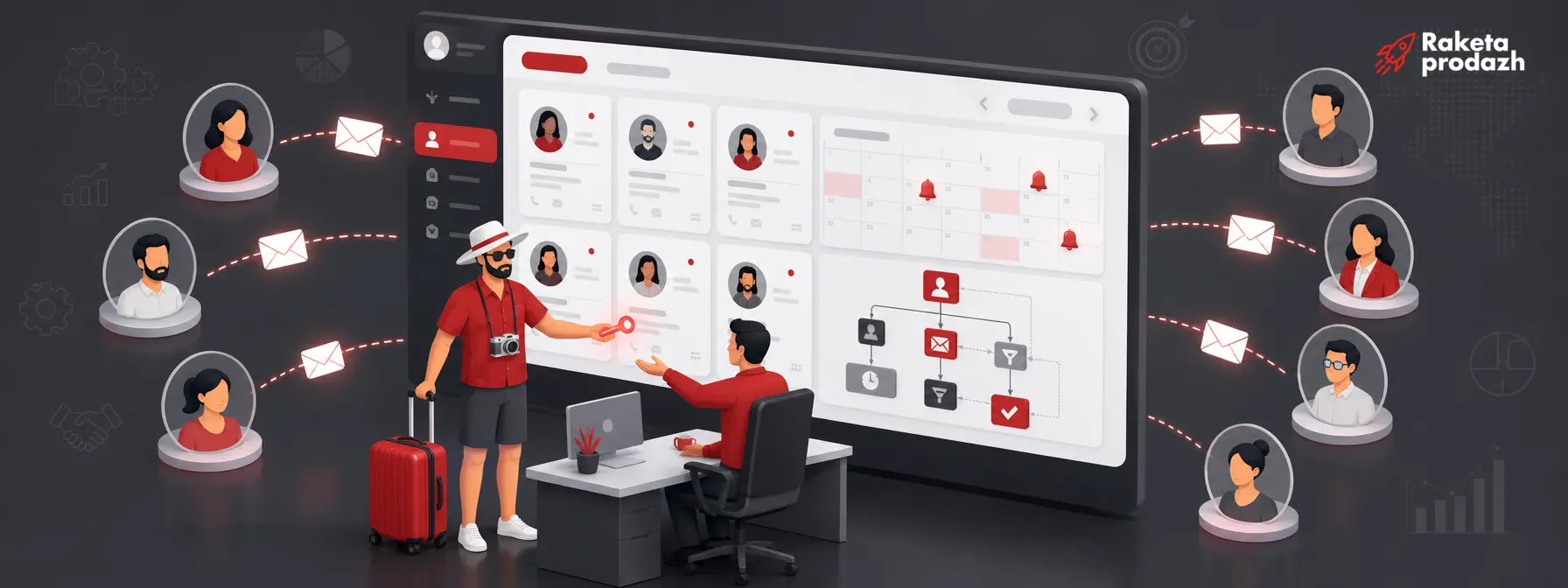
CRM for B2B repeat sales — CRM system with automated reminders and an account handed to a backup owner

All eight reasons in the article are symptoms of one illness: sales rely on the manager’s memory and goodwill, not on a system. You can implement checklists and triggers manually, but without a CRM, purchase-cycle analytics, and a trained team, the effect quickly fades. “Ракета Продаж” (Sales Rocket) handles this turnkey: we configure the CRM for the B2B cycle, automate reminders about repeat orders, implement customer-base segmentation, and build KPI dashboards to control customer return. Our specialists train managers in handling complaints, upselling, and reactivation – exactly the bottlenecks described in the article. Clients who have gone through sales department systematization with us get measurable results: in the INGVART case, retail revenue grew by 218% in 2 months, and the average check by 40% thanks to systematic cross-selling. Among the company’s partners are Mitsubishi, Yamaha, and Naftogaz, who have already moved their customer-base work onto systematic rails. Don’t wait until the next wholesaler quietly leaves for a competitor – build a system that brings customers back automatically.

Turn one-time buyers into permanent partners in just 6 weeks - book a free consultation!

Conclusion

image

Repeat purchases from wholesale customers aren’t an accident but the result of a system. Even a great product and honest service don’t guarantee a return if silence sets in after shipment, offers are the same for everyone, and a repeat order takes five phone calls. A working CRM, purchase-cycle analytics, constant work with feedback, and smart communication turn a satisfied wholesaler into a permanent partner. Start simple. Find the step where you lose customers after the first delivery, assign an owner to each account, and set a trigger ahead of the expected purchase date. The most expensive customer is the one you have to win all over again.

In this article:
See more
Book a FREE sales funnel audit
CONTACT US
FAQ
How can you tell that a wholesale customer has really left?

Compare the pause with their usual cycle. If it has been exceeded by one and a half to two times and there’s no reply to your messages, launch reactivation.

When should you contact a customer about a repeat order?

A few days before the expected purchase date, so there’s enough time for approval and delivery.

Should you win a customer back with a discount?

First find out why they left. A discount only fixes the price, not mistakes and delays. It’s better to offer a targeted condition on a trial order.

SUBSCRIBE TO MY TELEGRAM CHANNEL
The most valuable sales information right on your phone!
icon

LOTS OF USEFUL INFORMATION, FREE TEMPLATES, AND CHECKLISTS ON MY INSTAGRAM

Materials and practical advice on sales growth in our blog: