Key Takeaways
- Sales triggers are psychological stimuli that activate emotional responses in customers and push them toward purchase decisions, significantly increasing conversion rates.
- Effective sales are 95% based on emotional decisions that customers later rationalize with logic, which is why triggers work directly with the emotional part of the brain.
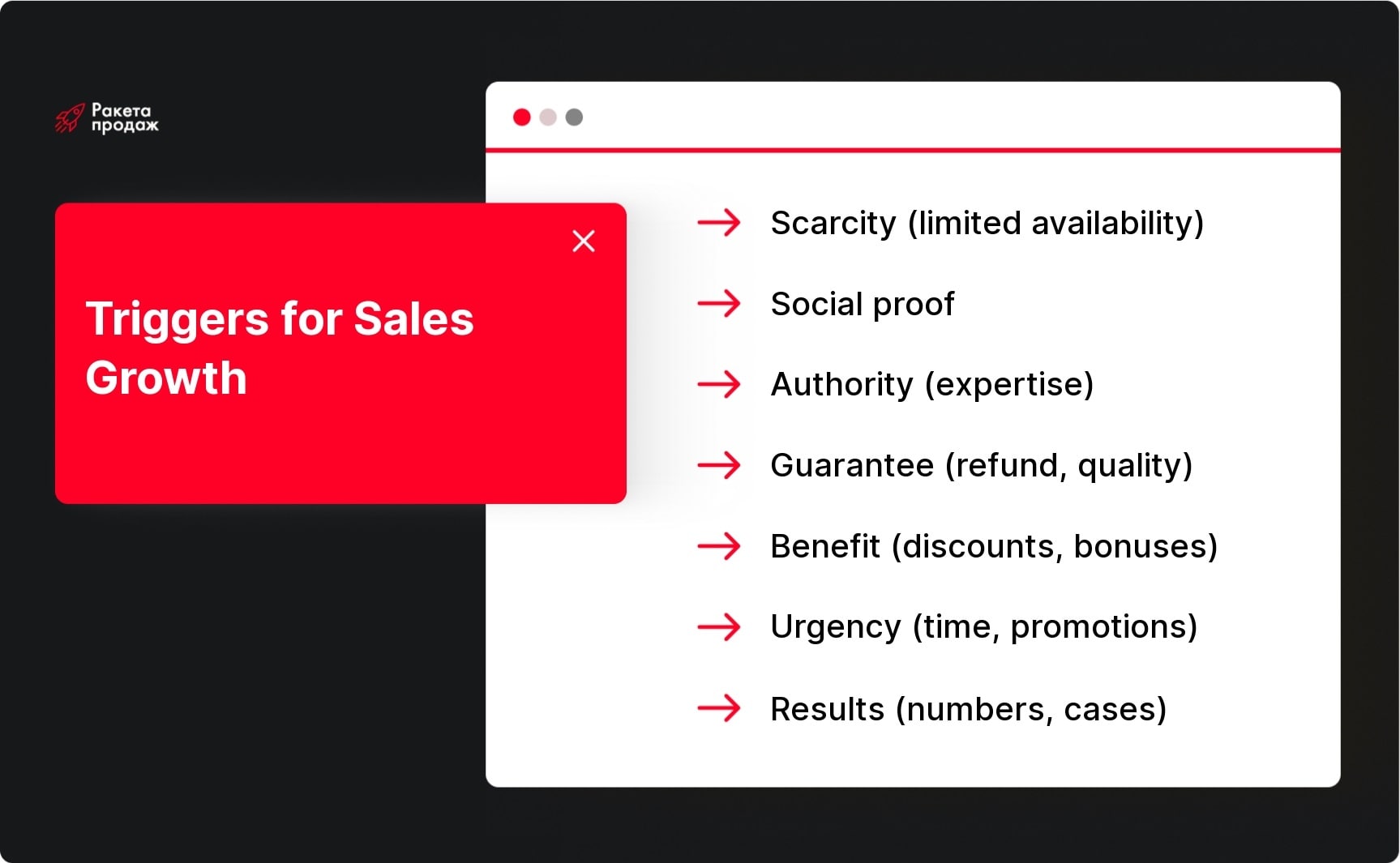
- The most powerful trigger types include scarcity (limited quantity), social proof (testimonials), authority (expert opinion), and guarantee (risk reduction).
- Implementing triggers requires a systematic approach: analyzing your target audience, selecting appropriate triggers, A/B testing, and measuring results with specific metrics.
- Using multiple triggers simultaneously creates a stronger effect, but it’s important to avoid overuse so customers don’t feel manipulated.
In the full article, you’ll find detailed descriptions of all trigger types and step by step instructions for implementing them in your business to increase sales. Read below 👇
In the business world, where competition grows daily, simply offering a quality product is no longer enough. Modern sellers must not just introduce the product but activate those “triggers” in the buyer’s mind that lead to purchasing from you rather than a competitor.
Sales triggers aren’t about manipulating customers. They’re more about understanding human psychology and providing the right solution at the right moment. And if you’re not using them in your sales strategy yet, you’re leaving money on the table.
Let’s explore why triggers work, what types exist, and how to implement them in your sales funnel to significantly increase conversion.
Sales triggers are psychological stimuli that prompt buyers to make purchasing decisions. Essentially, these are specific words, phrases, images, or offers that activate a desire in the customer’s mind to purchase a product or service.
A sales trigger is like a “button” that, when pressed, launches a chain of emotions and thoughts leading to a purchase. For example, the phrase “Only 3 items left” activates fear of missing out, while “98% of customers recommend this product” creates trust and a desire to be part of the majority.
Sales triggers are effective tools that help managers close deals faster. In a sales department, triggers for sales serve as instruments that help:
- Shorten the sales cycle
- Remove customer hesitation
- Increase average order value
- Boost repeat purchases
- Reduce rejection rates
Sales triggers are special techniques that can be used at various stages of customer interaction—from initial advertising to post-sale service. They influence buying behavior by creating need, enhancing desire, and prompting action.
Text illustration:
Without a trigger: “Our company offers marketing consultations”
With a trigger: “Only today, an experienced marketer with 15 years of expertise will reveal a strategy to increase your sales by 43% in a 30-minute consultation”
In the first case, the client receives just information. In the second, they encounter several trigger words in sales: urgency (“only today”), authority (“experienced marketer with 15 years”), and specific results (“increase sales by 43%”).
How many times have you encountered situations where seemingly well-built advertising campaigns and quality products don’t deliver expected results? Statistics show that 70% of successful sales depend not on the product itself, but on a properly built customer interaction system that includes effective psychological triggers.
At “Rocket Sales,” we’ve created a comprehensive methodology combining best global practices (SPIN, BANT, MEDDIC, Challenger Sale) with an individual approach to each business. Our team doesn’t just consult but fully immerses in your business: we develop sales scripts with integrated triggers, configure CRM systems, and create analytics tools that track the effectiveness of each sales funnel step. Thanks to our systematic approach, our clients receive stable conversion increases from +5% to +86%, with an average revenue growth of +35%.
Turn psychological triggers from theory into a powerful sales tool—order a comprehensive audit of your sales department right now!
Why Do Triggers Work? Consumer Psychology and Behavior
The effectiveness of triggers is based on a deep understanding of human psychology. Although we consider our decisions rational, a significant part of our actions are driven by subconscious mechanisms and emotional reactions.
Key Psychological Foundations of Triggers:
How This Works in Practice:
When a customer sees the phrase “Last day for 50% discount,” it activates:
- Fear of missing out
- Sense of urgency
- Desire to save money
- Belief that they’re making a rational decision
All these emotions and thoughts arise almost instantly and push toward action—purchase.
| Trigger |
Activated Emotion |
Psychological Basis |
Usage Example |
| Scarcity |
Fear of missing out |
Value increases with limited availability |
“Only 5 tickets left at this price” |
| Social proof |
Trust, sense of security |
Collective experience reduces perceived risk |
“Over 10,000 satisfied customers” |
| Urgency |
Fear of being late, impulsiveness |
Time pressure accelerates decision-making |
“Offer valid today only” |
| Authority |
Respect, trust |
We tend to follow expert advice |
“Recommended by leading specialists” |
Understanding these psychological mechanisms allows not only for creating effective trigger words but also using them ethically, offering customers truly valuable solutions to their problems.
There are many different triggers, each working in its own way and potentially effective in certain situations. Let’s look at the main types of sales triggers and how to use them properly.
The value-based offer trigger is built on a fundamental human need to feel that a purchasing decision is reasonable and justified. Even when decisions are driven by emotions, customers still seek a logical explanation that they received maximum value for their money. This is why messages focused on savings, added value, and tangible benefits consistently deliver strong conversion results in both B2C and B2B sales.
It is important to note that a value-based offer is not necessarily about offering the lowest price. In most cases, it works by shifting the customer’s attention from price to value. Instead of focusing on cost, the buyer evaluates the overall benefit: time saved, reduced risks, or multiple problems solved with a single solution.
When used correctly, this trigger helps overcome price objections, strengthens competitive positioning, and creates a sense of making a “smart purchase” rather than an impulsive decision.
How to use it:
- Emphasize the balance between price and quality
- Offer bonuses and additional benefits
- Compare the price to competitors or to a “standard” offer
Example:
“When you purchase an annual subscription, you receive 3 additional months for free plus personal consultations — saving over 30%.”
A guarantee reduces perceived risk and addresses customer objections, making the offer safer and more attractive. To achieve this, you can offer a money-back refund in case of dissatisfaction, provide extended product guarantees, and confidently guarantee results from using the service. Such measures help the client make a decision without fear of making a mistake. For example, we are confident in the quality of our course, so we offer a 30-day money-back guarantee if you don’t see the first results.
How to use:
- Offer money back if dissatisfied
- Provide extended product warranty
- Guarantee results from using the service
Example: “We’re confident in our course quality, so we offer a 30-day money-back guarantee if you don’t see initial results.”
People tend to trust the opinions of others, especially when those people are similar to them. Social proof helps clients feel more confident in their choice and reduces the perceived risk of purchase. It is effective to use customer reviews, show the number of users, and display ratings to visualize the product’s popularity. For example, over 5,000 entrepreneurs have already increased their sales using our CRM system — their experience demonstrates the real value of the offer.
How to use:
- Publish customer reviews
- Show the number of buyers or users
- Display ratings and evaluations
Example: “Over 5,000 entrepreneurs have already increased their sales using our CRM system. Here’s what they say…”
Personalization creates a sense of special attention to the client and increases their loyalty. It is effective to address the client by name, offer product customization, and provide individual recommendations based on previous purchases. This approach shows that you consider each client’s unique needs and aim to offer exactly what suits them. For example: Alexander, considering your interest in B2B marketing, we have prepared a personalized selection of case studies for you.
How to use:
- Address the client by name
- Offer product customization
- Provide individual recommendations based on previous purchases
Example: “Alexander, given your interest in B2B marketing, we’ve prepared a personalized selection of case studies on this topic for you.”
Appealing to the experience of a company or specialist builds trust and helps the client reduce doubts when making a choice. It is important to highlight the number of years in the market, mention completed projects, and share challenging cases that were successfully resolved. This approach demonstrates your company’s expertise and reliability, increasing client confidence. For example, over 15 years, we have implemented more than 1,000 automation projects for businesses of various sizes.
How to use:
- Address the client by name
- Offer product customization
- Provide individual recommendations based on previous purchases
Example: “Alexander, given your interest in B2B marketing, we’ve prepared a personalized selection of case studies on this topic for you.”
A limited-time offer increases the perceived value of the product and creates a fear of missing out for the client, encouraging a faster purchase decision. It is effective to limit the quantity of the product, set time frames for the offer, and create special limited editions of the product. This approach makes the offer more attractive and motivates immediate action. For example, only 50 participants can join this masterclass, and 42 spots are already booked.
How to use:
- Limit product quantity
- Set time frames for offers
- Create special limited editions
Example: “Only 50 participants can attend this masterclass. 42 spots have already been reserved.”
People tend to trust recognized experts and opinion leaders, so involving authoritative specialists increases trust in your product or service. It is important to showcase awards and certifications, as well as reference research and scientific data that confirm the effectiveness of your solutions. This approach strengthens the company’s reputation and convinces the client of the reliability of your offer.
How to use:
- Involve well-known specialists
- Display awards and certificates
- Reference research and scientific data
Example: “Our teaching methodology was developed in collaboration with professors from Kyiv National University and is recommended by the Ukrainian Business Education Association.”
The specific results that a client gains from using a product create a clear understanding of its value and help in making a purchase decision. It is effective to provide concrete numbers and metrics, show “before” and “after” comparisons, and share the achievements of other clients. This approach convincingly demonstrates the real benefits and effectiveness of your offer.
How to use:
- Provide specific numbers and indicators
- Show “before and after” comparisons
- Share other clients’ results
Example: “Our clients increase their website conversion by an average of 35% during the first month of using our system.”
Clearly indicating what problem your product solves allows clients to immediately see its value.
How to use:
- Start by describing the problem the client experiences
- Emphasize exactly how your product solves this problem
- Explain why other solutions are less effective
Example: “Tired of constant project deadline failures? Our task management system reduces communication time between departments by 70% and monitors task status in real-time.”
Remember, the most effective strategy is combining several psychological sales triggers. For example, combining social proof, scarcity, and guarantee creates a powerful comprehensive stimulus for purchase.
How to Implement Triggers in Your Business
Implementing triggers in your sales strategy isn’t just about adding a few “magic” phrases to your marketing materials. It’s a systematic approach requiring understanding of your audience and product specifics. Here’s a step-by-step guide on how to properly integrate sales triggers are into your business:
Before choosing sales triggers, it is crucial to clearly understand who your customer is and what influences their purchasing decisions. For this reason, target audience analysis should be structured across several key levels.
| Analysis Level |
What Is Analyzed |
Why It Matters for Triggers |
| Demographic |
Age, gender, income level |
Defines tone of communication and pricing boundaries |
| Psychographic |
Values, interests, fears, expectations |
Enables selection of emotional triggers |
| Behavioral |
Decision-making patterns and speed |
Helps integrate triggers into the sales funnel |
| Pain Points |
Core customer problems |
Makes triggers relevant and solution-oriented |
| Objections |
Reasons for hesitation or refusal |
Allows barriers to be addressed proactively |
| Feedback |
Customer-stated reasons for purchase |
Reveals which triggers actually work |
Surveys and interviews with existing customers complement this analytical framework. They help identify real decision-making drivers that are not always visible in data reports and form the basis for building effective, evidence-based sales triggers.
Selecting Appropriate Triggers
Based on target audience analysis, determine which trigger phrases will be most effective:
- For status-oriented audiences, authority and exclusivity triggers work best
- For practical buyers, value and guarantee triggers will work
- For those afraid of making mistakes, social proof and results are important
Testing Triggers (A/B Tests)
Never rely solely on intuition when selecting triggers:
Create different content versions with different triggers
- Test different formulations of the same trigger
- Check various trigger combinations
Measure key indicators
- Conversion
- Decision-making time
- Average check
- Bounce rate
Scale successful experiments
- Implement working triggers across all communication channels
- Adapt triggers for different audience segments
Integration with CRM and Other Systems
For maximum effectiveness, triggers should be part of a comprehensive strategy:
Automate trigger usage
Integrate triggers at all touchpoints
- In advertising materials
- On the website
- In sales scripts for managers
- In email campaigns
- On social media
Potential Issues When Using Triggers
When implementing triggers, it’s important to avoid common mistakes:
Excessive use
- Overloading content with triggers makes it unnatural
- Customers may feel manipulated
Brand inconsistency
- Triggers should match your overall communication tone
- Premium brands should carefully use discount and urgency triggers
Ethical questions
- Triggers should be based on real advantages
- Avoid creating false scarcity or urgency
Cultural differences
- Consider cultural context when using triggers
- What works in one market may not work in another
Practical Implementation Steps
Audit existing materials
- Evaluate which triggers you already use
- Identify where new triggers can be added
Train your team
- Conduct training for sales managers
- Explain how to recognize and use triggers in customer conversations
Create a trigger content library
- Develop templates for different communication channels
- Adapt them for various scenarios
Develop a monitoring system
- Track trigger effectiveness
- Make adjustments based on data received
Remember that implementing trigger words in sales is an ongoing optimization process. What works today may become less effective tomorrow, so it’s important to constantly test new approaches and adapt to changing customer needs.
How to Measure Trigger Effectiveness?
To ensure that your implemented triggers are actually working and delivering expected results, you need to build a system for measuring their effectiveness. This will allow you not only to assess the ROI from trigger implementation but also to continuously optimize your strategy.
Key Metrics for Evaluating Triggers
Methods for Measuring Effectiveness
A/B Testing
The most reliable way to evaluate a specific trigger’s effectiveness is to conduct A/B testing:
- Create two versions of a page/email/sales script
- Version A — control (without trigger or with current trigger)
- Version B — experimental (with new trigger)
- Divide traffic/audience evenly between versions
- Compare results by selected metrics
Cohort Analysis
Allows tracking trigger impact on long-term customer relationships:
- Divide customers into groups by acquisition time
- Compare cohort indicators before and after trigger implementation
- Analyze changes in LTV, purchase frequency, average order value
Customer Journey and Conversion Funnel
Analysis of how triggers affect customer movement through the funnel:
- Track each customer step after trigger contact
- Identify points where triggers are most effective
- Determine where conversion problems exist
Surveys and Qualitative Research
Direct feedback from customers:
- Conduct post-purchase surveys
- Ask what influenced purchase decisions
- Find out which offer elements were most convincing
Use charts and diagrams for better understanding of trigger effectiveness:
| Trigger |
Initial Conversion |
Conversion After Implementation |
Growth |
| Social Proof |
2.3% |
3.8% |
+65% |
| Urgency |
2.1% |
3.2% |
+52% |
| Guarantee |
2.4% |
3.5% |
+46% |
| Value Proposition |
2.2% |
2.9% |
+32% |
Successful Measurement Examples
Example 1: An electronics online store added the urgency trigger “Only 5 items left” to certain products. A/B testing showed a 37% conversion increase for these products compared to the control group where the trigger wasn’t used.
Example 2: A business education company added successful graduate testimonials (social proof trigger) to their sales page. The result was a 62% conversion increase and a 3-day reduction in decision-making cycle.
- Short-term metrics (conversion, CTR) — weekly
- Mid-term indicators (average order value, purchase frequency) — monthly
- Long-term metrics (LTV, customer retention) — quarterly
Remember that measuring trigger effectiveness isn’t a one-time event but a continuous process. Markets change, competitors adapt, and what worked yesterday may not work tomorrow. Regular analysis and optimization will help maintain high effectiveness of your sales triggers.
Implementing effective triggers into a sales system isn’t just adding a few “magic” phrases to scripts. It’s a comprehensive process requiring a systematic approach and professional expertise. “Rocket Sales” specializes in creating complete sales systems where psychological triggers are integrated at every stage of customer interaction. We not only develop individual strategies but ensure their proper implementation: from writing effective scripts and configuring CRM to training managers and creating analytical dashboards to monitor results. In 7+ years, we’ve successfully built 187+ sales departments across 14+ different industries, including collaborations with brands like Mitsubishi, Audi, Naftogaz, and Hitachi. Our approach is based not on theoretical models but practical tools with measurable results—our clients achieve average revenue growth of 35%, with the best result being +$1.6 million in 4 months.
Create a sales department where every trigger works for maximum conversion—sign up for a free audit right now!
Sales triggers are powerful tools that, when used properly, can significantly increase conversion and improve the effectiveness of your marketing efforts. We’ve examined the main types of triggers, psychological mechanisms behind their work, and ways to implement them in your business strategy.
Key takeaways:
- Triggers work due to deep psychological mechanisms that influence buyers’ decision-making
- The most effective triggers include scarcity, social proof, authority, and guarantee
- Implementing triggers requires a systematic approach, starting with careful target audience analysis
- It’s necessary to constantly test different triggers and their combinations to achieve maximum results
- Measuring trigger effectiveness should be regular and comprehensive
Remember that using triggers isn’t manipulation but a way to help customers make decisions that truly meet their needs. An ethical approach to trigger application not only increases short-term sales but also builds long-term trusting relationships with customers.
Action Plan for Implementing Triggers in Your Business:
- Analyze your target audience and identify their main motivations and fears
- Choose 2-3 triggers most relevant to your product and audience
- Implement selected triggers in marketing materials and sales scripts
- Set up A/B testing to evaluate effectiveness
- Analyze results and adjust strategy
- Gradually expand your set of triggers
Start small, test, analyze, and scale successful practices. And remember that even the most effective trigger cannot replace a quality product and genuine care for customer needs.


 Time to read: 15 min.
 29 July 2025