Key Takeaways
- A school that sells modules and hours of video loses to one that sells reduced uncertainty.
- A manager who honestly says “it’s too early for you” brings fewer refunds and more referrals.
- Your funnel doesn’t end at payment. The most important part starts during the course and leads to the next purchase.
- Automation without well-tuned logic turns chaos into an expensive email campaign, so check the customer journey manually first.
- Growth often hides in first-contact speed and consultation show-up rate, not in new traffic.
In the article below you’ll find seven steps for setting up a funnel, metrics for your weekly planning meeting, and examples of schools that have already gone down this path. Read the article below 👇
How Selling Educational Services Differs from Regular Sales
The first difference is simple. The customer isn’t buying a box with a product in it, but a future version of themselves. The result depends on the student’s own motivation, so it can’t honestly be guaranteed. The decision rests on trust in the instructor and the program. If you’re wondering how to sell educational services, start with the main thing: you’re selling reduced uncertainty, not the number of modules and hours of video.
There are other specifics too. Demand is seasonal, and part of sales is tied to the start of a cohort. Often a parent pays while the child studies, so you have to convince both. In corporate training, a separate B2B process appears, where HR, the manager, and the finance director all have a say. Refunds and student dropout hit the economics harder than it seems at the start.
That’s why an educational services sales department doesn’t just “close for payment.” It matches the person with the right program and sometimes honestly says: “It’s too early for you.” It sounds odd, but such a manager brings fewer refunds and more referrals. The same rule applies to an educational center sales department, where clients are often guided for years. Now let’s look at the basic structure of the journey.
Does it feel like your online school’s funnel works on its own, while where exactly leads get lost is a mystery? Most educational projects build the customer journey intuitively, and only later find out they were losing up to half of their leads between consultation and payment. At “Ракета Продаж” (Sales Rocket), we specialize in systematically rebuilding the sales funnel and sales department for the specifics of educational services, from the first lead magnet to the repeat purchase of the next level. Our clients include educational companies, for example the children’s development center chain “Лавка Шалостей Карусель,” where we built the department structure, trained the team, and implemented a CRM with KPI control. Over 8+ years, we’ve built 208 sales departments in 14+ industries, and conversion at individual funnel stages for our clients grew by 5–86%. The average increase in client turnover is +35%. This means that instead of experimenting with lead magnets at random, you get a proven system that accounts for both B2B sales to corporate clients and work with parents and students.
Turn your sales funnel into a predictable source of payments. Get a free sales funnel audit for your school!
Classic Stages of an Online School Sales Funnel
The AIDA model is usually the foundation. First, attention: a person encounters the school for the first time in an ad, on social media, or through an acquaintance. Then interest: they read the program, watch the instructors’ talks, and compare you with others. Next, desire: reviews, concrete benefits, and clear value kick in. The finale is action, meaning an application, payment, and enrollment in the course.
The scheme looks like this: attention → interest → desire → action → learning → repeat purchase.
For education, this model is only a framework. Between desire and action, consultation and doubts usually hide, and after payment the most important part begins. This is where a lead magnet helps: a mini-lesson, a test, or a template. It solves a small part of the same problem as the main course. For example, many educational platforms offer a free trial week. During it, a person completes a project and understands for themselves whether the profession suits them. That’s the first “purchase” without money.
Upsells and customer retention work as a continuation of the same path. The student finished the basic course and got a result. It’s logical to offer them the next level or a related program. Next, we’ll look at the types of schemes and who they suit.
Types of Sales Funnels for Online Schools: Schemes and Examples
The shortest scheme goes through a landing page: ads or search → program page → payment. For an inexpensive and straightforward product, a sales funnel for an online course often looks exactly like this. The pros are a quick cycle and simple analytics. The downside is that a cold audience is reluctant to pay a stranger right away. Social media and communities work more slowly. An expert regularly publishes useful content, gathers people in a chat or channel, and trust builds before the launch. This is good for niches where the decision is tied to identity, such as a career change.
Webinars and marathons engage through an event. A person registers, attends the lesson, sees the method, and gets an offer. For the Ukrainian school Superludi, free meetups delivered cheaper leads and higher payback than direct course advertising. A subscription or club model is built on long relationships and regular payment. Automated funnels with email campaigns and chatbots take over warming up and reminders, but work only with well-tuned logic.
Any online course sales funnel and online school sales funnel stands on these building blocks. They’re combined, not chosen once for life. You can look at more sales funnel examples for different types of business separately. Here’s what suits whom.
- Landing page. Inexpensive standard courses and an audience with an already formed search intent.
- Social media and communities. Experts with a strong personal brand and schools that need constant demand between launches.
- Webinars and marathons. Mid-priced programs where you need to show the method before payment.
- Club model. Products with regular updates, such as languages, analytics, or business practices.
- Automated funnels and bots. Schools with several starts per year and a sufficient flow of applications.
Now let’s put this together into a working sequence of actions.
Step-by-Step Sales Funnel Setup for an Online School
A good sales funnel for an online school isn’t built in one evening. First you find out who your student is, then you draw the path, launch the entry points, and only after that optimize. If you jump straight to chatbots, you’ll automate chaos. Then the online school sales system turns into a beautiful but expensive email campaign.
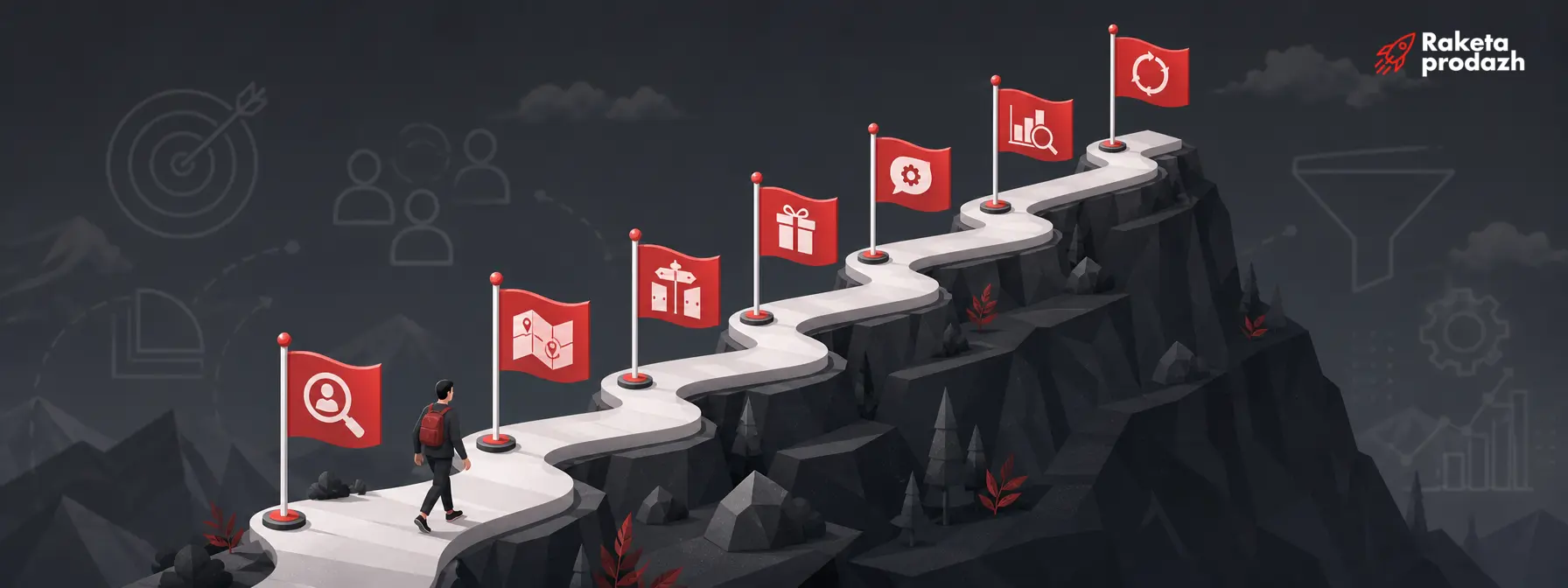
Below are seven steps. They suit both a small training center and a school with several products. The main principle is simple: at each step you answer one question and record the answer in numbers. If you need a more general overview, read about step-by-step sales funnel setup in any business. Let’s start with the audience.
1. Target Audience Analysis
First, find out why people actually study. Not “they want to master a profession,” but “they want to change jobs within six months” or “they’re afraid their child won’t pass the exam.” Talk to five to ten recent buyers, a couple of people who declined, and several graduates. Ask what they googled, where they looked for reviews, and what they were afraid of before paying. These conversations are more valuable than any survey of two hundred people.
Then look for where the audience lives. For the Ukrainian market, the internet audience is large, around 25 million users, and purchases increasingly happen from smartphones. For useful and educational information, people most often go to YouTube and Facebook. But the size of a platform doesn’t equal your audience, so check a channel by the cost of a qualified lead. For each priority segment, write down the customer’s task, barriers, and alternatives. This is the basis for everything else.
Draw a customer journey map from the first touchpoint to the repeat purchase. Each stage needs a definition, an owner, and a deadline. A “lead” isn’t just any comment on social media, but a person with a valid contact and consent to be contacted. If marketing, sales, and instructors understand the word “qualified” differently, reports turn into an argument about terminology.
Take the specifics of the course into account. For an inexpensive product, the path is shorter: a page, a sample lesson, payment. For a high-ticket program, diagnostics, consultation, and installments are added. If a parent pays, two roles appear on the map: who chooses and who pays. In B2B, add a pilot and budget approval. The main thing is that every step has an observable action visible in the CRM. The next step is about funnel entry points.
3. Launching Entry Points
Now build the places where a person enters. These are a landing page for a specific segment, a profile or channel on social media, an event page, and an application form. One universal landing page for a beginner, a practitioner, and a corporate customer will work so-so for all of them. It’s better to make two or three pages with different promises and proof.
Check the mobile version as if the customer were standing on a crowded minibus. The first screen should be readable in a second, the button pinned, the fields short, and payment available through Apple Pay and Google Pay. Separately, place transparent terms: the price, payment schedule, refund rules, and the offer agreement. This boring part often sells better than a new creative. To check your ideas, you can look at international landing page benchmarks, but it’s better to set goals based on your own history. Next comes work on the first useful contact.
A free material should collect contacts and build trust at the same time. Diagnostic tests, templates, mini-lessons, and hour-long workshops work well. A person solves a small part of their task, sees your method, and concludes on their own that it’s faster with you. There’s no point in churning out “forty-page checklists” just for an email. Subscribers will pile up, but payments won’t.
It’s important to connect the lead magnet with the main course. If you sell an analytics program, offer a skill-level test and a breakdown of the results. If you’re a training center preparing people for an exam, give a practice test with feedback. Then measure not only registrations, but also attendance, task completion, and the transition to a consultation. For mid and high-ticket products, a workshop or trial week often pays off better than a direct sale. Now let’s talk about how to handle this flow.
Once entry points work, set up triggers. A person looked at the price and left, started an application and abandoned it, registered and didn’t show up to the webinar. Each of these states needs its own message. The same series of emails for everyone looks like advertising, while a person who gets an answer to their objection at the right moment, such as about workload or installments, feels heard.
Watch the balance between automation and live communication. A manager calls hot and expensive leads, while cold ones get educational nurturing. At this stage, the online school sales department comes into play, and it needs rules. What is the time to first contact, how many attempts to reach a lead, who handles those who declined, what is the next step in each card. Make promotions and deadlines real, tied to the start of a cohort or the number of spots with a mentor. A made-up timer quickly teaches the audience to wait for a discount.
6. Systematic Bottleneck Analysis
Now we look at the numbers. The minimum set is: ad accounts, web analytics, CRM, payments, and the learning platform. Every person should have a single identifier, and the card should include the source, campaign and UTM tags, the reason for loss, and the payment amount. Without this, you argue by gut feeling about where things “dropped.” Read more about how to run a sales channel performance analysis in a separate article.
Calculate conversion between stages and end-to-end conversion. A hypothetical example: out of 10,000 visits, 10% become leads, then some reach a consultation, and in the end you get 18 sales. If you improve just four transitions, sales will be around 33. See? Growth is often cheaper to find in show-up rate and contact, not in traffic. Analyze by cohorts, not by weeks. This week’s leads pay a month later, and you can’t compare them with payments from this same week. If it’s hard to figure out on your own, a sales funnel audit will help.
Some people didn’t buy today but will buy later. They need a clear series of touchpoints. Remind them about the webinar recording, answer an objection, invite them to the next cohort, offer payment in installments. Reprocessing those who declined, in Superludi’s public case, was part of the sales department system, not a one-off promotion.
Return also works with those who’ve already bought. After the course ends, a training center sales department or a school sales department can offer the next level, a related program, or participation in a community. Referral bonuses and a request for a review work well while the result is still fresh. Use discounts as an exception. Risk reduction works much more strongly: a trial experience, transparent terms, and an honest description of the workload. Next, we’ll look at how to strengthen the whole structure.
How to Improve the Effectiveness of an Online School Sales Funnel
Start with content and lead magnets. They go stale faster than it seems. Update examples, fresh cases, and answers to objections once a quarter. Read call recordings and chat questions, which contain ready-made topics. Then connect a CRM and automation: you can read separately about how sales automation and CRM work. Assigning an owner, a meeting reminder, and a scenario for incomplete payment save hours and keep leads from slipping away. Chatbots are good at simple tasks, but check the logic manually first.
Then work on average check and sales formats. An individual offer, an upsell to an extended plan, and a cross-sell of a related course raise revenue from the same customer. Show the full price, payment schedule, and refund terms before payment. For the Ukrainian audience, this is especially important, since buyers are more cautious about large checks and often abandon an order because of a glitch or distrust.
Results come from regular analytics, testing hypotheses one at a time, and message personalization. There’s no universal cheat code. When the funnel is already working, you’ll find it useful to adapt the funnel to new segments and seasonal changes in demand. A short checklist for your weekly planning meeting looks like this.
- Compare indicators by sources and managers over the last 8–12 weeks.
- Find the single weakest link and formulate one hypothesis.
- Check the speed of first contact and the consultation show-up rate.
- Update one proof block, for example a real case with a starting point and timeframe.
- Record the result of the experiment, even if it failed.
Now let’s see what this looks like for those who have already gone down this path.
Examples of Successful Sales Funnels in Online Education
Superludi shows the power of the “event plus discipline” combination. The team removed sources of fraud, tested segments, and launched free meetups. Leads became cheaper and payback higher than with direct course advertising. In parallel, they built a sales department: regulations, scripts, CRM, telephony, and repeat work with declined leads. According to public data, the department of 11 people overfulfilled its sales plan in the first month. The figures were published by contractors, so take the principles, not the absolute values.
Mate academy, meanwhile, builds trust on results. In its 2025 report, the school publishes specific figures: 1,169 graduates employed, a median time to offer of 49 days, and the share of offers from partners. For some programs, pay-after-hiring applies.
What do they have in common? Each funnel reduces purchase risk and confirms the promise with data. Prometheus adds selection and shows a cascade from applications to completion and employment. Your school would benefit from adopting this cascade, even if the scale is smaller. Let’s wrap up.
An honest sales system without pressure wins in the long run, but building it on your own is a long and resource-intensive path: you need to think through the stages, set up a CRM, train managers to work with “hot” and “cold” leads, and build return and upsell mechanisms. “Ракета Продаж” (Sales Rocket) takes on exactly this work turnkey: from auditing the current funnel and identifying bottlenecks to developing scripts, implementing CRM analytics, and a KPI system for managers who guide students from application to repeat purchase. We’ve already helped 208 companies in 14+ industries, including educational projects, build sales departments that consistently hit their plan and increase conversion at individual stages by up to 86%. The average increase in our clients’ turnover is +35%, and the best result is +$10,907,403 in 4 months of work. Instead of testing hypotheses blindly and losing leads at every unworked stage, you get a ready-made system with clear numbers and owners at every step. Don’t put off systematizing your sales until the next cohort. Every month without it means missed payments and overloaded managers.
Build a sales funnel that brings up to 86% more leads to payment. Leave a request for a free consultation today!
A sales funnel for online schools works when the promise, product, data, and team follow one route. The customer journey doesn’t end with payment. It continues with onboarding, results, and the next purchase. That’s why you should regularly calculate conversions by stage, look at cohorts, test one hypothesis at a time, and not scale what doesn’t pay off yet. There’s no universal answer to the question of how to sell courses, and every school has its own growth points. Build your funnel consciously, start with one segment and one strong first step, and then add the rest. An honest sales system without pressure and made-up deadlines wins over the long run.


 Time to read: 9 min.
 12 October 2026