icon

5 questions to ask before firing your sales manager

The decision to fire a Head of Sales (Sales Director) is one of the riskiest in business. When sales decline, the Sales Director is first in the firing line. But are they really to blame? Often the problem lies not with the person but with the system: lack of marketing, weak product, or unrealistic management expectations. Meanwhile, firing can trigger a chain of negative consequences – from revenue drops to the collapse of the entire sales team.

Key Takeaways

  • Failure to meet sales targets often signals not a weak Sales Director, but a lack of system: unrealistic goals, weak marketing, or product issues override any talent.
  • A strong leader controls conversion at each funnel stage, team discipline, and deal margins; a weak one looks for external reasons for failures.
  • Firing without a replacement ready triggers a chain reaction: revenue drop, key managers leaving, and process chaos for several months.
  • Your Sales Director may not be at fault if you lack an implemented CRM, transparent funnel, stable lead flow, and clear KPIs for the team.
  • Before firing, check if you’ve exhausted coaching, motivation review, enhanced analytical support, and role redistribution in the department.

In the article below, you’ll see five specific questions to ask before firing, to avoid a costly mistake. Read on 👇

Let’s examine when to fire the Head of Sales is truly necessary and when it’s better to look for other solutions. The problem requires careful analysis, as the cost of a mistake may be too high for your business.

When does the need to change sales manager arise?

The decision to fire a Sales Director should not be emotional. It’s important to identify objective signs that truly indicate the need to replace the leader, rather than temporary difficulties or external circumstances.

The first and most obvious signal is chronic failure to meet sales targets. If quarter after quarter the department fails to achieve its goals, and the manager cannot offer a working strategy to fix the situation – it’s a reason to think. Comparison with competitors is particularly revealing: if the market is growing but your sales are falling, the problem is likely with internal processes.

The second critical indicator is the team atmosphere. High staff turnover, especially among strong managers, constant conflicts, low engagement – these are all signs of leadership problems. A good Sales Director creates an environment where people want to work and develop; a bad one causes talented staff to leave and demotivates those who remain.

You cannot ignore factors such as a manager’s inability to adapt to changes. If your Sales Director resists CRM implementation, doesn’t understand modern sales methods, can’t build a funnel and ensure its transparency – this is a clear sign of professional stagnation. The market doesn’t stand still, and a leader must not only keep up with changes but anticipate them.

To understand whether you should fire the Head of Sales, try to objectively assess – have there been attempts to resolve the situation through training, coaching, or providing additional resources? If all these measures haven’t led to improvement, perhaps the problem really is with the leader, not the circumstances.

Why firing a Sales Director is a high-risk decision for business

Even if you have objective grounds for firing your sales manager, you need to soberly assess the consequences of changing the Head of Sales. Changing a sales manager always carries serious risks that can exacerbate existing problems.

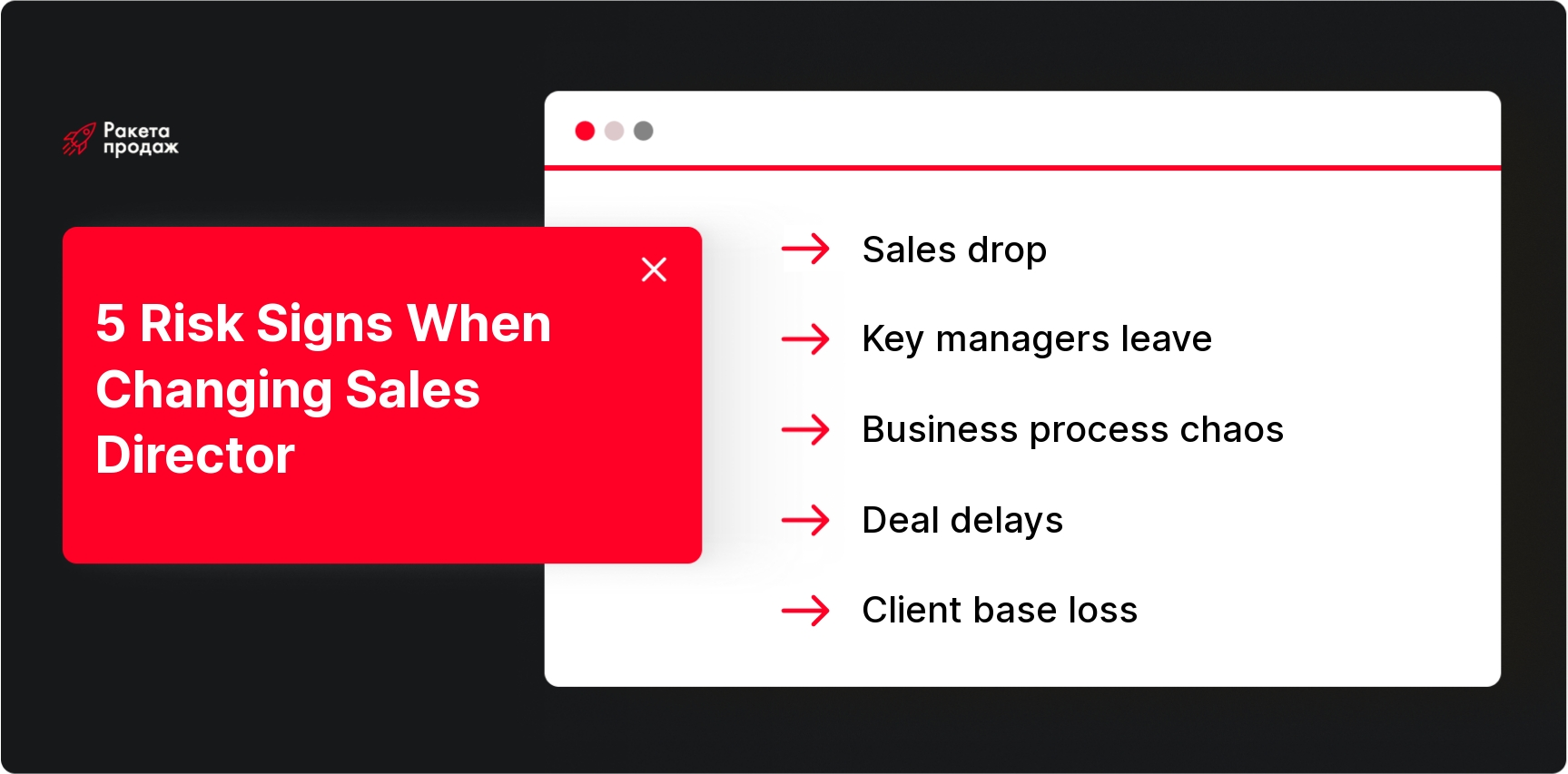
The most obvious and painful risk is a drop in revenue. During the “interregnum” period, when the old manager has already left but the new one hasn’t settled in, sales almost always decline. The department remains without clear leadership, deals get delayed, managers lose motivation. This period can last from several weeks to several months, and each day of downtime results in lost profits.

The second danger is losing key employees. Strong personal connections often form between the Sales Director and the team. The leader’s departure can trigger a chain reaction of resignations, especially among the most effective managers. In some cases, the Sales Director takes a significant portion of the department to competitors, taking not only people but also the client base.

Business leaders often face a dilemma: fire the Sales Director or give them another chance? Typically, in 70% of cases, the problem lies not with a specific person but with the lack of a system. “Sales Rocket” offers a comprehensive sales department audit that helps identify the true causes of problems: from process structure to leader competencies. Our experts will evaluate the effectiveness of your Sales Director, identify bottlenecks, and provide a clear action plan. Over 8+ years, we’ve built 208 effective sales departments across 14+ different industries with impressive results: our clients’ average turnover increase is +35%. We don’t just diagnose but implement changes: from staff training to creating working business processes and KPI systems that make sales department work transparent and predictable.

Find out if the problem really is with your Sales Director or with the system - order a free consultation!

The risks of changing the Head of Sales in the context of disrupting established business processes cannot be underestimated. Even if your Sales Director wasn’t perfect, they built a certain work system – sales funnel, meeting regularity, reporting format. A new leader might decide to “optimize” these processes, which in practice often means a period of chaos and experiments at the company’s expense.

Here are some examples of real consequences of ill-considered Sales Director changes:

  • A software sales company fired its sales manager due to conflict with the CEO. Four of six key managers left with him, revenue fell by 40% and took over a year to recover.
  • In a consulting firm, a new Sales Director decided to completely rebuild the motivation system and CRM, which led to department paralysis for several months.
  • After firing its Sales Director, an equipment manufacturer couldn’t find a worthy replacement for six months; during this time, the CEO personally had to handle sales at the expense of strategic management.

The risk is especially high when the “best salesperson” is appointed to the Sales Director position. A good manager won’t necessarily be a good leader – these roles require completely different skills and mindsets. Before making a decision about firing, you need to honestly answer a series of diagnostic questions.

Question #1. Is the problem with the leader or the sales system?

The first and most important question when considering should you fire the Head of Sales: have we correctly identified the source of the problem? Very often, company leaders fire the Sales Director when the problem lies elsewhere. It’s like changing the captain of a sinking ship without patching the hole in the hull.

Systemic problems will almost always be stronger than any leader, even the most talented one. If the company hasn’t established basic processes, has no clear product offering or marketing, then firing the Sales Director will only worsen the crisis.

To understand the root of the problem, conduct an honest audit of your sales system. How to conduct a sales department audit will help structure the process of checking all key elements and identify weaknesses.

Ask yourself the following questions:

Do you have a realistic sales plan based on market analysis, not the owner’s wishes? Surprisingly, many companies first announce unrealistic goals and then blame the Sales Director for not meeting them.

Are clear KPIs defined for the sales department and for each manager? Without specific measurable indicators, it’s impossible to objectively evaluate the work of the team and its leader.

Is a CRM system implemented and correctly configured? If sales are conducted “in notebooks” or Excel, and the manager doesn’t see the complete funnel picture – this is a system problem, not a human one.

Does marketing provide a stable flow of quality leads? Or is the sales department forced to find clients “from scratch”?

Is the sales process mapped out step by step from first contact to closing the deal? Do all participants understand what they should do and when?

Are there tools to control manager activities and the quality of their work with clients?

If you answered negatively to most of these questions, the problem is likely with the system, not the leader. In this case, a new Sales Director will face the same difficulties and probably show no better results. Instead of firing, it’s worth focusing on building a working sales system together with the current leader.

Question #2. Are results declining due to the Sales Director's management mistakes?

After making sure that the basic sales system works (or its shortcomings aren’t critical), the next step is to assess how effectively the leader manages available resources. Here you need to focus on indicators that truly depend on the Sales Director, not those determined by external factors.

Evaluating leader effectiveness becomes a key analysis stage: it includes measurements of conversions, average check, employee discipline, and ability to develop the team.

A good sales leader should manage several key metrics. The first is conversion at different funnel stages. If leads exist but aren’t “closing” into deals, this may indicate weak control over the quality of managers’ work. The Sales Director should understand at which funnel stages losses occur and why.

The second important metric is average check and deal margins. If managers constantly give excessive discounts, don’t offer additional services or products, this is often a consequence of insufficient training or control by the leader.

Team discipline is equally important. Do managers fulfill their call plans? Do they send commercial proposals on time? Do they correctly enter information into the CRM? These are basic things for which the Sales Director is responsible.

Pay attention to signs indicating leader weakness:

The Sales Director doesn’t control managers’ work, doesn’t hold regular meetings about deal status, doesn’t give feedback.

The department lacks planning and sales forecasting; the leader lives “one day at a time.”

There’s no analytics on the effectiveness of different channels, customer segments, or products.

The team chronically fails to meet plans, while the Sales Director always finds external reasons and never takes responsibility.

The department has high staff turnover, especially among experienced managers.

The Sales Director doesn’t develop the team: there’s no training, mentoring, or career growth.

The leader works as a “player-coach” – personally handling key clients instead of developing the team.

If you find most of these signs, the problem is likely with the leader. But before making a decision about firing, it’s worth considering the third important question.

Question #3. Is there a candidate stronger than the current Sales Director?

Even if you’ve determined that the problem is with the sales leader, don’t rush to fire them. The key question when evaluating the risks of changing the Head of Sales: do you have a candidate in mind who will guaranteed show better results? As they say, “better is the enemy of good,” and sometimes a weak but stable Sales Director is better than no leader at all.

Firing without a prepared replacement is a leap into the unknown with high business risk. The transition period when the sales department remains without leadership can cost the company dearly.

During this time, control over processes decreases. Managers begin to work in “free mode,” discipline decreases, important stages in the sales funnel disappear. Clients feel this deterioration and may go to competitors.

Chaos and uncertainty arise in the team. Employees don’t understand who makes decisions, who to turn to with questions, how the motivation system will change. This leads to decreased productivity even among the most disciplined managers.

Often a hidden or explicit power struggle begins in the department. Ambitious managers try to take the leader’s place, groupings form, intrigues arise. All this distracts from the main task – sales.

The most dangerous effect is the practical stoppage of sales. This especially applies to complex B2B sales with a long cycle, where the leader’s participation is required in negotiating terms, discounts, special customer requirements. Without a Sales Director, these processes slow down or stop.

Finally, all these problems lead to overloading the owner or CEO, who has to delve into the operational work of the sales department at the expense of strategic tasks.

Therefore, before firing your current Sales Director, make sure you have at least two strong candidates for this position ready to start work quickly. Strategies for finding a new leader will help select suitable candidates and structure processes for finding the most qualified managers.

The ideal situation is when a new leader can start work with an overlap period to take over from the previous one, but this happens rarely.

Question #4. What will happen to the team after the firing?

The fourth important question concerns the team’s reaction to the leader’s dismissal. The Sales Director is not just a function but a leader around whom a certain culture, relationship system, and trust is formed. Their departure can seriously affect the entire department.

First, assess the team’s loyalty level to their leader. In cohesive teams, firing the Sales Director may be perceived as betrayal or injustice, especially if the leader is respected. This creates an atmosphere of distrust toward the company’s senior management.

There’s a high probability that key managers will leave following the Sales Director. Often close professional and personal connections form between the leader and strong salespeople. They may follow the leader to a new company, especially if offered better conditions.

Losing experienced salespeople is not just about declining sales. It’s the loss of accumulated knowledge about clients, products, competitors. A new leader will have to spend a long time recovering this information, if it’s even possible.

Even employees who stay may experience stress and decreased motivation. They’ll face the need to rebuild relationships, adapt to a new management style, prove their value. Employee adaptation during the transition period becomes one of the most important tasks to maintain the team and ensure stable department operation.

The situation is particularly risky when the Sales Director created the team “from scratch.” In this case, their dismissal can effectively destroy the entire sales department, which was held together by their authority and vision.

Before making a decision, talk individually with key employees to understand their mood and plans. Assess how strong their attachment to the leader is and whether they’re ready to continue working without them. This will help predict consequences of changing the Head of Sales and prepare measures to retain valuable staff.

Question #5. What to check before firing a Sales Director?

The last but very important question: have all possibilities for correcting the situation with the current Sales Director been exhausted? Dismissal should be a last resort when all other methods no longer work.

Before taking radical action, it’s worth considering alternative options that can help your sales leader become more effective. Perhaps the problem can be solved without a painful replacement.

Professional coaching and training often work wonders even with experienced leaders. The Sales Director may have gaps in certain skills – people management, funnel building, analytics. Targeted training or working with a coach can help close these gaps.

Sometimes the problem is an incorrectly structured motivation system. The Sales Director may be demotivated themselves, which is transmitted to their team. Review KPIs and financial incentives to ensure they truly encourage desired behavior and results.

Consider redistributing roles in the department. Maybe your Sales Director is an excellent strategist but weak operationally? Or conversely, good at managing people but doesn’t see the big picture? Find them an assistant with complementary skills, such as a strong analyst or operations manager.

Many leaders benefit from enhanced analytical support. Provide the Sales Director with tools for better understanding data – from advanced CRM to dashboards with key metrics. Often the problem is not unwillingness but inability to work with information.

Finally, clear regulations and procedures can structure the work of even a disorganized leader. Help the Sales Director implement standard operating procedures, checklists, meeting formats, and reports.

It’s important to give the leader a specific timeframe to correct the situation. Determine with them 3-5 key indicators that should improve and the timeframe. Regularly track progress and give feedback. Such a structured approach often motivates people more than the threat of dismissal.

If after all these measures the situation doesn’t improve, then dismissal may indeed be the only solution. But in that case, you’ll be sure that you’ve exhausted all possibilities and given the person a chance to improve.

Firing a Sales Director is a risky step that can either take your business to the next level or plunge it into chaos. Before making such a decision, it’s worth investing in a systematic audit and optimization of all sales processes. “Sales Rocket” offers a comprehensive service for systematizing the sales department: from diagnosing the current state to implementing effective business processes. We create a transparent control system that allows objectively evaluating the work of the leader and the entire team through mathematical indicators. Our methodology includes developing regulations, implementing CRM with proper analytics, setting up a KPI system, and training personnel. The results speak for themselves: conversion growth up to +86%, average increase in client turnover by 35%, and the maximum recorded result is +$10,907,403 in 4 months of work. Our clients include companies such as Mitsubishi, Naftogaz, and Yamaha.

Transform a problematic sales department into a systematically working mechanism - order diagnostics and get a change plan today!

Conclusions and recommendations

image

The decision to fire a sales department head should be balanced and based on objective analysis, not emotions. Five key questions will help you avoid hasty steps and make the right decision.

Remember that firing a Sales Director is not just a personnel decision but a strategic move with far-reaching consequences for the entire company. Sales decline, loss of key employees, disruption of business processes – all these risks need to be carefully weighed against the potential benefits of changing leadership.

If you’ve still decided that replacement is necessary, act according to plan:

  1. Find a strong candidate BEFORE firing the current Sales Director. For more about the procedure – see replacing a sales leader.
  2. Prepare a detailed plan for the transition period, including responsibility distribution and client communication.
  3. Develop a strategy for retaining key sales managers.
  4. Ensure transparent communication with the team about the reasons for changes and next steps.
  5. Create a clear system of goals and support for the new leader for the first 3-6 months.

Remember that any leadership change is an opportunity not only to solve existing problems but also to reach a new level. With the right approach to this decision, you can minimize risks and maximize potential benefits for your business.

In this article:
See more
Book a FREE sales funnel audit
CONTACT US
FAQ
When do you really need to fire a Sales Director?

You should fire a Sales Director when you’re sure the problem is with their management competencies, not the sales system; when all attempts to fix the situation through training and support haven’t produced results; and when you have a strong replacement candidate.

Should you fire a Head of Sales if the department isn't meeting targets?

Failure to meet targets is a symptom, not a diagnosis. First check if the plan itself is realistic, if necessary conditions are provided (leads, tools, product), and only then assess the leader’s role in the failure.

What are the consequences of changing sales manager for business?

The main risks include: temporary sales decline, key employees leaving with the Sales Director, loss of relationships with important clients, disruption of business processes, and decreased team motivation.

What to check before firing the Head of Sales?

Check systemic factors (plan, product, marketing), the Sales Director’s management indicators (conversions, activities, turnover), availability of a strong replacement candidate, probability of key employees leaving, and possibilities for correcting the situation without dismissal.

When should you not fire a Sales Director?

You shouldn’t fire a Sales Director if the main sales problems are caused by external factors or systemic deficiencies; if you don’t have a worthy replacement; if there’s a high risk of losing the team; or if the leader is showing progress in solving problems.

SUBSCRIBE TO MY TELEGRAM CHANNEL
The most valuable sales information right on your phone!
icon

LOTS OF USEFUL INFORMATION, FREE TEMPLATES, AND CHECKLISTS ON MY INSTAGRAM

Materials and practical advice on sales growth in our blog: