icon

Harvard Method in Sales: Transition from Conflict to Collaboration

The Harvard negotiation method has long been recognized as one of the most effective strategies for reaching agreements beneficial to both parties. Instead of the traditional “who can outargue whom” approach, it offers a completely different philosophy – finding solutions where all participants win. This systematic approach, developed as part of the Harvard Negotiation Project by scholars Roger Fisher, William Ury, and Bruce Patton, has revolutionized how we think about negotiations.

Key Takeaways

  • The Harvard method shifts negotiations from bargaining to collaborative problem-solving: instead of “who can outargue whom,” you seek a win for both sides.
  • Today’s customers easily recognize manipulation and aggression; negative experiences instantly spread through social media and kill future deals.
  • A customer’s position (such as “it’s expensive”) hides true interests: limited budget, fear of risks, management requirements, or habit of bargaining.
  • Strong salespeople ask open questions (“Why is this important to you?”), identify hidden motives, and offer options the customer hasn’t even considered.
  • Objective criteria (ROI calculation, market data, industry standards) move the conversation from opinions to facts and reduce emotional tension.

In the article below, you’ll find specific questions for this negotiation technique, signals to check for, and a step-by-step algorithm for applying the Harvard method at each sales stage 👇

In sales, this method is particularly valuable as it helps move away from exhausting “battles of arguments” to constructively seeking mutually beneficial solutions. Imagine for a moment: what if negotiations aren’t a struggle, but a joint search for a solution? What if instead of squeezing maximum value from a client, you look for an option that will genuinely solve their problems while being profitable for you? This is precisely the transition from confrontation to collaboration we’ll discuss.

What is the Harvard Negotiation Method

The history of the Harvard method began in the 1970s when a group of scholars at the Harvard Negotiation Project started researching why some negotiations lead to sustainable agreements while others result in disappointment for both parties. Their work culminated in the book “Getting to Yes,” which transformed ideas about how effective negotiations should proceed.

The key difference between the Harvard method and traditional positional negotiations is that it abandons the “tug-of-war” paradigm. In the classic negotiation model, each side takes a certain position and tries to convince the other side to yield. This creates an atmosphere of struggle where one’s gain means another’s loss. The Harvard approach offers an alternative – looking deeper than stated positions to find the basic interests behind them.

The principled negotiation method is particularly relevant for modern sales, where buyers have access to vast amounts of information and alternative offers. Today’s customer isn’t just looking for a low-priced product – they’re seeking solutions to their problems, a partner they can trust, and confidence that their interests are taken into account. The Harvard method of negotiation perfectly matches these market demands, where long-term relationships are valued more than short-term gains. In an era where every negative review can cost a company dozens of potential clients, the “win-win” approach becomes not just an ethical choice but a business necessity.

Core Principles of the Harvard Method

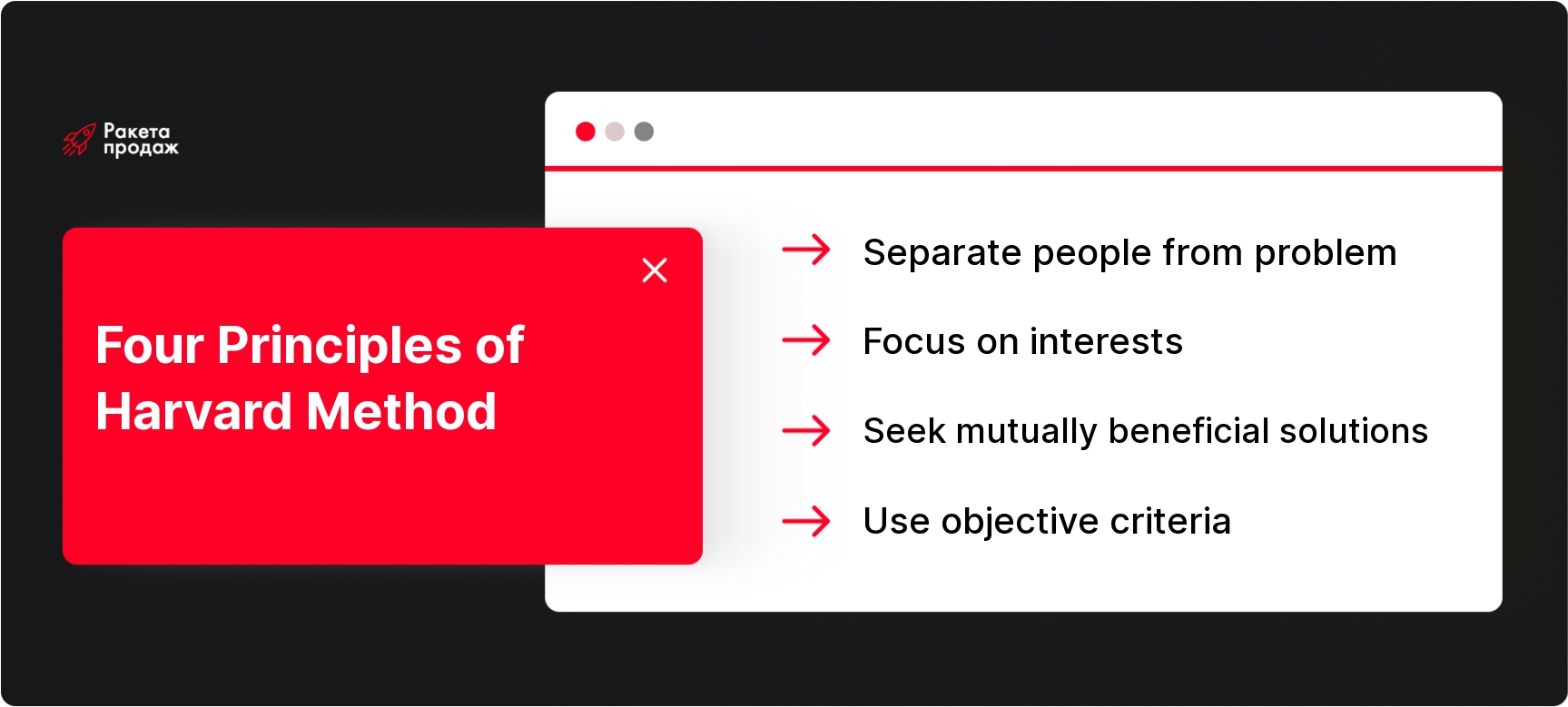
The Harvard negotiation method is based on four fundamental principles that completely change the approach to dialogue with customers or partners. These principles create a structure that allows moving from confrontation to joint problem-solving, while maintaining firmness in defending one’s own interests.

Understanding these four basic rules gives a salesperson powerful tools for building trusting relationships and closing deals that truly satisfy both parties. They work in complex corporate negotiations as well as in everyday customer interactions.

  • Separate people from the problem: This principle emphasizes the importance of maintaining constructive relationships, even when you disagree with your counterpart’s position. By attacking the problem, not the person, you create a safe environment for open discussion without personal offense or emotional tension.
  • Focus on interests, not positions: A position is what a person says they want. An interest is the true reason why they want it. For example, when a client demands a discount (position), behind this may be a limited budget or the need to justify the purchase to management (interests).
  • Invent mutually beneficial options: Instead of zero-sum bargaining where one person’s gain means another’s loss, this principle calls for seeking creative solutions that satisfy the interests of both parties simultaneously.
  • Use objective criteria: Decisions should be based on fair, neutral standards rather than power or manipulation. These might include market prices, industry norms, scientific data, or any other independent criteria.

Each of these principles works in conjunction with the others, creating a holistic approach to negotiations focused on results and relationship preservation. They help shift focus from short-term gain to long-term collaboration.

Why "Fighting" in Sales No Longer Works

The classic sales model, which many of us have seen in movies and perhaps encountered in life, is based on confrontation. The salesperson tries to “push” the client, overcoming their resistance through all available means – from manipulative techniques to direct emotional pressure. This approach assumes that selling is a battle where victory goes to the stronger, more assertive, and craftier.

However, in modern reality, this model increasingly fails. Today’s buyer is radically different from consumers of past decades. They are well-informed: before purchasing, they study reviews, compare competitors’ offers, and read professional assessments. Information accessibility has made clients more rational in their decisions. They easily recognize manipulation and often react negatively to pressure, seeing it as an attempt to deceive or impose unnecessary services.

Additionally, today’s market is highly competitive, and company reputation plays a huge role. Aggressive sales techniques destroy trust not only with the current client but also affect the perception of the brand as a whole. Negative experiences spread quickly through social media and reviews, reducing customer LTV (lifetime value) and scaring away potential buyers.

In a situation where a salesperson using “hard close” techniques literally backs a client into a corner with demands for immediate decisions, threats of price increases, or mentions of product scarcity, they may close the deal – but will this client return? Will they tell friends about a positive experience? Now imagine a salesperson conducting a trusting dialogue, sincerely identifying needs and helping make an informed decision. This approach not only increases chances for the current sale but also lays the foundation for long-term relationships.

Ultimately, a salesperson playing “win at any cost” may win tactically but loses strategically. Success in modern sales is built not on single transactions but on the ability to build long-term relationships based on trust and mutual benefit. And here, the principled negotiation method becomes an indispensable tool.

The Essence of Transitioning from Conflict to Collaboration

Cooperative negotiations using the Harvard method, built on the win-win principle, represent a fundamental shift in thinking compared to the traditional win-lose approach. Instead of viewing negotiations as a competition with limited resources, where increasing your share necessarily means decreasing the other party’s share, the cooperative approach sees an opportunity to “expand the pie” before dividing it.

Do you know that feeling when negotiations with clients turn into tense confrontation, where each side tries to “pull the blanket” to their side? The Harvard method described in the article offers a completely different approach – collaboration instead of conflict. But implementing these principles into the real work of a sales department without expert support can be challenging. “Sales Rocket” specializes in comprehensive systematization of sales departments, including team training in effective negotiation techniques and implementing processes oriented toward win-win strategies. Our experts conduct deep analysis of current client communications, develop optimal scripts and regulations, train the team, and implement quality control systems. As a result of such transformation, our clients receive not only conversion growth up to 86% but also form long-term relationships with buyers, which significantly increases customer LTV. The average revenue growth of our clients is +35%.

Transform your client negotiations from confrontation to productive dialogue – order a free sales department audit!

The “win-win” principle in sales means that a successful deal should create value for both parties. The customer receives a solution that truly addresses their needs and brings them benefits exceeding costs. The seller receives fair compensation for their product or service, as well as the opportunity for long-term cooperation and recommendations. Unlike the “win-lose” approach, where one side feels cheated or forced to agree, the “win-win” strategy creates the foundation for sustainable relationships.

In practice, finding mutually beneficial solutions requires creative thinking and flexibility. Salespeople applying the Harvard method often use approaches such as:

Seeking bonus solutions – offering additional services or features that have high value for the client but relatively low cost for the seller. For example, including free staff training when purchasing a new system.

Developing flexible terms – adapting standard offers to specific customer needs. This may include various payment schemes, phased implementation, or modular solutions that can be expanded over time.

Creating joint initiatives – proposals where both sides invest resources to achieve a common goal. For example, jointly developing a case study about implementing a solution for marketing purposes of both companies.

It’s important to understand that “collaboration” in the Harvard method doesn’t mean altruism or abandoning one’s own interests. On the contrary, it’s a pragmatic approach recognizing that the best protection of both parties’ interests comes through finding solutions that consider everyone’s needs. A salesperson who helps clients get maximum value from their offer not only closes the current deal but also lays the foundation for long-term partnership.

Consider a specific example: A B2B company offers software for business process automation. The client is interested but concerned about high initial costs and implementation risks. Instead of simply lowering the price (which would reduce profit) or insisting on full prepayment (which would increase risks for the client), the seller proposes phased implementation with payment upon achieving specific results. This solution reduces the client’s financial risks, guarantees them real return on investment, and allows the supplier to maintain margins and gain a loyal long-term client. Both sides win more than with a standard approach to bargaining.

If you’re interested in expanding your strategic toolkit and implementing similar approaches, pay attention to effective B2B sales strategies, which are also built around win-win principles and long-term benefits.

Principle 1: Separate People from the Problem

The emotional component of negotiations often becomes the main obstacle to reaching a mutually beneficial agreement. When sellers and buyers perceive each other as adversaries rather than partners in solving a common problem, tension arises that hinders rational discussion. In such situations, personal emotions – whether irritation, distrust, or desire to “win” – obscure the essence of the issue and can lead to decisions unfavorable for both sides.

Harvard sales propose consciously separating attitude toward the person from attitude toward the problem being discussed. This allows maintaining a respectful tone and constructive atmosphere even during serious disagreements about the substance of the proposal. A salesperson who can separate people from problems shows that they value the client as a person, regardless of whether they accept the commercial offer.

In practical terms, this is expressed in a number of communication techniques aimed at “de-escalating” tense moments. For example, instead of defending against a client’s objection, the salesperson might say: “I understand that the price issue is important to you. Let’s look together at how we can solve this problem.” Such a phrase shows that the seller hears the client’s concern and is ready to work on a solution together, rather than opposing them.

Another example is when a client is clearly irritated by previous experience with the company or its competitors. Instead of moving to defense or accusations, an effective seller might say: “I’m sorry to hear about your negative experience. I would be upset in your place too. Let’s discuss what specifically went wrong and how we can ensure a different result.”

A common mistake in sales is attacking the client’s position instead of discussing the essence. For example, when a client says “your offer is too expensive,” an inexperienced salesperson might perceive this as a personal challenge and start proving the client wrong. A salesperson applying the Harvard method will take this as information about the client’s interests and will explore what stands behind this statement – limited budget, comparison with competitors, or doubts about the value of the offer.

Separating people from problems allows maintaining long-term relationships even when the current deal doesn’t happen. A client who felt respect and a partnership approach is more likely to return in the future or recommend you to colleagues, even if they chose another solution now. In a world where reputation and recommendations play an increasingly important role, this becomes a significant competitive advantage.

Principle 2: Focus on Interests, Not Positions

The fundamental difference between positions and interests is key to understanding the Harvard negotiation method. A position is what a person says they want; an interest is the reason why they want it. It’s the misunderstanding of this difference that often leads to deadlocks in negotiations.

When a client states “it’s expensive for us,” this is their position, but behind it may lie many different interests: limited budget, need to justify expenses to management, desire to reduce financial risks, comparison with other offers, or simply a habit of bargaining. A seller focusing only on the position will immediately try to offer a discount or start proving that the price is fair. A seller working with interests will first find out what exactly stands behind the words “it’s expensive for us.”

To identify a client’s true motives, a seller needs to master the technique of asking the right questions. Instead of closed questions that assume “yes” or “no” answers, they should use open questions starting with “what,” “how,” “why.” For example: “What in our offer seems most valuable to you?”, “How do you plan to use our product?”, “Why is the cost issue so important to you at this moment?”

A special place in the Harvard method belongs to the question “Why is this important to you?” This simple but powerful question helps move from the superficial level of positions to the deeper level of interests. Often clients themselves don’t fully realize their motives, and such a question helps them better understand their own priorities.

A practical example: a client insists on urgent delivery (position). The seller could immediately discuss the possibility of expedited delivery and its cost. But by asking “Why is urgency so important to you?”, they might learn that the client needs to demonstrate the product at an exhibition next week (interest). This opens new possibilities: perhaps the client would be satisfied not with urgent delivery of the entire batch, but with express delivery of an exhibition sample? Or is it possible to provide a temporary demonstration unit? Focus on interest, not position, opens space for creative solutions.

Another example: a corporate client says they’re not satisfied with the support conditions in the standard package. Instead of immediately offering an extended support package for an additional fee, the seller finds out that the client is particularly concerned about possible equipment downtime during peak work periods. Understanding this interest, the seller can offer a targeted solution – priority support specifically during critically important hours for the client, possibly without significantly increasing the overall contract cost.

The ability to see interests behind a client’s positions is a skill that develops with practice and requires genuine curiosity and desire to understand the other person from the seller. This principle helps move beyond simple bargaining to finding solutions that truly meet the needs of both parties.

By the way, to develop skills in interacting with large corporate clients, it may be useful to undergo training for managers working with key clients, where the emphasis is on understanding interests, not just meeting sales plans.

Principle 3: Seek Mutually Beneficial Solutions

The transition from bargaining to joint value creation represents a fundamental change in approach to sales. In the traditional bargaining model, sellers and buyers perceive negotiations as a process of dividing a fixed “pie”: if one gets more, the other inevitably gets less. The Harvard method offers a different perspective – the possibility of “enlarging the pie” before dividing it.

The “win-win” principle in sales means that a successful deal should create value for both parties. The client receives a solution that truly addresses their needs and brings them benefits exceeding the costs. The seller receives fair compensation for their product or service, as well as the opportunity for long-term cooperation and recommendations. Unlike the “win-lose” approach, where one party feels cheated or forced to agree, the “win-win” strategy creates the foundation for sustainable relationships.

In practice, finding mutually beneficial solutions requires creative thinking and flexibility. Salespeople applying Harvard-style negotiations often use approaches such as:

Seeking bonus solutions – offering additional services or features that have high value for the client but relatively low cost for the seller. For example, including free staff training when purchasing a new system.

Developing flexible terms – adapting standard offers to specific customer needs. This may include various payment schemes, phased implementation, or modular solutions that can be expanded over time.

Creating joint initiatives – proposals where both sides invest resources to achieve a common goal. For example, jointly developing a case study about implementing a solution for marketing purposes of both companies.

It’s important to understand that “collaboration” in the Harvard method doesn’t mean altruism or abandoning one’s own interests. On the contrary, it’s a pragmatic approach recognizing that the best protection of both parties’ interests comes through finding solutions that consider everyone’s needs. A salesperson who helps clients get maximum value from their offer not only closes the current deal but also lays the foundation for long-term partnership.

Consider a specific example: A B2B company offers software for business process automation. The client is interested but concerned about high initial costs and implementation risks. Instead of simply lowering the price (which would reduce profit) or insisting on full prepayment (which would increase risks for the client), the seller proposes phased implementation with payment upon achieving specific results. This solution reduces the client’s financial risks, guarantees them real return on investment, and allows the supplier to maintain margins and gain a loyal long-term client. Both sides win more than with a standard approach to bargaining.

If you’re interested in expanding your strategic toolkit and implementing similar approaches, pay attention to effective B2B sales strategies, which are also built around win-win principles and long-term benefits.

Principle 4: Rely on Objective Criteria

Using objective data in negotiations is a powerful tool for reducing emotional tension and shifting discussion to a constructive path. Instead of subjective opinions and personal preferences, which are difficult to dispute or reconcile, objective criteria provide a common basis for decision-making. In the context of sales, such criteria can be market data on prices and competitors’ offers, return on investment (ROI) periods, technical product specifications, industry standards and regulations.

Reference to facts has greater persuasive power than emotional arguments because facts are hard to dispute and are perceived as neutral. When a salesperson says “I think our solution is the best on the market,” it’s a subjective statement that’s easy to doubt. When they say “According to independent research by analytical agency X, our solution provides 30% higher productivity compared to industry averages,” that’s an objective argument that’s perceived completely differently.

The transition from subjective “I think” to objective “according to market/analytics data” changes the tone of the entire conversation. For example, when discussing price, instead of stating “Our price is fair,” it’s more effective to say “If we look at the average market cost of similar solutions, we’ll see that our offer is in the middle of the price range, while including additional services that are usually paid for separately.”

Training salespeople to work with facts rather than beliefs is an important part of implementing the principled negotiation method in an organization. This requires salespeople to have deep knowledge of their product, market, competitors, and customer needs. They must be able to collect, analyze, and present relevant information in an accessible form. Modern CRM systems and business analytics tools significantly facilitate this task, allowing quick access to current data about the market, clients, and the effectiveness of various solutions.

Calculations of economic effect from implementing a product or service become especially valuable in B2B sales. When a salesperson can show how and in what timeframe the proposed solution will bring specific financial benefits, it shifts the discussion from the level of “expensive/inexpensive” to “profitable/unprofitable.” For example, software costing 1 million rubles that saves a company 500 thousand rubles monthly pays for itself in two months and then generates pure profit – this is no longer an “expensive” solution but a profitable investment.

Using objective criteria is particularly effective when handling client objections. Instead of arguing with clients about their subjective perception, the salesperson can provide facts that help clients independently reach the necessary conclusion. This not only increases the chances of successfully closing the deal but also enhances client satisfaction with the decision made, as they feel they’ve made an informed, rational choice.

image

How to Train Your Sales Team in the Harvard Approach

Implementing collaboration principles into a sales department’s corporate culture is a strategic task requiring a systematic approach and support from management. Companies that have successfully integrated the Harvard method into their processes usually begin by creating a shared vision and understanding of this approach’s value for all stakeholders: salespeople, clients, and the business as a whole.

There are several effective formats for training sales teams in Harvard method principles. Training in principled negotiations can be conducted by external experts or internal trainers who have undergone special preparation. Such training usually includes theoretical portions, case studies, and role-playing games modeling real negotiation situations. It’s important that training isn’t a one-time event but part of a continuous learning system.

If your goal is to quickly and practically master key negotiation principles and techniques together with colleagues, consider negotiation training in corporate program formats. This format allows the team not only to learn the fundamental basics of the method but also to apply them to real cases from their own practice.

Reviews of actual client negotiations are another valuable training format. Regular sessions where the team analyzes recent negotiations, identifies successful techniques and areas for improvement help reinforce Harvard method principles in practice. Such reviews are especially effective when conducted in a friendly, constructive atmosphere, focusing on learning rather than criticism.

Deal coaching involves individual work by a manager or more experienced colleague with a salesperson to prepare for specific negotiations and their subsequent analysis. This format allows adapting Harvard method principles to the specifics of a particular situation and the salesperson’s working style.

The role of leadership in encouraging win-win behavior cannot be overestimated. Managers who themselves demonstrate Harvard method principles in work with the team and clients create a powerful example to follow. Additionally, it’s important that the system for motivating and evaluating salespeople’s work corresponds to the values of collaboration and long-term client relationships.

Many companies implementing the Harvard approach revise their KPIs, adding metrics reflecting negotiation quality and customer satisfaction to traditional sales indicators. For example, instead of simply tracking the number of calls or meetings, they evaluate the quality of these interactions: how well the salesperson identified client interests, offered an adapted solution, used objective criteria to justify the offer. KPIs may also include customer retention indicators, repeat sales, cooperation expansion (upsell and cross-sell), and the number of referrals from existing clients.

To build a culture of collaboration and long-term sales, it’s extremely important to pay attention to sales department management, implementing not only new techniques but also systematic team development.

Training in the Harvard method is not just mastering a set of techniques, but developing a new mindset and approach to sales. Such transformation requires time, patience, and consistency. Companies that invest in this direction gain not only increased sales effectiveness but also a more satisfied, motivated team working in an atmosphere of trust and mutual respect.

Mistakes in Implementing the Harvard Method

Implementing the Harvard negotiation method in sales, despite its effectiveness, may encounter a number of common mistakes and misconceptions. Understanding these pitfalls helps avoid disappointments and achieve real results from applying the method.

One of the most frequent mistakes is misinterpreting the principle of collaboration as a sign of weakness. In the business environment, especially in sales, there has long been a cultivated idea that a successful negotiator should be tough, assertive, and even aggressive. Against this background, willingness to collaborate and seek mutually beneficial solutions may be perceived as compliance or indecision. In fact, the Harvard method implies firmness in defending one’s interests, combined with flexibility in finding ways to satisfy them. A salesperson following this approach doesn’t abandon their goals but seeks more effective ways to achieve them.

Another common mistake is trying to apply the method without deep analysis of interests. Some salespeople limit themselves to a superficial understanding of client needs, not asking clarifying questions and not exploring what actually stands behind stated wishes. Without this critical stage, it’s impossible to find truly mutually beneficial solutions. The Harvard method requires genuine interest in the needs and motives of the other party, as well as willingness to invest time in studying them.

Formalism in method implementation is another serious problem. This happens when a company declares Harvard method principles, but in practice salespeople continue to act according to old schemes, merely imitating the new approach. For example, they may use the “right” phrases and techniques but not really listen to the client and not consider their interests when forming the offer. Such “pseudo-collaboration” is quickly recognized by clients and can even worsen relationships, creating an impression of insincerity and manipulation.

To avoid these mistakes, companies should pay special attention not only to technique training but also to forming the right mindset and values. This includes working with salespeople’s beliefs about the nature of negotiations, developing empathy and active listening skills, encouraging creative approaches to finding solutions. It’s also important to create a support system that will help salespeople apply new skills in practice and overcome transition period difficulties.

Sales department managers play a key role in overcoming these mistakes. They should not only explain the principles of the method but also demonstrate them by their own example, both in interaction with clients and with the team. Regular feedback, discussion of successful cases, and work on mistakes help consolidate the correct understanding and application of the Harvard method in daily sales practice.

When conducting assessment of negotiations using the Harvard method, managers should look for authentic implementation of the principles rather than surface-level compliance. This evaluation should focus on how well the salesperson identified interests, separated people from problems, and worked toward mutually beneficial outcomes.

The Harvard negotiation method is not just a theoretical concept but a powerful practical tool that can radically change your business performance. However, systematic implementation of this approach requires expertise, experience, and methodology. “Sales Rocket” offers a comprehensive solution for transforming your sales department – from diagnosing current processes to implementing new scripts, regulations, and control systems based on Harvard method principles. Our specialists will help your managers master techniques for identifying clients’ true interests, teach them to use objective criteria in argumentation, and develop individual solutions for each client. Over 7+ years, we have successfully implemented more than 200 projects across 14+ industries, including work with companies such as Mitsubishi, Audi, Naftogaz, and many others. Our approach is confirmed by results – “Sales Rocket” clients note not only sales growth but also increased customer satisfaction, reduced client base “turnover,” and an increase in recommendations.

Implement Harvard negotiation principles in your sales department's DNA – get guaranteed conversion growth up to 86% in just 3 months!

Conclusion

The Harvard negotiation method represents a holistic philosophy of mature sales, where the win for both sides becomes the foundation for long-term relationships. Instead of the traditional approach where sales are perceived as a battle for advantage, this method suggests viewing it as a joint search for a solution that satisfies the needs of both seller and buyer.

The four basic principles – separating people from the problem, focusing on interests instead of positions, finding mutually beneficial options, and using objective criteria – create a solid foundation for negotiations that lead to sustainable agreements and strengthen business relationships. In a world where competition is becoming increasingly fierce, and reputation and recommendations play an ever greater role, such an approach provides a significant strategic advantage.

It’s worth noting that Harvard method principles can and should be applied not only in negotiations with clients but in all aspects of business management – from interaction with employees to negotiations with suppliers and partners. Companies that implement these principles comprehensively create a culture of mutual respect and collaboration, which positively affects all business processes and results. So, starting with training the sales department, you can transform the entire organization, making it more effective, harmonious, and successful in the long term.

The Harvard Method in Sales has proven particularly effective for businesses looking to elevate their approach to customer relationships. Whether you’re focusing on Harvard sales strategies for your team or implementing principled negotiations throughout your organization, the benefits extend far beyond immediate revenue gains.

In this article:
See more
Book a FREE sales funnel audit
CONTACT US
FAQ
What is the Harvard negotiation method?

The Harvard method is an approach to negotiations based on four key principles: separating people from the problem, focusing on interests rather than positions, generating mutually beneficial options, and using objective criteria. The essence of the method is that instead of positional bargaining, participants strive to understand each other’s interests and find solutions that satisfy both parties.

Why is the Harvard method more effective than hard negotiations?

Hard negotiations may bring short-term benefits but often destroy relationships and hinder future collaboration. The Harvard method creates a foundation for long-term relationships, increases customer satisfaction, and the likelihood of repeat deals. Additionally, it helps find more creative and beneficial solutions for both sides that are impossible to discover in positional bargaining.

What does "separating people from the problem" mean in negotiations?

It means maintaining respectful relationships with your counterpart, even when you disagree with their position. You discuss and criticize ideas and proposals, not the opponent’s personality, avoid accusations, and acknowledge your counterpart’s emotions. This approach allows for constructive dialogue even during serious disagreements and maintains the possibility of future collaboration.

How do you identify a client's interests if they only talk about price?

Ask open-ended questions that help understand what’s behind the focus on price: “Why is the pricing issue so important to you?”, “What parameters, besides price, influence your decision?”, “What do you hope to get from this purchase?”. It’s also useful to learn about the client’s previous experience, their business goals, and the constraints they face. Often, price discussions hide issues of budget constraints, risk assessment, or the need to justify expenses to management.

SUBSCRIBE TO MY TELEGRAM CHANNEL
The most valuable sales information right on your phone!
icon

LOTS OF USEFUL INFORMATION, FREE TEMPLATES, AND CHECKLISTS ON MY INSTAGRAM

Materials and practical advice on sales growth in our blog: