Key Takeaways
- An owner who checks every call and every email turns oversight into micromanagement. The team stops thinking independently, and the sales manager loses authority.
- Healthy oversight of the sales department is built on transparent KPIs and automatic reports, not on tracking every action a manager takes.
- Your focus should be on key areas: plan fulfillment, revenue forecasting, conversion by funnel stage, and reasons for customer refusals.
- Without CRM integration with telephony and the website, the system becomes an extra burden, and managers log data inconsistently.
- Oversight through data and coaching works better than constant intervention. If you can’t leave for a business trip without risking a “sales collapse,” the system isn’t working.
In the article below, you’ll find a step-by-step algorithm for implementing systemic oversight, specific automation tools, and common mistakes to avoid 👇
This problem is familiar to many Ukrainian business owners: either you “keep everything in your head” and control things manually, or you let go of the situation and lose manageability. Statistics show that about 40% of companies still operate without a CRM, which automatically pushes leaders toward manual control. But there’s a third way – building oversight of the sales department through a system: goals, KPIs, reports, CRM, a management rhythm, and spot checks, rather than manual intervention in every single operation. This is the essence of proper Sales Department Oversight: shifting from personal intervention to systemic control. Let’s break down in detail how a business owner can monitor sales effectively, since this question – how can a business owner monitor sales without drowning in daily operations – is one of the most common challenges leaders face.
The Difference Between Oversight and Micromanagement
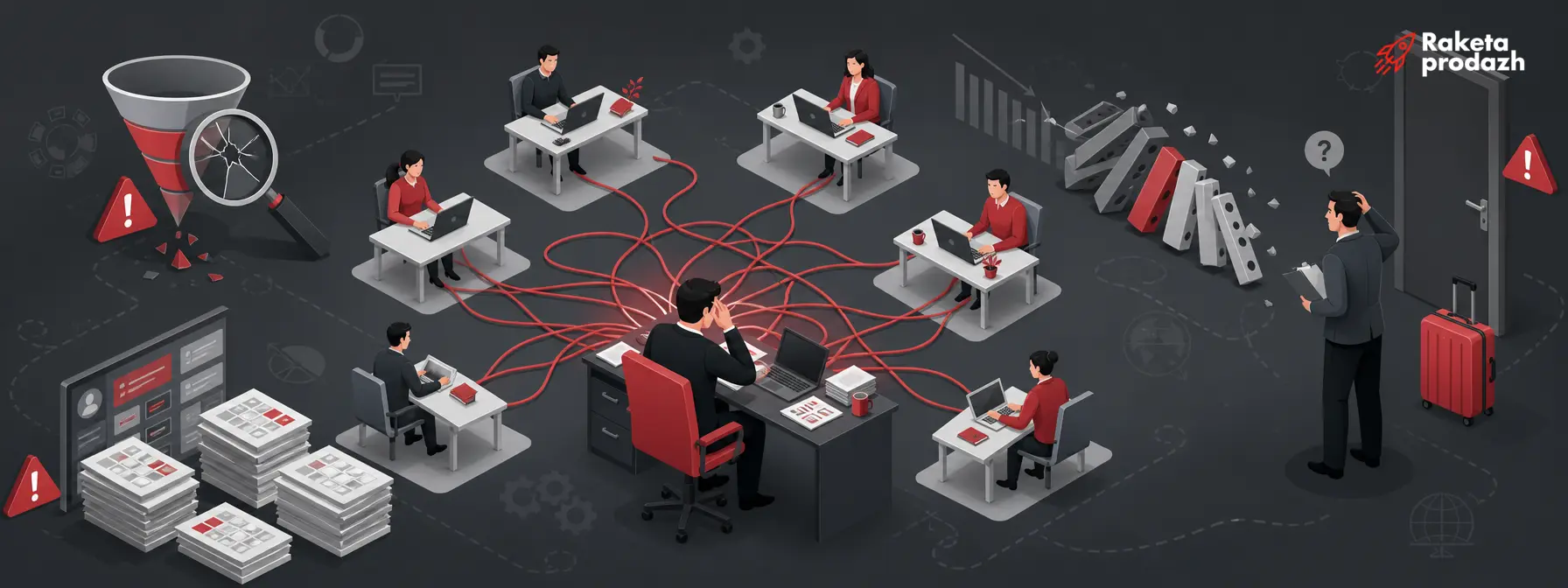
Oversight and micromanagement are often confused, even though they’re fundamentally different approaches. Healthy oversight is built around results and a transparent system. You set clear sales department KPIs (conversion, number of deals, average check), configure automatic reports, and let managers choose their own tactics within the process. Micromanagement is monitoring every single action: requiring approval for every email, interfering in negotiations, checking every call and message.
When an owner controls every step, the team stops thinking independently. Managers wait for instructions instead of showing initiative. The sales manager becomes a mere relay between the owner and employees. Decision-making speed drops because everything goes through you. Experienced salespeople leave, unable to handle the constant oversight.
Ukrainian practice shows a classic picture: managers update the CRM inconsistently, leads get lost, reporting is opaque, and the leader’s role boils down to firefighting. At one IT company, the owner demanded daily reports from every manager, personally reviewed every commercial proposal, and got involved in every complex deal. The result – the team worked slowly, was afraid to experiment, and the owner spent 60% of their time on oversight instead of business development. This is micromanagement in its purest form, disguised as concern for results.
Does it feel familiar – being constantly buried in the day-to-day operations of the sales department, yet never quite understanding the real state of affairs? When managers’ reports don’t match the numbers in the CRM, and plans fall through for unclear reasons, owners instinctively start checking every call and every deal. It’s a natural reaction, but it turns the leader into a bottleneck instead of solving the problem. At “Rocket Sales,” we’ve spent over 8 years building a systemic methodology for transparent oversight of the sales department without micromanagement. We implement documented processes, set up automatic CRM reporting, standardize communications, and build dashboards with key metrics. The result – you see the full picture of the sales department through numbers and analytics, not through daily intervention in every operation.
Get a sales department that runs like clockwork without constant supervision - our clients see an average revenue growth of +35%!
Why Owners Slide Into Sales Micromanagement
Wanting to control sales is natural – the business’s survival depends on it. But owners often cross the line not out of malice, but out of fear and a lack of alternatives. The first reason is fear of losing revenue. When a plan falls through for unclear reasons, the owner starts looking for someone to blame and personally digs into every deal. The second reason is distrust of the data. If the CRM shows one thing, managers say another, and actual sales show a third, the owner starts checking everything manually.
Often the problem lies in weak team discipline. Managers don’t follow processes, forget to update deal statuses, miss calls. The sales manager can’t keep up or works chaotically themselves. In this situation, the owner feels that only their personal intervention can fix things. Another reason is habit. If you used to close key deals yourself, it’s hard to trust that to others. You know how client work should be done, and you see managers doing it “wrong.”
Micromanagement also appears when there are no clear reports and analytics. When there’s no transparent picture of the sales funnel, manager activity, or reasons for refusals, the owner starts gathering information personally – through conversations, checks, participating in negotiations. The goal isn’t to “just trust” the team, but to build a system where you can see the state of sales without daily intervention – true supervision of sales department managers rather than constant hands-on checking.
What a Business Owner Should Control in the Sales Department
An owner shouldn’t monitor every single action – it’s too time-consuming and demotivates the team. Focus needs to be on key areas that affect management decisions. The first area is sales plan fulfillment broken down by managers, products, and channels. The second is pipeline and revenue forecasting for the month and quarter. Without this, it’s impossible to plan cash flow and development.
It’s also important to monitor lead quantity and quality. If leads dry up, sales will drop within 2-4 weeks. Conversion by funnel stage shows where customers are being lost: at first contact, presentation, or contract negotiation. Response speed to inquiries affects loyalty and competitiveness. Manager activity (number of calls, meetings, proposals sent) shows their motivation and workload.
Reasons for customer refusals help identify problems with the product, pricing, or competitors. CRM data quality affects the reliability of all other metrics. Lead source effectiveness shows where to invest the marketing budget. The sales manager’s performance is a key delegation point. Risks on large deals require personal attention. Revenue dynamics and margin are the bottom-line indicators of the entire system’s effectiveness.
The rule is simple: if a metric doesn’t affect your decision-making, it doesn’t need to be part of your regular oversight. Oversight for its own sake creates information noise and distracts from what matters.
Systemic Oversight - Key Principles and Implementation Stages
Systemic oversight differs from manual control in that it works automatically and transparently. The foundation is clear processes and rules of the game. Every manager knows their goals, the stages of working with a client, communication standards, and quality criteria. All actions are logged in the CRM automatically or according to simple rules. Reports are generated without manual work. The leader analyzes data and makes decisions instead of gathering information bit by bit.
Systemic sales department management allows an owner to see key metrics, monitor deviations, and make data-driven decisions without getting immersed in the day-to-day work of every manager.
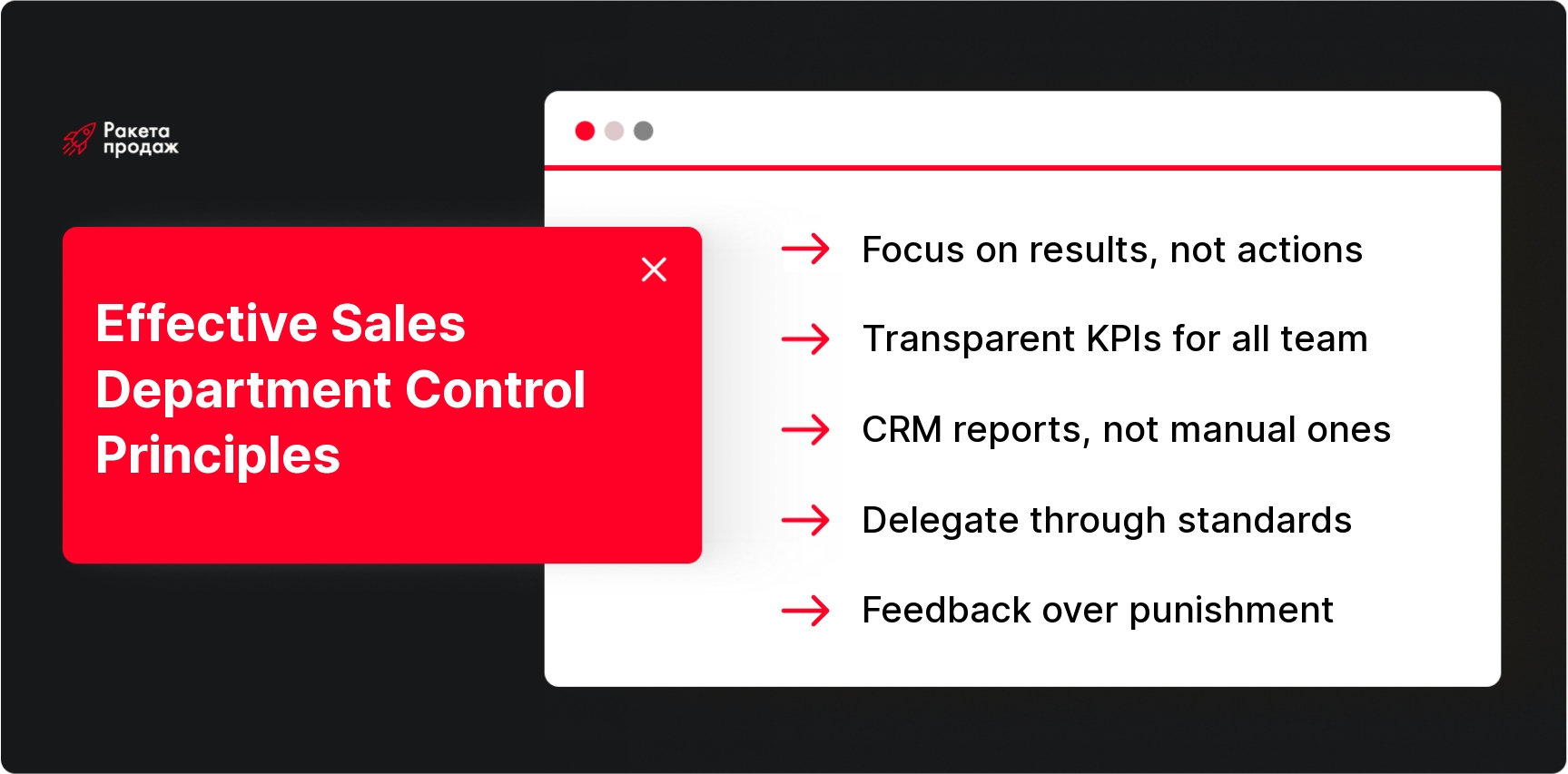
The main principle is that transparency matters more than total control. It’s better to see 80% of the team’s actions through the system than to manually check 100%. The second principle is focusing on results, not activity. A manager who makes fewer calls but closes more deals is more effective than one who calls all day without results. The third principle is sales reporting automation. Callback tasks, overdue deal notifications, and weekly reports should be generated without human involvement.
The fourth principle is delegation through standards. The sales manager gets the authority to manage the team within established KPIs and processes. The fifth principle is feedback instead of punishment. Deviations from the plan are a reason for analysis and correction, not for finding someone to blame.
Implementation starts with diagnosing current processes: where deals are being lost, how managers work, what data is available. Then a target model is designed: sales funnel, roles, KPIs, standards. The next step is implementing a CRM system and integrations with telephony, the website, and messengers. In parallel, the team is trained and a management rhythm is established. The final stage is regular reviews and system improvements.
Practical Methods of Oversight Without Micromanagement
Reporting automation is the first step toward giving up manual control. Instead of daily “talk-through” meetings where every manager recaps their actions, use CRM dashboards. Set up automatic weekly reports on the funnel, activity, and conversion. The leader reviews them in advance and, during the meeting, discusses only deviations and plans for the following week. This saves time and improves the quality of discussions.
Checkpoints at each funnel stage help track progress without constant intervention. Set deadlines: a lead must be processed within 2 hours, a commercial proposal sent within 24 hours of a meeting, a contract agreed upon within a week. The CRM automatically flags overdue items, and the sales manager works on specific cases instead of monitoring everyone across the board.
Call analysis through recordings and AI tools provides an objective picture of communication quality. Instead of randomly listening to 5-10 conversations a week, the system analyzes 100% of calls and produces reports on: script adherence, objection handling, and tone of communication. This turns quality control from subjective into analytical. Understanding how to manage the sales department without micromanaging allows you to build effective monitoring of the performance of sales managers, and mastering how to manage managers without micromanaging is what ultimately separates scalable teams from ones stuck in constant firefighting.
Methods for organizing teamwork:
- Weekly reviews of complex deals – the team discusses stuck projects and looks for solutions
- Monthly retrospectives – analysis of results, successful cases, mistakes, and improvements
- Pair work – experienced managers help newcomers and share best practices
- Employee training and onboarding for complex clients or new products
Hold one-on-one sessions with managers based on data, not on feelings. Before the meeting, review reports on the specific employee’s activity, conversion, and funnel. Discuss specific metrics and improvement plans rather than general impressions of their work.
Tools and Technologies for Effective Oversight
A CRM system is the heart of modern sales oversight. The Ukrainian market offers a wide range of options: from universal solutions to industry-specific systems for medicine, real estate development, and e-commerce. The key requirement is integration with telephony, the website, and messengers. This ensures deals are automatically created from inquiries, all calls are logged, and task notifications are sent. Without integrations, the CRM becomes an extra burden for managers.
Virtual telephony with detailed analytics shows who’s calling and how much, call duration, and missed calls. Ukrainian providers offer real-time reports: who’s currently on the line, who’s free, how many customers are waiting. This allows you to manage workload on the fly without being physically present in the office. Such tools demonstrate how to evaluate the sales department’s performance systematically and objectively.
AI solutions for analyzing negotiations automatically process call recordings, flag script violations, analyze the emotional tone of conversations, and identify reasons for refusals. Speech analytics systems provide aggregated reports on the entire team’s communication quality. This replaces manual call listening and subjective assessments.
Comparison of solution types by business scale:
When choosing technologies, it’s important to start with basic functionality and gradually expand capabilities. Implementing all tools at once often leads to chaos and team resistance. It’s better to first set up CRM and telephony, get them running stably, and then add AI and advanced analytics.
Oversight vs Motivation: How to Maintain Productivity and Trust
Oversight without proper motivation turns into a policing system. It’s important to combine transparent metrics with positive recognition of results. Financial motivation should be tied to metrics you actually monitor: plan fulfillment, conversion, and CRM data quality. If a bonus depends on “the manager’s general impressions,” the system loses objectivity.
Non-financial recognition works just as well as money. Public praise for a difficult deal closed, involving top managers in strategic projects, company-funded training – all of this boosts loyalty and engagement. The key is having clear and fair criteria. When a manager sees a direct link between their actions, results, and rewards, they resist oversight less.
Sales manager motivation is one of the key components of successful management and sustaining initiative within the team. If a manager isn’t meeting the plan, the first question shouldn’t be “why are you performing poorly,” but “what help do you need.” Maybe they lack objection-handling skills, don’t understand the specifics of a new product, or struggle to manage several large deals at once. A coaching approach turns oversight from a punitive tool into a developmental one.
Examples of smart motivation in practice:
- Monthly manager rankings with public recognition of top performers
- An extra day off for exceeding the plan by 20%
- Participation in industry conferences for top employees
- Mentoring newcomers as extra responsibility for experts
Team growth reinforces individual motivation. Regular training, reviewing best practices, and exchanging experience between managers create an environment of development. When the team grows professionally, the need for strict oversight decreases – people naturally strive for high results.
Step-by-Step Guide for Leaders: Implementing Oversight Without Micromanagement
Start with an audit of the current situation. Analyze how the sales department currently operates: is there a CRM and how much is it actually used, how are negotiations conducted, what reports do managers produce, how much time does the sales manager spend on oversight. Identify the main problems: lost leads, low conversion, lack of process transparency, high turnover. This will help you focus on critical points instead of implementing “everything at once.” Study how to control sales team without micromanagement in practice.
The second step is designing the target system. Define the sales funnel stages, roles and responsibilities, and baseline KPIs for the company and each manager. Choose CRM and telephony tools suited to your scale and industry. Document work standards: response times for inquiries, requirements for client card management, communication protocols. Don’t try to design the perfect system right away – it’s better to start with something simple that works. A well-designed system will help you organize effective oversight of the sales department.
Step-by-step implementation algorithm:
- Set up CRM and basic integrations (telephony, website)
- Train the team on the new tools
- Launch automatic reports and dashboards
- Establish a management rhythm (meetings, one-on-ones)
- Add AI analysis and advanced analytics
- Conduct regular reviews and process optimization
The third step is training and support. The team needs to understand why the changes are necessary and how they’ll help in their work. Run training sessions on the new tools, explain the logic behind the KPIs, show the connection between processes and results. The first 2-3 months will involve resistance and mistakes – that’s normal. It’s important to maintain discipline without punishing technical hiccups.
The fourth step is building a new management culture. The sales manager needs to shift from being a “watchdog” to being an analyst and coach. The owner focuses on strategic metrics rather than operational details. Regular meetings are built around data, not personal impressions. Successes and problems are discussed openly, with a focus on improvement. At this stage, effective oversight of the sales department takes shape.
Common Mistakes Owners Make When Overseeing the Sales Department
The first mistake is monitoring all managers directly, bypassing the sales manager. This devalues the department head’s role and creates confusion in the chain of command. Managers start receiving conflicting instructions, the sales manager loses authority, and the owner spends time on operational tasks. The right approach is to work with the sales manager as the single point of accountability for the team.
The second mistake is focusing only on revenue without analyzing the funnel. When the plan isn’t being met, many owners demand “make more calls” or “lower the prices.” But the problem could be in lead quality, presentation conversion, or negotiation length. Funnel analysis reveals the real reasons behind declining sales. Ineffective supervision of sales department managers often leads to exactly these kinds of mistakes.
The third mistake is monitoring every little detail instead of key deviations. If you check every email and every meeting, you won’t have time for strategic tasks. The right approach is to set up automatic alerts for critical situations: overdue large deals, a drop in manager activity, a sharp rise in refusals.
A few more common mistakes:
- Requiring reports that nobody actually uses
- Keeping parallel spreadsheets instead of trusting the CRM
- Getting involved in every complex deal
- Changing rules without consulting the sales manager
- Criticism without clear quality criteria
- Lack of regular team meetings
The fourth mistake is confusing oversight with a constant physical presence in day-to-day operations. Oversight is a system of metrics and processes, not your physical presence next to your managers. If you can’t go on a business trip because “everything will fall apart,” the system isn’t working. Proper oversight functions regardless of your location.
These mistakes lead to owner burnout, team demotivation, and a decline in the sales manager’s sense of responsibility. In the end, instead of growing efficiency, you get a vicious circle: the more you control, the worse the system performs.
Moving from chaotic oversight to systemic management of the sales department isn’t just about implementing a CRM or new reports. It’s a comprehensive process overhaul that requires deep understanding of sales specifics and experience working with different business models. “Rocket Sales” specializes precisely in building such systems: we implement a transparent sales funnel with checkpoints, set up automatic alerts for critical deviations, build KPI dashboards for leaders, and train teams to work by new standards. Our methodology allows owners to focus on strategic tasks while the sales department operates according to clear algorithms and achieves predictable results. Among our clients are companies that have gained not just a 5-86% increase in conversion, but a genuine shift in corporate culture: from “firefighting” to steady, planned growth. Our best result – a monthly turnover increase of +$10,907,403 over 4 months of work.
Build a sales department run by data, not emotions - order a comprehensive oversight system build!
Building a productive, self-sufficient sales department without total control is achievable today – with the right balance of automation, transparency, and human relationships. Ukrainian experience shows: companies that move from chaotic sales to systemic ones gain not only revenue growth but also a qualitative shift in the leader’s role – from “hands-on controller” to team strategist. In the long run, this approach boosts staff initiative and lets you focus on business development instead of routine oversight. Start by implementing clear KPIs and reporting automation – and within a month you’ll see how the team’s accountability and performance improve without micromanagement.


 Time to read: 9 min.
 24 July 2026