icon

Why Sales Managers Leave in Their First Month: 5 Adaptation Mistakes

Hiring a sales manager is an investment that, when done right, brings the company solid profits. But what if your new employees don’t stay longer than the first month? The statistics are unforgiving: every third manager leaves the company before the end of the probation period, and 80% of those who quit in the first six months make this decision in the first two weeks of work.

Key Takeaways

  • Organizational chaos on day one (no workstation, access, headset) signals systemic problems and undermines a new hire’s confidence in the company.
  • Information overload without practice paralyzes the manager. PDFs instead of role-plays make first calls fail, and motivation dies when it’s impossible to quickly find an answer.
  • The lack of a mentor—or assigning a busy top performer—leaves the newcomer isolated. Unhealthy competition turns colleagues into enemies.
  • Overpromising in interviews and a “100% plan” in the first month creates a financial dead end: the manager realizes they’ll be earning below market for months.
  • No regular 1:1s and criticizing the person instead of reviewing actions destroy trust. The newcomer doesn’t know the success criteria and works blindly until “execution day.”

In the full article, you’ll find precise early warning signals, an emergency 7-day stabilization plan, and specific tools that turn onboarding chaos into a structured process. Read below 👇

The cost of such a mistake for business is enormous. Expenses for search, interviews, onboarding, and basic training average 1-3 monthly salaries. And if you factor in the lost profits from failed deals, management time spent on adaptation, and damage to the company’s reputation in the labor market, the figures grow to 5-6 salaries for each failed salesperson.

The paradox is that early departure is almost always a failure of the organization, not the candidate.

If a newcomer drops out in the first few weeks, it means that employee adaptation errors have been accumulating for a long time, breaking even the most promising newcomers. During this critical period, the new employee is looking for confirmation that their choice was right. And 5 classic adaptation mistakes become clear evidence to the contrary: “I’m in the wrong place, I need to run.” The question “Why employees leave the company?” almost always has a simple answer – it’s not about the people, it’s about the system.

Often we find the main culprit of turnover in the sales department not where we expect. Judge for yourself: 80% of managers who quit in the first six months make this decision in the first two weeks of work. The cost of such a mistake reaches 5-6 salaries for each failed salesperson. The problem is not in the people themselves, but in the lack of a systematic approach to adaptation. “Sales Rocket” has created a methodology over 7+ years that addresses exactly these pain points. We develop structured sales books with training materials, clear adaptation plans, and workbooks for new managers. Our clients receive ready-made scripts, templates, and step-by-step instructions that help newcomers quickly reach target indicators. As a result, the average revenue increase for our clients is +35%, and the maximum recorded result is +$1.6 million in 4 months of work.

Transform chaotic adaptation into a transparent system and reduce turnover by 73% - order a consultation now!

Mistake #1: Organizational Failure and Chaos

Imagine the situation: a new manager comes to work on the first day, full of enthusiasm and readiness to conquer the heights of sales. But instead, he faces complete chaos. His workplace is not prepared, the computer is not configured, access to CRM is not granted, headset for calls is missing, and colleagues only shrug in response to questions.

This situation is the first alarm bell for a newcomer. He perceives it not just as an unfortunate oversight, but as a systemic problem of the company. Questions immediately arise in his head: “If they couldn’t prepare for my arrival, which they knew about in advance, how do they manage more complex processes? If basic things aren’t set up, what happens with their attitude towards customers?”

For a sales manager, the feeling of confidence in the product and company they represent is especially important. The lack of this confidence from the first hours of work undermines their ability to sell convincingly. In some cases, by the end of the first day, the employee makes an internal decision that this company is not the place where they see their future.

The problem is exacerbated by the fact that the manager loses precious time that could have been spent studying the product and market. Instead, they have to go around departments begging for elementary tools for work, feeling like a burden to busy colleagues. This experience creates deep disappointment and a feeling that the company simply doesn’t respect either their time or professionalism.

In the end, organizational chaos becomes that “red flag” that signals to the newcomer about serious internal problems. And even if the situation improves later, the first impression has already been formed – they have to work in a company where disorder is the norm. And most ambitious salespeople at this point start thinking about looking for new opportunities. After all, chaos in an organization almost always means problems with commission payments, lack of clear rules, and constant struggle with internal processes instead of focusing on customers.


If you want to know the real reasons for staff turnover, and see in our case study how we overcame turnover in the sales department, and also understand what non-obvious tools helped reduce outflow, read this analysis of real practice.

Mistake #2: Information Shock and the "Library" Method

The second fatal mistake in sales manager adaptation is the wrong approach to training. Often managers operate on the principle: “Here’s the knowledge base, instructions, and regulations – read and figure it out.” As a result, instead of practical training, the newcomer receives a stack of documents or access to a folder with dozens of PDF files that they must study independently.

This “library” approach is not just ineffective – it causes immediate burnout and panic in the new employee. A sales manager is by nature a person of action, oriented towards concrete results, not theoretical study of materials. By overloading them with information without practical application, the company practically guarantees their imminent departure.

Too Much Theory Too Early

The first days of work are the most sensitive time for a new manager. Their brain is already overloaded with new faces, names, processes. And then there’s the need to absorb a massive amount of information about products, prices, competitors, technical details, and internal rules.

When everything is dumped on a newcomer at once, information paralysis occurs. The person simply doesn’t know what to grab first. They experience anxiety from realizing they can’t remember everything and begin to doubt their own abilities. “If everyone else somehow manages this, but I don’t – maybe the problem is with me?” – this thought quickly undermines the newcomer’s confidence.

At the same time, from the huge mass of information, they cannot extract the things that are really important for starting. As a result, by the end of the first week, their motivation drops sharply and stress increases. They see an insurmountable mountain of knowledge before them and don’t understand how to deal with it in the allotted time.

Error in Presentation of Material: PDF Instead of Practice

Another common problem is an unsuitable training format. Most companies limit themselves to providing text materials, believing this is sufficient. But sales managers are people who learn through action and observation, not through reading.

The absence of practical training elements (role plays, scripts with examples, analysis of successful and unsuccessful calls) deprives the newcomer of tools for real work. They may know the theory but have absolutely no idea how to apply it in conversation with a client.

This leads to the first independent calls becoming a real ordeal. The manager feels unprepared, gets lost when the client objects, cannot competently present the product. Failure in the first communications hits hard on their self-esteem and desire to continue working in the company.


It’s important to use best practices for training managers, so that adaptation brings quick and guaranteed results. Check out examples of modern approaches.

The "Closed Door" Problem: Inability to Quickly Find Answers

Another aspect of information overload is the unstructured knowledge base. When a new manager has a specific question (for example, how to arrange a special offer or what documents are needed for a certain type of client), they should be able to find the answer quickly.

But often the search for this answer turns into a real quest. The knowledge base is not indexed, materials are scattered across different folders and documents, search function is missing. As a result, solving a simple question takes a disproportionate amount of time, which is critically important for a salesperson working with live clients.

This frustration is intensified when the manager is unavailable or too busy to answer questions. The newcomer feels abandoned in the face of a difficult task without the necessary support. And this often leads to the breakdown of the first communications with clients, when the manager cannot promptly provide the necessary information or is forced to call back several times.

Mistake #3: Cultural Vacuum and Lack of a Mentor

Sales is a team sport, even if each manager works with their own client base. Team energy, colleague support, and a sense of belonging play a huge role in a salesperson’s success. But many companies completely ignore the social aspect of adaptation, creating a cultural vacuum for the newcomer.

In such conditions, even the most talented manager quickly loses motivation. After all, sales is a job that requires constant emotional reinforcement, exchange of experience, and the ability to celebrate victories or share disappointments from rejections.

The "Abandoned Kitten" Problem: Emotional Isolation

Many leaders don’t even think about how important it is to formally introduce a new employee to the team and integrate them into the collective. Often the newcomer spends the first weeks in complete isolation: they are not introduced to colleagues, not invited to lunches, not included in informal chats.

Such emotional isolation causes strong discomfort. The person feels like a stranger, an outsider, with no right to ask for help or just talk about work. For a sales manager, who by nature is usually communicative and socially active, this is especially painful.

The lack of social integration leads to the employee not seeing themselves as part of the team and not being able to develop a sense of loyalty to the company. As a result – even with interesting tasks and good compensation, they don’t feel an emotional attachment to the workplace and easily decide to leave.

In some companies, newcomers literally sit in their corner for weeks, not knowing colleagues’ names and not understanding the internal hierarchy. This situation creates constant stress and a feeling of non-belonging, which completely negates even the most thought-out technical onboarding.

Ineffective Buddy Assignment

Even when companies recognize the need for mentoring, they often make the mistake of assigning the department’s best salesperson as a buddy (mentor). At first glance, this is logical – let the newcomer learn from the leader. But in practice, this approach often fails for two reasons.

First, top sellers are usually too busy with their clients and fulfilling their own plans to devote enough time to training a newcomer. They may formally agree to the mentor role, but actually be unavailable for questions and help.

Second, not every strong salesperson knows how to teach. They may lack pedagogical skills, patience, or desire to share their developments. As a result, mentoring is reduced to short phrases: “Watch how I do it and do the same,” without explaining the principles and logic of actions.

For a new manager, this situation is equivalent to a complete absence of a mentor. They don’t receive the necessary support, have no opportunity to ask “stupid” questions, and learn from others’ experience. This significantly slows down their development and increases feelings of uncertainty, which ultimately leads to a decision to look for a company with a more systematic approach to training.

Substitution by Competition: Why the Team Doesn't Help

Another factor destroying the adaptation of new managers is unhealthy competition within the sales department. Leaders often encourage a “competitive spirit” without thinking about its dark side. As a result, newcomers are perceived by experienced employees as a threat – competitors for leads, resources, and bonuses.

In such an atmosphere, team veterans aren’t interested in the newcomer’s rapid growth. On the contrary, it benefits them for the newcomer to remain ineffective longer. They may intentionally give incomplete information, hide useful life hacks, or even sabotage the new colleague’s work.

The newcomer quickly reads this atmosphere and understands they’re in a toxic environment where it’s every man for himself. For many, this becomes the deciding factor when making the decision to quit. After all, sales is already a stressful profession, and not everyone is ready to fight internal obstacles as well.

Mistake #4: Financial Dead End and Inadequate KPIs

The main motivation for most sales managers is financial reward. They enter the profession and a specific company with certain income expectations. And when reality sharply diverges from these expectations, this is the main reason for dismissal from work.

The financial stress factor is especially strong during the starting period of work, when the employee doesn’t yet have a stable income from sales, but is already forced to meet inflated management expectations. As a result – dismissal in the first month of work becomes a common outcome when companies fail to manage expectations properly.

Inflated HR Promises: The "Expectation vs. Reality" Gap

The story begins at the interview stage, when HR and managers paint rosy prospects for the candidate: “We have high-quality warm leads”, “Our managers earn an average of 80-100 thousand”, “Already in 2-3 months you’ll reach a stable high income.”

But when the employee starts working, they discover a completely different picture. The database turns out to be cold and long worked out, the average check is much lower than stated, and the lead distribution system is built in favor of experienced managers.

Such a gap between the promised and the actual is perceived as deception and undermines trust in the company as a whole. The new manager feels cheated and begins to look for an organization that is either more honest in its promises or can actually provide the stated level of income.

It’s especially dangerous when this gap is discovered in the very first days of work. The employee understands that months of hard work with minimal income await them, although they were promised something completely different. And the brighter the prospects were painted at the interview, the stronger the disappointment and desire to leave.

KPI Setting Error: 100% Plan in the First Month

Another common problem that contributes to sales manager adaptation errors is setting unrealistic KPIs for new managers. Many leaders believe that “you need to set a high bar right away,” and require the newcomer to fulfill 100% of the plan already in the first month of work.

But this requirement ignores the reality of the adaptation period. Even an experienced salesperson needs time to master a new product, understand the specifics of the target audience, figure out the CRM and internal processes. For a newcomer to the profession, this period is even longer.

When the manager realizes that the goals set for them are unattainable, they get a sense of guaranteed failure. Why try if even maximum effort won’t lead to plan fulfillment? This thought kills motivation and creates a constant feeling of anxiety.

Moreover, unrealistic KPIs make the employee think that the company deliberately creates impossible conditions to avoid paying bonuses or have a formal reason for dismissal. This further undermines trust and increases the desire to find a more honest employer.

Stress Pricing: How the Manager Loses Money

The financial dead end for a new manager often looks like this: they spend time and energy mastering the product and processes, but don’t see a direct link between their efforts and income. Moreover, they begin to feel they’re losing money by staying with the company.

This happens when the motivation system is structured so that newcomers are essentially doomed to minimal income in the first months. High entry threshold, lack of guaranteed payments during the adaptation period, depriving of bonuses for not achieving unrealistic KPIs – all this creates a sense of financial pit.

The manager quickly calculates and understands: even if they stay and work hard, at best they’ll start earning normally in 3-4 months. And until then, their income will be below market rate or minimal.

This realization becomes the last straw. Why spend months on a company that doesn’t invest in their growth and doesn’t provide financial stability during the adaptation period? It’s easier to leave now and find a place where entry conditions are more fair.


Methods for retaining managers and transparent motivation tools play a key role in successful sales department work. We recommend reading the article to learn more about these effective approaches.

Mistake #5: Lack of Feedback Loop and Criticism

Any new employee needs regular, constructive feedback. This is especially true for sales managers, whose work is constantly measured by specific indicators. But many leaders either completely ignore the need for feedback, or do it incorrectly, which becomes another reason for the early departure of valuable personnel.

The problem of lack of clear communication between the leader and the new manager creates a situation that can be described as “Silence or Execution” – a long absence of any assessment, suddenly replaced by harsh criticism or even a decision to part ways.

"Radio Silence": Absence of Regular One-on-Ones

A classic situation in companies: the leader believes that if there are no critical problems, there is no need to hold regular meetings with the new employee. “If something goes wrong, I’ll say so myself” – they think, completely ignoring the newcomer’s need to confirm the correctness of their actions.

As a result, the manager works practically blindly. They don’t know if they’re building the product presentation correctly, filling out the CRM properly, qualifying leads correctly. Each workday passes in anxiety and uncertainty.

The absence of weekly one-on-one meetings in the first month of work is a direct mistake by the leader. It is during this period that basic skills and habits are formed, which are then difficult to correct. Without timely feedback, a newcomer can move in the wrong direction for a month, reinforcing erroneous approaches.

When the leader finally pays attention to the results of the new manager’s work (usually at the end of the probation period), it turns out that many problems have accumulated that could have been easily eliminated at early stages. But now it’s much harder to fix them, and sometimes it’s too late – the employee is demotivated and ready to leave.


Effective staff adaptation in the sales department includes regular feedback as one of the key tools.

Criticism of Personality Instead of Analysis of Actions

Another common problem is the non-constructive nature of feedback. Many leaders, especially those who haven’t undergone special training, tend to criticize the employee’s personality, not their specific actions.

Instead of saying “You didn’t use the script in the conversation with the client, which reduced the effectiveness of the presentation”, they say “You’re inattentive and don’t know how to follow instructions”. Instead of “You didn’t fill in the ‘Client Need’ field in the CRM, which means we can’t analyze the funnel”, they say “You’re irresponsible and don’t care about the team”.

This approach causes a strong defensive reaction. No one likes when their personality is attacked, not their actions. The manager feels unfairly evaluated, begins to defend themselves or, even worse, internally agrees with the negative assessment and loses confidence.

Criticism of personality kills the desire to work and develop. The person sees that in management’s eyes they’re already labeled as a “bad employee”, and doesn’t believe in the possibility of changing this perception. The result – decreased motivation and search for a company where their professional qualities will be evaluated more objectively.

Not Knowing the Criteria: Manager Doesn't Know They're Failing

Perhaps the most dangerous scenario is when the employee doesn’t understand until the last moment that their work is being evaluated as unsatisfactory. This happens when success criteria weren’t clearly formulated initially or were too vague.

For example, the leader considers the main performance indicator to be the number of meetings, but doesn’t inform the new manager about this. The manager focuses on the quality of preparation for negotiations and the depth of work with each client, believing they’re doing everything right. And at the end of the month hears that “results don’t meet expectations”.

This situation is perceived as extremely unfair. The person sincerely tried, did what they thought was right, possibly even achieved certain successes – and suddenly learns that all this time they were moving in the wrong direction.

The lack of clarity in evaluation criteria creates a constant feeling of uncertainty and anxiety. The manager cannot assess their own progress, doesn’t understand what to focus on first. In the end, they either burn out from endless attempts to guess management’s expectations, or leave for a company with a more transparent evaluation system.


One of the tools for transparent management is correct evaluation of leader effectiveness and their connection with team performance results.

Psychological Threshold: When the Manager Decides to Leave

Most leaders don’t realize how quickly a new employee forms the decision to leave. Research shows that this happens much earlier than one might assume – usually between the 5th and 10th day of work, after the first serious encounters with organizational chaos, information overload, or toxic environment.

By this time, a complete picture of the company has already formed in the manager’s mind, and if it differs sharply from what was presented at the interview, a strong cognitive dissonance arises. The person begins to feel that they were deceived or that they themselves made a mistake in choosing a workplace.

The process of deciding to leave usually goes through several stages. First, there’s a slight disappointment and the thought “maybe this isn’t exactly what I was looking for.” Then, as negative experiences accumulate, a clearer realization forms: “I definitely don’t want to work here for long.” And finally, after some final trigger (it could be a conflict, unfair criticism, or another organizational failure), a firm decision is made: “I need to leave as soon as possible.”

Interestingly, many managers who decide to leave in the first weeks are not in a hurry to submit a resignation letter. They begin a passive job search while “serving their time” in the current position. Their productivity and engagement drop sharply, they stop investing in learning about the product and processes, minimize communication with colleagues. In fact, the company has already lost this employee, even if formally they’re still on staff.

The psychological mechanism that triggers the decision to leave is often related to a breach of basic trust. A new manager comes to the company with a certain credit of trust and willingness to invest their strength, time, and energy. But when they face the fact that the company doesn’t invest in them equally (doesn’t prepare a workplace, doesn’t provide necessary knowledge, doesn’t give feedback), a feeling of unequal exchange arises. “I try, but they don’t” – this thought destroys motivation and the desire to stay.

Another important factor is social integration. If by the end of the first week the manager doesn’t feel part of the team, doesn’t have “their” place in the collective, and doesn’t see support, the probability of their leaving increases many times. People can tolerate imperfections in processes or products, but social isolation is much harder to bear, especially for extroverts, of which there are many among salespeople.

The role of the leader in this critical period is difficult to overestimate. It is they who must track the first signs of disappointment and actively work to eliminate them. Regular short meetings, open questions about how adaptation is going, what difficulties arise, what can be improved – all this allows identifying problems before they become fatal.

Experienced leaders know that the first two weeks are the time when you literally need to “keep your finger on the pulse” of a new employee, providing them with maximum support and attention. Investments during this period pay off many times over – with stable work, growth in results, and manager loyalty in the long term.

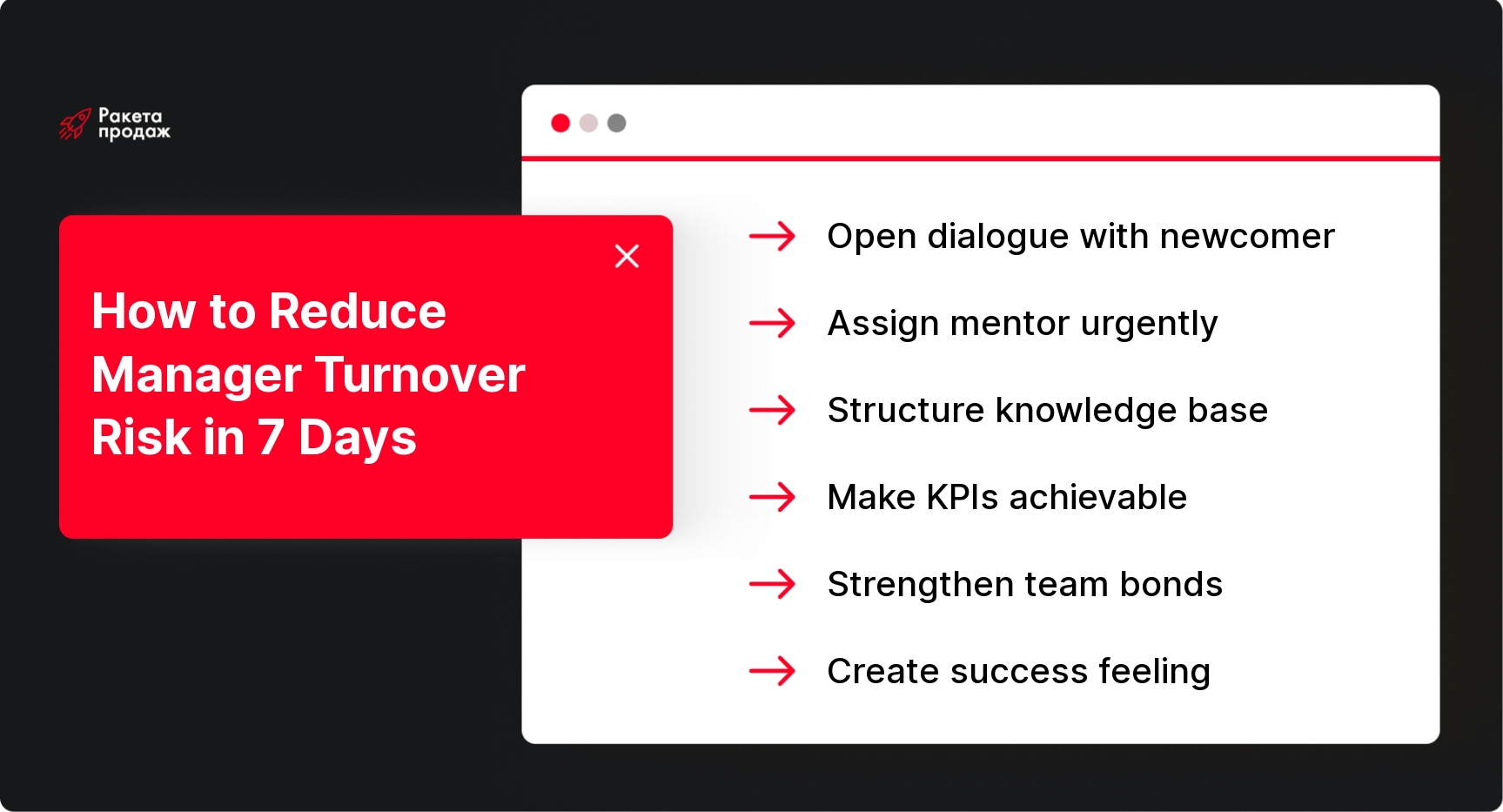
Damage Control: How to Stabilize Adaptation in 7 Days

image

If you see that the adaptation of a new manager is not going according to plan, and the first signs of potential departure have appeared (detachment, decreased enthusiasm, passivity, lateness), not all is lost. There is a set of emergency measures that can be taken within 7 days to stabilize the situation and return the employee to a constructive path.

First of all, it’s necessary to have an open conversation with the manager. This should not be a formal meeting “for show”, but a sincere dialogue about what’s going wrong. It’s important to create a safe atmosphere where the employee can fearlessly share their disappointments and concerns. Often the very fact of such a conversation already reduces tension and shows that the company is not indifferent to their condition.

After identifying problem areas, you need to immediately start eliminating them. If the problem is the absence of a mentor – appoint one right now, and it’s better to choose not the most loaded employee, but someone who is really ready to invest time in training the newcomer. Allocate separate hours in the schedule of both employees for this and monitor the first meetings.

If the main difficulty is information overload, then it’s necessary to urgently structure knowledge. Create a brief guide to the most important aspects of the product and processes, prioritize: “you need to know this now, this in a week, and this when you master the basics.” Give the opportunity to ask questions in a convenient format – for example, through a dedicated chat or regular short meetings with an expert.

It’s critically important to revise the KPIs for the coming month. If the plans were initially unrealistic, acknowledge this and set achievable goals. For example, instead of “5 sales in the first month” set “5 quality presentations with feedback from the leader.” This will reduce financial stress and provide an opportunity to focus on skill development, rather than panic attempts to achieve the unachievable.

Social integration also requires immediate attention. Organize an informal team meeting where the new manager can get to know colleagues in a relaxed setting. Ask experienced employees to share their stories about how they adapted and what difficulties they faced – this will show the newcomer that their problems are normal and can be overcome.

One of the most effective measures is creating an individual plan for the coming week. This plan should contain specific, measurable, achievable tasks with a clear understanding of who will help fulfill them and how. For example: “Conduct 3 training calls with a mentor, receive feedback, implement corrections in the next 5 calls.” This approach gives a sense of structure and progress, which is often lacking in the chaotic beginning of work.

Don’t forget about the technical side. If the manager still has problems with access, equipment, or programs, solve them as a priority. Appoint a specific person responsible for technical support of the new employee so they don’t waste time fighting with infrastructure.

An important psychological moment – give the manager an opportunity to feel success. Find a task that they will definitely be able to perform well, and publicly note their achievement. This could be a well-conducted presentation, properly filled data in the CRM, or a well-prepared commercial offer. The first recognition of success is a powerful stimulus for further development.

Finally, conduct daily short check-ins during this “rescue week.” Literally 15 minutes at the beginning or end of the day to track progress, answer arising questions, and adjust the plan if necessary. This will create a feeling for the employee that they haven’t been left alone with problems, and the company is really interested in their success.

If all these measures are applied comprehensively and promptly, then in most cases it’s possible not only to retain a manager who was already thinking of leaving, but also to turn them into a loyal, productive employee. After all, competently resolving a crisis situation often forms a stronger connection than if problems hadn’t arisen at all.

The early departure of sales managers from the company is not a sentence, but a consequence of systemic errors that can be fixed. But organizing effective adaptation on your own is difficult: it requires expertise in sales, a methodological base, and experience in structuring knowledge. “Sales Rocket” offers a comprehensive solution to this problem as part of the “Sales Department Systematization” service.

We create a personalized sales book with training materials and tests, develop clear scripts and templates for a quick start, implement an effective system of motivation and results control. Each new manager receives a structured adaptation plan and access to the online course “Basics of Sales”. This approach ensures quick integration of employees and stable sales.

Our clients increase conversion by 5-86% and achieve stable growth in turnover. Instead of spending months on the endless search for “ideal candidates”, create a system that will make any suitable manager successful.

Create a sales department where new employees consistently achieve results in the first month - get a free audit of your adaptation system!

Conclusion

Employee adaptation errors, especially in the first month of work, are perhaps the most expensive mistakes a company can make. They cost not only direct financial losses (recruiting expenses, training, salary), but also missed opportunities, lost clients, and reputational risks as an employer.

Key sales manager adaptation errors – organizational chaos, information shock, cultural vacuum, financial dead end, and lack of feedback – form a toxic cocktail that literally pushes new employees out of the company. This happens especially quickly with talented and ambitious managers who are not ready to spend their time and energy overcoming the organization’s systemic problems.

It’s important to understand that the decision to leave is made much earlier than it might seem – often already in the first or second week. And if you don’t track early warning signals, you can miss the moment when everything can still be fixed.

At the same time, there are proven strategies for stabilizing adaptation even in a crisis situation. An honest conversation, appointing a mentor, structuring information, revising KPIs, social integration, and creating an individual plan can fundamentally change the new employee’s perception of the company.

The impact of adaptation on performance of the organization is difficult to overestimate. Investments in quality onboarding are not just a “nice bonus” for the new manager, but a strategic decision that directly affects the financial performance of the business. The impact of staff adaptation is especially noticeable in such key indicators as turnover in the sales department and the speed at which employees reach target productivity. Companies that pay due attention to the first 30 days of an employee’s work get a faster path to results, higher loyalty and, consequently, more stable sales growth in the long term.


If you want to systematically reduce the risk of these mistakes, also read our analysis: manager adaptation errors and typical misconceptions of leaders.

In this article:
See more
Book a FREE sales funnel audit
CONTACT US
FAQ
How quickly should a sales manager close their first deal?

Timelines depend greatly on product complexity, sales cycle length, and the manager’s own experience. In B2C with a short cycle, this could be 2-3 weeks, in complex B2B – 2-3 months. It’s important to establish realistic expectations in advance and communicate them to the new employee to avoid disappointment on both sides.

What percentage of the sales plan should be set for a newcomer in the first month?

The optimal approach is a progressive scale: in the first month 30-50% of the standard plan, in the second – 60-70%, in the third – 80-90%, and only from the fourth month – the full plan. This allows the newcomer to focus on learning and doesn’t create a demotivating feeling of an “unattainable goal”.

How often should assessment be conducted during the probation period?

Ideally, during the probation period, a multi-level feedback system operates: weekly one-on-one meetings with the immediate supervisor, daily interaction with the mentor, an interim assessment in the middle of the probation period, and the final one at the end. This allows identifying and correcting problems at early stages.

Should HR or the Sales Manager be responsible for organizing the workplace?

Workplace organization is a joint responsibility of HR and the sales department manager. HR usually handles basic administrative aspects (issuing passes, basic access), while the Sales Manager handles specific work tools (access to CRM, databases, telephony). It’s critically important that there is a clear distribution of responsibilities between them, otherwise some tasks will “fall through the cracks”.

SUBSCRIBE TO MY TELEGRAM CHANNEL
The most valuable sales information right on your phone!
icon

LOTS OF USEFUL INFORMATION, FREE TEMPLATES, AND CHECKLISTS ON MY INSTAGRAM

Materials and practical advice on sales growth in our blog: