Key Takeaways
- Your managers are burning out from being generalists: searching for contacts in the morning, preparing proposals during the day, closing deals in the evening, while hot leads cool down in the queue.
- SDR teams work as a smart filter: they weed out clients without budget and need, while sales managers only get qualified meetings with real potential.
- Companies that contact a lead within the first hour get 7 times more meetings than those who postpone the call to the next day.
- SDR is only justified when you have a working CRM, described deal stages, clear ICP, and repeatable sales process – otherwise you’re investing in chaos.
- Chaotic outbound once per quarter doesn’t work; effective sequences include 8-12 touchpoints across different channels over 3-4 weeks.
In the article below, you’ll see specific signs of team overload, criteria for assessing business readiness, and situations when SDR will only hurt. Read the full article 👇
As a result, hot leads cool down while a manager finishes writing a proposal for another client. Quality inquiries get lost in spam flow. And you notice that sales growth has slowed down, although the market seems to be there. This is exactly when smart business owners start thinking about an SDR team – specialists who take on the entire “top” of the sales funnel. Let’s figure out how to tell if your business needs an SDR team and when to hire your first SDR specialist.
What is an SDR Team and What Do They Do
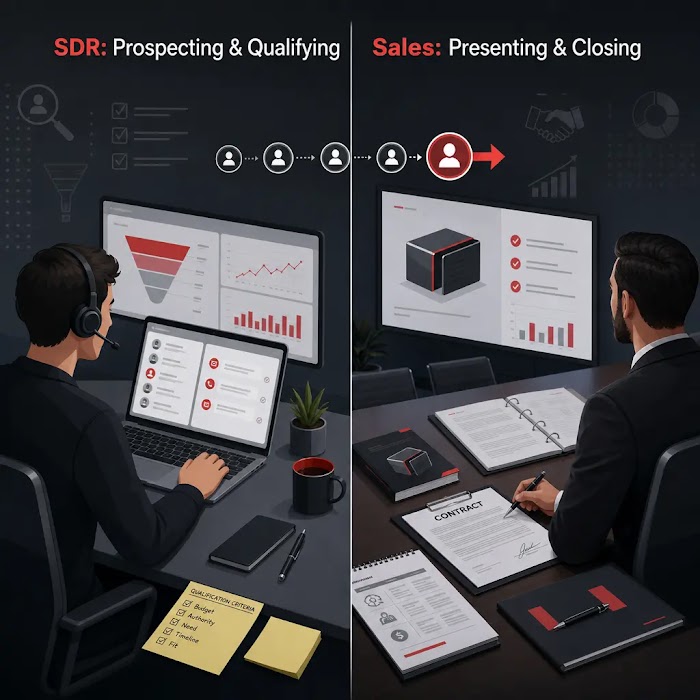
To define SDR sales, we need to understand that a sales development representative (SDR) is not just a trendy English name for a telemarketer from the 2000s. This is a specialized role in modern B2B sales that focuses exclusively on the top of the funnel. The SDR department works as a filter between marketing and the sales department: they search for potential clients, conduct initial qualification, and pass “warmed up” meetings to experienced sales managers.
Understanding what is an SDR team begins with recognizing that the main task of a sales development representative is to turn a cold contact into a qualified opportunity. They study the target audience, build touchpoint sequences (email, LinkedIn, calls), conduct discovery calls, and schedule meetings with clients who truly fit your ideal customer profile. The SDRs meaning in sales is clear: they free your experienced salespeople from routine tasks, allowing them to concentrate on what they do best – closing deals.
A modern SDR department is an analytical sales department that works with data, tests messages, and constantly gathers market feedback. This helps not only increase the number of meetings but also improve the quality of the entire GTM strategy through effective sales team development.
Recognized yourself in the description of overloaded sales managers who simultaneously search for clients, qualify leads, and close deals? Most B2B companies face this problem when trying to scale sales independently. At “Sales Rocket,” over 8+ years of work, we’ve helped 208 companies build systematic sales departments with proper role division between SDR specialists and sales managers. Our approach includes a complete audit of current processes, designing an optimal sales funnel, developing scripts for the SDR team, and implementing efficiency control tools. Among our clients are companies like Mitsubishi, Yamaha, and Naftogaz, who received a transparent lead generation and qualification system. The result? Average revenue growth of our clients is +35%, and conversion growth reaches 86% thanks to proper function division in the sales department.
Turn sales chaos into a managed system with an SDR team - get a free audit of your sales funnel effectiveness!
How SDR Differs from a Sales Manager
If a classic sales manager is the “universal soldier” of sales, then a sales development representative is a “sniper” of the top funnel. A sales manager conducts presentations, leads negotiations, prepares commercial proposals, handles objections, and closes contracts. Their area of responsibility is turning a qualified meeting into a signed contract.
SDR in the sales department works at a different level. They don’t deal with pricing, don’t prepare technical specifications, and don’t conduct lengthy negotiations. Their task is to find a company that could potentially become a client, establish initial contact, understand basic needs and budget, and then pass this information to a sales manager for further work. It’s like division of labor in a factory: one specialist is responsible for material preparation, another for final assembly.
Such role division is critically important because the skills of successful cold outreach are fundamentally different from the skills of conducting complex negotiations. A qualifier should be a curious researcher with high stress tolerance, while sales managers should be deep product experts with developed empathy. When one person tries to combine both roles, the quality of each suffers.
Why Separate Lead Generation and Sales?
Imagine a surgeon who does tests himself, prepares the operating room, performs surgery, and manages the patient after discharge. Technically possible? Yes. Efficient? Definitely not. The same principle works in sales: when a manager simultaneously searches for clients and closes deals, they unconsciously choose what’s closer to results.
Typical picture: a manager has three hot deals at the negotiation stage and a stack of cold leads that need to be called. What will they choose? Of course, they’ll work on current opportunities and postpone new contacts “for tomorrow.” As a result, fresh leads cool down, and the funnel starts “thinning” at the top.
A lead generator in the SDR team solves this problem systematically. They work on a clear schedule, have plans for the number of new contacts and meetings, and their motivation is tied specifically to quality filling of the top funnel. When a sales manager runs out of current deals, SDRs have already prepared a new batch of qualified meetings.
Moreover, specialization allows each role to develop in their direction. SDRs study new attraction channels, test messages, and analyze conversions by segments. Sales managers deepen product expertise, study client industries, and improve objection handling skills. As a result, the entire team becomes more professional and productive.
When Companies Really Need an SDR Team
When analyzing when you need an SDR, it’s important to understand that this isn’t a startup whim or a mandatory attribute of a “mature” company. This is a tool that makes sense only under certain conditions. First of all, an SDR team is effective in the B2B segment with a relatively mass market: when you have hundreds or thousands of potential clients, not 10-15 large enterprise accounts.
SDR sales is especially relevant for SaaS products, IT services, consulting, B2B services, and technology solutions with a repeatable sales cycle. If your product requires mandatory client qualification before demo (checking budget, need, authority), then SDRs will help filter out irrelevant requests and prepare sales managers for productive meetings.
It’s critically important that the company already has basic systematicity in sales: working CRM, described deal stages, clear ICP, and at least approximate communication scripts. An SDR team doesn’t replace missing strategy – it amplifies an existing sales system. At the stage when you’re thinking about creating or improving this systematicity, pay attention to CRM and telephony implementation to ensure seamless team operation.
SDR is also justified for companies with scaling ambitions: if you’re planning expansion into new regions, launching outbound campaigns, or actively developing partner channels. In stable business without growth plans, SDR investments may not pay off.
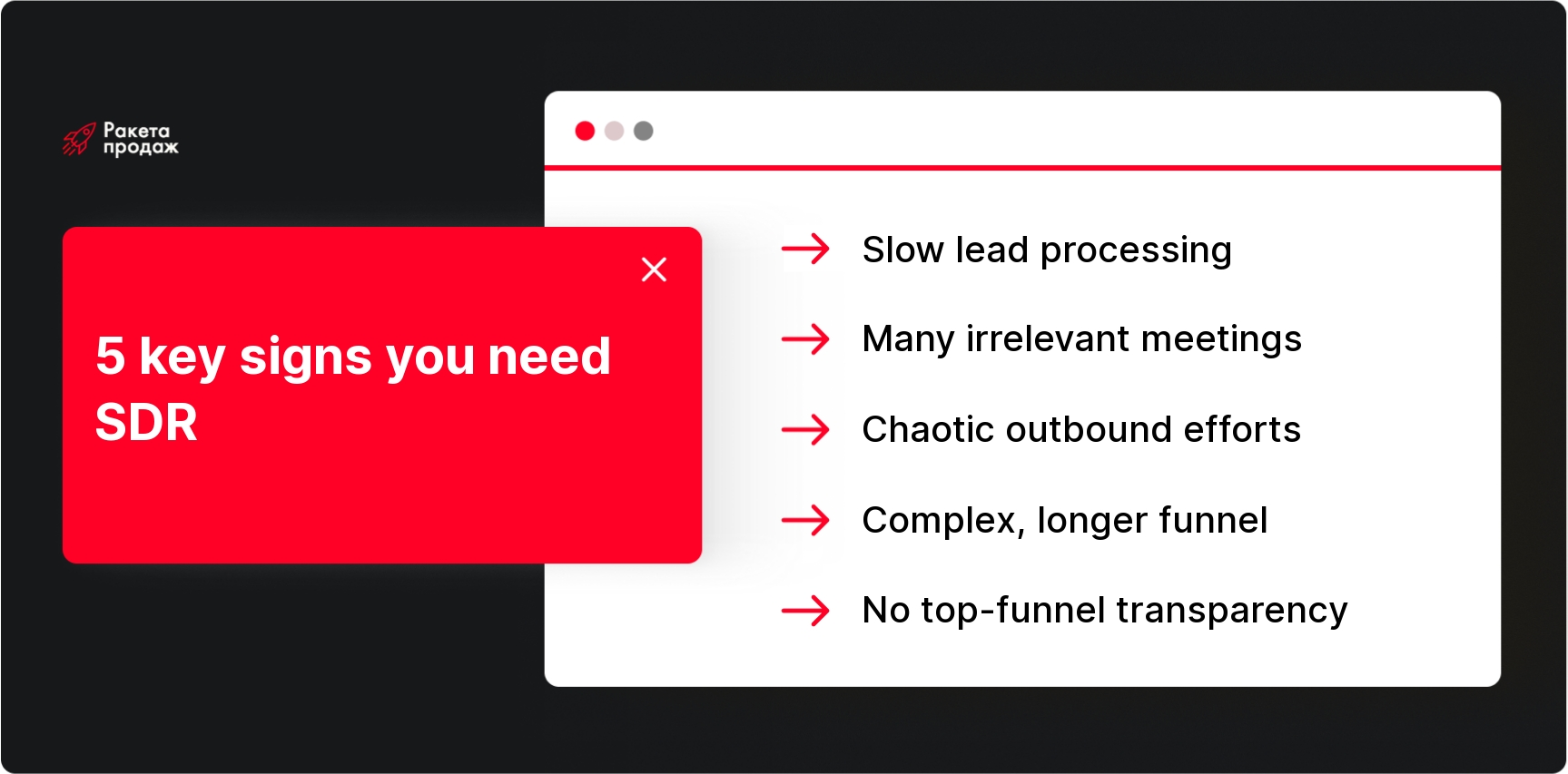
Sign 1. Sales Managers Don't Have Time to Process New Leads
The most obvious signal that indicates signs that a company needs an SDR become clear – when inquiries come in but sit in CRM for several days without processing. Managers respond with delays, forget to make follow-up calls, don’t record initial contact results, or simply choose the “most understandable” requests, ignoring the rest. If you regularly find week-old leads in the system without “processed” status, this is a direct sign of team overload.
Research shows that first contact speed with a lead critically affects conversion probability. Companies that contact a client within the first hour get 7 times more qualified meetings than those who postpone the call to the next day. When your managers are busy with current deals, this speed inevitably drops.
SDRs solve the problem systematically: their main task is to contact each new lead as quickly as possible, conduct basic qualification, and either schedule a meeting with a sales manager or record the reason for refusal. This allows not losing “hot” clients due to slow reaction and simultaneously frees experienced salespeople for working with already qualified opportunities. Who is responsible for qualifying leads? With a dedicated SDR team, this responsibility is clearly defined and efficiently handled.
Don’t forget about sales department KPI management, which allows tracking the effectiveness of each role and preventing lead loss at key funnel stages.
Sign 2. Sales Managers Spend Time on Irrelevant Inquiries
If your managers regularly hold meetings with clients without budget, need, or appropriate company size, they’re literally burning the most expensive resource – time of an experienced specialist. Typical picture: a manager spends an hour on a presentation to a startup without funding or a large corporation that needs a solution 10 times cheaper than your product.
The problem worsens when a company actively invests in marketing but hasn’t set up quality lead qualification. Contextual advertising, content marketing, and partner channels bring a large volume of inquiries, but some of them initially don’t fit your ICP. Sales managers are forced to “sift” this flow manually, losing focus on promising deals.
Here, the qualifier role becomes essential – SDRs act as a “smart filter” between marketing and sales. They conduct discovery calls, check client compliance with target audience, clarify budget and decision-making timelines. Only meetings with real need, appropriate budget, and readiness to buy in the foreseeable future reach the sales manager.
The result is higher conversion rate at the “meeting → opportunity” stage and higher motivation of the sales team, which sees their time being spent on truly promising projects.
In the process of increasing lead generation efficiency, special attention is paid to sales funnel effectiveness: only transparent analytics will help see real losses and pointedly improve qualification stages.
Sign 3. Company Has Outbound, But It's Irregular
Many B2B companies understand the potential of cold sales, LinkedIn outreach, and email campaigns, but in practice, these activities happen irregularly. Sales managers make a few calls per month, send personal LinkedIn messages “when there’s time,” or launch mass mailings once per quarter. This approach gives minimal results and creates a false impression that outbound “doesn’t work.”
The problem is that effective cold outbound requires systematicity and high touch frequency. Modern sequences include 8-12 touches across different channels over 3-4 weeks. For an experienced sales manager who simultaneously manages 10-15 active deals, maintaining such intensity is physically impossible.
An SDR team turns chaotic outbound into a managed process. They work on clear touch plans, maintain detailed analytics by channels and messages, and test different audience segmentation approaches. This allows not only increasing activity volume but also constantly improving market communication quality.
This is especially important for companies planning expansion into new geographies or segments – SDRs help quickly test demand and find first clients without serious local marketing investments.
Sign 4. Sales Funnel Has Become Longer and More Complex
If your product has evolved from a simple solution to a comprehensive platform, the sales cycle inevitably becomes more complex. Now, before a deal, you need to understand the client’s organizational structure, identify all decision-making process participants, determine selection criteria and budget process. Sales managers spend more and more time on preliminary diagnostics instead of direct sales.
In complex B2B sales, discovery can take 2-3 meetings just to understand whether it’s worth investing in this opportunity at all. When an experienced salesperson with high hourly cost does this, deal economics worsen. Moreover, many managers don’t like “digging into details” at an early stage and prefer to immediately move to solution presentation.
SDRs take on all preparatory work: research the client company, identify key decision-makers, conduct preliminary needs and budget diagnostics. By the time of meeting with a sales manager, they already have a detailed client profile, understanding of their tasks, and context for personalized presentation.
This is especially critical for products with long sales cycles (6+ months), where preparation quality for the first meeting can determine the success of the entire deal.
Proper sales script development is also important, allowing SDR specialists and sales managers to unify communication and guarantee quality at each stage of complex sales.
Sign 5. Leadership Doesn't See Top Funnel Quality
Classic management problem: you have sales reports, deal conversions, and revenue, but no transparency on what happens with new leads. How many inquiries came in per month? How many were processed? What percentage converts to meetings? Why do some leads “disappear” without explanation? Often answers to these questions lie in managers’ heads, not in the system.
Without measurability, management and optimization are impossible. You don’t know which channels bring the highest quality leads, which messages work better, at which stage the biggest drop-off occurs. As a result, marketing investments are spent blindly, and growth potential remains unrealized.
An SDR department by definition works with metrics: number of contacts, conversion rate by channels, lead processing speed, quality of transferred meetings. This creates detailed top-funnel analytics and allows making decisions based on data, not intuition.
The ability appears to accurately calculate marketing campaign ROI, forecast the number of meetings and deals, and quickly identify bottlenecks in the client attraction process.
If you want to increase commercial team professionalism and get detailed analytics for leadership, it makes sense to consider sales manager training – competency improvement significantly affects process transparency and management decision accuracy.
When SDR Teams Are Ineffective
SDR is not a universal cure for all sales problems. There are situations when SDR team investments not only won’t pay off but can harm the business. The first red flag is the absence of clearly defined ICP or repeatable sales process. If your company still works on the principle “every client is unique,” SDRs will simply spam the market without understanding who exactly to look for.
The second problematic situation is too short sales cycle or self-serve model. If your product is bought through the website in a couple of clicks, adding SDR creates unnecessary friction in the process. Clients ready to buy right now don’t want to talk to a qualifier – they just want to place an order.
Third limitation is insufficient volume of potential leads. SDR needs constant loading: if there are only 50-100 potential clients in your niche, one experienced sales manager will be enough to cover the entire market. Creating a separate role for such a small volume is economically impractical.
Finally, the management question is critically important. If you don’t have someone who can train SDRs, listen to their calls, adjust scripts, and motivate the team, the function quickly degrades into meaningless activity “checking off” without real impact on results. This is especially important for determining do small businesses need an SDR team – without an experienced manager, small businesses risk wasting resources.
SDR and GTM Strategy Integration
A successful SDR team never works in isolation – it becomes the connecting link between marketing, sales, and product teams. In a properly configured system, marketing generates quality leads through content and advertising, SDRs qualify these leads and turn them into meetings, sales managers close deals, and the entire team receives feedback to improve the process.
SDRs work especially powerfully within Account-Based Marketing (ABM), where focus is on specific target accounts. SDRs research priority companies, find the right people, build personalized touch sequences, and coordinate activities with marketing campaigns. This allows creating “surroundings” of the target client through different channels and significantly increases the probability of successful contact.
SDRs also become a source of valuable market analytics. Through hundreds of conversations with potential clients, they gather insights about industry trends, typical objections, competitive activity, and changes in market needs. This information helps the product team adjust roadmap and marketing improve messages and positioning.
As a result, the SDR function transforms from a “meeting generator” into a strategic element of the entire go-to-market architecture, helping the company adapt faster to market changes and scale sales.
Creating an effective SDR team is not just hiring a few cold calling specialists. It’s comprehensive lead generation system building that requires clear processes, proper scripts, CRM integration, and constant results management. “Sales Rocket” specializes in creating such “turnkey” systems: from auditing current processes to full SDR function implementation with team training and reporting setup. Our methodology includes ICP development, building touch sequences for different channels, creating lead transfer systems between SDRs and sales managers, and implementing KPI dashboards for qualification quality control. Over two quarters, one of our clients achieved total revenue from SDR-attracted clients of $120,000, with maximum deal size of $90,000. Among our partners are companies like Audi, Ford, and Hitachi. Don’t waste months on experiments with uncertain results – build a working SDR system with guaranteed lead quality control.
Launch an SDR team that will bring +35% revenue growth within 6 weeks!
An SDR team is a powerful growth tool for B2B companies with systematic sales, clear ICP, and scaling ambitions. Understanding when to hire your first SDR depends on your current situation and capacity for proper implementation. However, success depends not on tool trendiness but on correct application. If you already have a repeatable sales process, stable lead flow, and readiness to invest in sales team development – SDR will help bring business to a new level of manageability and predictability. But attempting to use SDR as a replacement for missing strategy or a “magic wand” for growth will only lead to disappointment and lost money. Analyze your situation honestly, start with pilot projects, and remember: SDR is not about the number of calls, but about the quality of opportunities that reach your sales managers.


 Time to read: 9 min.
 19 June 2026