icon

What Mistakes Do Managers Make When Adapting New Sales Managers

Have you ever wondered how much it costs a company when a new sales manager quits? The statistics make you think hard: about 70% of newcomers leave the company not because of the complexity of sales, but due to poorly structured adaptation processes. Let’s calculate the real “cost of the mistake.” If a manager leaves after three months of work, the company loses: the salary paid (on average 700-800 euros), taxes, recruitment costs, and lost profits that a trained employee could have brought (totaling at least 3,000 euros). That’s a lot of losses due to poor-quality onboarding

Want a high-performing sales team without the hassle?
We’ll build it for you.
Contact Us

Key Takeaways

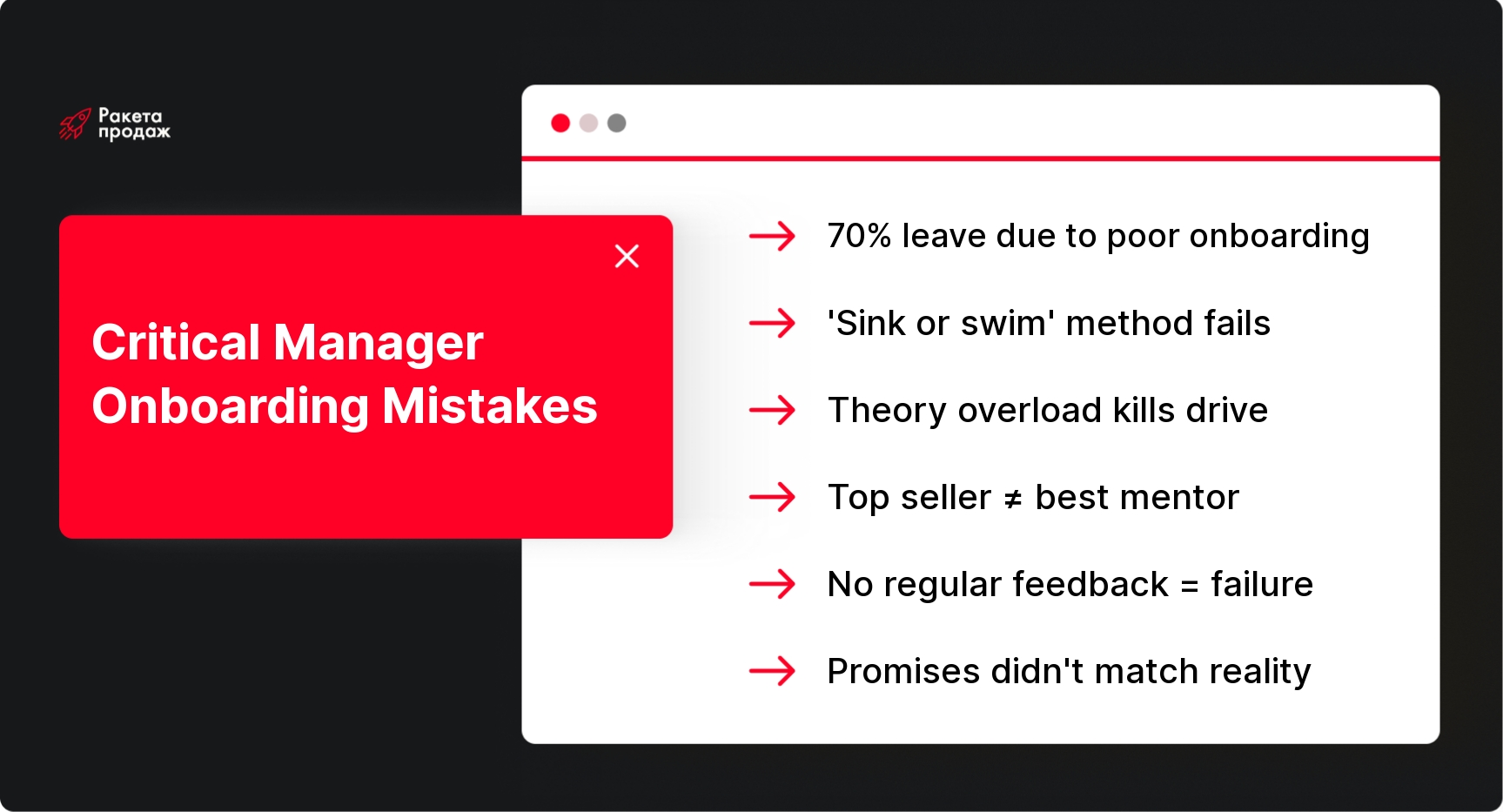
  • About 70% of new sales managers leave not because of job difficulty, but due to poorly structured onboarding, with each such mistake costing the company at least 3,000 euros.
  • The “sink or swim” method and the opposite extreme (weeks of reading regulations) are equally destructive; people remember 80% of what they do, but only 10% of what they read.
  • The best salesperson often becomes the worst mentor; their skills work automatically, they cannot explain the logic behind their actions, and they lose their own performance metrics while training newcomers.
  • The absence of weekly feedback forces newcomers to move in the wrong direction for months, only to learn about their failure during the final assessment.
  • The gap between promises made during interviews and reality (hot leads turn out to be cold, support is lacking) leads to 40% of new employees quitting within the first two weeks.

In the article below, you’ll find the exact signals of each of the nine critical adaptation mistakes, as well as specific steps to avoid them and retain talented managers. Read the full article 👇

We need to urgently figure out what typical mistakes managers make and how to avoid them. Let’s look at the most common sales manager mistakes that cost businesses not only money but also talented personnel.

image

Mistake #1: The "Sink or Swim" Method

This methodology from the old school of sales remains one of the most common. The scenario looks like this: on the first day, a new manager is given a phone, a contact database, and told: “Start calling!” No preliminary preparation, no scripts, no product training. At best, they get to sit next to an experienced employee for a couple of hours, and that’s considered sufficient.

The logic behind this approach is understandable: the manager believes they can immediately see which newcomers are truly “built” for sales. After all, a real salesperson will quickly orient themselves and start showing results (spoiler – they won’t). But in today’s reality, this method doesn’t work as expected. Instead of identifying potential stars, the company gets demoralized employees who either leave after the first week of work or start counting the days until the end of their probation period.

Why doesn’t this method work today? First, modern sales are much more complex than 10-15 years ago. Customers have become more informed and demanding. They easily recognize an unprepared manager and respond with rejection, sometimes even complaints to management. Second, young professionals have different expectations from the workplace. They are not ready to work in conditions of complete chaos and lack of support – this is perceived not as a challenge, but as disrespect and a sign of poor organization of processes in the company.

This extreme approach also creates a negative atmosphere in the team. Newcomers feel abandoned and isolated, which affects the overall company culture and the manager’s reputation. Now let’s look at what other extreme managers often resort to after realizing the ineffectiveness of the “sink or swim” method.

Mistake #2: "Information Coma" or Theory Overload

Having realized the ineffectiveness of the “throw them in the water” method, some managers rush to the other extreme – literally burying newcomers in theoretical information. The first work week turns into an endless marathon of reading regulations, watching training videos, and studying the product line. The newcomer sits in a separate office, immersed in dozens of documents, with the task of “studying everything from cover to cover.”

The manager thinks they’re doing everything right: the employee receives maximum information and will be fully prepared for work. But the reality turns out to be quite different. The human brain simply cannot absorb a huge amount of new information without practical application. By the end of the first week of such “training,” the employee remembers only a small part of the material, and often not the most important part for real work.

Psychologically, this method is also extremely ineffective. During the period of information immersion, the newcomer loses their initial enthusiasm and motivation. Instead of healthy excitement and a desire to start working, there is fear of not coping with the volume of information. When the time finally comes to make the first call to a client, the manager approaches it with great anxiety and “mush” in their head from fragments of read regulations.

Studies show that a person remembers only 10% of what they read, 20% of what they hear, but 80% of what they do in practice. Therefore, no matter how many documents a new manager studies, without real experience of communicating with clients, this information remains just theory that is quickly forgotten. To build a more effective process, it’s worth paying attention to modern approaches, such as coaching or training – how to choose – selecting a training format that will allow newcomers to apply their knowledge in practice as quickly as possible. Now let’s talk about why even the best salesperson can become the worst mentor for a newcomer.

Mistake #3: Appointing the Best Salesperson as a Mentor

It seems logical to appoint the most successful sales manager as a mentor for a newcomer. After all, they know all the secrets and tricks that help achieve high performance. However, this common practice often turns into a real failure for all parties involved.

The reason lies in a basic misunderstanding of the differences between the ability to sell and the ability to teach. A top sales manager usually has certain personal qualities: they are competitive, result-oriented, value their time, and are used to working independently. When such an employee is entrusted with training a newcomer, they experience an internal conflict. On one hand, they should help an inexperienced colleague; on the other hand, every minute spent on mentoring is a missed opportunity to make their own sales and receive bonuses.

Moreover, successful salespeople often cannot explain the logic behind their actions. Many of their skills are automatic, working at the level of intuition. When a newcomer asks why the mentor said a particular phrase to a client or why they chose a certain negotiation tactic, the “star” of the department often replies: “I just felt it was necessary” or “It comes with experience.” Such explanations don’t help the new employee build their own work system.

As a result of this mistake, all parties suffer: the newcomer doesn’t receive structured training, the mentor loses their performance indicators and gets irritated, and tension builds in the team. The new employee begins to feel like a burden, and the “star” mentor feels like a victim of management’s ill-considered decision. As a result, many promising candidates leave, and successful salespeople reduce their loyalty to the company.

One in three sales managers leaves the company in the first months of work, and with them go your investments in hiring, training, and missed sales. Not surprisingly, the cost of such turnover can reach 9 thousand dollars per employee. “Sales Rocket” has created a systematic approach to adapting managers that solves this problem. Our methodology includes a detailed adaptation plan, a ready-made sales book describing all processes, and a step-by-step training system under the supervision of experienced mentors. Thanks to this, new employees reach target indicators faster and stay with the company for a long time. Over 6+ years of work, we have successfully implemented this methodology in more than 158 sales departments in various industries, providing our clients with an average turnover increase of +35%.

Turn the adaptation of new managers from a problem into a competitive advantage - order a free consultation!

Now let’s look at another common manager trap – the confidence that all the basics are already clear to the new employee.

Mistake #4: The Illusion of Clarity

Many managers are so immersed in their business that they think obvious things actually require detailed explanation. “Our product is simple, it’s impossible to get confused,” “Our CRM system is intuitive,” “All sales stages are logical and don’t require explanation” – such assumptions often lead to serious problems in adapting new managers.

As a result of this illusion, the manager skips critically important moments in training. They don’t explain basic program settings, don’t discuss workflow nuances that are obvious to them, or the specifics of interaction with other departments. The new employee is afraid to appear incompetent by asking “elementary” questions and starts acting randomly, making mistake after mistake.

A typical example of such a situation is when a manager incorrectly fills in statuses in the CRM system or improperly prepares commercial proposals, not because they’re lazy or inattentive, but simply because no one explained how to do it correctly. The manager discovers the problem only when a critical volume of errors has accumulated and begins to accuse the employee of unprofessionalism, although the fault lies with the adaptation system.

Psychologically, this phenomenon is explained by the “curse of knowledge” – when a person who possesses certain information cannot imagine what it’s like not to possess it. It’s difficult for a manager to put themselves in the shoes of a newcomer who is seeing the company’s internal processes for the first time. What seems simple and logical after several years of work can be complex and confusing for a new person.

To avoid this trap, it’s worth involving not only experienced employees in creating the adaptation program but also those who joined the company relatively recently. They still remember what questions they had and what processes caused difficulties. You can learn more about modern approaches to building effective onboarding in the material about personnel adaptation in the sales department. Now let’s look at another important aspect of adaptation – setting the right goals for the probation period.

Mistake #5: Incorrect KPI Goals for the Probation Period

When it comes to goals for new sales managers, managers often fall into one of two extremes, and both are equally harmful to the successful adaptation of the employee.

The first extreme is setting too high, unrealistic sales plans from the first month of work. Some managers believe that a newcomer should immediately meet the same standards as experienced employees. The logic is simple: “We’re paying them a full salary, so they should provide full returns.” But in reality, this requirement becomes a powerful demotivator. When a new employee sees that the plan is fundamentally unachievable, they either lose faith in their abilities or start looking for workarounds, including manipulation of reports or even deceiving customers.

The second extreme is the complete absence of measurable goals during the adaptation period. “Just get comfortable, walk around, listen, then we’ll talk about plans” – this approach also demoralizes employees, but for a different reason. Without clear success criteria, newcomers don’t understand if they’re moving in the right direction or how well they’re handling their responsibilities. By the end of the probation period, this turns into an unpleasant surprise: the employee thought everything was going normally, but it turns out the manager is dissatisfied with their results.

The optimal approach is implementing a “ladder of plans,” where target indicators gradually increase from month to month. For example, in the first month, a new sales manager is given a plan of 30% of the standard, in the second – 50%, in the third – 70%, and only by the fourth month do they reach full load. This system allows for objective evaluation of an employee’s progress and gives them the opportunity to gradually gain momentum.

It’s also important that goals are diverse and include not only financial indicators (sales volume, average check) but also activity metrics (number of calls, meetings, commercial proposals), as well as qualitative parameters (product knowledge, presentation skills, handling objections). This provides a more complete picture of the employee’s development and allows identifying specific areas that need improvement.

Now let’s talk about a problem that often manifests after setting goals – the lack of regular feedback on the path to achieving them.

Mistake #6: Lack of Feedback

Perhaps one of the most demotivating situations for a new employee is working in an information vacuum, when the manager barely interacts with them throughout the probation period. Unfortunately, this scenario is very common: the manager hires a new sales manager, conducts an introductory briefing, and then disappears from their field of vision until the final certification.

Such behavior from the manager is usually explained by two reasons. The first is the banal workload of current affairs and the belief that newcomers should show independence. The second is the discomfort of giving negative feedback; many managers prefer to accumulate complaints to present them all at once at the end of the probation period.

The result is a dangerous situation: a new employee works for a whole month (or more) in the wrong direction, forms wrong habits, and makes repeated sales manager mistakes that could be easily corrected with timely intervention from the manager. And then, at the final assessment, they are surprised to learn that all this time they were doing “the wrong thing” and “the wrong way.”

The lack of regular feedback has serious consequences for employee motivation. Even if they try and achieve certain successes, without recognition from management, these successes seem insignificant. Over time, enthusiasm fades, and the manager starts working “from bell to bell,” without much involvement in the process.

The right approach involves conducting weekly one-to-one meetings with the new employee. At these meetings, the manager should not only discuss results and set tasks but also be interested in the difficulties the manager is facing, offer solutions to problems, and give constructive feedback – both positive and negative.

It’s critically important to follow the feedback rule: focus on the employee’s specific actions and the timeliness of the discussion, not emotions or personality. Instead of “you’re bad at handling objections,” it’s better to say: “I noticed that when a client objects to the price, you immediately offer a discount instead of emphasizing the value of our offer.”

Regular communication between the manager and the new employee creates an atmosphere of trust and support, which is critically important for successful adaptation. Now let’s discuss another important aspect of joining a company – social adaptation.

Mistake #7: Ignoring Social Adaptation

Many managers focus exclusively on the professional component of adaptation: product training, processes, sales techniques. In doing so, they overlook an equally important aspect – including the new employee in the company’s social environment. Yet sales is a team game, where success largely depends on interaction with colleagues, other departments, and management.

A special atmosphere of competition often forms in the sales department. Newcomers may be perceived as a threat, potential claimants to “warm” leads or major clients. Without the targeted intervention of the manager, this can lead to the social isolation of the new manager: they are not invited to informal meetings, information is reluctantly shared, their work may even be sabotaged.

The manager makes a serious mistake when not actively introducing the employee to the “pack.” This includes not only the official introduction of the newcomer to the team but also familiarizing them with the unwritten rules, team traditions, creating situations for informal communication and exchange of experience. Without this work, the new employee remains a “stranger” for a long time, which seriously hinders their professional realization.

Research shows that social discomfort is one of the main reasons for leaving even with good work results. People spend most of their time at work, and for most, it’s important to feel part of a team, to have good relationships with colleagues. If this doesn’t happen, even a successful sales manager may prefer to go to another company where the atmosphere will be more comfortable.

To solve this problem, various techniques can be used: appoint a “buddy” from among experienced employees who will help the newcomer feel at ease in an informal setting; organize team events with mandatory inclusion of new employees; create situations where newcomers can demonstrate their strengths and earn the respect of colleagues.

Special attention should be paid to issues of corporate atmosphere and team spirit, as sales department motivation and retention of valuable employees largely depend on this.

Social adaptation is an investment in the long-term effectiveness of the employee and the stability of the team as a whole. Now let’s move on to a mistake that can spoil even the most positive first impression of the company.

Mistake #8: Unprepared Workspace

It may seem like a small thing, but it can have a huge impact on a new employee’s perception of the company. Imagine: a person comes to their first day of work, full of enthusiasm and desire to prove themselves, but their workspace is not ready. There’s no computer, or it’s not set up, there’s no access to necessary programs, the phone doesn’t work, there’s no headset for calls – the list can be long.

Such domestic problems strongly affect motivation and first impressions of the company. Instead of immediately immersing themselves in work, the new manager is forced to go around departments, figuring out who can help with equipment setup, asking for passwords and access. They feel like a burden to colleagues and receive a clear signal: “This company is a mess, they weren’t expecting you here.”

This is especially destructive to the new employee’s perception of the entire adaptation process. If the company couldn’t prepare even the basic conditions for work, what about more complex things – training, mentoring, support? Not surprisingly, many managers start thinking about the correctness of their choice on the first day.

Technical unpreparedness also affects the effectiveness of training. The new employee cannot immediately apply the knowledge gained in practice, which reduces the assimilation of material. And the time spent solving technical problems could have been used to get acquainted with the product or processes.

Solving this problem requires preliminary planning and coordination between departments. The sales department manager should prepare a checklist of everything necessary for the new manager’s work in advance and check its readiness at least a day before the employee starts. The IT department should prepare a computer with the necessary software, the HR department – all documents and access to internal resources, and the immediate supervisor – ensure the availability of all work materials, from business cards to headsets.

A prepared workspace is a sign of respect for the new employee and an indicator of the company’s organization. Now let’s look at another common mistake that can quickly destroy trust between the company and the new manager.

Mistake #9: Gap Between Interview Promises and Reality

This scenario is painfully familiar to many sales managers: at the interview, the HR manager paints a rosy picture of working for the company – a “hot” client base, excellent motivation system, management support, career growth prospects. But when the employee starts work, reality turns out to be quite different – cold contacts, a complex system of penalties, lack of promised support, and no prospects.

Such a gap between expectations and reality leads to quick disappointment and loss of trust in management. The employee feels deceived, and this is one of the strongest negative feelings in the professional sphere. Statistics show that with a significant mismatch between reality and expectations, about 40% of new employees decide to quit within the first two weeks of work.

The problem often lies in the communication gap between the HR department and department heads. HR strives to attract the best candidates and often embellishes working conditions, while department heads then cannot or do not want to fulfill the promises made. As a result, everyone suffers: the company loses money and time on hiring a new employee, the manager is forced to look for a candidate again, and the sales manager gets a negative experience that can affect their further career.

To avoid this problem, transparency and honesty must be ensured at all stages of hiring. HR managers should provide realistic information about the job, including not only the pros but also potential difficulties. Recruiters should coordinate the job description with department heads to avoid making promises that cannot be fulfilled. And managers should be ready to discuss real working conditions with candidates at the interview stage.

By the way, if you are concerned about constant employee turnover and the associated costs, be sure to check out the practical case study on how to overcome turnover in the sales department and stabilize the team.

Honesty in the early stages of interaction with a potential employee is an investment in long-term relationships and team stability. Now let’s summarize the financial outcomes and see how much improper onboarding costs companies.

It’s important to note that manager mistakes in communicating with subordinates can seriously exacerbate adaptation problems. When a manager doesn’t know how to properly give feedback or demonstrates an authoritarian management style, it negatively affects the motivation of all employees, especially newcomers. Additionally, manager mistakes in delegating authority often lead to new sales managers not understanding the boundaries of their responsibility, creating additional difficulties during the adaptation period.

Sales department manager mistakes are especially destructive in the context of adapting new employees. When the sales manager doesn’t build a clear training system or doesn’t control this process, newcomers are left to their own devices. Employee adaptation mistakes in this case occur not because of the employee’s inability to learn, but due to systemic miscalculations in organizing the process of entering the position.

Manager mistakes when adapting new sales managers show how important it is to take a systematic approach to this process. It’s necessary to develop a clear program that will include both professional training and social adaptation, ensuring a gradual and comfortable entry into the position.

The Mathematics of Losses: How Much "Bad" Onboarding Costs

Let’s calculate the real financial losses from a sales manager leaving after 2 months of work. This calculation will help understand why quality adaptation is not just a “nice bonus” but a necessary business solution.

Let’s start with direct costs:

  1. Salary for 2 months: on average 700 dollars × 2 = 1400 dollars
  2. Taxes and insurance premiums: approximately 20% of salary = 280 dollars
  3. Hiring costs (job advertisements, recruiter services, time for interviews): minimum 500 dollars
  4. Administrative expenses (document processing, workspace setup, IT support): about 80 dollars

Now let’s add indirect losses:

  1. Cost of “wasted” leads that were given to an inexperienced manager and didn’t convert to sales: with an average lead acquisition cost of 25 dollars and 30 leads per month – about 750 dollars
  2. Lost profits: if an experienced manager brings the company 5,000 dollars in profit per month, then during the replacement search period (minimum 1 month) the company loses another 5,000 dollars
  3. Cost of the manager’s time for repeated search and adaptation: with a sales manager salary of 1,500 dollars and spending 30% of working time per month – that’s another 450 dollars
  4. Decreased team motivation due to constant turnover: difficult to evaluate in money, but it can lead to a 5-10% drop in sales for the entire team

Total: minimum losses from dismissing one sales manager after 2 months of work amount to about 8460 dollars. And this is a conservative estimate!

Now let’s compare this amount with investments in a quality adaptation program:

  1. Development of a structured adaptation plan: 1500 (one-time investment)
  2. Mentor’s time: 20% of an experienced employee’s working time for a month = 200 dollars
  3. Training materials: 50 dollars
  4. Regular meetings between the manager and the new employee: 300 dollars

Total: investments in a quality adaptation program amount to about 2050 dollars per employee. And from the second month even less after deducting the one-time project for developing an adaptation plan, that is, 450 dollars

The difference is obvious: 8460 dollars in losses versus 450 dollars in investment. Even if quality adaptation reduces the turnover of new employees by only 50% (and in practice this figure can be much higher), the savings will be colossal. Moreover, a well-adapted employee reaches target sales indicators faster, which brings additional profit.

These figures clearly show that quality onboarding is not just an HR function, but a strategic investment that directly affects the financial results of the business.

If you want to understand how effectively the process is built in your department, try to evaluate the effectiveness of the sales department manager using expert approaches.

Conclusion

The analysis of typical mistakes in adapting new sales managers reveals one important truth: most reasons for newcomers leaving lie not in the realm of personnel selection, but in the sphere of management decisions. Even the most talented and motivated sales manager will be demotivated by the “sink or swim” method, information overload, lack of support and feedback, unrealistic plans, and social isolation.

A quality adaptation system is not a luxury but a necessity in modern business. As the financial calculation shows, investments in good onboarding pay off many times over by reducing staff turnover, helping employees reach target indicators faster, and forming a strong team culture. Ultimately, the choice is obvious: you can continue to spend hundreds of thousands of dollars on constant staff rotation or invest in creating a system that will allow you to retain and develop talent. A wise manager will always choose the second path.

Common sales manager mistakes are often the result of an improperly built adaptation system. When a manager doesn’t pay proper attention to training newcomers, they begin to make typical mistakes in communicating with clients and handling objections, which directly affects the productivity of the entire department.

Properly organized adaptation of sales managers is not just an HR function, but a strategic investment that directly affects your income. However, developing an effective onboarding system requires time, expertise, and a deep understanding of sales psychology. “Sales Rocket” offers a ready solution: a comprehensive approach to building an adaptation system, including the development of a step-by-step adaptation plan, creating a sales book and training materials, implementing effective scripts and instructions, and constant monitoring of results. Our experts will audit current processes, identify weaknesses, and implement a proven methodology that has already helped 158 companies in 14+ niches. The result? Reducing the adaptation period, increasing the efficiency of new employees, and increasing the company’s overall turnover by an average of 35%. Among our clients are companies such as Mitsubishi, Yamaha, Naftogaz – businesses that take their sales seriously.

Create a sales department where every new employee is guaranteed to reach planned indicators within 60 days!
In this article:
See more
Book a FREE sales funnel audit
CONTACT US
FAQ
When should you fire a newcomer if adaptation isn't going well?

The decision to fire a newcomer should only be made after a full analysis of the reasons for unsuccessful adaptation. The critical point usually occurs after 60-90 days of work when progress can be objectively assessed. Before firing an employee, make sure you’ve provided them with clear goals, regular feedback, and necessary support. If after all corrective measures there is no progress, then the decision to terminate employment will be justified.

What to do if experienced managers ignore or oppress newcomers?

This is a corporate culture problem requiring active intervention from the manager. Start with individual conversations with experienced managers, explaining the importance of teamwork and mentoring. Implement a system of incentives for helping newcomers. Conduct team events to strengthen bonds between employees. In extreme cases, with obvious sabotage, apply administrative measures – a successful company cannot afford a toxic atmosphere in the team.

Is it possible to adapt a manager without a mentor at all?

Technically it’s possible, but significantly reduces the effectiveness of adaptation. Alternatives to traditional mentoring can be: detailed written instructions and regulations; video courses with examples of real situations; regular meetings with the manager; rotation between different experienced employees; creating a training group of several newcomers. However, the lack of personal support increases the risk of disappointment and departure of new employees.

How do you know if you've overloaded a newcomer with information?

The main signs of information overload: the employee stops asking questions; during oral questioning cannot reproduce key information; looks confused or depressed; makes simple mistakes in already studied processes; avoids independent decisions; shows signs of stress and anxiety. If you notice these symptoms, take a break in training, focus on consolidating already acquired knowledge through practice, and only then move on to new material.

SUBSCRIBE TO MY TELEGRAM CHANNEL
The most valuable sales information right on your phone!
icon

LOTS OF USEFUL INFORMATION, FREE TEMPLATES, AND CHECKLISTS ON MY INSTAGRAM

Materials and practical advice on sales growth in our blog: