icon

Sales Manager Hiring Plan: 7 Steps to a Stable Team

When you ask business owners about the main problems in their sales department, many immediately recall unexpected resignations, long vacancy closures, and downtime that lead to failed sales plans. You build ambitious plans, but the sudden departure of a key manager can undermine all efforts, and finding a replacement takes weeks or even months.

Key Takeaways

  • A vacant sales position costs you $500-1000 in lost profit per month.
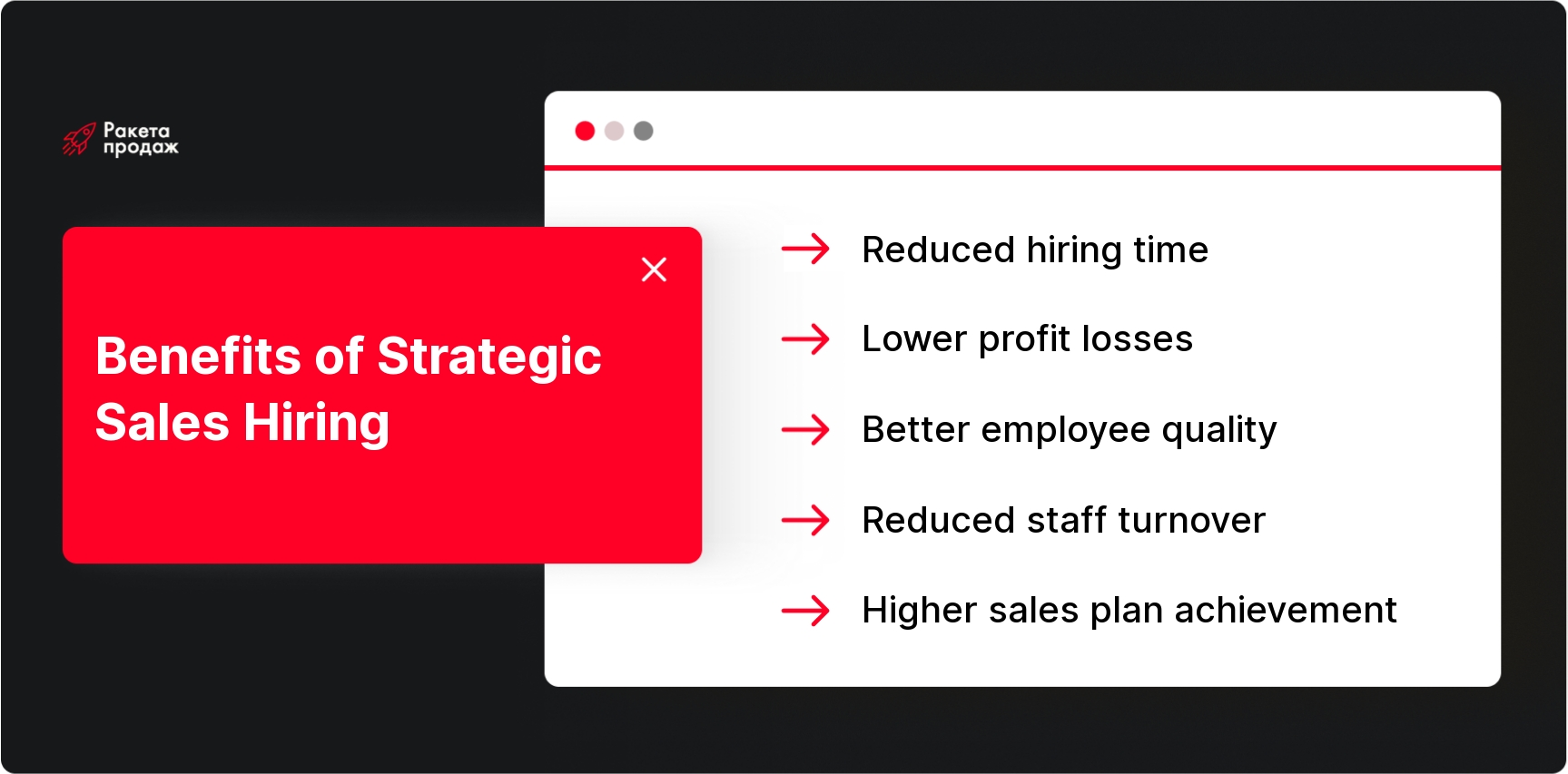
  • Planned recruitment reduces vacancy closing time from 30-45 days to 7-14 days through a pre-prepared reserve of vetted candidates.
  • Managers hired through a planned recruitment system achieve target indicators 30-40% faster than employees hired in haste.
  • The talent pool requires constant attention: update contacts quarterly, conduct follow-up interviews, invite promising candidates to corporate events.
  • Companies with planned recruitment are 15-20% more likely to achieve annual sales plans and reduce turnover from 25-30% to 10-15%.

In the article below, you’ll find specific tools for forecasting sales personnel needs, a step-by-step algorithm for forming a reserve, and metrics for monitoring the effectiveness of your hiring system 👇

The cause of this situation often lies in a reactive approach to hiring – when we start looking for people only after a “burning” vacancy appears. Such a chaotic approach is like firefighting: you spend time and resources on urgent searches while the department loses revenue.

The alternative is a sales manager hiring plan as a strategic approach to team formation, which involves creating a talent pool in advance, even before an urgent need arises. This is precisely the approach and its benefits for your business that we’ll discuss in this article. You’ll learn why reactive hiring destroys sales, how to forecast sales personnel needs, and what tools will help build an effective recruitment plan in your company.

Why Reactive Hiring Destroys Sales

Imagine the situation: your leading sales manager suddenly announces they’re leaving for a competitor. This usually causes panic – after all, key clients and projects depend on this employee. You urgently post a vacancy, but quality candidates don’t appear instantly. And your clients aren’t willing to wait until you find a replacement.

Reactive hiring is an approach where a company begins searching for employees only after a vacancy arises. While it seems logical (why look for people when there are no open positions?), in practice, this approach leads to serious business losses.

First, there are direct financial losses. Research shows that a vacant sales manager position costs a company an average of $500-1000 in lost profits per month. If filling the vacancy takes 1-2 months (which is typical for the current market), losses can amount to $3,000-30,000. And these are just direct losses from unreceived revenue, without considering the costs of urgent recruitment and decreased motivation of the remaining team.

Second, the absence of a talent pool leads to disruptions throughout the department. The remaining managers are forced to take on additional workloads, which leads to burnout and, consequently, even higher turnover. A snowball effect occurs: one resignation leads to others, and the situation becomes critical.

With reactive hiring, the quality of recruitment also suffers. When time is limited, you have to sacrifice thoroughness in candidate assessment. As a result, you often hire not the best but simply the available candidate who may not meet your requirements. Such employees rarely show good results and often leave within the first 3-6 months, starting a new cycle of reactive hiring.

Companies become especially vulnerable to reactive hiring during seasonal sales peaks or when launching new products. At these times, the need for strong managers is at its highest, but the labor market cannot instantly provide ready specialists. As a result, you miss growth opportunities during the most favorable periods.

A typical mistake many companies make is the illusion of savings: it seems that the absence of constant recruitment costs is good. But in practice, urgent hiring costs 2-3 times more than planned hiring, not to mention the indirect losses from vacancy downtime. Now, let’s understand what planned recruitment is and why it’s vital for a sales department.

What is Planned Recruitment and Why It's Critical for the Sales Department

image

Planned recruitment is a systematic approach to providing a company with personnel, where the search and evaluation of candidates are conducted continuously, not just when a vacancy arises. Essentially, it’s a transition from “firefighting” to prevention – you don’t wait for thunder to strike, but prepare your personnel infrastructure in advance for future growth and possible changes.

In the context of a sales department, planned recruitment is especially important since salespeople are employees who directly affect company revenue. Each day a vacancy remains open means direct financial losses. Additionally, sales managers typically have higher turnover compared to other departments, making a planned approach to hiring not just desirable but necessary.

A key feature of planned recruitment is that it’s closely tied to the company’s business indicators. You don’t just react to resignations, but forecast how many managers you’ll need to achieve planned indicators in 3, 6, or 12 months. This approach allows you to synchronize your personnel strategy with business goals – you know in advance how many salespeople you’ll need to meet an ambitious sales plan for the next quarter.

An important element of recruitment planning for continuously forming a sales team is maintaining a “bench,” that is, a database of potential candidates with whom you maintain contact. When a vacancy arises, you don’t start the search from scratch but reach out to already assessed candidates ready to start work. This radically reduces the time to fill a position.

Practice shows that companies that have implemented planned recruitment reduce vacancy closing time from 30-45 days to 7-14 days. This not only reduces direct losses from downtime but also makes the business more flexible – you can quickly scale your team with increased demand or when launching new directions.

Another important advantage of planned recruitment is the ability to reduce dependence on market conditions. When you urgently need a salesperson, you’re forced to accept market conditions, which often means inflated salary expectations from candidates and ill-considered hiring decisions. With a planned approach, you have time for careful selection and negotiation, which allows you to form a more balanced team. Let’s now look at how to forecast sales manager needs.

How to Forecast Sales Manager Needs

Accurate forecasting of sales personnel needs is the cornerstone of planned recruitment. Without understanding how many managers you’ll need and when, it’s impossible to build an effective hiring strategy. Fortunately, there are proven methodologies that help make such forecasts as accurate as possible.

You should start with analyzing the current workload on managers. Determine the optimal number of clients, leads, calls, and meetings that one salesperson can process effectively. Exceeding these indicators usually leads to decreased efficiency and burnout. It’s important to consider your business specifics: in some industries, a manager can handle 120-300 clients, in others – no more than 5-7.

Familiar with the situation when an unexpected resignation of a key manager threatens your sales plan? Statistics show that a vacant sales position costs a company $500-1,000 in lost profits. But it’s not just about money – client relationships suffer, remaining employees become overloaded, and the quality of hasty recruitment drops sharply.

“Rocket Sales” helps companies build a systematic approach to forming and developing sales departments. Instead of chaotic “firefighting,” we implement a predictable model where personnel selection, adaptation, and motivation become part of a unified system. Our experts develop detailed profiles of ideal employees, create sales books and adaptation programs that allow new managers to reach target indicators faster.

Over 6+ years, we’ve built more than 150 sales departments in 14+ business niches, and our clients’ average turnover increase is +35%. We don’t just consult but build processes with you – from funnel analysis to implementing effective scripts and quality control systems.

Transform chaotic hiring into a systematic process and forget about failed sales plans - order a free sales department audit!

Be sure to consider your business seasonality when planning recruitment. If you have clearly defined peak periods (such as the pre-holiday season in retail or summer season in construction), you should plan hiring 2-3 months before the season begins. This gives new employees time for adaptation and training so they can work at full capacity by the peak period.

The flow of incoming leads is another critical factor in forecasting sales personnel needs. If your marketing plans to increase lead generation by 30%, you’ll likely need a corresponding increase in sales staff. Otherwise, lead processing quality will drop, leading to decreased conversion and lost potential revenue.

Also, don’t forget about strategic company growth plans. If you’re planning to enter new markets, launch new products, or increase market share, this directly affects the required number of managers. A good approach is to develop several development scenarios (conservative, baseline, and optimistic) and calculate the necessary number of salespeople for each.

It’s also important to analyze historical turnover in the sales department. If about 20% of your managers resign annually, this means that for a team of 10 people, you need to hire at least 2 new employees just to maintain current numbers, not to mention growth. By tracking these trends, you can predict approximately when you’ll need new people.

Many companies implement a system of regular sales funnel monitoring to notice team overload in time. If lead processing time increases and conversion drops – this may signal that the team is already working at its limit and reinforcement is needed. All these factors will help you accurately predict when and how many new managers you’ll need. Now it’s time to talk about how to form a talent pool.

Candidate Pool: Why Form a "Bench"

A talent pool or “bench” is a pool of potential candidates with whom you maintain relationships and can bring in when a vacancy arises. It’s your insurance against sales downtime and guarantee that business processes won’t stop due to personnel problems.

The main advantage of having a talent pool is the radical reduction in time to fill a vacancy. Instead of the standard 30-45 days, you can fill a position in 7-14 days, and in some cases – even faster. This not only reduces direct losses from vacancy downtime but also allows you to maintain continuity in working with clients, which is critical for the company’s reputation.

A talent pool also significantly improves recruitment quality. When you don’t have an urgent need to fill a position, you can afford a more thorough evaluation of candidates. You choose not just a suitable person, but the best available. This directly affects the future effectiveness of your sales department.

Creating a candidate pool should become part of the regular work of the HR department and sales managers. Sources for replenishing the reserve can be various: candidates who were suitable for previous vacancies but weren’t selected for some reason; competitors’ employees with whom you maintain professional relationships; and recommendations from your current team.

An important point: a talent pool requires constant attention and updating. You can’t just create a candidate database and forget about it until a vacancy arises. People change jobs, their situations and priorities change. Good practice is to maintain regular contact with key candidates from your reserve, invite them to corporate events, share company news and sales team successes.

Many companies create special “brand ambassador” or “company friends” programs that include promising candidates. This allows you to maintain interest in your company and form a positive attitude towards it among potential employees. And when a vacancy arises, such candidates are already familiar with your culture and values, which accelerates their integration into the team.

Keep in mind that forming a sales team and maintaining a talent pool requires resources and a systematic approach. It’s not just a table of contacts, but an entire system of working with potential employees. But investments in creating such a system pay off significantly through sales stability and the ability to flexibly respond to market changes. Now let’s look at how planned recruitment affects sales team quality.

Planned Recruitment as a Quality Factor: Why Such Managers Are Stronger

The quality of a sales team directly affects a company’s financial results. And here planned recruitment gives a huge advantage – the opportunity to attract not just suitable, but truly strong managers capable of taking sales to a new level.

When you have time for careful selection, you can conduct a deeper assessment of candidates’ skills. Instead of one or two standard interviews, you can use a comprehensive approach: test assignments, role-playing games, team meetings, detailed analysis of previous sales cases. Such multi-stage evaluation allows you to identify not only professional skills but also personal qualities, the candidate’s values, and their compatibility with corporate culture.

Planned recruitment provides an opportunity to attract so-called “passive candidates” – successful professionals who are not actively job hunting but might be interested in your offer. Such specialists rarely respond to urgent vacancies; they need time to decide about changing jobs. With planned recruitment, you have this time, which expands the pool of available talent.

Another important advantage is the possibility of quality adaptation for new employees. With reactive hiring, newcomers are often immediately “thrown into battle,” expecting immediate results. This creates stress and increases the probability of errors. Planned recruitment allows you to allocate sufficient time for training and adaptation, which significantly increases the chances of a new manager’s success.

The topic of employee adaptation is especially important for reducing turnover and increasing effectiveness – you can learn more about best practices in the material on personnel adaptation in the sales department.

Interestingly, managers who come through a planned recruitment system typically demonstrate higher loyalty to the company. They feel they were chosen consciously, not out of “desperation,” which positively affects their motivation and engagement. Such employees are less likely to leave in the first months of work and more often achieve high results.

Planned recruitment also allows you to form a balanced team with different types of managers. Ideally, a sales department should have both aggressive “hunters” for new clients and thoughtful “farmers” capable of developing long-term relationships with existing customers. With reactive hiring, you take whoever is available, while with planned hiring, you can purposefully look for people with the right profile to complement the team.

Companies practicing planned recruitment note that new managers achieve target indicators 30-40% faster compared to those who came through reactive hiring. This is a direct result of better selection and adaptation. Now let’s look at how to build a planned recruitment system in a company.

How to Build a Planned Recruitment System in a Company

Building an effective planned recruitment system is a process requiring a systematic approach and coordination between different company departments. But the result is worth the effort: you get a reliable mechanism for providing the business with qualified salespeople exactly when needed.

The first step is synchronizing the hiring strategy with the company’s business goals. You need to clearly define what commercial tasks the organization faces for the coming year and more distant perspective. Are you planning geographical expansion, launching new products, increasing market share? All these factors directly affect the number and profile of required sales managers.

Based on the business strategy, develop annual and quarterly recruitment plans. These documents should indicate specific figures: how many managers you need to hire in each period, what competencies are critical for them, what the budget is for attracting and adapting them. It’s important that the recruitment plan is realistic and considers possible staff turnover, business seasonality, and timeframes for managers to reach target indicators.

The next step is organizing constant candidate sourcing. This means that the search and primary evaluation of potential employees are continuous, not just when vacancies open. Create a system for monitoring the labor market, track interesting specialists, maintain contacts with candidates from previous recruitments, use referral programs with your current employees.

It’s also important to implement effective candidate assessment tools. Develop standardized interviews, cases, and tests that will objectively evaluate key competencies of salespeople. This is especially important when different people conduct the assessment – having clear criteria ensures a unified approach and reduces subjectivity.

To systematically and without errors approach employee evaluation, we recommend studying modern methodologies for assessing sales manager effectiveness.

Don’t forget about automating recruitment processes. Modern ATS systems (Applicant Tracking Systems) allow you to effectively manage candidate flow, automate routine tasks, save interaction history, and generate analytical reports. This significantly reduces the workload on HR specialists and sales managers.

Be sure to establish a process for regular talent pool revision. Once a quarter, review the database of potential candidates, update information about them, conduct repeated interviews with the most promising ones. This will help maintain the relevance of your “bench.”

Finally, create a metrics system to evaluate the effectiveness of planned recruitment. Track indicators such as average time to fill a vacancy, cost of hiring one manager, percentage of successful probation completion, time for new employees to reach target indicators, turnover in the first 6-12 months. Analyzing this data will help continuously improve your recruitment system. Now let’s look at how planned recruitment affects turnover and sales department stability.

How Planned Recruitment Reduces Turnover and Increases Department Stability

High staff turnover is a real plague for many sales departments. Constant manager changes not only lead to direct financial losses but also negatively affect client relationships, corporate culture, and team morale. A salesperson recruitment plan becomes an effective tool for reducing turnover and creating a stable, high-performing team.

One of the main causes of high turnover is improper personnel selection when a person doesn’t match the position or corporate culture. With reactive hiring, when decisions are made under time pressure, the risk of such mismatch increases substantially. Planned recruitment, on the contrary, provides an opportunity to carefully evaluate candidates and select those who will truly fit into the team and succeed in your company.

Another turnover factor is insufficient adaptation of new employees. When a manager is hired in haste and immediately expected to produce results, without allocating time for training and team integration, this creates stress and often leads to early resignation. Planned recruitment allows you to build systematic adaptation, where newcomers gradually immerse themselves in the product, processes, and company culture, which significantly increases their chances of success.

Overloading the existing team due to manager shortages is another common cause of turnover. When salespeople are forced to work double duty due to vacant positions, this leads to burnout and decreased motivation. Planned recruitment ensures timely filling of vacancies, maintaining optimal workload on the team and preventing burnout syndrome.

Also, pay attention to mechanisms of personnel rotation in the sales department, which can be not only a problem but also a source of growth with the right systematic approach.

Interestingly, planned recruitment also increases the loyalty of existing employees. When people see that the company takes team formation seriously, invests resources in finding the best candidates, and creates comfortable conditions for newcomers, it strengthens their trust in the organization and desire to tie their future to it.

Sales team formation has other important advantages. It allows building long-term relationships with clients, which is especially important in the B2B segment. It contributes to the accumulation and transfer of experience within the team, the formation of a strong corporate culture, and the development of healthy competition between salespeople.

Companies that have implemented planned recruitment systems often note a reduction in annual turnover in sales departments from 25-30% to 10-15%. This not only saves resources on selecting and adapting new employees but also makes the department’s results more predictable and stable. Now let’s look at how planned recruitment affects the achievement of commercial goals.

How Planned Recruitment Affects Commercial Goal Achievement

Achieving ambitious commercial goals is impossible without a strong and stable team of salespeople. And here planned recruitment plays a decisive role, providing the business with necessary personnel resources exactly at the right time and in the right volume.

One of the key advantages of planned recruitment is the ability to prepare the team in advance for achieving target indicators. You know that to fulfill the annual plan, you’ll need, say, 15 managers instead of the current 10. With a planned approach, you begin recruiting and adapting new employees in advance so that by the start of the new financial year, the team is already staffed and ready to work.

Planned recruitment also allows avoiding “slumps” in sales during seasonal demand peaks. Many businesses have pronounced seasonality – for example, in retail it’s the pre-holiday period, in construction – the summer season. Knowing about the approaching peak season, you can strengthen the team in advance, avoiding a situation where managers physically can’t handle the order flow.

For a complete understanding of how to properly build an approach to specialist selection, we recommend familiarizing yourself with a practical case study of planned manager recruitment and tips for selecting the best candidates.

An important aspect is sales funnel management. When you have enough managers, each can devote more attention to each lead, which increases conversion at all funnel stages. With a shortage of salespeople, they are forced to “spread themselves thin” among many tasks, which inevitably reduces work quality and conversion. Planned recruitment ensures an optimal ratio between the number of leads and managers.

Another important point is reducing dependence on individual “star” salespeople. In many companies, a disproportionately large share of revenue is generated by 1-2 key managers. This creates serious risks – if such an employee leaves, the company can lose a significant portion of sales. Planned recruitment allows forming a more balanced team where the workload and results are distributed more evenly.

Interestingly, companies practicing planned recruitment often note improvement not only in quantitative but also qualitative sales indicators. When managers aren’t overloaded and have enough time to work with each client, the average check increases, purchase repeatability increases, and customer satisfaction indicators improve. All this directly affects the business’s long-term profitability.

Research shows that companies with planned recruitment systems are on average 15-20% more likely to achieve annual sales plans compared to companies using a reactive approach. This is a direct result of having the necessary number of prepared managers ready to work effectively with clients at the right moment. Now let’s look at tools for long-term personnel planning.

Tools for Long-Term Personnel Planning

An effective planned recruitment system requires not only the right approach but also appropriate tools. Modern technologies and methodologies significantly simplify the personnel planning process, making it more accurate and less labor-intensive.

Workload forecasting is one of the basic tools. Create a model that considers the number of leads, average time to process one lead, conversion at different funnel stages, and revenue targets. Based on this data, you can calculate the optimal number of managers for your sales department. Regularly update this model, considering changes in business processes and market situations.

CRM analytics becomes an indispensable helper in personnel planning. Modern CRM systems allow tracking manager productivity, analyzing bottlenecks in the sales funnel, and forecasting future revenue. Use this data to assess the current team effectiveness and plan future personnel needs.

Competency maps are another useful tool. Create a detailed description of knowledge, skills, and personal qualities necessary for successful work as a sales manager in your company. This will help structure the candidate assessment process and ensure a unified approach to hiring from all process participants.

Candidate pipeline is essentially your recruitment funnel. Similar to a sales funnel, it reflects the movement of candidates through various selection stages: from initial contact to job offer. Use specialized ATS systems or even simple tables to track the status of each candidate and plan next steps.

Regular talent pool revisions are critically important for maintaining its relevance. Allocate time (for example, once a quarter) to update information about candidates in your reserve, conduct repeated interviews with the most promising ones, and replenish the reserve with new contacts.

Sourcing automation significantly reduces the labor costs of candidate search. Use specialized platforms that automatically scan professional networks and job search sites, identifying potential candidates according to specified criteria. This will allow you to constantly replenish your talent pool without significant time investment.

Many companies also implement tools for succession planning – identifying potential internal candidates for key positions. Even if you currently don’t have internal candidates for the role of sales manager, regular assessment and development of promising managers can solve this problem in the future.

Don’t forget about traditional tools – such as employee satisfaction surveys, regular one-on-one meetings between managers and each salesperson, exit interviews with departing employees. These methods provide valuable information about team problems that can lead to resignations and help take timely measures. Now let’s look at how a leader can control the planned recruitment system.

How a Leader Can Control the Planned Recruitment System

Even the most well-thought-out planned recruitment system won’t work effectively without proper control from management. How can a leader ensure that the process is going according to plan and bringing expected results?

First of all, it’s necessary to define key metrics by which the recruitment system’s effectiveness will be evaluated. These metrics include: average time to fill a vacancy, cost of hiring one employee, percentage of successful probation completion, speed of new managers reaching target indicators, staff turnover in the first 6-12 months. Regularly track these indicators and compare them with target values.

It’s important to establish a clear distribution of roles between the HR department and the sales manager. HR usually handles candidate sourcing, organizing interviews, and process administration, while the sales manager determines candidate requirements, makes final hiring decisions, and is responsible for integrating new employees into the team. This role distribution should be clearly recorded and understood by both parties.

Regular meetings on personnel planning are a mandatory control element. Once a month, the sales manager should meet with HR specialists to discuss the current hiring status, progress on open vacancies, update the personnel needs forecast, and adjust the search strategy. Such meetings allow timely identification of problems and prompt course correction.

An effective leader should also personally participate in the final stages of candidate selection, even if HR handles most of the process. This not only improves hiring quality but also gives the leader direct understanding of what candidates are available in the market, what their expectations and motivations are. Such immersion in the process helps adjust candidate requirements and makes forecasts more realistic.

Control of new employee adaptation is equally important. The leader should regularly receive information about how newcomers are entering their position, what difficulties they face, how quickly they achieve target indicators. This allows timely adjustment of the adaptation program and providing additional support where needed.

Many successful leaders also practice regular talent pool audits. Once a quarter, they review the list of potential candidates, assess their relevance and potential, give feedback to the HR department regarding the quality of selected candidates. This helps maintain high quality of the talent pool and adjust search criteria.

Finally, the leader should regularly analyze the connection between hiring effectiveness and the department’s business indicators. If new employees quickly achieve target indicators, turnover is low, and the department consistently meets commercial goals – then the system is working effectively. If there are problems with achieving business goals, high turnover, or low effectiveness of new employees – it’s necessary to review the approach to hiring. By connecting HR metrics with business results, the leader ensures the strategic direction of the recruitment process.

Conclusion

Planned recruitment is not just one of the HR functions, but a strategic tool directly affecting the company’s commercial success. In today’s competitive world, where talented salespeople are scarce and the cost of hiring mistakes is high, a reactive approach to team formation inevitably leads to loss of time, money, and market opportunities.

Implementing a planned recruitment system requires initial resource investments and changing habitual approaches to work. But these efforts pay off many times over through reduced time to fill vacancies, improved quality of hired employees, reduced turnover, and, consequently, more stable and predictable sales results.

As you can see, planned recruitment is not just an HR department function, but a tool directly affecting your business growth. But building such a system without expert support is often difficult, especially when you’re already immersed in “firefighting.”

“Rocket Sales” offers a comprehensive solution for creating a systematic sales department, where planned recruitment and personnel adaptation become part of the overall structure. We develop detailed sales books, adaptation programs, training materials, and motivation systems for clients, which make the process of hiring and developing managers more effective and predictable.

Our approach is based on deep analytics and considers your business specifics – we don’t offer template solutions, but create a unique model that works specifically in your niche. Among our clients are companies like Mitsubishi, Yamaha, Naftogaz, and other market leaders whom we’ve helped to increase sales effectiveness and build stably working teams.

Thanks to our methodology, “Rocket Sales” clients achieve conversion growth from 5% to 86%, and the best result is a monthly turnover increase of $1.6 million in just 4 months of cooperation.

Create a sales department where hiring, training, and results form a unified system - sign up for a free consultation!

As you can see, planned recruitment is not just an HR department function, but a tool directly affecting your business growth. But building such a system without expert support is often difficult, especially when you’re already immersed in “firefighting.”

“Rocket Sales” offers a comprehensive solution for creating a systematic sales department, where planned recruitment and personnel adaptation become part of the overall structure. We develop detailed sales books, adaptation programs, training materials, and motivation systems for clients, which make the process of hiring and developing managers more effective and predictable.

Our approach is based on deep analytics and considers your business specifics – we don’t offer template solutions, but create a unique model that works specifically in your niche. Among our clients are companies like Mitsubishi, Yamaha, Naftogaz, and other market leaders whom we’ve helped to increase sales effectiveness and build stably working teams.

Thanks to our methodology, “Rocket Sales” clients achieve conversion growth from 5% to 86%, and the best result is a monthly turnover increase of $1.6 million in just 4 months of cooperation.

Create a sales department where hiring, training, and results form a unified system – sign up for a free consultation!

In this article:
See more
Book a FREE sales funnel audit
CONTACT US
FAQ
What does planned recruitment provide and why do companies need it?

Planned recruitment allows significantly reducing the time to fill vacancies (from 30-45 to 7-14 days), improving the quality of hired employees, reducing staff turnover, and ensuring business results stability. Companies need this to minimize losses from vacancy downtime, ensure uninterrupted work with clients, and be able to flexibly respond to market changes.

How does personnel planning help stabilize sales?

Personnel planning ensures having the right number of salespeople at the right time, which prevents “slumps” in sales due to personnel shortages. It also allows preparing the team in advance for seasonal peaks, new product launches, and entering new markets, ensuring stability and predictability of commercial results.

How to form a talent pool in the sales department?

Forming a talent pool includes constant monitoring of the labor market, working with “passive” candidates, maintaining contacts with applicants from previous recruitments, using recommendations from current employees. It’s important to regularly update information about candidates, maintain communication with them, and periodically assess their compliance with company requirements.

How to evaluate the effectiveness of a personnel recruitment strategy?

Recruitment strategy effectiveness is evaluated by metrics such as average time to fill a vacancy, cost of hiring one employee, percentage of successful probation completion, speed of newcomers reaching target indicators, turnover in the first 6-12 months. It’s also important to evaluate the impact of hiring on business indicators: stability of sales plan fulfillment, average check, customer satisfaction.

What risks arise in the absence of a pre-prepared team?

Main risks: long vacancy downtime and associated financial losses, overloading remaining employees and their burnout, decreased quality of customer service, missed growth opportunities during high demand periods, necessity for urgent hiring which often leads to compromises in candidate quality and inflated salary expectations.

How to connect personnel selection strategy with sales growth plan?

The selection strategy should be based on the company’s business plans: analyze how many managers you’ll need to achieve target indicators considering the productivity of one salesperson, time for adapting newcomers, expected turnover. Also consider seasonality, new product launches, entering new markets, and other factors affecting personnel needs. Regularly review the personnel plan when business goals change.

If you want to learn more about approaches to selecting strong employees, we recommend familiarizing yourself with a detailed guide on how to select a sales manager and increase the effectiveness of personnel work in the sales department.

SUBSCRIBE TO MY TELEGRAM CHANNEL
The most valuable sales information right on your phone!
icon

LOTS OF USEFUL INFORMATION, FREE TEMPLATES, AND CHECKLISTS ON MY INSTAGRAM

Materials and practical advice on sales growth in our blog: