icon

What to Do If a Client Says “We’ll Think About It” After a Consultation

A familiar scene. The consultation went great, the client asked questions, nodded, clarified the terms, and at the finish said, “Thanks, we’ll think about it.” From here, a manager usually picks one of two bad scenarios. The first: push and try to “close right now.” The second: say “OK, let us know” and dissolve into silence. When the customer says I’ll think about it, the phrase itself explains almost nothing. Behind it there may be a real internal discussion, doubt about the price, distrust, a need for approval, or just a polite refusal.

Want a high-performing sales team without the hassle?
We’ll build it for you.
Contact Us

Key Takeaways

  • The phrase “we’ll think about it” means nothing on its own, so look at the whole deal, not a single line.
  • A live prospect names a timeframe, tells you who is involved in the decision, and calmly agrees to the next contact, while a polite refusal dodges all of these details.
  • A manager who immediately “handles the objection” and pushes a discount turns the conversation into an interrogation and ends up facing a closed door.
  • A strong manager first acknowledges the client’s right to take a pause, then asks what exactly they want to think over, and offers no more than three possible reasons.
  • A good next step has a date, a recipient, and a link to the reason for the pause, while “I’ll remind you sometime” remains just a good intention.

In the article below, you’ll find ready-made phrases, message templates, and a step-by-step algorithm so you don’t pressure the client and don’t lose deals to silence. Read the article below 👇

If you’re looking for what to do if the customer says I’ll think about it, don’t start with a ready-made script or a discount. First, figure out what’s behind the phrase: genuine doubt, a need for internal approval, or an attempt to politely end the conversation. The manager’s next step depends on that.

Your job is not to argue but to understand what exactly the client is going to think over, and to agree on a next step. Let’s look at how to handle the “we’ll think about it” objection calmly and without pressure.

When “We’ll Think About It” Is Real Doubt and When It’s a Polite Refusal

The phrase “we’ll think about it” sounds the same coming from a person who is choosing between you and another option and from someone who simply wants to exit the conversation gracefully. That’s why you shouldn’t judge the objection “we’ll think about it” by a single line; look at the whole deal. When the customer truly thinks about it after the consultation, they asked substantive questions and clearly described their task. They discussed the budget or at least its range, know who takes part in the decision, name a timeframe, and calmly agree to the next contact. That’s a live deal, and it needs careful support, not an attack.

A polite refusal looks different. There are no specific questions, no decision deadline, no next step. The client postpones the conversation for the third time, avoids discussing reasons, and you yourself don’t understand what should happen next. One such sign proves nothing, but three in a row is already an alarm bell. Imagine a company from Lviv that asks for “a couple of days” but can’t name a single decision-maker. Most likely, that’s interest without authority. How not to ruin even that kind of conversation is covered in the next section, where we’ll look at the most common mistake.

client says I'll think about it — A manager compares two clients: one genuinely considering the deal, the other politely declining

Sound familiar? The client nodded during the consultation, and at the finish dropped the universal “we’ll think about it,” leaving the manager alone with guesses about whether it’s real doubt or a polite way to say goodbye. The problem is that most teams can’t read the signals of a live deal and handle the pause correctly without pressure and discounts. At Sales Rocket, we solve this systematically with the “Thematic Training + Quality Control System” service: we analyze real calls from your managers, identify growth areas specifically in objection handling, and implement working scripts through role-plays and case studies. In parallel, we set up your CRM so that every “I’ll think about it” is recorded with the reason, the participants, and the date of the next step, instead of dissolving into a “thinking” status. Over 8+ years, we’ve built 208 sales departments across 14+ industries, and our clients see conversion growth of 5–86% precisely thanks to skillful handling of doubts at the final stage of the deal. This isn’t a one-off training but a quality control system that keeps your team disciplined for months after implementation.

Turn “we’ll think about it” into a predictable next step - get a free audit of objection handling in your sales department!

The Main Mistake: Immediately Starting to “Handle the Objection”

When the customer says “we’ll think about it,” many managers switch into fight mode. “What exactly worries you?”, “Why don’t you want to decide now?”, “What’s stopping you from signing the contract?”, “If I give you a discount, are you ready to start?” From the outside, it looks like an interrogation. The client doesn’t owe anyone anything, so they shut down and answer, “No, I just need some time.” The door has slammed shut, and you’re standing in front of it with a discount calculator.

The numbers aren’t on the side of pressure either. The JOLT method is based on an analysis of 2.5 million sales conversations. In them, 40–60% of deals ended with no decision, and the client often wanted change but was afraid of making a mistake. Repeated pushing in such a situation only made the result worse. So first, accept the client’s right to think. Say, “Of course, a decision like this deserves some thought,” hold the pause, and only then gently ask what exactly they want to check. It sounds simple, but a normal conversation starts with exactly this line. Which questions help you get an honest answer, we’ll cover next.

Probing Questions to Uncover the Client’s Real Motives

Until you know what’s holding the client back, any argument is a shot in the dark. A discount doesn’t cure distrust, and a case study won’t replace a partner’s approval. Good clarifying questions are open, calm, and explain why you’re asking. Start with something soft and move toward the specific. If you ask right away, “Is it too expensive for you?”, the client may simply agree out of politeness and send you down a false trail.

Here are wordings that work.


“So I don’t overload you with unnecessary details, could you tell me what exactly you want to think over?”


“Is it more a question of price and terms, confidence in the result, or do you need to agree on the decision with someone else?”


“If we set the price aside, does the solution itself suit you?”

Name no more than three possible reasons, otherwise a large menu creates a burden of its own. Then switch on active listening. Hear them out, don’t interrupt, paraphrase what you heard, and ask, “Do I understand correctly?” This reaction shows that you aren’t rushing to sell and that you genuinely hear the person. Once the reason is named, it’s time to wrap up the meeting carefully, and that’s what the next section is about.

How to End a Consultation When the Client Isn’t Ready to Decide Yet

The best outcome of a meeting isn’t always a contract on the table. Sometimes it’s a clear picture of what happens next. By the end of the conversation, you should understand the reason for the pause and know how decisions are made in the company or family. You need a list of participants, the missing information, an agreed next step, and the date of the next contact. If these items are missing, the consultation isn’t finished, even if everyone shook hands.

An example of good logic looks like this. The client discusses the offer with a partner. The manager sends a short summary of the meeting with a quote the same day. On Tuesday at 11:00, the three of them hop on a fifteen-minute call and decide whether to move forward, adjust the terms, or close the matter. Don’t leave the deal on the phrase “OK, then we’ll wait for your decision.” That’s not a next step but a nice way to lose the client. Let’s look at what a good next step should look like.

What Makes a Good Next Step After “We’ll Think About It”

A good next step rests on four pillars. It’s specific, clear, has a date, and is tied to the reason for the pause. If the client doubts the budget, the step could be sending a quote with two scenarios. If the decision is made by the director, it’s a meeting with the decision-maker. For technical questions, a consultation with a specialist will do; for unclear project boundaries, a clarification of the scope of work. If they’re waiting for a budget committee, schedule a discussion right after it.

Now about a bad step. “I’ll remind you sometime” is not a step but a good intention with no address. Such a phrase creates neither commitment nor a reason to reply. Check yourself with a simple question. If someone asked you tomorrow what exactly should happen, when, and with whom, could you answer in three seconds? If yes, the step is good. If you hesitate, it’s just a polite pause with a fancy name. The special case where the client themselves asks for a specific time frame is covered next.

What to Do If the Client Asks, “Give Us a Week to Think”

The main rule is simple. Don’t argue with the timeframe itself. A week to think is a normal request, especially for a big purchase, and if you start haggling for three days, you’ll only provoke resistance. It’s better to accept the timeframe and fill it with meaning. To do that, clarify a few things. What should happen during this week? Who will the client discuss the decision with? What information do they need from you? When is it convenient for them to come back to the question?

If the person is genuinely discussing the offer, such questions come across as care, not pressure. For example, you can say, “Of course. What needs to become clear for you this week so that the decision feels obvious?” After the answer, immediately set a specific follow-up date. Not “next week,” but “next Thursday at 4:00 p.m., for ten minutes.” If the client winces at any date, that’s also information about how alive your deal really is. Now let’s put all these ideas into a single sequence of actions.

Step-by-Step Algorithm for Handling the “I’ll Think About It” Objection

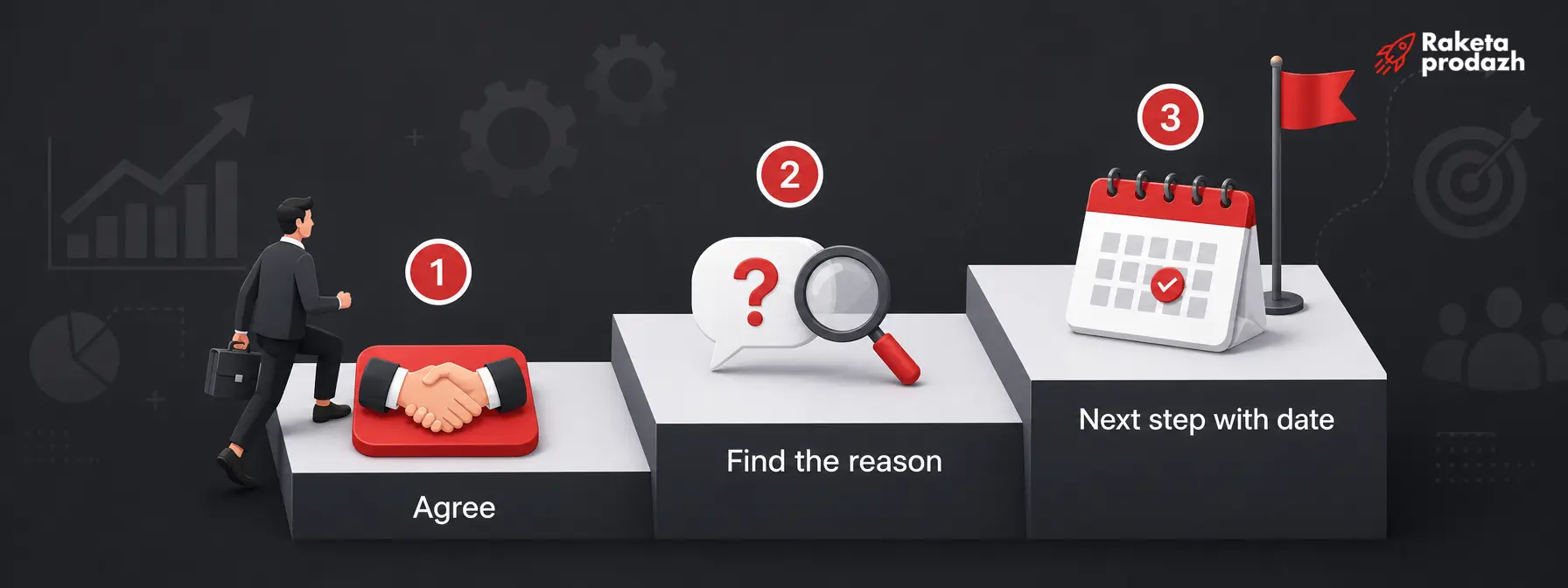
How do you handle the “I’ll think about it” objection without losing control or applying pressure? You need a three-step sequence that fits into your overall system of objection handling in sales. A Gong study covering 67,149 conversations shows that successful salespeople hold the pause longer after an objection, ask clarifying questions more often, and check whether the answer is clear. Speed hurts here; calm helps. You keep the initiative through structure, not through pressure.

  1. Joining. Acknowledge the client’s right to think in specific words, for example, “I understand, it’s important to make a well-considered decision.” Typical mistakes that hurt at this step are interrupting the client, saying “What is there to think about?”, and immediately offering a discount.
  2. Clarifying the essence. Ask, “What exactly do you want to think over?”, paraphrase the answer, and check whether it’s the only reason. You don’t need a series of five questions in a row here; a dialogue with pauses is enough. Don’t interrogate or argue with the reason given.
  3. Closing with a step. Give one precise answer to one reason and propose a next step with a date. For example, “I’ll send the quote today, and on Thursday at 3:00 p.m. we’ll talk and decide.” Don’t bury the client under ten materials and don’t push with an artificial deadline.

The algorithm seems obvious until you get to a live conversation, and that’s where objection handling training helps. So next, we’ll put together working wordings for every case.

how to handle the 'I'll think about it' objection — Three-step diagram for handling the 'I'll think about it' objection

Response Options and Professional Wordings

There’s no universal phrase, and that’s good news, because a parrot script is always audible. That’s why, when deciding how to respond to “we’ll think about it,” adjust your answer to the channel and the type of client. In a face-to-face meeting, you can afford a pause and a warm tone. On the phone, you need short lines and a quick return to the question, as in cold calling techniques. In written communication, a clear structure and one call to action work. For an analytical person, numbers will do; for an emotional type, a story and calm.

If you don’t know how to respond to the customer when they say I’ll think about it, here’s what you can use.

  • “Of course, it’s fine to think it over. What exactly do you want to check before deciding?” A basic line for any product.
  • “Tell me honestly, do you need time, or is the offer not right for you at the moment? Both are fine.” Removes the social cost of saying no and cleans up the funnel.
  • “What should become clear during this time?” Works well with expensive and complex products.
  • “If we keep the result but change the payment schedule, would that solve it?” Fits when the reason is money.
  • “Who else will be evaluating the decision, and what matters most to them?” For B2B and family purchases.
  • “I suggest a short trial stage with a clear result.” For services with an intangible result.

Light humor is also appropriate if it helps people relax. For example, “I promise not to call every day, only on schedule.” Ask for contact details for the next conversation through value, not through persistence.

Working With a Client in Email, Chats, and Messengers

The written format changes the rules. There’s no intonation here, so a short “so, have you thought about it?” reads as pressure. It’s better to respond the same day, while the conversation is fresh, and the message should consist of three parts. Context reminds them what the client said. Value gives one relevant resource. Action proposes a simple next step. If the client is thinking after the consultation and has gone silent, don’t duplicate the same text across Telegram, Viber, and email at once. Choose the channel the client themselves named as convenient.

Here are three working templates. The first confirms the agreement.


Marina, thank you for the meeting. To confirm, the neighborhood and layout work for you, and what’s left to check are the documents and the final payment. By 6:00 p.m., I’ll send the quote and the draft contract, and on Friday at 11:00 a.m. we’ll talk for 15 minutes.

The second offers a resource in exchange for contact.


Oleh, you were unsure about the real budget after the purchase. I’ve prepared a personalized calculation for two scenarios. Where would you like me to send it, to a messenger or by email?

The third gently brings the client back after silence.


I couldn’t reach you at the agreed time. I suggest two options: move the conversation to Tuesday afternoon, or close the search and come back at your signal. Which works better?

That leaves the clients who genuinely need a pause.

following up with a client in chats and messengers — A manager guides a client in a messenger with a message built from context, value and action

Techniques for Guiding a Client Who Genuinely Needs Time to Think

Some deals objectively require a pause. A complex product, a large sum, several decision participants. In such cases, the main principle is this. Don’t manipulate or push; help the person make a decision. A good manager leads the client to clarity, even if the clarity is called “no.” Record all agreements in writing so you don’t argue later about who promised what. And remember that effective sales strategies are built on long-term relationships, not on chasing a single deal.

Here are techniques that work.

  • Agreeing on a repeat contact. Not “we’ll talk,” but “Thursday at 4:00 p.m., for 10 minutes, we’ll go over the quote.”
  • A reminder of yourself. A short catalog, a card with the quote, or a useful memo. The main thing is that the item is useful, not just a souvenir.
  • Additional value in the final phrase. For example, “I’ll send you a checklist of questions worth asking any supplier, even us.”
  • A time-limited offer. Only an honest and verifiable one, say, the price is locked in until the 15th.
  • A trial period or a refund. Reduces the fear of making a mistake, for example, a 14-day pilot with clear success criteria.

And now, about how to make sure the phrase doesn’t come up so often in the first place.

3 Methods for Proactively Handling the “I’ll Think About It” Objection

The best way to reduce the number of pauses after a meeting isn’t to improve the final line but to fix the start of the conversation. The first method is a meeting script. Agree on the conversation plan in advance, relying on a step-by-step sales algorithm. Say, “First I’ll clarify your task, then show you two relevant options, and at the end we’ll honestly decide whether it makes sense to move forward.” The client hears that “no” is also an acceptable answer, and they don’t need to hide behind a polite “I’ll think about it.”

The second method is getting ahead of it. You yourself name the typical doubts before the client brings them up. For example, “At this point people usually ask about implementation timelines and the risk of overpaying, so let’s go over that right away.” The third method is a direct request. Find out the selection criteria and the rejection criteria in advance. “What should the offer include for you to say yes? And what would lead to a no?” This transparency saves time for both sides. But sometimes the objection appears through our own fault, and that’s what the next section is about.

Manager Mistakes That Provoke the “I’ll Think About It” Objection

Most often, we provoke the objection “I’ll think about it” ourselves. The first mistake is stating the price too early. Imagine a manager who in the first two minutes announced 48,000 UAH, before the client even understood why they needed it. After that, any presentation sounds like a justification of that sum. The second mistake is pressure and caring about the deal instead of caring about the client’s needs. Phrases like “the promotion is only today” without a real deadline work once, and the trust is lost forever.

The third mistake is the absence of clear value. If the client can’t say what exactly they’ll get, there’s nothing for them to decide, and they take a pause. A mini-scenario looks like this. The manager shows ten plans, names the price, pushes a discount, and hears “we’ll think about it.” The right strategy is the opposite. First learn the task and the criteria, then show one main option and one alternative, and state the price together with the result. Then the phrase appears less often and sounds more honest.

The algorithm from this article works, but implementing it in the heads of your whole team and maintaining discipline over the long run is a separate task that requires a systematic approach, not a single instruction on the wall. Sales Rocket covers this completely: as part of the “Thematic Training + QCS,” we listen to real calls from your managers, find typical mistakes such as naming the price too early or interrogating instead of joining, rewrite scripts for your specifics, and reinforce the skill through practice, homework, and regular control. Separately, we set up your CRM and checklists so that every client pause is recorded with the reason and the follow-up date instead of getting lost in the funnel. The result for our clients is an average revenue increase of +35%, conversion growth of up to 86%, and a team that handles “I’ll think about it” systematically, not on the intuition of an individual manager. We’ve worked with Mitsubishi, Naftogaz, Yamaha, and dozens of other companies that used to lose deals on this very phrase. Don’t let clients “think” endlessly – build a system that turns a pause into a next step with a date.

Cut losses at the “we’ll think about it” stage and raise conversion up to 86% - sign up for a free consultation!

Conclusion

image

When a client says “I’ll think about it,” it’s not a wall but an invitation to a more honest conversation. What to do if a client says I’ll think about it? A simple logic works. Acknowledge the right to a pause, ask what exactly needs to be thought over, give one precise answer, and set a specific step with a date. Don’t push, don’t hand out discounts automatically, and don’t leave the deal on the phrase “we’re waiting for your decision.” Adjust your wording to the channel and the type of client, and in written communication, write with context and value, not with a reminder of yourself. Record the reason and the date in your CRM so the funnel shows the truth. Sometimes the outcome will be an honest “no,” and that’s also a good result, because you saved time for yourself and the client. Value every contact, and clients will come back on their own.

In this article:
See more
Book a FREE sales funnel audit
CONTACT US
FAQ
Should you give a discount if the client says “we’ll think about it”?

No, first find out the reason. A discount before diagnosis teaches the client to use a pause as leverage. If the issue is price, it’s better to change the payment schedule or the scope.

What should you write to a client after “we’ll think about it”?

Remind them of their doubt, send one resource on it, and propose a time for a call. A message like “have you thought about it?” doesn’t work.

How can you tell that “we’ll think about it” means a refusal?

There are no questions, no timeframe, and no next step, and postponements keep repeating. Ask directly whether they need time or the offer isn’t right for them.

How should you record “we’ll think about it” in your CRM?

Record the reason, the client’s words, the participants, the needed material, the date, and the channel of the step. Don’t leave a “thinking” status without a date.

SUBSCRIBE TO MY TELEGRAM CHANNEL
The most valuable sales information right on your phone!
icon

LOTS OF USEFUL INFORMATION, FREE TEMPLATES, AND CHECKLISTS ON MY INSTAGRAM

Materials and practical advice on sales growth in our blog: