icon

Why Clients Request a Quote and Disappear

You sent the proposal, the client wrote “Great, we’ll take a look,” and then silence. Sound familiar? When a client disappeared after the proposal, it’s not just one deal that suffers. The forecast of the entire sales team takes a hit. This happens in B2B, in B2C, and in real estate. The good news is that silence almost always has a cause, and the cause can be figured out. In this article, we’ll look at why clients disappear, what mistakes managers make, how to restart the conversation, and what to set up in your CRM so that silence doesn’t cost you money. No magic phrases that “work in 100% of cases.” Just a working system that will help you in Kyiv, in Lviv, and in Dnipro.

Want a high-performing sales team without the hassle?
We’ll build it for you.
Contact Us

Key Takeaways

  • A client who goes quiet after the quote is usually not reacting to the price, but to fear of making a mistake or a wish to leave everything as is.
  • A manager with no scheduled proposal walkthrough and no dated next step turns a deal into hope instead of a forecast.
  • An undelivered file or an email in spam looks like a “client disappeared after proposal” situation, so check receipt first and think about a discount later.
  • Every touchpoint after the quote should give the client something new, such as a mini-calculation or a one-pager for the finance director, not the phrase “just reminding you about myself.”
  • If deals sit untouched for months, the cause is the process (wrong person, no budget or criteria), and a new PDF design won’t fix it.

In the article below you’ll find a step-by-step cascade of touchpoints, sample messages, and signs that show where things broke: in the quote or in the process. Read the article below 👇

Why Clients Disappear After a Commercial Proposal

Let’s start with the unpleasant part. When the client isn’t responding after receiving a quote, it rarely means “too expensive.” According to JOLT research based on more than 2.5 million recorded B2B conversations, 40 to 60 percent of lost deals end not with a competitor’s win, but with no decision at all. Of those deals, 56 percent come down to fear of making a mistake, and 44 percent to a desire to leave everything as is. You didn’t lose to the company next door, but to the familiar status quo.

Why isn’t the client responding after the quote in practice? Priorities shifted, and after the shelling a generator turned out to be more important than a new CRM. The email flew into spam. The quote looks like a template. A second supplier with a similar price appeared. Or the person is simply afraid of choosing the wrong thing. In B2B, there’s also the specifics of long deal cycles, and your contact often doesn’t decide alone, but retells twenty pages to the finance director. A typical scene: a manager sent an estimate for 480,000 UAH, got “we went to think it over” and two weeks of silence. What they were thinking about was how to explain to the owner why this is needed right now. You can learn to read this silence, but first let’s check whether you gave them a reason yourself.

A familiar situation: the quote is sent, the client wrote “Great, we’ll take a look” – and then silence, and the deal slowly slips out of the forecast. Most often it’s not about the price or the client’s personality, but about the fact that the deal follow-up process isn’t documented anywhere and relies only on the manager’s memory. At “Sales Rocket,” we systematically solve exactly this problem: we audit your sales team, identify at which stage contact with the client is lost, and set up your CRM so that a task for the next step is created automatically and deals with no activity don’t hang in the funnel for months. We implement regulations and checklists for touchpoints after sending a quote, train managers to restart the conversation without “just reminding you about myself,” and set up a quality control system that checks every week whether the CRM is being maintained correctly. Over 8+ years, we’ve built 208 sales teams across 14+ industries, and the average revenue growth of our clients after systematization is +35%. This isn’t a one-off tip, but a full-fledged system that closes the problem of client silence once and for all.

Turn stalled deals into predictable revenue - get a free audit of your sales team!
client disappears after proposal — A manager looks at a silent phone while the client fades into fog behind glass

Typical Manager Mistakes After Sending a Quote

The most common scenario looks like this. The manager clicked “send,” exhaled, and started waiting. The client wasn’t warned that the email was coming, no call was agreed on, and there’s no task in the CRM. A week later, the manager tries to remember where they left off, and the client has already forgotten why they asked for a calculation. Waiting without action is not a strategy, but hope with a corporate email address.

The second problem is that nobody checked whether the file arrived. The email could have gone to spam, the link might not have opened on a phone, the attachment might have been too heavy. Meanwhile the manager is sure the client is silent because of the price and is already preparing a discount. A discount on an undelivered PDF, you must admit, is a generous gesture. All the main missteps and ways to fix them are collected in the table, and other typical manager mistakes are covered in a separate article.

Mistake What it risks How to fix it
The client wasn’t warned about the sending The email gets lost among incoming messages Name the format and time in advance, duplicate in a messenger
No touchpoint after sending Interest cools down within a couple of days Schedule the first contact before sending
No task in the CRM The deal stalls and gets forgotten Make “next step with a date” a required field
Receipt not verified You’re arguing with a silence that doesn’t exist Check whether it was opened or ask directly
Passive waiting The deal lives only in the forecast Schedule a proposal walkthrough before sending

All these gaps can be closed, and next we’ll look at exactly how to restart the conversation.

Best Practices for Bringing a Client Back Into the Conversation

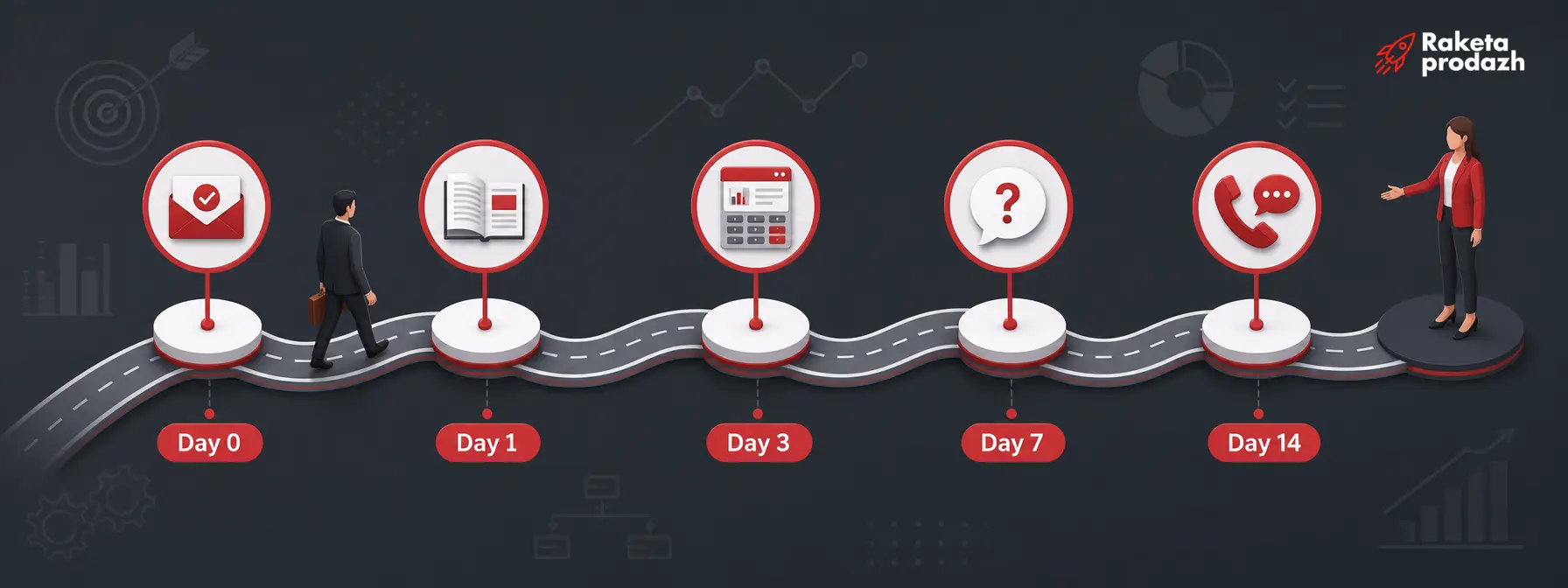
How to win back a client after the quote? Definitely not with the word “reminding.” Every touchpoint should do something new. A working cascade looks like this. On the day of sending, you confirm delivery. The next day, you check whether the document was opened. On the third day, you send something useful, for example a short calculation or a case study. On the seventh, you ask about the status. Closer to day fourteen, you call or write on Telegram or Viber. Follow-up after sending a quote works when it changes its function rather than repeating “so, what’s up?”.

Personalization is a real cheat code here, and personalization of sales communications helps make every touchpoint more precise. Go back to the client’s own words, add a new fact, and offer an easy choice of answer. For example: “Olena, you wanted to stop losing inquiries from Telegram. After our conversation, the context may have changed. What’s closer right now: you’re discussing it internally, you need a phased budget, or the task has shifted?” It’s safe for the client to answer honestly.

And what if the silence drags on? How to close a deal with a client after the quote without burning bridges? Directly and calmly. “It looks like the project isn’t a priority right now. I’ll close the deal in the current cycle so I don’t distract you. If it’s still relevant, reply with one word, and we’ll get back to the plan.” Such an email often gets a reply faster than the tenth reminder. So that this doesn’t rely on the manager’s memory, you need tools.

how to re-engage a client after a proposal — Diagram of the follow-up touch cascade after the proposal by day

Technologies and Systems That Will Help You Not Lose Clients

Technology doesn’t sell anything on its own, but it spares you the most frustrating loss, when a client was simply forgotten. A CRM should automatically create a task after a quote is sent, require a date for the next step, and highlight deals with no activity. We’ve written separately about how to organize working with CRM systems in sales. Document tracking services, such as PandaDoc, show whether a file was opened and which sections were read. This isn’t a reason to call a minute after it was viewed. It’s a hint about what to talk about when you finally do call.

In the Ukrainian market, there’s room to grow here. According to Ringostat, based on 31,653 companies, in 2025 38 percent of the platform’s clients didn’t use a CRM at all. That means that for many, the “client disappeared after proposal” story isn’t about psychology, but about a spreadsheet and sticky notes on a monitor. Bring email, Telegram, Viber, and calls into a single card, and the manager won’t have to remember where they last wrote to the client.

One more condition. The system needs a standard and a manager who looks at it every week. Without that, even the trendiest CRM will become a beautiful graveyard of tasks. But even perfect automation won’t save you if you write too often.

How Not to Become Pushy: Balancing Frequency and Value of Touchpoints

The fear of seeming annoying is understandable, which is why many managers go quiet first. The line is simple. A pushy touchpoint is needed only by you, and a useful one is needed by the client. A good benchmark: three to five contacts over two weeks, if the client hasn’t named their own decision deadline. If they named a meeting date, that date sets the rhythm, not the sales team’s calendar. If they asked not to be disturbed until Monday, the sequence stops.

Check every message with the question “what will the client get from reading this?” It could be a clarification about a risk, a mini-calculation, a market observation, or a one-pager for the finance director. A weak version sounds like “Good afternoon, just reminding you about myself.” A strong one sounds like “I prepared a one-page summary of the economics to make it easier for you to discuss the decision with management.”

It’s worth switching channels when three emails in a row went unread and the client is online in a messenger. It’s time to stop when there’s no answer to a direct question about priority or to a closing email. And don’t write “I see you opened the pricing page three times.” That sounds like surveillance, not care. Now let’s go back to the beginning and look at what to do in the first hours after sending.

What to Do Right After Sending a Commercial Proposal

What to do after sending a quote? The main rule sounds boring, but it works. Don’t leave a deal without a next step. Ideally, the proposal walkthrough meeting is scheduled before sending. Then a vague “we’ll look and get back to you” turns into “we’ll meet on Tuesday at 11:00 and go through the numbers.” A document without a presentation leaves all the interpretation to the client, and they are not a salesperson and are under no obligation to explain your value.

Don’t ask for a decision right away. That creates pressure and provokes a polite disappearance. Ask for a small action, such as confirming receipt or setting aside fifteen minutes for questions. Then work in order.

  1. Make sure the document was received and opens on both a phone and a laptop. Briefly ask about it in a messenger.
  2. Don’t demand an instant answer. Based on a previously agreed scenario, schedule a discussion for a specific date.
  3. Record in the CRM the date and participants of the conversation, including the finance director or the owner, if they’re the one deciding.
  4. Prepare answers to three likely questions, about price, timing, and risks, and a one-page summary for those who won’t be on the call.
  5. Determine who on your side and who on the client’s side will join the next conversation.
  6. Don’t close out the day until the deal has a next step with a date. Otherwise it sits in the forecast just out of inertia.

If there’s still silence after this, it’s time to find out where things broke, in the quote or in the process.

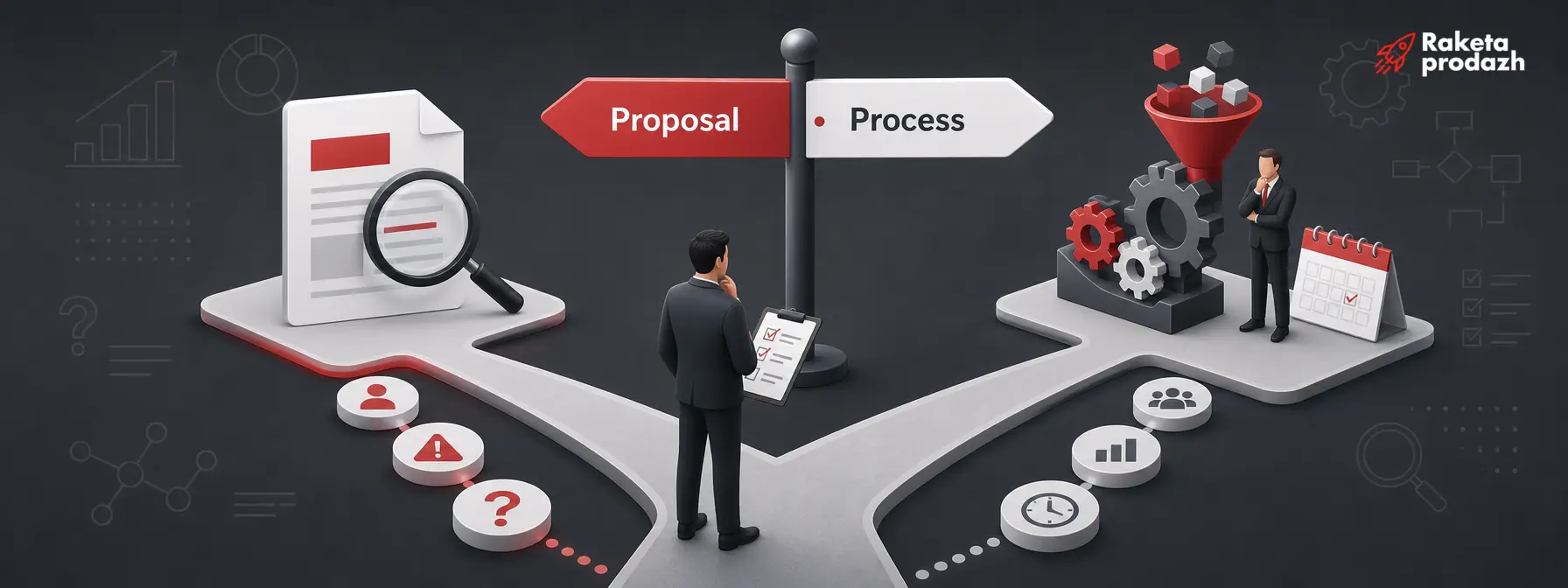
How to Tell Whether the Problem Is in the Proposal Itself or in the Sales Process

Diagnostics save months. The problem is more likely in the quote if the client doesn’t understand the scope of work, asks many questions about what’s included in the price, the document looks like a template, and proposals for different clients are almost identical. A price without an explanation of the economics reads as a random number. In that case, fix the structure. Start with the client’s situation, then recommend one option, and show timelines, risks, and the next step.

The problem is more likely in the process if the quote went to someone who isn’t the decision-maker, there’s no agreement on the next step, the manager doesn’t know the budget and selection criteria, and the proposal was sent after a brief introduction. If deals sit untouched for months, it’s definitely not about the font. A new PDF design won’t fix a weak sale. It’s like buying an expensive suit and showing up to the meeting without an agenda.

Sign Where to look for the cause
The client doesn’t understand what’s included in the price Quote
The proposal looks like a template Quote
The price isn’t explained Quote
The quote went to someone who isn’t the decision-maker Process
No agreement on the next step Process
Budget and selection criteria are unknown Process
Deals sit untouched for months Process

All that’s left is to gather everything into one short idea.

proposal problem or sales process problem — Diagnostic fork: is the problem in the proposal or in the sales process

Silence after a quote is not the client’s character, but a shortage of system: without a documented next step, without CRM control, and without regular useful touchpoints, even a strong proposal risks going unanswered. You can apply all the advice from this article on your own, but for the result to be lasting and not depend on the memory and discipline of an individual manager, you need a well-built system. “Sales Rocket” implements exactly this kind of system turnkey: we set up a CRM with automatic tasks after a quote is sent, write follow-up regulations without “so, what’s up?”, train managers to present a proposal rather than just send a file, and put in place management control that doesn’t let deals hang without a date. As a result, clients get conversion growth of up to 86%, and the average revenue growth after systematization is +35%, with the best recorded result being +$10,907,403 in 4 months of work. Among the partners whose sales we put in order are Mitsubishi, Yamaha, and Naftogaz. Don’t lose deals in silence – build a system where every quote makes it to a decision.

Stop losing clients after the quote - regain control of your funnel in 6 weeks!

Conclusion

image

When the client has gone silent after the quote, it’s not a verdict, but a signal that the process weakened somewhere. The causes vary, from fear of making a mistake to a plain undelivered email, so they need to be treated differently, too. Agree on a walkthrough of the proposal before sending it, record the next step in the CRM, and make every touchpoint useful. Give the client a safe way to tell the truth, and don’t be afraid to close the cycle politely if the priority is gone. Technology will bring order, but trust is still built by people who understand the client’s situation. Start with one step. Look at your deals with no next date and get back to them today.

In this article:
See more
Book a FREE sales funnel audit
CONTACT US
FAQ
What should I write to a client who disappeared after the quote?

Go back to their task, add new value, and offer a simple choice of answer instead of “so, what’s up?”.

Should I offer a discount if the client stopped responding?

No. A discount doesn’t cure fear or internal approval. It’s better to change the scope, stages, or payment terms.

Why is it better to present a quote rather than just send it?

At the walkthrough, you explain the logic, remove risks, and immediately lock in the next step.

SUBSCRIBE TO MY TELEGRAM CHANNEL
The most valuable sales information right on your phone!
icon

LOTS OF USEFUL INFORMATION, FREE TEMPLATES, AND CHECKLISTS ON MY INSTAGRAM

Materials and practical advice on sales growth in our blog: