Key Takeaways
- The patient doesn’t come to make a purchase but arrives with anxiety about their health, so pressure and attempts to “close the deal” instantly destroy trust.
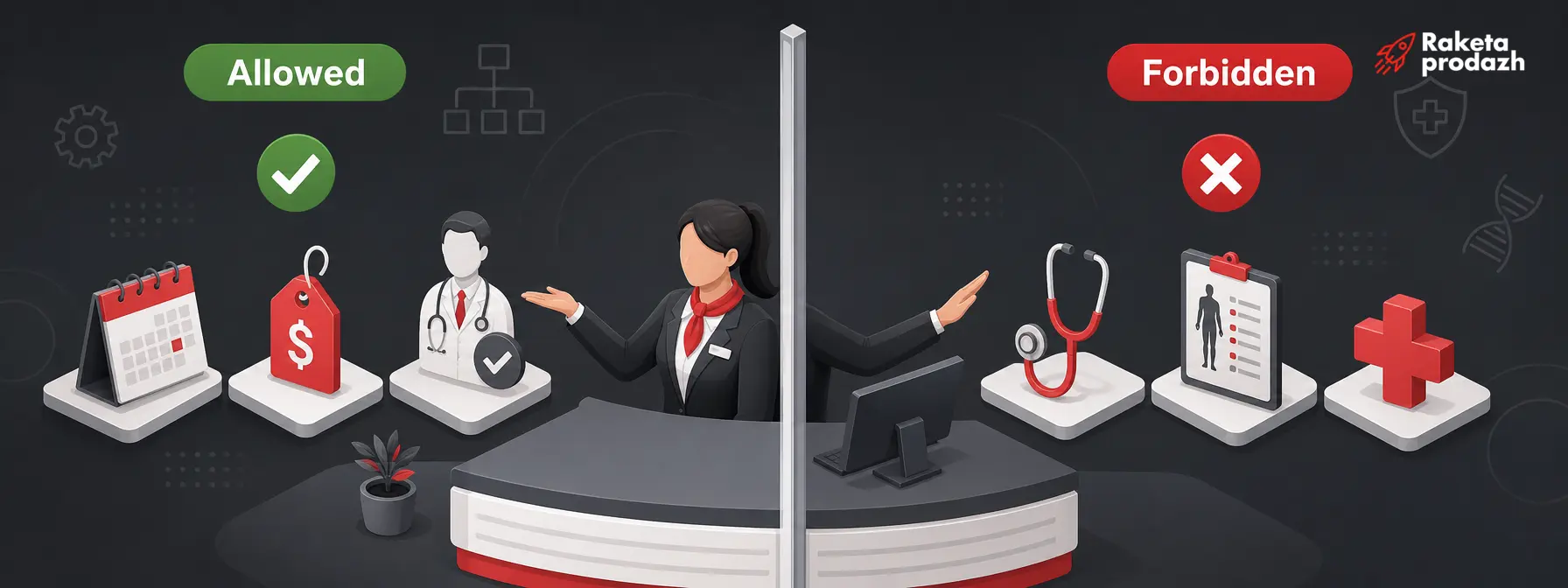
- The administrator sells an organizational step, not a medical decision; making a diagnosis or promising a result is off-limits for them.
- Weak scripts avoid the price question or push back with “health is worth more than money,” while strong scripts state the cost directly or honestly explain the range.
- Specific time slots instead of an open-ended “when’s convenient for you” speed up booking and reduce the number of “I’ll think about it” responses.
- Artificial urgency and discrediting competitors damage a clinic’s reputation faster than a high price ever could.
Below you’ll find specific phrases for scripts, mistakes to avoid, and an algorithm for talking to patients without pressure or loss of trust 👇.
A sales funnel analysis helps pinpoint exactly where potential patients are dropping off, and the numbers are unpleasant but understandable: sales scripts for medical services are often copied from retail or banking, forgetting that a patient isn’t coming to make a purchase but arrives with anxiety about their health.
A good clinic script works by different rules. It’s not about “selling at any cost,” but about making sure the person understands where to go next, which doctor to see, on what terms, and why it costs exactly that much. Every contact, from the first call to appointment confirmation, either builds trust or destroys it.
In this article, we’ll break down how selling in medicine differs from selling in other fields, where clinics most often lose patients, and how to build scripts for communicating with patients so that conversion grows while the clinic’s reputation stays clean.
Peculiarities of Selling in Medicine
Selling medical services works differently than selling insurance or a gym membership. Patients often arrive stressed, in pain, or anxious, and that changes the entire logic of the conversation. Direct sales techniques built on persuasion and creating desire work against the clinic here: a person in that state doesn’t want to be “closed on a deal,” they want to be heard and helped to understand what’s going on.
The information asymmetry between doctor and patient adds another layer of complexity. A person can’t physically assess the quality of medical care the way they’d assess the quality of coffee or an English course, so they’re forced to take the clinic’s word for it. Any pressure or insufficiently clear explanation is instantly read as manipulation, and no staff member can guarantee a treatment outcome, which is worth keeping in mind when developing scripts.
- Ethics and a ban on pushing services the patient doesn’t need
- Mandatory informed consent before any paid procedure
- A long decision-making cycle, especially for expensive treatment programs
- Simple wording without medical jargon, understandable without a doctor’s explanation
It’s precisely because of these peculiarities that regular sales scripts and medical ones need a different underlying logic.
How a Medical Script Differs from a Regular Sales Script
In classic sales, a manager has plenty of room to maneuver: they can amplify a product’s value, create a sense of missed opportunity, negotiate. In medicine, this toolkit is severely limited, and not out of politeness, it’s a matter of substance.
Clinic staff don’t make a diagnosis or prescribe treatment, even if they’re “pretty sure” about the patient’s issue based on experience. They don’t promise a guaranteed result or exaggerate risks to push someone toward booking. Artificial urgency like “decide today or it’ll be too late” is unacceptable here unless it’s an actual medical instruction from a doctor. And of course, no one should nudge a patient toward a procedure they objectively don’t need.
The job of a clinic administrator’s script is much narrower and more honest: help the patient make a decision on the organizational side and get them to the right specialist. Not to sell a specific service, but to guide the person through the first step of the journey, from there the doctor makes the decisions. The difference may seem small at first glance, but it’s exactly what separates an ethical clinic from one that’s risking its reputation.
So it makes sense to figure out exactly where the administrator’s line of responsibility lies.
A familiar situation: a clinic administrator genuinely wants to help but speaks on instinct rather than by a system, and some patients get lost simply because of an unfortunate phrase or unnecessary pressure. Developing balanced scripts that boost conversion while staying ethical is hard to do on your own: it takes experience working with call recordings, call analytics, and an understanding of where the line between care and pushiness actually is. At “Rocket Sales,” over 8+ years we’ve built a methodology that covers exactly this task end to end: a full package of scripts and templates for a clinic administrator, tailored to your specialty, topic-focused training sessions with breakdowns of real calls, and implementation of a quality control system (QCS) with checklists for regularly evaluating administrators’ conversations. We don’t just write out script text, we build the logic of every part of the conversation and train staff to understand the purpose, not memorize lines. Clients who implement these solutions see call conversion growth of up to 86% and an average revenue increase of +35%. It’s a systemic approach that protects the clinic’s reputation while increasing the number of patients who actually make it to a booking.
Build scripts that sell care, not pressure, get a free audit of your clinic's calls!
What the Administrator Can Sell, and What They Can't
The boundaries of the administrator’s role need to be as clearly defined as the doctors’ schedules. Sales scripts for a medical center administrator only work when the person knows exactly what falls within their zone and what doesn’t.
The administrator can explain the appointment format, describe a service within the information the clinic has approved, quote the cost, match a doctor to the patient’s request, offer a convenient time, and explain how the visit is organized. That’s their direct job, and doing it well, politely, and quickly has nothing to do with pushing services. But determining a diagnosis, choosing treatment instead of the doctor, promising a clinical outcome, assessing whether a procedure is necessary, or interpreting a patient’s symptoms is something the administrator must never do, even if the patient themselves asks to “just get a rough read over the phone.”
- Can: match a doctor, quote the price, offer a specific appointment time
- Cannot: make a diagnosis, assess whether a procedure is needed, promise a treatment result
The main principle is simple: the administrator sells the next organizational step, not a medical decision. Next, let’s break down what blocks that step should consist of.
What Blocks a Good Clinic Administrator Script Should Consist Of
Scripts for a medical clinic administrator rarely work as one continuous text. It’s far more effective to build them out of blocks, each with its own purpose, and the order can shift slightly depending on the situation.
That’s why scripts for a clinic administrator are better designed not as a rigid conversation scenario but as a set of clear blocks and phrasing options for different situations. The administrator needs to understand what task they’re solving at each stage of the dialogue and be able to adapt phrases to the patient’s request without stepping outside the boundaries of their role.
The basic structure looks like this: greeting and introduction, identifying the patient’s request, a few clarifying questions, explaining the appropriate appointment format, answering organizational questions, stating the cost, offering a booking, choosing a specific date and time, confirming, and outlining the next step. Each block solves its own small task: the greeting eases tension, clarifying questions help route the patient to the right doctor, and confirmation removes uncertainty for the patient.
It’s important that staff understand not the script’s text by heart, but the purpose of each block. That way, when an unusual question comes up, they won’t get flustered or start reading an off-topic script.
- Greeting and identifying the request set the tone for the whole conversation
- Clarifying questions and choosing the appointment format save the patient’s time
- Cost, booking, and confirmation close the conversation with a concrete outcome
With this structure in mind, it’s easier to work through specific situations, let’s start with the first call.
Script for the First Incoming Call to the Clinic
The first call to a clinic decides more than it seems: a significant portion of inquiries are lost right at this stage if the administrator sounds too dry or, conversely, too pushy. It’s useful to periodically listen to and review call recordings, the same principle behind breaking down a real cold call works just as well for medical calls. Scripts for medical center call centers usually start with something simple but important: the administrator introduces themselves, names the clinic, and asks how they can help.
Next, they listen carefully to the request and ask one to three relevant organizational questions to determine the appropriate appointment format. For example, they might ask: “Could you tell me, would you like to book a first consultation, or have you visited us before?” This kind of question helps with routing, it’s not a substitute for medical diagnosis, and that’s the key difference from trying to “feel out” symptoms over the phone.
Once the format is clear, the administrator offers a specific visit time and confirms the booking, repeating the details out loud. The conversation shouldn’t turn into an interrogation or a scripted dialogue read off a page, the questions should simply lead to a result.
- “Which location works better for you, the branch in [district] or the central office?”
- “Do you already have test results or previous exams related to this issue?”
The logical next step is talking about price, which administrators usually dread the most.
Script for a Patient Who Immediately Asks About Price
The question “how much does this cost” comes up in the first few seconds of a call more often than one would like, and this is exactly where many sales scripts for medical services fall apart. There are three typical situations, and each needs its own response.
If the price is fixed, it should and can be stated directly, without unnecessary hedging: the patient has the right to know the cost right away. If there’s a range, it’s important to explain what it depends on, for example the scope of an exam or the doctor chosen. And if the exact amount can only be determined after a consultation, be honest about that, state the cost of the initial visit, and don’t promise a final figure in advance.
Bad responses show up everywhere: a dry “the price is only available after the consultation” with no explanation, dodging the question, or, worst of all, pressure along the lines of “health is worth more than money.” These phrases work against the clinic and destroy trust faster than any high price would.
- Fixed price: “An orthopedist consultation costs 800 hryvnias, that’s the cost of the first visit.”
- Range: “The cost depends on the scope of the examination, usually between 1,200 and 2,500 hryvnias.”
- After consultation: “The doctor will give you the exact amount after the exam, and the consultation itself costs 600 hryvnias.”
With pricing sorted out, it’s logical to move on to how to properly close the conversation with a specific booking.
Script for Booking a Patient's Appointment
The booking mechanics might seem like a minor detail, but it’s often exactly what determines whether the patient actually makes it to the clinic. The open-ended question “when’s convenient for you” sounds polite, but in practice it forces the person to think it over and often makes them put the decision off.
It works much better to offer a choice between specific options: “I can offer Tuesday at 3:00 PM or Wednesday at 6:30 PM. Which one works better for you?” Specific slots reduce uncertainty and speed up the decision, because the patient doesn’t have to come up with a time themselves, they just pick from ready-made options.
Once an option is chosen, it’s worth repeating the date and time, stating the doctor’s name and the clinic’s address, giving any necessary organizational instructions (for example, arrive on an empty stomach), and explaining how the booking will be confirmed, by call or by message.
This simple sequence answers most of the patient’s questions before they even get a chance to ask them, which in turn reduces the number of reschedules and “I’ll think about it” responses.
Script for a Patient Who Says "I'll Call Back Myself"
The phrase “I’ll call back myself” doesn’t always mean a rejection, often it’s just a way of buying time to think. It’s important here not to turn a polite “I’ll call back” into an excuse for a series of pushy follow-up calls, that quickly slides into pressure.
There are two reasonable ways to handle this. If the patient clearly wants to keep the initiative in their own hands, it’s worth simply respecting that and leaving them the clinic’s contact details without pushing anything. If the situation allows, it’s fine to gently suggest a follow-up with the patient’s consent: “Would you like me to message you on messenger in a couple of days if you haven’t decided yet?”
This approach preserves respect for the patient’s decision while still leaving a chance to bring them back to the clinic without making them feel “hunted down.” Next, let’s look at what to do when the clinic simply has no available time slots.
Script for When There's No Available Time
The worst thing an administrator can do when there are no open slots is end the conversation with “we’re fully booked.” To the patient, that sounds like a dead end, and they simply go look for another clinic.
Instead, it’s worth offering alternatives: a different day, a different time, another doctor with the same specialty, a different branch of the network, a waiting list, or a callback when a slot opens up. For example: “The soonest opening with this doctor is next week, but I can offer an appointment on Wednesday with a colleague of the same specialty, or put you on the waiting list if this particular specialist matters to you.”
- “There are no open slots this week, but let me put you on the waiting list.”
- “I can offer the branch in [district], they have an opening as early as tomorrow.”
These kinds of phrasings keep the clinic in a proactive position without pressure and leave the patient with the feeling that they were taken care of, not just turned away.
Script for a Patient Who Wants Only a Specific Doctor
Sometimes a patient is set on seeing only one specialist, and that doctor has no upcoming openings. In this situation, the administrator’s job isn’t to talk them out of it, but to honestly lay out the options.
They can state the nearest available date with that doctor, even if it’s two to three weeks out, offer a waiting list in case another booking gets canceled, and, if the patient is open to it themselves, mention an alternative specialist with a similar profile. But the patient’s choice must never be devalued in any way.
A phrase like “don’t wait for him, go see someone else, he’s not any better” sounds like pressure and damages trust in the clinic itself, not just in that particular doctor. The decision in this situation should stay with the patient, the administrator’s job is only to show all the real options.
Having covered the choice of doctor, let’s move on to the final step of the booking funnel, confirming the visit.
Script for Confirming the Appointment
Appointment confirmation should be short and crystal clear, with no promotional add-ons or extra offers. What matters to the patient is quickly seeing the essentials: their name, the date and time of the visit, the doctor’s name, the clinic’s address, and, if needed, a brief note on preparing for the appointment.
For example: “Ivan Petrovich, you’re booked for Thursday, March 14, at 11:00 AM with Dr. Koval, address: 12 Shevchenko Street. If you need to reschedule, just message us in this same chat.” This format doesn’t overload the patient and immediately provides a way to reach out in case of a reschedule.
The simpler and more to-the-point the confirmation, the less chance there is that the patient will mix something up or forget to show up, and that directly affects the no-show rate.
Script for Appointment Reminders
An appointment reminder works best when it feels like genuine care, not just another sales attempt. The format can vary: SMS, a messenger message, an automated call, or a personal call from the administrator if the visit is significant or expensive.
A good reminder contains only the necessary facts: the date, time, doctor, and a brief prep note if one is needed. No “and by the way, we have a promotion” in the same message, that’s two different types of communication, and they shouldn’t be mixed together. To make sure these reminders don’t get lost and go out on time, regular CRM monitoring in the clinic matters, not just a one-time setup.
If the patient replies that they won’t be able to make it, staff should immediately offer to reschedule rather than just log the cancellation and move on. Next, let’s look at what happens after a patient has already had their initial consultation.
Script for After the Initial Consultation
This moment is one of the most important in the entire funnel, because it’s where it gets decided whether the patient will continue treatment at this particular clinic. If the doctor has determined the next stage, the administrator or coordinator steps in not to “push through” a sale, but to help organize the process.
It’s appropriate to check whether the patient needs help booking, offer available dates, explain the organizational sequence of visits, and provide the cost estimate approved by the doctor. It’s also worth answering questions about scheduling and payment and, if needed, setting up a follow-up in a few days.
A critical point: staff should not re-sell the medical necessity of the treatment itself, that part was already settled by the doctor during the consultation. The administrator’s job is purely organizational, to help carry the doctor’s decision through to an actual booking, not to convince the patient that they need the treatment.
There are particularly many nuances here when a patient is prescribed a multi-stage treatment plan, let’s cover that separately.
Script for a Patient Assigned a Treatment Plan
Multi-stage treatment plans are typical for dentistry, surgery, rehabilitation, and complex programs, and this is exactly where the risk of sliding into pressure is especially high. The script should help the patient understand the sequence of stages, not push them toward an immediate decision.
A good conversation structure includes breaking the treatment down into clear stages, agreeing on dates for each visit, explaining the doctor-approved cost, and describing organizational payment options, such as installments. All that’s left is to set the date for the next visit, and the plan becomes concrete rather than abstract.
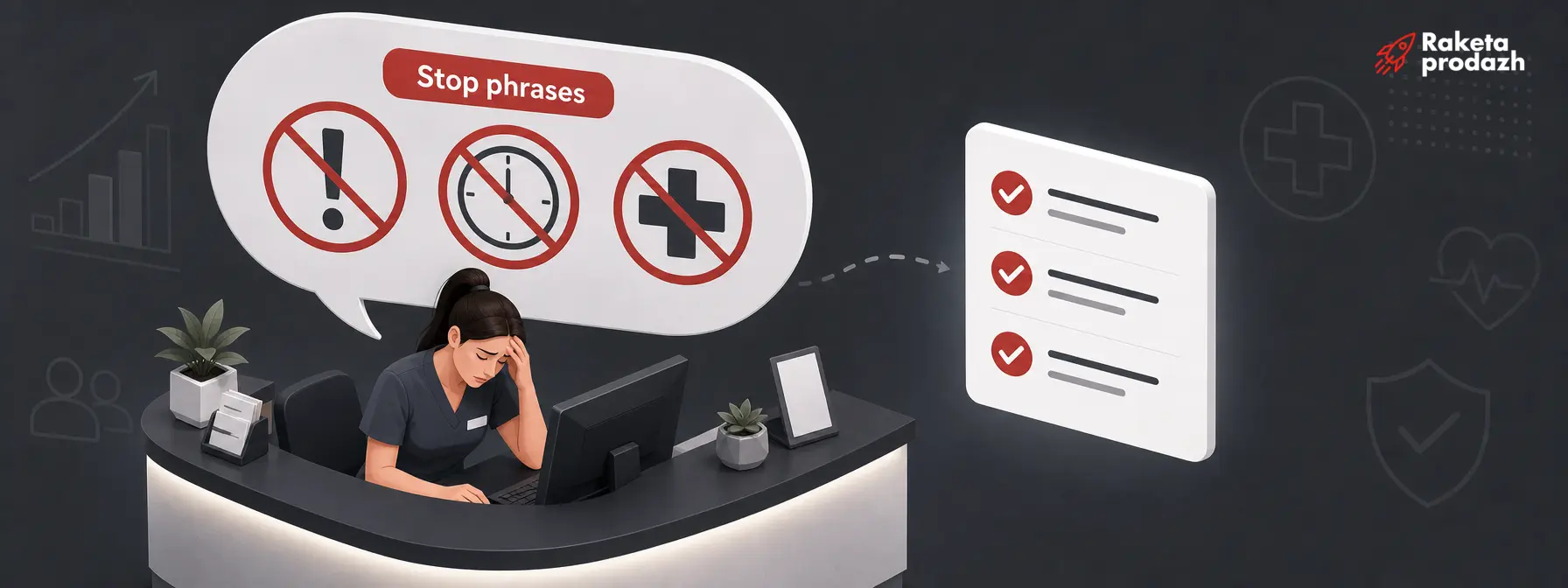
It’s absolutely off-limits to use pressure phrases like “you need to decide today,” “it’ll be too late later,” or “if you don’t book now, it’ll get worse,” unless it’s an actual medical warning from a doctor with real grounds. Such phrasing is quickly read as manipulation and undermines trust in the entire clinic, even if the treatment plan is objectively something the patient needs.
That brings up a separate topic: how to handle these conversations not by voice, but in text messages.
What to Say to Patients in Messenger Apps
Text messaging has its own rules, and scripts for communicating with patients over messenger need to account for that. Short messages work best here, one question at a time, and clear time options, rather than a long text with the clinic’s history and a full list of services.
Medical findings shouldn’t be sent over text, nor should any information that requires a doctor’s explanation, it’s better to offer a call or a visit right away. Being careful with confidential information matters even more here than in a voice conversation, because a text conversation stays in the history and could be read by anyone if the patient’s phone ends up in the wrong hands.
The main mistake is a huge “sales pitch” in response to a simple first question from the patient. The person asked about the price and got three paragraphs about the clinic’s advantages, and that comes across as pushy and off-putting. Next, let’s look at a situation where the patient openly compares the clinic to competitors.
How to Write a Script for a Patient Who Compares Clinics
Comparisons with competitors come up in almost every other clinic conversation, and it’s easy to slip into an unprofessional tone here. Phrases like “they’re worse,” “we’re the best,” or “they’ll do it wrong there” don’t just sound bad, they directly violate requirements for advertising medical services, which prohibit unfair competition and misleading comparisons, as discussed in detail in the breakdown of liability for violating advertising law.
The right approach looks different: first, find out what criterion the patient is comparing clinics on, price, doctor, equipment, or something else. Then calmly explain how the service is structured at your clinic, describe understandable organizational differences, answer the pricing question, and offer a consultation so the patient can compare in practice rather than just by description.
The main rule is simple: no discrediting competitors, not even by implication. Confidence in your own clinic sells better than criticizing someone else’s.
The next classic sticking point in any conversation about money is the “too expensive” objection.
How to Handle the "Too Expensive" Objection Without Manipulation
The objection “too expensive” almost never literally means “I don’t have the money,” more often it’s a signal that the patient doesn’t fully understand what the cost is made up of. The conversation’s logic should start with acknowledging the concern, not defending the price, and in that sense, general principles of handling objections in sales apply to the medical field too, though with some adjustments for ethics.
Next, it’s worth clarifying exactly what seems expensive, the whole treatment plan or a specific stage, and explaining what the cost is made up of: what’s included in the price, what materials or exams are factored in. If the clinic has organizational payment options, like installment plans, it’s worth mentioning them. But promising a discount without authorization is never acceptable, that creates problems further down the line.
It’s important to leave the patient a real option to decline without feeling guilty. Manipulation through fear, phrases like “are you really going to skimp on your own health,” or devaluing a person’s financial situation are unacceptable, even when it’s very tempting to close the booking right here and now.
Since we’re already on the topic of unacceptable tactics, it’s worth going into more detail.
Phrases That Should Never Be Used in Medical Sales
The list of risky phrasing in medicine is longer than it seems at first glance, and some of it slips into conversation by accident, simply out of a desire to sound convincing. Guarantees of results, scaring patients with consequences, and an administrator making a diagnosis top this list, and interestingly, these overlap a lot with typical sales mistakes found in other industries too, just with a much higher cost when they happen here.
Next come categorical statements like “you definitely need this procedure,” guilt-based pressure, artificial scarcity (“slots are filling up fast, decide right now”), price manipulation, and promises of “it’ll definitely help” without medical grounds. A separate category is discrediting another doctor within the clinic or a competing institution, which we already covered above, and it violates not just ethics but also the basic principles of patient informed consent.
The safe alternative to every one of these phrasings sounds the same: facts, organizational information, a recommendation to consult a doctor for a medical opinion, and respect for the patient’s right to choose. This principle is easier to remember than the entire list of things not to say, and it works in any unusual situation.
Next, let’s talk about how this same principle gets adapted across different medical specialties.
How to Adapt Scripts for Different Medical Specialties
There’s no such thing as a one-size-fits-all script for an entire clinic, and that’s normal. Phrases for a dental office administrator will look noticeably different from phrases for a lab or a diagnostic center, even though the underlying ethical principles stay the same.
The length of the conversation changes: scripts for a dental office administrator and surgery typically require more clarifying questions than a simple test collection. The need for a preliminary consultation changes too, along with the number of treatment stages, the price range, and whether a follow-up is needed after the visit. Gynecology and cosmetology require particular care with wording given how sensitive the topic is, while a multi-specialty center has to juggle several different logics at once.
- Dentistry and surgery: more clarifying questions, treatment plan broken into stages
- Diagnostics and lab work: short conversation, clear turnaround times for results
- Cosmetology and gynecology: delicate wording, minimal unnecessary questions over the phone
That said, the principle of “don’t pressure, don’t guarantee a result, don’t diagnose over the phone” stays the same across every specialty. All that’s left is figuring out how to actually train administrators on this.
How to Train Administrators to Work with Scripts
Handing an administrator a PDF with a script and expecting everything to just work from there on its own simply doesn’t happen. Sales scripts for a medical center administrator are absorbed only through practice, not by reading a document once before onboarding, and in this sense sales training programs for managers provide a solid model that’s easy to adapt to medical specifics.
Effective training includes breaking down the logic behind each stage rather than just memorizing phrases, role-playing exercises with typical cases, and reviewing real calls with both strong and weak phrasing examples. It’s also worth practicing tricky situations separately: talking about price, the phrase “I’ll think about it,” cancellations, no-shows, and moving a patient on to the next stage of treatment.
The main goal of training isn’t to drill text into someone’s head, but to teach them to understand why each block of the conversation exists. That way, staff can confidently handle the conversation even in situations that weren’t covered in the training cases, and that, ultimately, is the sign of a well-built sales system at a clinic.
A good clinic administrator script, as you’ve probably noticed by now, isn’t a one-time document but a living system: blocks, logic, quality control, and ongoing team training. Implementing and sustaining such a system on your own is difficult, especially when administrators keep changing and no one regularly listens to or reviews calls. “Rocket Sales” takes this task on completely: we develop a full set of scripts tailored to your clinic’s specifics, run topic-focused training sessions with role-playing exercises and real case reviews, and then implement a quality control system with checklists and regular call analytics, so the results don’t fade a month after training. Our clients see inquiry-to-booking conversion growth of up to 86% and consistently strong communication that builds patient trust instead of damaging it. For example, when we implemented scripts and a control system for Mitsubishi Motors’ sales department, conversion grew by 25%, and the plan was exceeded by 133% in just three months of work. Don’t put off setting up this system until patients start leaving en masse for competitors with clearer communication.
Turn every call to your clinic into a chance to keep a patient, not lose one, submit a request for a call audit and script development today!
Scripts for a medical clinic administrator work toward two goals at once: they boost inquiry-to-booking conversion and protect the quality of communication with patients. That’s not a contradiction, it’s a natural pairing, as long as the script is built on honesty, clear wording, and respect for the person’s decision. The better an administrator or coordinator understands the boundaries of their role, the structure of the conversation, and the next organizational step, the less they need aggressive sales tactics, and the higher the chance that the patient will come back to the clinic again, rather than just booking once.


 Time to read: 9 min.
 30 September 2026