Key Takeaways
- The first deal and reaching full plan completion are different metrics – don’t mix them up.
- There’s no single sales plan completion time – deal cycle length and lead quality can change the timing dramatically.
- Demanding 100% plan fulfillment from month one demotivates new hires – a step-by-step onboarding model works better.
- A thin pipeline and dropping conversion rates between stages signal risk well before the end of the month.
- If the entire team fails to meet the plan at once, the problem lies in the plan’s numbers, not the people.
The full article shows how to calculate your team’s real ramp-up, which signals to watch for, and how to tell a plan problem apart from a manager problem. Read the full article below 👇
And when can you reasonably ask for full sales plan fulfillment, without cutting them any onboarding slack? Often the same question gets asked more simply: what’s the sales plan completion time after hiring a new manager? Put another way, how long does it take a manager to meet the sales plan?
The honest answer will disappoint anyone looking for a single number. There’s no universal sales plan fulfillment deadline, and there can’t be one. At a company with a steady flow of inbound leads and a short deal cycle, the first sale can genuinely happen in the second or third week. In industrial B2B, on the other hand, a manager spends months building a pipeline, going through approvals and tenders, before seeing the first payment.
In this article, we’ll break down two different metrics that people often confuse. The first is how much time is needed from hiring to the first deal. The second is how much time it takes to reach stable, repeatable fulfillment of the full plan. These are separate metrics, and lumping them into one “norm” isn’t a good idea.
What Counts as a Manager Fulfilling the Sales Plan
Before you can calculate timelines, you need to define the term itself. A plan can be set based on revenue, gross profit, number of deals, new clients, signed contracts, shipments, or actual payments received. And this isn’t just a technicality – the metric you choose determines the exact moment you can say a manager has fulfilled the sales plan.
If the plan is based on payments, a signed contract alone doesn’t count as fulfillment. The client might change their mind, delay payment, or put things on hold. If the plan is tied to shipments, you’ll need to factor in production or logistics cycles that the manager has no physical control over. That’s why a sales manager’s sales plan fulfillment should mean one specific, measurable event, not a vague sense that “the person is doing well.” In other words, a manager’s sales plan fulfillment is only recorded at the moment that specific event happens – not before. Once the terminology is clear, it’s easier to understand why there’s no single average sales plan completion time.
Sounds familiar: a new manager starts, and you’re left guessing how long to wait for the first deal and when you can reasonably demand full plan fulfillment. Without a clear onboarding system, this question gets answered with a “let’s wait and see” approach – which means months of lost revenue and demotivated new hires who quit before they ever hit their stride. At “Rocket Sales,” we solve this problem systematically: we calculate the real ramp-up period tailored to your specific deal cycle, build a step-by-step onboarding plan with micro, medium, and macro goals, and set up checkpoints that reveal a new hire’s progress from week one. Over 8+ years, we’ve built 208 sales departments across 14+ industries, and we know how to turn an abstract “probation period” into a measurable path to 100% plan fulfillment. Our clients don’t get guesswork – they get predictable results: an average revenue increase of +35%, and in some cases, sales growth of 218% within 2 months of implementing the system.
Stop guessing how long it takes a manager to reach full plan fulfillment - calculate your ramp-up with professionals.
Why There's No Single Average Sales Plan Completion Time
Sales plan fulfillment time depends on a dozen variables, and most of them have nothing to do with a manager’s personal qualities. Deal cycle length, sales type (inbound or cold outreach), average deal size, product complexity, the number of decision-makers involved, and whether there’s an existing client base – each of these factors can stretch or shrink the timeline dramatically.
Add to that lead quality, how well-known the company is in the market, the need for technical approvals, tender participation, demand seasonality, the new hire’s training period, and production lead times. Put it all together, and two managers with the same experience but at different companies could reach full plan fulfillment two to three months apart – and that’s completely normal. That’s why it makes more sense to compare managers within the same sales model, with the same product and lead flow, rather than the market as a whole. These are exactly the factors that shape the typical timing for reaching the plan, which we’ll get into next.
Typical Sales Plan Completion Time: What Affects the Timing
Average timelines for reaching the plan vary a lot, but the same overall logic applies across all sales models. Transactional products with a short cycle deliver results faster, while complex B2B solutions take months to build up a pipeline. Timing is shaped by deal length, product specifics, market seasonality, the employee’s experience, and the quality of the pipeline they inherit when hired.
The onboarding process and how goals are set deserve special attention. If a new hire is given a financial target from day one without micro, medium, and macro goals, it creates an illusion of control but doesn’t actually help the manager progress step by step. Micro goals cover the first week (calls, product learning), medium goals cover the first month (first meetings and proposals), and macro goals cover the quarter (stable fulfillment). Breaking down monthly planning this way helps both the manager and the sales lead see real progress instead of hoping for a miracle by the 30th. Next, let’s look at the specific stages a new hire goes through on the way to their first deal.
From Onboarding to First Deal: How Long Does It Take a Manager
The path from hiring to the first sale can be broken down into clear manager onboarding stages: learning the product, mastering the CRM and internal processes, practicing scripts, making first contact with clients, generating qualified opportunities, sending the first proposal or holding the first meeting, and finally closing the first deal. Each stage takes time, and skipping it isn’t possible without risking the quality of the work.
The timing of the first deal is largely constrained by the company’s natural sales cycle. If the average deal cycle is three months, expecting a full sale in the second week simply doesn’t make sense – unless the manager inherited already-mature deals from a previous rep’s pipeline. That’s why the question of how long does it take from onboarding to the first deal should always be checked against your company’s actual sales cycle, not some abstract benchmark from an article online. But landing the first deal doesn’t mean the manager has reached full plan fulfillment – and that’s worth discussing separately.
The First Deal and Reaching Full Plan Fulfillment Aren't the Same Thing
The first deal shows that a manager can get through the entire sales process at least once, from first contact to signing. But it could be a fluke, a small deal, or one that came from a hot inbound lead that would have converted no matter who handled it. Drawing big conclusions about a manager’s readiness from a single sale is risky.
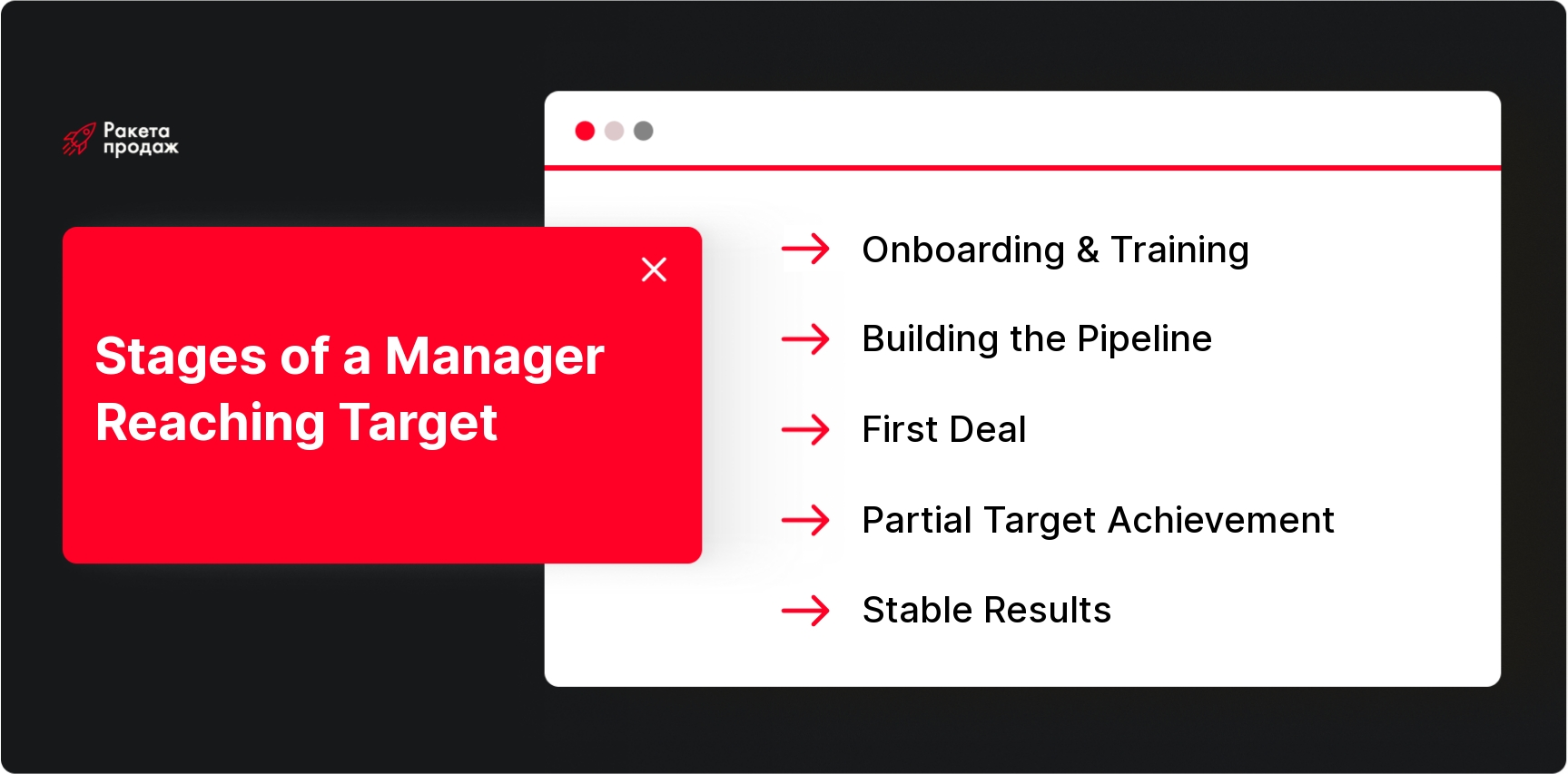
Reaching full sales plan fulfillment means something else entirely: the rep can consistently build enough pipeline and predictably close the required number of deals, month after month. The progression looks like this: first deal → repeatable deals → partial plan fulfillment → stable fulfillment of the full plan. Between the first and last steps of this chain, two to three full sales cycles might pass, and that’s a normal sales plan fulfillment rate for a complex product. To describe this path systematically, sales teams use the concept of ramp-up.
What Is a Sales Manager's Ramp-Up
Ramp-up is the period during which a new hire reaches full working productivity – the level of results considered standard for an experienced manager. It covers the time needed for training, learning the product, building a pipeline, completing the first full deal cycle, building a client base, and hitting target conversion rates at every stage of the funnel.
A company should plan for this period in advance, rather than judging a new hire by the same standards as a manager who’s been on the job for a year. A convenient internal model looks like this: onboarding → ramp-up → target productivity. By the way, under Ukraine’s Labor Code, the legal probation period is capped at three months, which also sets a natural upper limit for formally evaluating a new hire – although real ramp-up in complex sales can extend beyond that. Understanding ramp-up naturally leads to the question of how to structure a manager’s plan for this transitional period.
What a Manager's Plan Might Look Like During Onboarding
Demanding 100% of the financial plan from the first month is a classic management mistake that demotivates even strong candidates. It’s smarter to build a step-by-step model where the initial focus is on training, activity, and pipeline building, with financial numbers appearing gradually as the manager works through a full deal cycle.
Roughly speaking, it could look like this: the first period covers learning the product, CRM, and scripts, along with activity metrics (calls, meetings, proposals). The second period involves a partial financial target plus funnel metrics, say 30% of the standard quota. The third period, after completing at least one full sales cycle, means reaching 60%, and then the full standard plan. The numbers 30% → 60% → 100% here are purely illustrative – your company’s numbers could differ depending on deal cycle length and product complexity. This step-by-step logic leads to a practical question: how do you calculate the real, not theoretical, sales plan completion time for your specific team?
How to Calculate the Real Time It Takes a Manager to Reach the Plan
A useful working formula looks like this: time to reach the plan ≈ onboarding period + pipeline-building time + average deal cycle. But this isn’t pure arithmetic, because these periods partially overlap. A manager might start working with real clients while still learning the product, so simply adding up all the timeframes mechanically would be a mistake.
The most accurate way to assess sales plan fulfillment time is to use your own company’s historical data. Look at how long it typically takes new hires to get their first qualified lead, their first meeting, their first deal, 50% of plan, 80%, a first month at 100% fulfillment, and several stable months in a row – in other words, essentially how long it takes a sales manager to fulfill the sales plan at each intermediate stage. These numbers give you a real internal benchmark instead of a guess borrowed from someone else’s industry. And since we’ve brought up deal cycle as a key variable, let’s look at its impact separately.
How the Deal Cycle Affects the Speed of Sales Plan Fulfillment
The speed of sales plan fulfillment depends directly on how many steps a client goes through from first contact to payment. In transactional sales, a new hire gets feedback quickly: results show up within days, mistakes get corrected on the fly, and enough data accumulates within a couple of weeks.
In an average B2B cycle, the picture is different. Results show up later because the manager first has to build up enough pipeline for some deals to reach the finish line. In complex B2B sales or manufacturing, the financial outcome can lag significantly behind the manager’s actual activity due to tenders, technical approvals, legal formalities, and production timelines. In these models, it makes more sense to evaluate a new hire’s first months using leading indicators – number of meetings, qualified opportunities, pipeline volume – rather than revenue alone. Since outside benchmarks are so unreliable, the logical next step is to build your own.
How to Determine a Normal Average Plan Fulfillment Rate for Your Company
To understand average sales plan fulfillment at your company, it’s more useful to gather 6-12 months of data on your own team instead of relying on some abstract market norm. For each manager, look at their assigned plan, actual results, sales plan fulfillment percentage, tenure, number of leads, pipeline volume, average deal size, stage-by-stage conversion, and how seasonality affects results.
Compare three groups separately: new hires in the ramp-up period, employees who’ve completed onboarding, and stable, experienced top performers. This breakdown will immediately show whether the plan is realistic and how much time is typically needed to ramp up in your specific sales model. It’s also worth calculating the average sales plan fulfillment percentage for each of the three groups – this will reveal the real spread, rather than a single averaged number. For instance, ramp-up period practices at Western companies confirm that without an internal benchmark, any standard remains just a hypothesis. Once you’ve gathered this data, you have a tool not just for evaluating the plan, but for spotting managers who are moving toward their target too slowly, early on.
How to Tell a Manager Is Moving Too Slowly Toward Plan Fulfillment
It’s important to spot pacing problems before the end of the reporting period, not after a failure becomes obvious on the last day of the month. There’s a set of warning signs that flag risk early, and they’re worth checking regularly, not just at the final team meeting.
- The pipeline is smaller than needed, given the average conversion rate at each funnel stage.
- Too few new qualified opportunities appear each week compared to the norm for that stage of ramp-up.
- Intermediate conversion rates are dropping – for example, between a call and a meeting, or between a proposal and signing.
- Deals sit stagnant for a long time, with no next step scheduled, or it keeps getting pushed back.
If, by mid-month, the math already shows there’s not enough pipeline to hit quota, waiting for a miracle by the 30th makes no sense – you need to act right away. But even when a problem is caught in time, it’s important to figure out exactly what’s preventing the manager from closing deals on schedule.
What Prevents Timely Sales Plan Fulfillment and How to Overcome Common Barriers
More often than not, sales plan fulfillment time gets derailed not by one big cause, but by a set of familiar bottlenecks – essentially, common sales mistakes that repeat month after month. A manager loses focus juggling several deals at once, then scrambles frantically in the last days of the month to “catch up” on the plan instead of working systematically throughout the whole period. Sometimes sales leaders themselves make the problem worse by fixating on activity (calls, emails) instead of the real result at each funnel stage.
Add to that employees who aren’t a good fit for the role, a short planning horizon with no intermediate checkpoints, resistance to changes in the sales process, and poor communication between manager and sales lead. Here’s how it works in practice: setting clear micro-goals at the start eases anxiety and gives the manager a clear path forward. Transparent monthly planning broken down by week helps avoid a last-minute scramble. And a consistent process, attention to developing communication skills, and careful hiring reduce the risk that this problem repeats with every new person on the team. Sometimes, though, the issue isn’t the specific manager but the plan itself, and that’s worth checking separately.
How to Tell the Problem Isn't the Manager, but the Plan
There are clear signs of an unrealistic plan that become visible when you look at the whole team at once, not just one person. If most experienced managers consistently fail to hit it, and even top performers rarely reach 100%, the issue is more likely in the numbers than in the people.
Check whether the plan requires more leads than marketing actually generates, and whether the required number of deals exceeds what one manager can physically handle. Look at whether the plan increased without any change in lead flow or market size, whether it accounts for seasonality, and whether the average deal size used in the calculation is inflated compared to actual figures. If the deal cycle has gotten longer but the plan stayed the same, the gap between expectations and reality will only keep growing. Chronic plan failure across the whole team almost always calls for revisiting the planning system, not mass firing employees. But sometimes the opposite is true, and the cause really does lie with a specific individual.
How to Tell the Problem Really Is the Manager
The opposite situation looks like this: other reps, with a comparable lead flow and the same conditions, consistently fulfill the sales plan, while one particular manager falls behind repeatedly. If they qualify leads worse, book fewer meetings, show lower conversion at every stage, follow up slowly, lose deals at the final stage, or fail to maintain enough pipeline, the cause is more likely their skills or how they organize their own work.
It’s important to look not just at the final sales number, but at exactly which funnel stage the deviation from the norm shows up. If the gap starts as early as first contact, that’s one story with one set of solutions. If the problem only shows up at the final closing stage, that’s a completely different story, and it needs to be addressed specifically, not with generic sales training for managers for the whole team.
As this article has shown, there’s no single sales plan completion time – there’s only your own deal cycle, your own ramp-up, and your own checkpoints, which need to be measured and tracked. Gathering this data yourself, building a step-by-step 30% → 60% → 100% model, and separating a manager problem from a plan problem is a task that takes time and expertise that a sales manager buried in day-to-day operations often doesn’t have. “Rocket Sales” handles this process end-to-end: we audit your funnel, calculate the real ramp-up period for your product and deal cycle, implement KPIs and dashboards to spot underperforming managers early, and train your team to close gaps at specific funnel stages. Our partners include Mitsubishi, Yamaha, and Naftogaz, and our clients overachieve their plans by an average of 112% and see revenue growth of up to +35% in the first months of working with us. Stop losing revenue by guessing at timelines and retraining new hires blindly – build a system where reaching the plan is measurable and manageable from day one.
Shorten your new managers' path to 100% plan fulfillment with guaranteed revenue growth - get a free sales department audit right now!
The speed of sales plan fulfillment can’t be evaluated separately from the sales model and a specific manager’s maturity. A transactional business with a short cycle delivers results in weeks, complex B2B takes months to build a pipeline, and both situations are equally normal for their conditions. Rather than searching for a universal market norm, it’s far more productive to measure your own company’s ramp-up, tie it to the real deal cycle, and set clear checkpoints from a new hire’s first weeks through stable fulfillment of the full quota. This approach turns the abstract question of how much time is needed to fulfill the sales plan into a concrete, measurable, and manageable process that you can use for hiring, onboarding, and sales planning for years to come.


 Time to read: 9 min.
 23 September 2026