icon

Breaking Down a Real Cold Call Scenario

Evaluating a cold call “on average” is almost pointless. The same phrase sounds fine in one context and kills the conversation in another. That’s why in this article we’ll break down not generic advice, but a specific scenario: what the manager said, how the client reacted, where the conversation went as planned, and where the manager lost attention and the next step.

Want a high-performing sales team without the hassle?
We’ll build it for you.
Contact Us

Key Takeaways

  • Weak managers start with a company and product pitch, strong ones first check whether the client has a real problem.
  • Your call fails not because of objections, but because of a lack of questions to the client before you start offering something.
  • The phrase “send it to my email” without a follow-up date and a specific topic means the lead is lost.
  • An early presentation kills the conversation because the client hears a promotional monologue instead of a solution to their problem.
  • A successful cold call doesn’t end with a sale, but with a fixed next step (a call, an email subject line, a return date).

In the article below, you’ll see a real cold call scenario, specific mistakes at each stage, and an improved version of the conversation with an explanation of why it works 👇

First, we’ll give the context of the call, then the dialogue itself, and after that we’ll break it down stage by stage, find the mistakes, and show how it could have been said differently. This kind of cold call analysis is more useful than any theory because it shows the mechanics using a real example, not general statements.

In What Context Does the Cold Call Happen

Before breaking down the conversation itself, it’s important to understand the background. The manager works at a B2B company that specializes in reporting automation and CRM system audits. He’s calling the head of sales at a mid-sized company that, based on open data, is growing and most likely uses a CRM without deep reporting setup.

The contact wasn’t chosen randomly. The company ended up in the database as potentially relevant because similar clients usually run into the problem of funnel transparency as their team grows. The goal of the call at this stage isn’t to sell an audit, but to check whether the person on the other end actually has this problem, and to agree on a next step if the hypothesis is confirmed.

Without this context, cold call analysis turns into an abstract “did I like it or not” judgment. The same phrase can be perfectly fine for a warm lead who submitted a request themselves, and a total failure for a cold contact who wasn’t expecting a call at all. That’s exactly why we’ll keep this context in mind at every stage of the conversation going forward.

Does this situation sound familiar: managers make dozens of cold calls, but the results are minimal? Or every salesperson works off their own “signature” script, and as a leader you have no idea exactly where potential clients are being lost? This is a typical problem for 80% of companies trying to build cold sales without a systematic approach. Over 8+ years, “Sales Rocket” has developed a comprehensive methodology for training cold calling that includes analysis of real conversations, personalized scripts for each segment, and a quality control system. We don’t just run trainings – we completely rebuild the process: from auditing current calls to implementing clear algorithms and continuous results monitoring. We’ve built 208 sales departments across 14+ industries, where teams consistently hit 150% of plan every month. Our clients see an average conversion increase of +35%, and the best result from cold calling has been an 86% increase in the number of meetings booked.

Turn cold calls into a systematic source of new clients - get a free audit of your team's calls!

The Goal of a Cold Call: What the Manager Should Get by the End

Many cold calling mistakes start before the manager even picks up the phone, because the goal of the call was set incorrectly. In B2B, the first cold contact rarely should end in a sale. A far more realistic goal is to check relevance, understand whether there’s a problem, reach the right person, or agree on a short next step.

If a manager sets a goal of “sell in two minutes,” they inevitably start rushing, overload the conversation with a presentation, and lose the client mid-sentence. In practice, conversion typically stays in the single-digit percentages, so a realistic goal for the first contact is more modest than it seems: get agreement for a short call, send relevant material with a specific topic, or confirm that the topic is relevant and it’s worth coming back in a week. That’s exactly why effective cold calling techniques are built not around a presentation, but around checking relevance and getting agreement on the next step.

In our example, you’ll see how the lack of a clear goal turns the call into a product monologue with no real outcome. Next, we’ll break down the dialogue itself and see this mistake in action.

Example of a Cold Call: The Original Scenario

Below is a real, reconstructed call scenario that contains typical weak spots. Names are fictional.

Manager: Good afternoon! My name is Andrey, I represent the company “Dataflow,” we handle CRM and reporting automation for sales departments. Is it a good time to talk?

Client: Well, I have a minute, go ahead.

Manager: Great! We’ve been in business for seven years, we have over two hundred clients, including large manufacturing and logistics companies. We help set up dashboards, automatic sales funnel reports, integrations between CRM and other systems, and we have ready-made templates for different industries.

Client: Okay, so what exactly are you offering?

Manager: We can do a free audit of your CRM, look at how your reporting is set up, find bottlenecks, and propose a solution. It takes a couple of meetings, and we have flexible pricing.

Client: Look, we’ve basically got everything set up, our managers work in the system, we have some reports. We’re not really interested right now.

Manager: Why not? A lot of clients thought that too, and then found serious gaps.

Client: Maybe, but now is definitely not the time. If anything, just send info to my email, we’ll take a look.

Manager: Sure, of course, I’ll send it. Thanks for your time, have a great day!

Client: You too, goodbye.

cold call example — Illustration of a typical cold call with a salesperson monologue and a disengaged client

Quick Takeaway on the Call: What Went Wrong

Looking at the call as a whole, the manager reached the right person but didn’t turn the contact into a result. He moved too quickly into talking about the company and the product, without finding out whether the client actually had a real reporting problem. There were almost no questions to the client, and when faced with the “not interested” objection, the manager tried to push rather than understand.

The ending of the conversation sounds polite, but it’s actually a failure. “Send it to my email” without any specifics almost always means nobody will open that email. The manager didn’t lock in a topic, a follow-up date, or even the contact’s name – only their job title.

It’s important not to turn this into a takedown of one specific manager. These kinds of cold calling mistakes are typical and show up on most teams, because the issue is usually not the salesperson’s personality, but the lack of a clear conversation structure. Next, we’ll break the call down stage by stage and show exactly where the initiative was lost.

Cold Call Analysis Stage by Stage

A cold call is best analyzed not through a general impression, but through specific stages, each with its own goal. This approach to cold call analysis lets you see exactly where the conversation went wrong, instead of just saying “the call was weak.”

Typically, these stages are identified: opening the conversation, introduction and context, reason for the call, relevance check, questions to the client, a short value hypothesis, handling objections, the next step, and locking in the result. At each stage, the manager has a specific goal, and it’s that goal’s achievement that should be evaluated – not the general feeling of “did I like the conversation or not.”

In our example, some stages were skipped entirely, while others were done just for show. Next, we’ll go through each of them, starting from the very beginning of the call.

Stage 1. Opening the Call: Why the First Seconds Matter So Much

The first 10-15 seconds of a call decide whether the client will keep listening or start looking for a way to end the conversation. In our example, the manager said hello, introduced himself, and asked if it was a good time to talk – that’s fine. But then came a classic mistake: “we’re a company that does…” instead of explaining why the call might be relevant to this specific person.

This kind of opening sounds formulaic because the client has already heard it dozens of times from different salespeople. The client instantly recognizes the “they’re calling to sell me something” pattern and switches into defense mode, even if they’re technically still listening. The difference between “we do CRM automation” and “I’m calling because I noticed that companies like yours often struggle with funnel reporting” is huge, even though both phrases are saying roughly the same thing.

A stronger phrasing is built from three parts: a brief introduction, the reason for the call, and a connection to the client’s role or task. For example: “Andrey, from Dataflow, I’m calling heads of sales departments whose teams have grown and it’s gotten harder to keep track of plan vs. actual numbers for each manager – does that sound like your situation?” This kind of opening moves straight into the next stage: explaining why the client should even bother listening further.

Stage 2. Call Context: Why Should the Client Keep Listening

The client in a cold call wasn’t expecting the conversation and has no obligation to be interested just because the manager called. This means the job of the first few sentences isn’t just to introduce yourself, but to quickly explain the context: why you’re calling right now, who you usually work with, and what problem you solve.

In the scenario we analyzed, this step was completely missing. The manager went straight from the introduction to listing the company’s capabilities, skipping the explanation of why this should matter to this particular client. As a result, the conversation sounded like an ad, not a personal offer.

An alternative could have sounded like this: “I’m calling because we work with B2B companies where the sales department is growing, but it’s getting harder for the manager to see plan vs. actual and funnel drop-offs in real time.” This kind of phrase doesn’t sell the product – it describes a situation the client might recognize themselves in. And if there’s no recognition, that’s also a fine result, because then you can quickly check relevance and not waste time.

Stage 3. The Mistake of an Early Product Presentation

One of the most common cold calling mistakes, visible in our example, is jumping into a product presentation before the manager understood the client’s situation. Andrey talked about seven years in the market, two hundred clients, dashboards, and integrations before even finding out whether the topic of reporting was relevant to this specific person.

As a result, the client heard not a solution to their problem, but a promotional monologue, to which they politely but firmly responded, “we’ve got everything set up already.” That’s a classic defensive reaction to a presentation that knows nothing about the listener’s actual situation.

In a cold call, the presentation should be minimal and sound like a hypothesis, not a statement. Instead of “we have the best CRM audit service,” a phrasing like “often companies at your stage of growth have their reporting set up, but managers still waste time on manual exports – is that relevant for you?” works better. This approach doesn’t pressure the client and leaves room for them to say yes or no, without feeling like something’s being pushed on them.

Stage 4. Questions to the Client: What Was Missing from the Script

In the original scenario, the manager asked the client almost no questions at all. Because of this, he never found out who’s responsible for reporting, whether there’s actually a current problem, whether the current process is satisfactory, or whether it’s even worth digging deeper into the topic. Without questions, any product presentation turns into shooting in the dark.

Good questions for a cold call are short and sound like normal human speech, not a ten-point interrogation. Here are a few examples that could have been used in the conversation we analyzed:

  • “Can I ask, do you personally keep track of plan vs. actual for your managers, or does someone else handle that?”
  • “Is funnel transparency something that’s relevant for you right now, or is the current process working fine?”
  • “How are you currently handling reporting – manually in Excel, or through the CRM?”
  • “Would it make sense if I quickly showed you how similar companies at your stage usually handle this?”

Even a couple of these questions would have given the manager material to make the presentation specific instead of generic. It’s questions, not a company overview, that move a cold call forward to the next stage of the conversation.

Stage 5. The "We're Not Interested" Objection: How the Manager Handled It

When the client said “we’re not really interested right now,” the manager reacted defensively: “Why not?” and tried to keep pushing the idea of an audit. This kind of reaction often increases resistance, because it sounds like arguing rather than an attempt to understand the other person.

A better way to handle objections in cold calls is calmer: accept the client’s reaction without arguing, clarify the reason, and gently bring the conversation back to the question of relevance. For example: “I understand – so I don’t waste your time, let me just check one thing: is the issue of tracking sales drop-offs already handled on your end, or is it just not a priority right now?”

The difference between these two approaches is that the first feels like an attempt to force a decision, while the second feels like a genuine desire to understand. The manager’s job at this stage isn’t to convince the client that the topic matters, but to understand exactly what they’re dealing with: a real refusal, a lack of relevance right now, or simply an automatic defensive reaction to an incoming call. This understanding determines whether it’s worth continuing the conversation or better to politely close it and come back later.

Stage 6. The "Send It to My Email" Objection: Why It's Not a Real Next Step

The phrase “send it to my email” sounds like a compromise, but most of the time it’s just a polite way to end the conversation without any commitment. The manager’s mistake in the scenario we analyzed is that he immediately agreed and said goodbye, without clarifying anything specific or agreeing on a follow-up contact.

The better move at this point is to ask a clarifying question that turns “send it to my email” into a concrete agreement. For example: “Of course, I’ll send it over. So I don’t send you a generic text, can you tell me what’s more relevant for you: manager oversight, plan vs. actual on the funnel, or lead quality?” This kind of question makes the email personal and gives a reason to follow up on a specific topic.

It’s also worth clarifying who will actually look at the email, and proposing a specific follow-up date: “I’ll send it today, and on Thursday I’ll drop a quick message or call to see if it makes sense to move forward.” The main point here is that an email with no connection to a next step almost never turns into a sale – it just delays the rejection by a couple of weeks.

Stage 7. Wrapping Up the Call: Was an Agreement Actually Locked In

A good cold call ends with a concrete result: a scheduled meeting, an agreed-upon follow-up call, an identified decision-maker, or at least a clearly documented reason for the refusal. In the scenario we analyzed, none of this happened – the manager only got a generic “send it to my email” and a polite goodbye.

This kind of ending looks neutral, but in practice it means the lead will almost certainly be lost. Without a date, a topic, and an agreement on a follow-up contact, the email goes into a general folder and gets forgotten, and the manager moves on to the next call with no clear idea of what to do with this client going forward.

Even if the conversation doesn’t lead to a meeting, the minimum result should be at least a clear reason for the refusal and a note in the CRM that will help you come back to the contact at the right moment. This brings us to the next step of the analysis: gathering all the mistakes we found in one place.

The Main Cold Calling Mistakes in This Example

If we gather everything we’ve broken down stage by stage, we get a list of typical cold calling mistakes that show up far beyond just this one scenario. Each one on its own doesn’t look critical, but together they drag the call’s conversion down to almost zero.

  • Weak context and a formulaic introduction: the client never understood why this call was relevant to them specifically and just heard a generic story about the company instead of a personal reason for the call.
  • Presenting too early without checking relevance: the manager started talking about the product before finding out whether the topic was relevant to the client at all.
  • Too few questions to the client, which left the presentation generic instead of tied to the person’s actual situation.
  • Objections were handled head-on, through arguing or pushing, instead of through clarifying questions.
  • “Send it to my email” was treated as the result of the call, instead of a reason to agree on a specific next step.
  • No next step was locked in, and there’s almost no data for the CRM aside from the contact’s job title.

Each of these mistakes affects conversion in its own way: the client shuts down faster and wants to end the conversation, the manager doesn’t understand the real situation, and the next contact – if it even happens – becomes a formality that once again doesn’t move the deal forward. But before rewriting the whole scenario, it’s worth acknowledging what actually went well in this call.

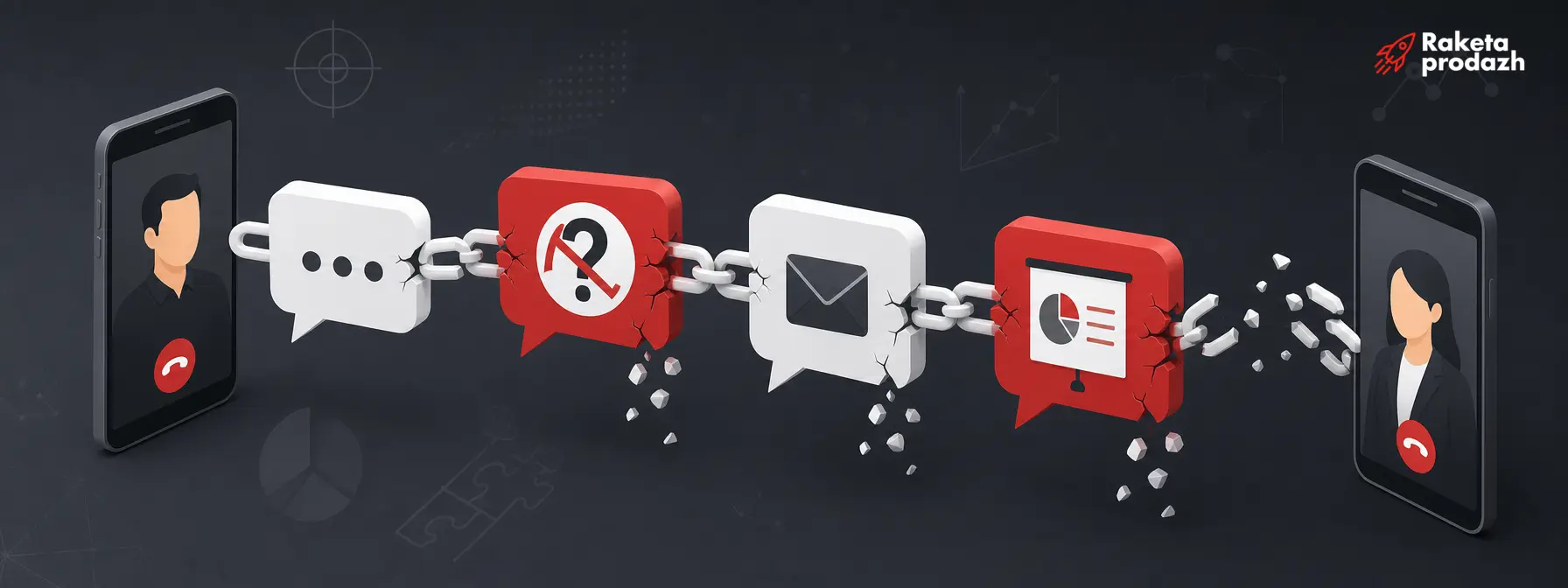
cold call mistakes — Schematic illustration of a chain of mistakes during a cold call

What the Manager Did Right

Cold call analysis shouldn’t turn into criticism for criticism’s sake, because even a weak conversation almost always contains some good elements. In our example, the manager reached exactly the right role – the head of sales – rather than some random employee, and that’s already half the battle for a cold contact.

He spoke fairly concisely, didn’t drag out his lines, and didn’t push aggressively on the client even after hearing a refusal. Agreeing to send materials by email is also a fine step on its own – the problem isn’t the action itself, but the fact that it was left with no connection to further contact. The point of the analysis isn’t to “tear apart” the manager, but to figure out which elements of the conversation are worth keeping, which need strengthening, and which should be replaced entirely in the next version of the script.

Improved Version of the Cold Call

Below is the same call, but with a stronger structure. It’s not perfect and not super long, but it’s controlled and reflects customer-centricity in sales rather than a product pitch.

Manager: Good afternoon, this is Andrey, from Dataflow. I’m calling heads of sales departments whose teams have grown over the past year – literally one minute, is now good?

Client: Yes, I’ve got a minute.

Manager: Great. We usually get brought in when it becomes hard for a company to see plan vs. actual for each manager and reports have to be pulled together by hand. How’s that for you right now – does that sound familiar, or is everything pretty transparent?

Client: Well, partly yes, we pull some reports together in Excel, and it takes up a lot of time.

Manager: I get it, that’s a common situation as teams grow. Can I ask, who usually handles those reports – you personally, or one of your managers?

Client: I handle it myself, but I don’t always have time to really dig into it.

Manager: Then this might be useful: we do a short CRM audit, show you where time is being lost on manual work, and suggest what could be automated. It’s usually a 30-minute call based on your company’s actual numbers. Does it make sense to take a look?

Client: Look, right now isn’t really the best time, too much going on.

Manager: I understand. So I don’t waste your time, let me just check: is automating reports just not a priority for you right now, or is it more that you simply don’t have time to dig into it yourself?

Client: More the second one, honestly, I just haven’t gotten around to it.

Manager: In that case, here’s what I’ll do: I’ll send over a short example of what this kind of audit looks like for a similar company – no generic text, specifically about manual reporting. And on Wednesday I’ll drop a quick message or call to see if it’s worth moving forward. Does that work?

Client: Yeah, let’s do that, sounds fine.

Manager: Great, thank you, talk to you Wednesday then.

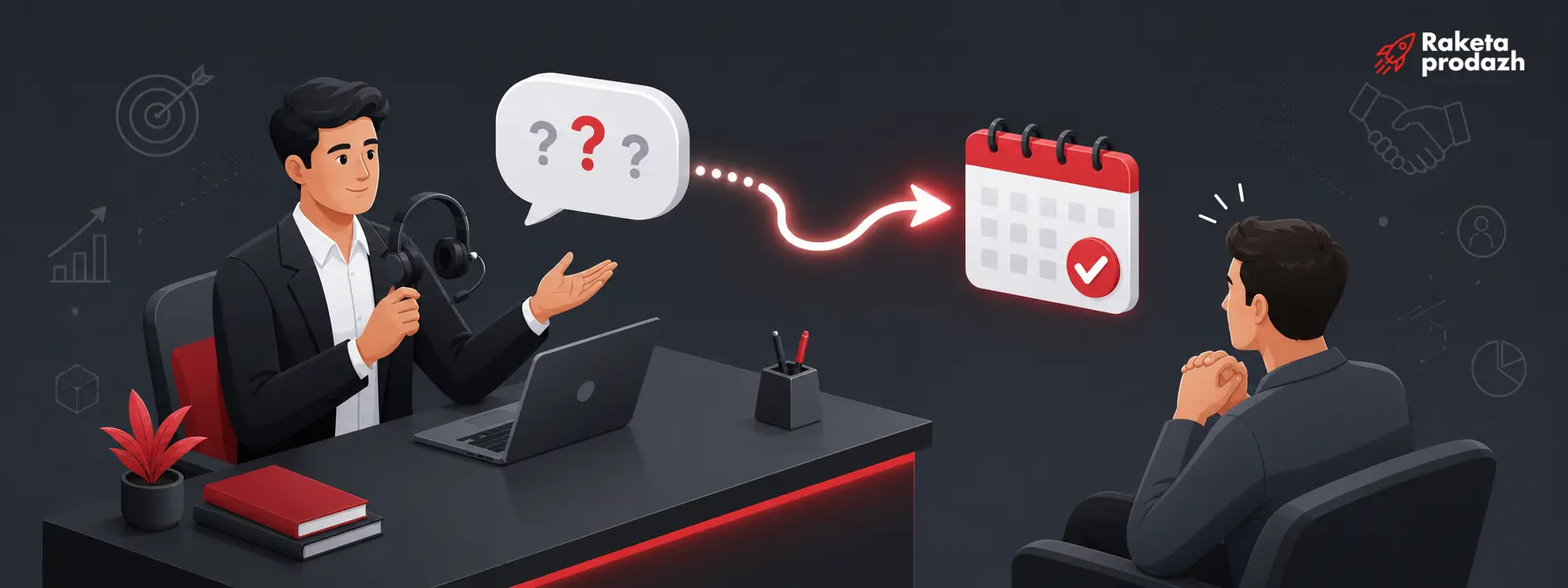
improved cold call script — Illustration of an improved cold call script ending in a clear agreed next step

Why the Improved Script Works Better

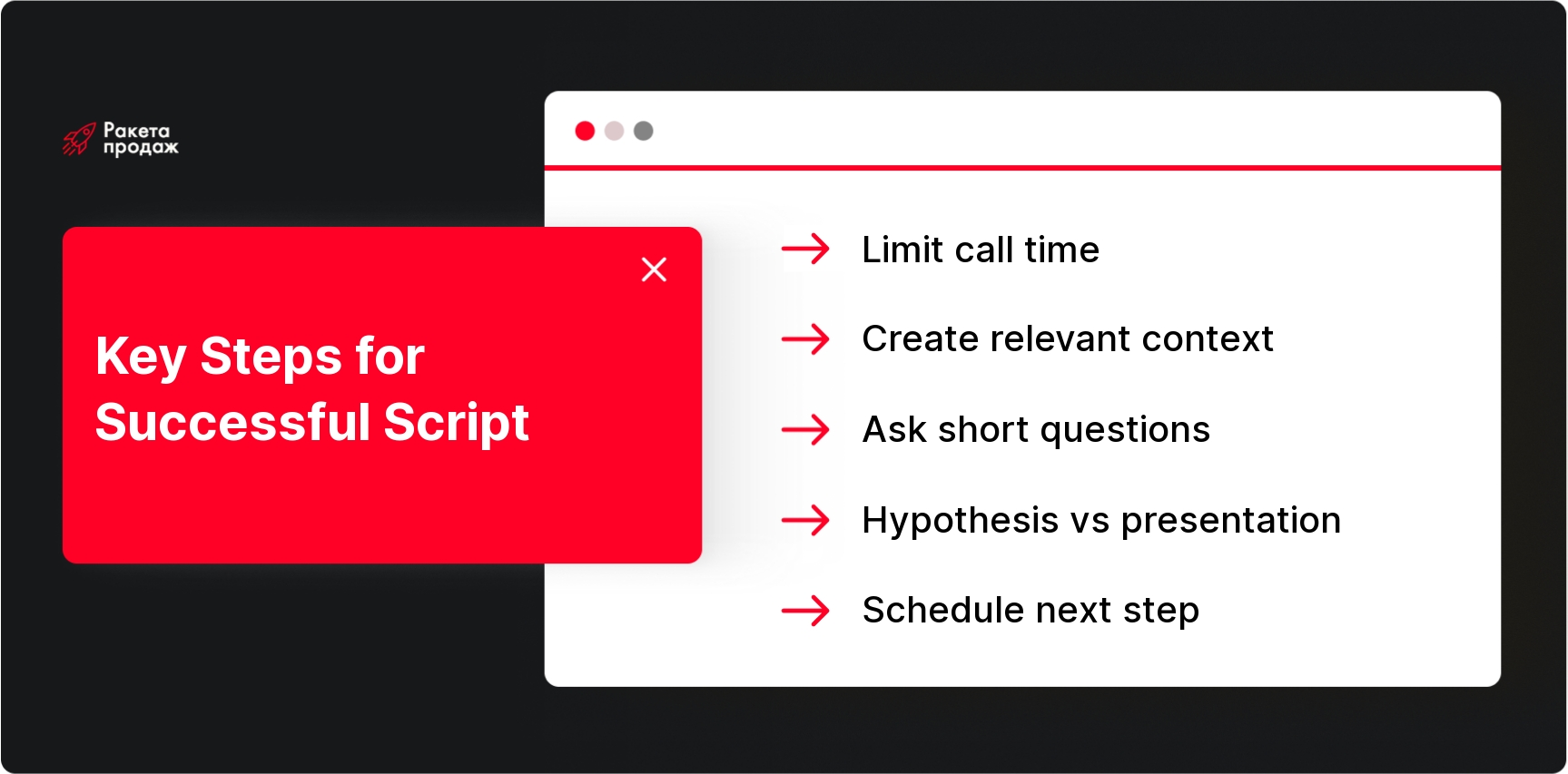
The difference between the two versions isn’t about the length of the conversation or the manager’s eloquence – it’s about the structure and logic of the dialogue. The improved version immediately limits the length of the call, which lowers the client’s tension and increases the chance they’ll keep listening. From there, the manager builds context through a specific situation rather than a general company overview, and doesn’t overload the conversation with a presentation before understanding what’s going on with the client.

The key difference is that the manager checks relevance through short questions rather than statements. This approach is close to the consultative selling model, where the call is built around the client’s situation rather than a product presentation. He doesn’t argue with the “not the best time” objection – he clarifies its nature and adapts his message to the client’s response.

At the end, the manager gets a concrete next step with a date and a topic, instead of a vague “send it to my email,” and along the way collects data that can actually be entered into the CRM: who’s responsible for the topic, what the pain point is, and when to follow up. This example of a cold call shows that the strength of a conversation isn’t about length or pressure – it’s about clarity and relevance.

Analyzing cold calls is an important first step, but real results only come from systematically rolling out changes across the whole team. The mistakes broken down in this article show up in 95% of managers who work without structured scripts and regular feedback. “Sales Rocket” specializes in comprehensive solutions for cold sales problems: we audit calls, create personalized scripts for your industry, train your team in effective techniques, and implement a quality control system. Our methodology includes analyzing real dialogues, role-playing, objection-handling practice, and ongoing monitoring of each manager’s results. By the end of our work, our clients get a team that confidently makes cold calls, consistently books meetings, and turns them into deals. Our partners include companies like Mitsubishi, Yamaha, and Naftogaz. With 208 sales departments built, we know how to quickly fix weak spots in cold sales and deliver measurable results. Don’t waste months on your own experiments with an uncertain outcome.

Build a team that turns every cold call into a potential deal!

Conclusion

image

Cold call analysis is only useful when it’s based on a specific dialogue and clear criteria, not on a general feeling that “the call went fine.” The scenario we broke down shows that most mistakes aren’t about the manager’s weakness, but about the lack of structure, an early presentation, and not enough questions. To make cold calls work better, it’s not enough to just tell the team to “call more.” It’s far more useful to regularly review real scenarios, find specific cold calling mistakes in them, test out new phrasing as part of sales script development, and teach managers how to get a next step without pressuring the client.

In this article:
See more
Book a FREE sales funnel audit
CONTACT US
FAQ
What are the most common cold calling mistakes?

The most common ones are a weak context at the start of the conversation, presenting the product too early, too few questions to the client, and no locked-in next step by the end of the call.

How do you know if a cold call was successful?

A successful call doesn’t necessarily end in a sale. It’s enough if the manager checked relevance, learned about the client’s situation, and agreed on a specific next action with a date.

How can you improve a cold call script?

It’s worth shortening the company introduction, adding diagnostic questions, removing the early product presentation, writing out a clear next-step phrasing for common objections, and regularly running cold calling training sessions for the team.

SUBSCRIBE TO MY TELEGRAM CHANNEL
The most valuable sales information right on your phone!
icon

LOTS OF USEFUL INFORMATION, FREE TEMPLATES, AND CHECKLISTS ON MY INSTAGRAM

Materials and practical advice on sales growth in our blog: