icon

Real Estate Agent and Developer Sales Manager Motivation: Why a Simple Commission Doesn't Work

The real estate market plays by its own rules: deals drag on for months, clients get nervous about exchange rates and interest rates, and competition for strong managers grows every quarter. In this kind of environment, real estate sales manager motivation determines whether a sharp specialist stays on the team or leaves for a competitor offering a more transparent commission. A single bonus for a closed deal is often not enough: it pushes toward the finish line but doesn’t explain how to get there.

Want a high-performing sales team without the hassle?
We’ll build it for you.
Contact Us

Key Takeaways

  • Commission paid only for closed deals pushes managers to cherry-pick “hot” clients, ignore the CRM, and skip complex leads where the commission isn’t guaranteed.
  • Your funnel falls apart when only the final step gets paid, while all the intermediate stages (consultations, viewings, follow-ups) get no attention at all.
  • A strong real estate agent incentive system rewards how fast leads get processed, the number and quality of viewings, CRM discipline, and conversion at every stage – not just the signed contract.
  • A developer’s sales manager works with a specific pool of properties and a project-level plan, so their real estate sales manager KPIs include show rate, reasons for rejections, and database quality – not just the number of sales.
  • A workable model combines a base salary for stability, a commission or bonus per deal, a team bonus for hitting the plan, and income adjustments based on CRM quality and standards compliance.

In the full article, you’ll find concrete examples of real estate agent motivation at an agency and a developer’s manager, plus a step-by-step logic for tying commission and KPIs together in one system 👇

In this article, we’ll break down why the classic real estate agent commission doesn’t work the way it’s supposed to, what a real estate agent incentive system should include, and how to build KPIs that actually move the funnel forward instead of just recording the result. We’ll also look at real-world pay models used by agencies and developers.

Understanding What Makes Motivation in Real Estate Different

Real estate sales aren’t like retail or classic B2B. Here, a deal can stretch from the initial inquiry to signing the contract over several months, and the client’s decision is tied to emotions: security, status, investment, sometimes relocation due to the war. The manager operates under high uncertainty, where today’s hot client can vanish tomorrow without explanation, while a cold lead can suddenly warm up six months later and bring in a big commission.

That’s exactly why real estate agent motivation needs to account not only for the financial outcome but also for the specialist’s psychological resilience. It’s becoming increasingly important for agencies to build professional hiring processes, not just retain the people already on the team. A manager needs autonomy in decision-making, recognition for complex deals, and confidence that their effort on the intermediate stages is visible to management rather than dissolving into overall department statistics. Next, let’s look at why a single commission isn’t enough for that.

Why a Simple Commission Doesn't Work as the Only Motivator

A commission per deal is logical and easy to understand: close the contract, get paid. The problem is that it only motivates the final result, not the actions that lead to that result. A manager who’s paid exclusively for closed contracts starts behaving rationally from a purely self-interested standpoint: they pick only “hot” clients, ignore the CRM, put off follow-ups, and steer clear of complex deals where the commission isn’t guaranteed.

The client journey in real estate is long: inquiry, consultation, property selection, viewing, follow-up touchpoints, negotiations, paperwork, booking, contract, payment. If only the last step gets paid, every other stage is left without any management attention. A hypothetical property owner waiting for a second call will never get it, and a lead who’s “not ready right now” simply falls out of the database. That’s exactly why a real estate agent incentive system built on pure commission often delivers short-term results but breaks down funnel manageability over the medium term. Next, let’s talk about what real estate sales department motivation specifically needs to account for to close these gaps.

real estate sales managers motivation — A broken sales funnel where a manager picks only hot leads while the CRM is neglected

What Real Estate Sales Department Motivation Needs to Account For

A real estate sales department motivation system needs to link a manager’s income to the financial result while accounting for the specifics of a long funnel. At the same time, it’s important to separate tracking metrics from metrics that directly affect pay: lead processing speed, number of viewings, follow-ups, conversions, and CRM quality are all worth monitoring, but not every one of them needs to become a paid KPI.

Real estate sales department motivation can’t be limited to closed deals alone, because the quality of funnel management determines how many deals will even show up over the coming weeks. Lead processing speed, the number and quality of consultations, the number of scheduled and actually completed viewings, follow-up discipline, and CRM accuracy all directly affect how many leads make it to a booking and a contract.

Just as important are rejection reasons, repeat inquiries, and referrals: if a manager doesn’t record why a client said no, the company loses data it needs for product and marketing work. The system should reward the behavior the business actually needs: reacting quickly to a new lead, getting the client to a viewing, staying in touch after the first conversation, and working the database systematically rather than only chasing this week’s “warm” contacts. When motivation is built around these points, the manager stops cherry-picking convenient deals and starts managing the entire funnel. The logical next step is a well-thought-out real estate agent compensation system, and we’ll break down what it can consist of.

Does this feel familiar: sales managers each working on their own, chasing only hot clients and forgetting about the CRM? And sales plans getting hit or miss because it’s unclear what’s actually driving the result? This is a classic situation that most real estate agencies and developers run into when they lack systematic motivation. At “Sales Rocket,” over 8+ years we’ve built more than 208 sales departments across 14+ industries, including real estate, and we know how to turn chaotic manager work into a manageable sales funnel. Our expertise covers building motivation systems tailored to the specifics of the real estate market: from setting up KPIs by funnel stage to rolling out transparent pay schemes that motivate the team to focus not just on closing deals, but on lead-processing quality too.

Build a motivation system that boosts sales by +35% and makes your department's work predictable - get a free consultation right now!

Real Estate Agent Compensation System: What It Can Consist Of

A real estate agent compensation system is rarely built on a single element, and the more mature the agency, the more layers it has. Real estate agent commission remains the foundation, but around it a structure is built that balances short-term results with long-term work on the client and property owner database.

The specific set of elements depends on the business model: in-house agents work differently from independent agents on a partnership model, and selling properties requires different logic than rentals, exclusives, new developments, or commercial real estate. Still, most working schemes combine a similar set of tools.

  • A commission percentage for each closed deal, often graded by property type.
  • A fixed portion that gives the manager financial support during months with fewer deals and also eases sales team onboarding at the start of employment.
  • A bonus for hitting the plan and a higher commission rate for exceeding it.
  • A bonus for an exclusive property, direct work with a property owner, a repeat client, or a referral.
  • A team bonus for hitting the department’s overall plan.
  • Penalties or restrictions for breaking CRM discipline, and withholding part of the bonus until the deal is fully closed.

This combination makes it possible to build a real estate agent incentive system that works for both quick results and database quality. A similar logic, with different emphasis, applies to real estate sales manager motivation at a developer.

Real Estate Sales Manager Motivation at a Developer

At a developer, the logic is a bit different, because the manager isn’t working with the open market but with a specific pool of properties and a plan for a specific project. They need to process incoming leads quickly, consult well, schedule and conduct viewings, keep the CRM gap-free, and bring the client through to booking, contract, and payment.

Developer sales department motivation is usually built on a combination of a fixed base salary, a bonus for hitting the personal and team plan, a commission or a fixed payout per deal, plus KPIs for intermediate funnel stages and CRM quality. If you leave only the commission in place, a predictable skew appears: the manager starts fighting for the hottest leads from advertising, while warm and cold contacts that need more attention go unprocessed. To truly motivate sales managers, KPIs need to cover the intermediate funnel stages, not just the final deal. At the scale of a single project, this means losing some potential sales that simply never made it to a viewing. Next, let’s look at exactly which metrics are worth tracking at the level of an individual manager.

Real Estate Sales Manager KPIs

The key real estate sales manager KPIs are: plan fulfillment, the number and value of closed deals, conversion between funnel stages, response speed, show rate, follow-up compliance, and CRM quality. That said, not all of these metrics should directly affect the employee’s pay: some of them are there for the manager to use for monitoring and diagnosing the funnel.

In practice, the set of metrics usually covers the entire funnel, from the first contact to the client’s repeat inquiry.

  • Speed of first contact and the percentage of leads processed out of the total flow.
  • The number of consultations held and viewings scheduled, plus show rate – that is, the percentage of clients who actually showed up to the viewing.
  • Conversion from lead to viewing, from viewing to booking, and from booking to contract.
  • Personal plan fulfillment and the total sales amount or commission earned.
  • CRM data quality and the number of overdue follow-ups.
  • Reasons for rejections, repeat inquiries, and client referrals.

These metrics come together into a clear picture: exactly where the manager is losing clients and what needs improvement. At the department level, a similar logic scales up into developer sales department KPIs.

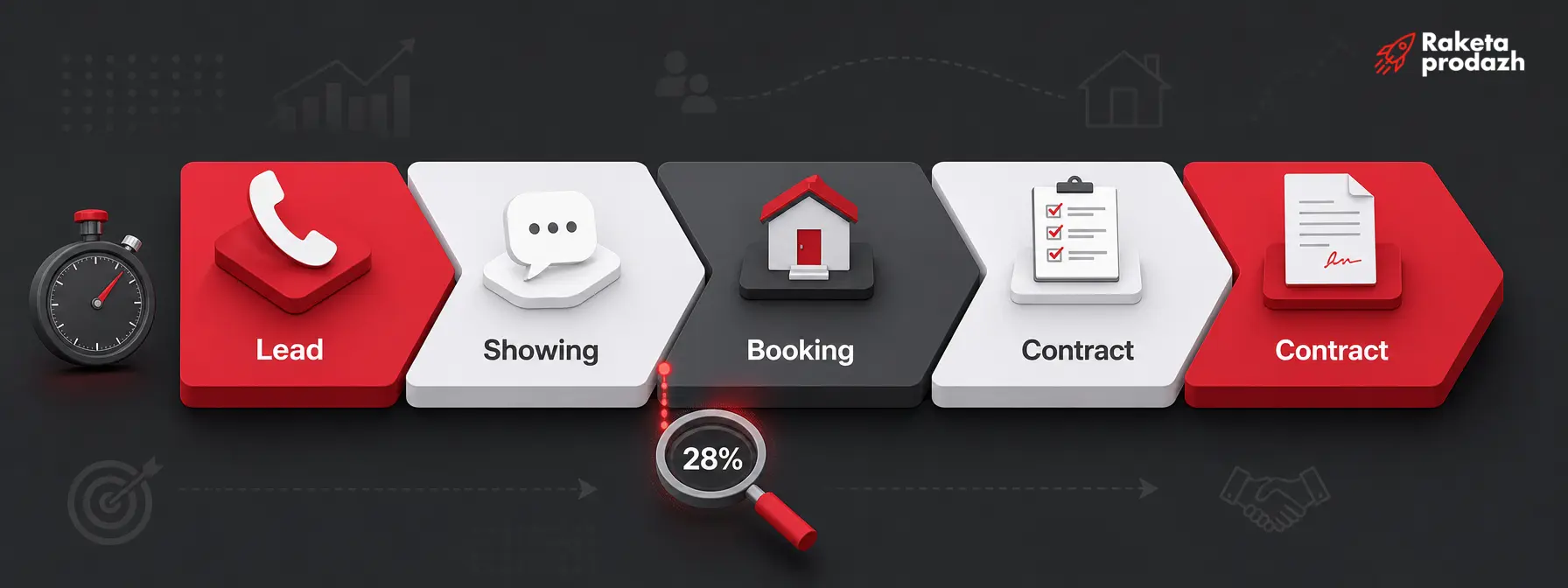
real estate sales manager KPI — A funnel stage diagram with key performance indicators for a real estate sales manager

Developer Sales Department KPIs

Developer sales department KPIs solve a different problem: they tie sales, marketing, and management of a specific property into one overall picture, rather than just assessing individual managers. It’s important for the head of the department to see how the funnel behaves at the level of the entire project, not just in terms of each employee’s personal results.

Here, the focus shifts to metrics that are rarely visible at the individual manager level but are critical for managing sales of the property overall.

  • Sales plan fulfillment for the property, the number of units or spaces sold, and total revenue.
  • Sales velocity for the property and conversion from leads to viewings, viewings to bookings, and bookings to contracts.
  • The share of missed calls and inquiry processing speed by channel.
  • Cost per deal broken down by advertising source and the effectiveness of those sources.
  • CRM quality across the whole department and plan fulfillment for each manager.
  • The rejection rate by main cause, to spot systemic problems rather than isolated cases.

When this data is gathered in one place, the manager sees not just “who sold more,” but exactly where revenue is being lost: at lead intake, at viewings, or at the contract-signing stage. The next step is logical: turn this data into a clear motivation system where commission and KPIs work together instead of competing with each other.

How to Tie Commission and KPIs Together in One Motivation System

Commission and KPIs shouldn’t be pitted against each other: commission ties a manager’s income to the financial result, while KPIs help track which actions actually produce that result. It’s better to include only a limited number of metrics in the pay system – ones within the employee’s sphere of influence – and use the rest of the metrics purely for management oversight.

There’s no need to throw out the per-deal commission, but it should become part of a broader system rather than the only source of income. A workable approach might look like this: the manager gets a base salary for financial stability, a bonus or commission for each closed deal, an additional bonus for hitting the overall plan, and income adjustments based on quality metrics.

A handy way to split things up: the results-based portion covers the fact of the deal, the process portion covers specific funnel actions (calls, viewings, follow-ups), and the quality portion covers CRM discipline, service, and compliance with client-work standards. That said, it’s important not to overdo it: if KPIs start “eating up” the entire paycheck and turn the salary calculation into a two-page formula, real estate agent motivation or developer manager motivation quickly loses its point.

An employee should be able to understand within a couple of minutes what they need to do today to earn more by the end of the month. Next, let’s see what this logic looks like in a concrete example at a real estate agency.

An Example of Real Estate Agent Motivation at an Agency

Let’s break down a conditional model without tying it to specific figures, just to show the logic rather than the “one correct” scheme. Incidentally, a similar principle is used by international brokers too: for example, Tranio combines a base salary, a bonus for closed deals, and an open grading system. The agent earns a real estate agent commission for each closed deal, and that percentage grows if the specialist hits their personal plan for deal count or turnover for the month.

There’s also a bonus for handling an exclusive property, for a repeat client, or for a referral that brought in a new buyer. The key condition for getting the full bonus amount, not just the base part, is correct CRM record-keeping and a complete deal document package: without that, part of the payout can be held back until the data is put in order. Separately, a team bonus kicks in when the agency hits its overall plan, which pushes agents to share leads and help each other with tricky deals. This kind of real estate agent incentive system shows that income is built not just on closing deals, but on quality work with the database, property owners, and repeat inquiries.

realtor motivation in a real estate agency — An example of a realtor's motivation structure combining salary, commission, and bonus

An Example of Developer Sales Manager Motivation

At a developer, the model is usually built around predictability and funnel manageability, not just around one manager’s personal result. The foundation is a fixed base salary that gives the specialist financial stability regardless of seasonal demand fluctuations. On top of that comes a bonus for hitting the personal plan and a separate payout for each booking that actually turned into a contract, rather than staying on paper.

A team bonus kicks in when the whole group of managers hits the plan for the property, which encourages them to help each other during peak loads, for example when launching a new building. In parallel, KPIs run for lead-processing speed, CRM discipline, and conversion from viewing to booking, and if there are too many overdue tasks or unprocessed inquiries, part of the bonus can be capped. This kind of real estate sales manager motivation supports not just the final deal, but the manageability of every stage: from the first lead to the signed contract and the actual payment.

Building effective real estate sales department motivation isn’t just about coming up with the right percentages and KPIs – it’s about creating a system that works long-term and fits the specifics of your business. Understanding the principles is one thing; implementing them so the team actually starts working by the new rules instead of sabotaging the changes is another. “Sales Rocket” specializes in comprehensive, turnkey sales department systematization: we don’t just design motivation schemes, we completely rebuild business processes, roll out CRM systems, build KPI systems, and train the team to work by the new standards. Our methodology includes analyzing current processes, developing personalized motivation schemes, implementing control tools, and providing ongoing support during the adaptation phase. The result? Our clients see an average turnover increase of +35%, with the best result being +$10,907,403 over 4 months of work. Our partners include companies at the level of Mitsubishi, Yamaha, and “Naftogaz.” Don’t spend months experimenting with a motivation system that might not work.

Get a sales department that consistently hits 150% of its plan every month!

Conclusion

image

Well-thought-out real estate sales manager motivation doesn’t come down to a single number in a contract. It combines commission, a fixed portion, KPIs by funnel stage, and intangible tools: recognition, sales manager training, mentoring, and honest feedback. This kind of comprehensive approach helps the team stay productive even during periods of falling demand or market turbulence. If you’re building a real estate agent compensation system or developer sales department motivation, start with a transparent formula and clear KPIs, not with an attempt to guess the perfect commission percentage. That way the team will understand what they’re getting paid for, and you’ll get a manageable funnel instead of a fight over hot clients.

In this article:
See more
Book a FREE sales funnel audit
CONTACT US
FAQ
What's the difference between real estate agent motivation and developer sales manager motivation?

An agent more often works on the open market and earns most of their income through commission, topped up with bonuses for exclusives and referrals. A developer’s manager works with a specific pool of properties, so their motivation is built around a base salary, funnel-stage KPIs, and bonuses for bookings that turned into contracts.

How do you keep a motivation system from getting too complicated?

An optimal motivation system should contain a limited number of metrics that the manager understands and can actually influence. The manager, meanwhile, can monitor far more funnel metrics without tying every single one of them to pay.

What should real estate sales department motivation look like?

It should reward not just closed deals but also good funnel management: speed of reacting to a lead, the number of viewings, follow-ups, and accurate CRM record-keeping. This kind of balance helps get more clients to a contract instead of losing them at intermediate stages.

SUBSCRIBE TO MY TELEGRAM CHANNEL
The most valuable sales information right on your phone!
icon

LOTS OF USEFUL INFORMATION, FREE TEMPLATES, AND CHECKLISTS ON MY INSTAGRAM

Materials and practical advice on sales growth in our blog: