Key Takeaways
- The first contact solves one task: filter out irrelevant prospects and schedule a meeting, not close a deal or deliver a product presentation.
- An SDR who starts with a template presentation or asks for “five minutes of your time” loses the lead before the dialogue begins.
- Qualification checks for pain points, monetary or time damage, deadlines, and the contact’s role – without this, the meeting turns into empty talk.
- Inbound leads require quick response and context reminders about their inquiry, while cold contacts need a trigger or case study from a similar industry within the first 20 seconds.
- Transferring a lead to an account manager without structured information about the client’s problem, decision participants, and current tools breaks the funnel at the next stage.
In the article below, you’ll find a step-by-step structure for qualification scripts, questions to verify client relevance, and specific phrasing examples for cold and inbound leads 👇
The task of the first contact with a customer is fundamentally different from a full sale. You shouldn’t close a deal on the first call – your goal is to establish contact, quickly explain the reason for reaching out, verify client relevance, and agree on the next step. A well-structured B2B sales script helps separate real buyers from those “just interested” and saves time for all process participants. Using an effective B2B cold calling script during initial outreach ensures you maintain prospect interest while gathering essential qualification data.
What is B2B Client Qualification and Why Do You Need a Script?
B2B qualification is the process of determining how well a potential client fits your ideal buyer profile and whether they’re ready to purchase within a reasonable timeframe. Without quality qualification, your managers waste time on “empty” meetings with people who lack budget, authority, or real need for the solution.
A B2B Client Qualification Script isn’t text for verbatim reading, but a structured conversation map. It helps managers conduct conversations with clear logic: introduce themselves, state the reason for contact, quickly check interest, ask the right questions, and propose the next step. A good qualification script leaves room for live dialogue while ensuring the manager doesn’t forget important points and gathers all necessary information for deciding on further work with the lead.
Does this sound familiar: you created a script, but managers use it formally, conversion remains low, and clients quickly end conversations? The problem isn’t that scripts “don’t work,” but that they’re not adapted to your business’s real specifics and don’t account for B2B buyer psychology. At “Sales Rocket,” over 8+ years we’ve created a systematic methodology for developing sales scripts that considers each funnel stage’s specifics and psychological triggers for decision-making. Our scripts don’t just structure conversations – they turn every contact into a qualified lead opportunity. We’ve built 208 sales departments across 14+ niches and know how to create scripts that actually work in field conditions.
Get scripts that increase first contact conversion to 86% - order turnkey development!
Using a structured approach is especially critical for teams with managers of varying experience levels – scripts help newcomers not get lost in conversations, while experienced staff maintain unified communication quality standards. An effective B2B sales script includes both qualification questions and ready blocks for presenting product value. If you’re unsure how to approach creating your scenario, turn to professional experience and case studies on creating and developing sales scripts to build the most effective conversation.
How First Contact Differs from Full Sales
The first contact with a client solves completely different tasks than a presentation or deal negotiations. At the first contact stage, managers shouldn’t tell detailed product stories, argue with objections, or try to close deals at any cost. Their main task is understanding whether there’s potential alignment between the client’s task and company capabilities.
Primary lead generation works on the upper part of the sales funnel. Your goal is to qualify the client, gather basic context of their situation, assess interest level, and either pass a quality lead to a sales manager or schedule the next meeting with a specific agenda. If you try to “sell” on the first call, the client will feel pressure and likely shut down.
Imagine the difference between networking introductions and commercial proposals – first contact with clients is more like the former. You study each other, identify common interests, and agree on a more detailed conversation if there’s mutual interest.
How to Prepare for a B2B Qualification Call
Preparation for the first contact with a potential client often determines the entire conversation’s success. SDRs (Sales Development Representatives) should research the company and specific person to personalize their approach and demonstrate serious attitude toward potential partnership. Understanding how to start a conversation with a potential client begins with thorough preparation and research.
Start by studying basic company information: business size, industry, main activity areas, geographical presence. Pay attention to recent events – leadership changes, investment rounds, new product launches, office moves, or significant team growth. These “triggers” often indicate potential needs for your services. It’s also important to understand which suppliers they already work with and what tools they use in their processes.
Research the specific contact through LinkedIn, corporate websites, and professional publications. Learn their position, area of responsibility, professional background, and interests. This helps you find the right conversation tone and select relevant examples from practice. Understanding what to say to a client during first contact comes precisely from quality preparation.
- Study their website, social media pages, recent press releases, and industry news
- Check if you have mutual connections or clients from similar companies
- Formulate a hypothesis about what tasks might be relevant for this business type
- Prepare 2-3 brief examples of working with similar clients
- Schedule call time considering industry specifics and contact’s position
Quality preparation not only increases your chances of successful conversation but also shows clients you take them seriously, not just calling through a database list. This also helps you understand how to qualify a lead most effectively.
How to Start a Conversation with a Potential Client
The first 20-30 seconds of conversation determine whether the client will listen further or try to end the conversation as quickly as possible. Your opening should be short, specific, and connected to the contact’s possible tasks, not your desire to sell something.
The structure of a successful opening looks like this: brief introduction of yourself and company, explanation of the call reason, quick indication of potential conversation value, and a question about availability to talk now. Avoid general phrases like “want to propose cooperation” – they tell the client nothing about why they should spend time talking with you.
Opening variations depend on contact source. For cold calls, mention a successful case with a similar company and specific problem you solved. For website leads – remind them they left an inquiry and clarify request context. For LinkedIn contacts – reference your correspondence or mutual connections.
B2B Cold Call Script: Basic Logic
B2B cold calls have special characteristics since clients don’t expect your outreach and may be suspicious. Your task is to explain as quickly as possible why this conversation could be useful specifically for them and get permission to continue the conversation.
Cold call structure should be especially compressed: introduction (10-15 seconds), call reason tied to client context (20-30 seconds), question checking topic relevance, 1-2 clarifying questions for basic qualification, and next step proposal. Total first cold contact duration rarely exceeds 3-5 minutes.
It’s critically important not to overload clients with information about your services on the first call. Instead of detailed product capability stories, better focus on understanding the client’s situation and getting agreement for more detailed conversation. Remember: the cold call goal isn’t to sell, but to get a meeting or more convenient time for full conversation. The script for the first call to a client should focus precisely on establishing contact, not selling.
To find the most relevant techniques, we recommend familiarizing yourself with effective cold calling techniques and testing them in practice in personal scenarios.
How to Conduct the First Conversation with an Inbound Lead
An inbound lead fundamentally differs from cold contact – the person already showed interest in your services by leaving an inquiry, downloading material, or writing in chat. This gives you an advantage but also imposes certain obligations regarding quality and response speed.
When working with inbound leads, it’s critically important to quickly react to the request and remind them of the inquiry context. The client might have filled out several forms on different websites and not remember what exactly they requested from your company. Start the conversation by reminding them where and when they left the inquiry, and immediately transition to clarifying their tasks.
How to have your first conversation with a client in the case of inbound leads requires deeper dive into needs diagnosis. Ask questions about what specifically the client is looking for, why they reached out right now, what criteria they have for choosing a contractor, who else participates in decision-making. Since interest is already shown, you can dive deeper into task details and discuss next steps more specifically.
Perfect Qualification Script Structure: Step by Step
An effective qualification script builds as a sequence of logically connected blocks, each solving a specific task. The main goal is getting maximum information in minimum time while making the contact feel comfortable, not creating an interrogation feeling.
Start with unusual or friendly greeting instead of standard phrases. Questions like “How are things?” or “How’s your mood?” break the cold call template and increase the probability the client will want to continue the conversation. After this, quickly indicate context and conversation value – who you are, why you’re calling, what benefit the conversation might bring. Use specific numbers or mention pain characteristic of the client’s industry.
Move to verification questions – they should be simple to answer but informative for understanding the contact’s role and topic relevance. Modern qualification frameworks like SPICED or MEDDIC offer structured approaches to gathering information about situation, decision-making process, and selection criteria. A competent first-touch script should include questions for lead qualification at each stage.
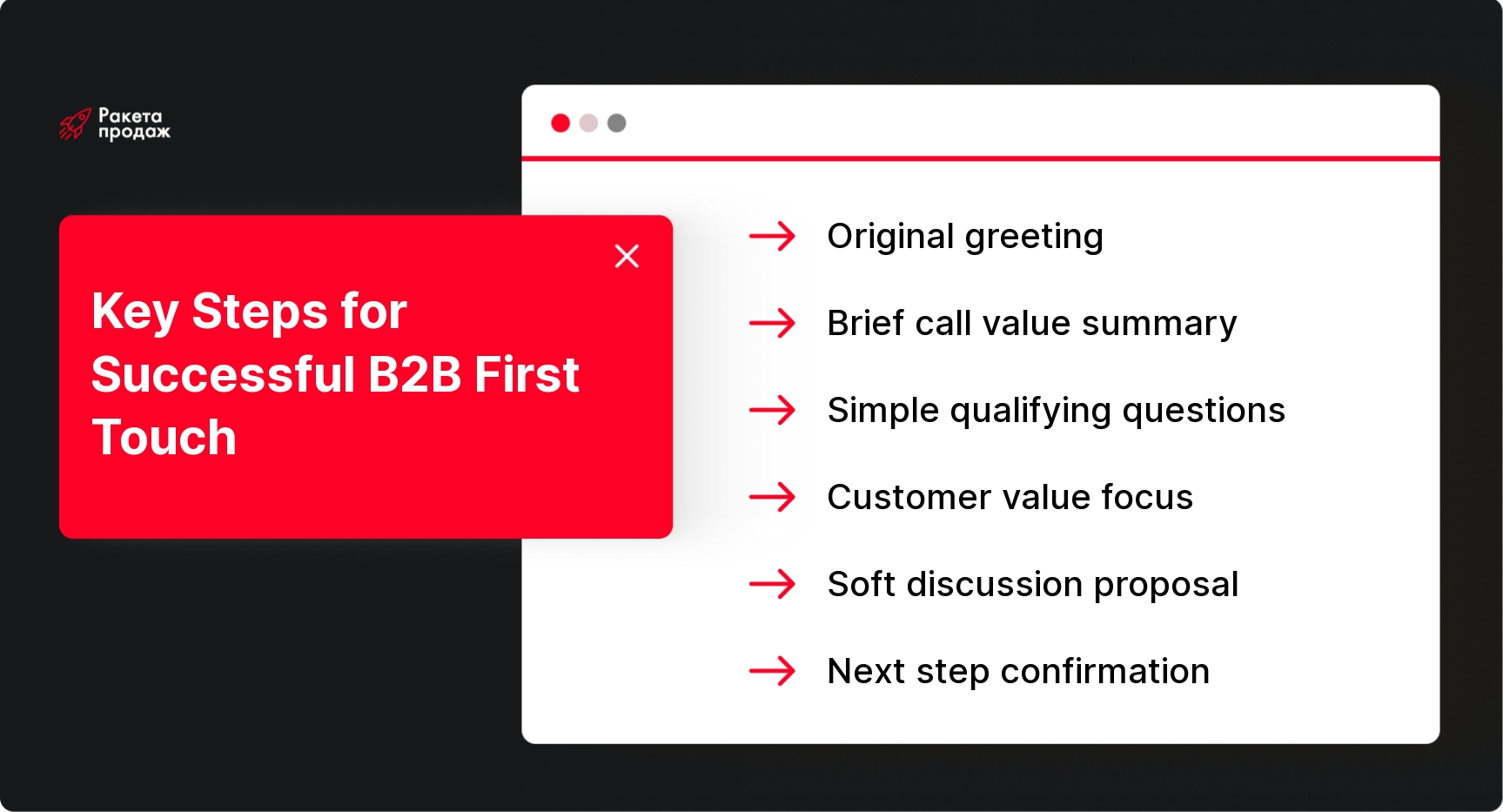
- Opening with pattern interrupt: Unusual conversation start instead of standard “is it convenient to talk?”
- Quick context and value: 15-30 second introduction focusing on client benefit
- Verification questions: Easy questions for understanding role, influence, and problem relevance
- Brief value presentation: Adapted to specific client situation
- Soft call to action: Proposal to discuss details instead of direct meeting request
- Next step fixation: Specific agreement with date and continuation format
End the call not with formal “thank you,” but clear next step fixation indicating time, format, and expected meeting results.
Qualification Criteria: What You Must Find Out
Quality qualification requires gathering information on several key criteria, without which subsequent lead work might be empty time waste. These criteria help understand not only client need but also their purchase readiness. Understanding how to conduct initial lead qualification is critically important for entire sales funnel success.
Start by studying current situation – how the client now solves the task, what tools or processes they use, what satisfies them and what doesn’t. This provides starting point understanding and helps formulate proposals in existing solutions context. Using comprehensive questions for the Lead Qualification helps reveal the complete picture of the prospect’s current state.
Be sure to identify pain points and their business impact. It’s insufficient to learn that “the process works slowly” – it’s important to understand what this translates to in money, time, or reputation risks. Without clear damage understanding, it’s difficult to justify investment in new solutions. The right questions for client qualification help reveal true change motivation.
- Situation and context: Current processes, tools, and approaches to task solving
- Pain points: Specific problems and work difficulties
- Problem impact: Measurable damage in money, time, or quality
- Critical event: Deadlines or events creating solution urgency
- Roles and influence: Who makes decisions and who influences choice
- Success criteria: How the client will understand the solution works
Find out if there’s a critical event or deadline forcing them to seek solutions right now. Without urgency understanding, it’s difficult to forecast deal closing time and client priority in your funnel.
Key Script Building Mistakes and How to Avoid Them
Many managers make typical mistakes that “burn” potentially good leads at the first contact stage. Understanding these mistakes helps you build more effective scripts and avoid funnel losses.
The first common mistake is overly aggressive time requests. The phrase “can I have five minutes of your time?” has become so worn out that many clients automatically refuse. Better explain conversation value and offer flexibility in time selection.
The second mistake is excessive first contact questions. Some managers try to gather all possible information in one call, turning qualification into interrogation. This tires clients and reduces dialogue continuation probability. Focus on 3-5 key questions that help decide on the next step.
- Replace “can I have five minutes?” with specific conversation benefit explanation
- Don’t ask more than 5-7 questions in first contact – leave details for the meeting
- Treat refusal as opportunity to learn alternative contacts or decision timeline reconsideration
The third mistake is ignoring corporate realities. In large companies, decisions are made collectively with several department participation. If you work only with one contact and don’t inquire about other process participants, the deal might get stuck indefinitely.
Account Manager Feedback: What SDR Should "Transfer"
Successful qualification isn’t just scheduling a meeting, but quality information transfer to account managers or closers. Poorly organized lead transfer can nullify all attraction and primary qualification work.
SDR should transfer not just contacts and meeting time, but structured information about client problems in their language, current relevance reasons, key decision-making process participants, and current tools. This information helps account managers prepare for meetings and conduct them most effectively.
Use standardized lead transfer checklists in CRM: brief company and context description, identified pain points, current solutions, budget frameworks (if discussed), key decision participants and their roles, meeting expectations, next steps and deadlines. This approach guarantees no important details get lost during transfer.
First Contact Script Structure Example
A practical first contact script should be flexible enough for different situation adaptation while ensuring coverage of all key qualification points. Below is a universal structure you can customize for your product and audience.
Greeting and introduction: “Good afternoon, [Name]. My name is [Your name] from [Company name]. We help [company type] [solve specific task]. Do you have a couple minutes to discuss whether this might be relevant for [client’s company name]?”
Outreach reason with personalization: “I reached out to you because [specific reason: industry, size, recent event]. We recently helped [similar company] [specific result], and thought you might have similar tasks.”
Convenience and interest check: “How relevant is the topic of [solution area] for your company right now?” or “Do you encounter [specific pain] problems?”
Qualification questions: 2-3 questions about current situation, main challenges, and priorities. Next step proposal: “If this topic is interesting, I could show how we solved a similar task for [reference] and discuss what might work in your case. When would be convenient to meet?”
Adapt the script to lead type: for cold contacts add more context about outreach reason, for inbound leads – more questions about request specifics.
If you want to be confident in your approaches’ effectiveness, regular sales script testing will help identify bottlenecks and optimize first conversation structure.
Creating an effective qualification script is only the first step toward building a predictable sales department. But implementation requires a systematic approach: team training, control process setup, CRM integration, and constant optimization based on real data. “Sales Rocket” provides a comprehensive turnkey solution: from current process audits and personalized script development to complete manager training and quality control system setup. Our methodology includes not only script creation for all funnel stages, but also new employee adaptation systems, KPI dashboards for managers, and regular performance monitoring. Among our clients are Mitsubishi, Yamaha, and Naftogaz. In 4 months, our clients get average revenue growth of +35%, with the best result being +$10,907,403. Don’t spend months on experiments with uncertain results.
Create a sales department that consistently exceeds plan by 150% monthly!
A competent B2B client qualification script is a living tool requiring constant improvement and tight integration with performance data. It’s built not on attempts to “sell at any cost,” but on a systematic approach to identifying real needs and assessing mutual fit between client and your solution. A modern effective script is based on short, precise questions and quick diagnosis of problems that truly concern business today, avoiding formal information gathering for checkboxes. By building a flexible and adaptive first contact with a client scenario and integrating it into systematic lead work processes, you’ll create a predictable flow of quality opportunities, strengthen sales department interaction, and significantly accelerate company revenue growth even in the most competitive B2B segments.


 Time to read: 9 min.
 24 June 2026