icon

A/B Testing Sales Scripts: How to Properly Compare Variants and Improve Results

A sales script is not just text on paper, but a living tool for communicating with customers. Every word can bring you closer to a deal or, conversely, push away a potential buyer. In the sales world, people often believe in the existence of a “perfect script,” but reality shows that a universal scenario that works equally effectively for all companies and target audiences is a myth.

Key Takeaways

  • There is no universal script that works for all companies and audiences. A/B testing replaces intuition with data and shows what specifically works for your customers.
  • Change only one script element at a time. If you change the greeting, questions, and objection handling simultaneously, you won’t understand what exactly influenced the result.
  • Greetings and calls to action deliver the quickest impact. The first 10-15 seconds and the final closing for a meeting typically improve conversion by 15-40%.
  • Specific figures and customer examples work better than general phrases. Saying “saves 12 hours per week per manager” sells better than “increases efficiency.”
  • A minimum of 100-200 calls for each script variant is needed for a reliable test. A smaller sample gives random fluctuations instead of a real evaluation of changes.

In the full article below, you’ll find a step-by-step algorithm for conducting A/B tests, specific script examples, and tools for automating analysis 👇

This is where A/B testing comes in – a reliable method to determine which phrases, approaches, and script structures bring the best results in your specific case. Instead of relying on intuition or copying competitors, you get data that accurately shows what works for your customers and your product. Next, we’ll look at how to properly organize such testing and avoid typical mistakes.

What is A/B Testing of Sales Scripts

A/B testing of sales scripts is a systematic approach to comparing two versions of a scenario where only one element is changed. Essentially, it’s an experiment in which your current script version (variant A) is compared with a modified version (variant B) to determine which one more effectively achieves the set goals. This approach allows you to test A/B sales scripts in real conditions and get objective data about which formulations actually work better.

The key principle of such testing is to change only one variable at a time. For example, if you want to check how a new greeting affects conversion, you change only the introductory part, leaving the entire rest of the script structure unchanged. This allows you to precisely determine which element influenced the result. If you change both the greeting and the presentation of the product value and the approach to handling objections simultaneously, you won’t be able to understand what exactly worked or didn’t work.

Testing sales scripts differs from A/B testing in marketing or web design in that it has to account for the human factor. The same script performed by different managers can sound completely different. Therefore, it’s important to ensure that both variants are tested in comparable conditions and with an equivalent distribution among managers.

Here’s a simple example: your company sells software for business process automation. The current script (variant A) begins with the phrase: “Good day, my name is [name]. I represent [company name]. We develop software for business process automation.” The alternative variant (B) starts differently: “Hello! I’m calling to tell you how companies of your level save up to 30% of work time with our software.” All other parts of the script remain the same. By conducting such a test, you can see which approach better engages the client in conversation and ultimately leads to higher conversion to the next sales stage.

Have you ever wondered how many potential clients you lose due to ineffective sales scripts? Practice shows that most companies use outdated scripts that haven’t undergone any testing, relying only on the manager’s intuition. At “Rocket Sales,” over 8+ years of work, we’ve created a unique methodology for building and testing scripts that takes into account your niche specifics and target audience characteristics. Our specialists apply modern international approaches (BANT, MEDDIC, SPIN) for developing and A/B testing scripts that actually work.

The results speak for themselves: “Rocket Sales” clients see an average conversion increase from 5% to 86%, with an average revenue growth of +35%. We don’t just develop scripts, but create a comprehensive sales system that includes staff training, CRM implementation, and regular results monitoring.

Stop losing clients due to ineffective scripts - get a free audit of your sales department and increase conversion up to 86%!

Why Conduct Script Testing: Business Benefits

A/B tests in sales allow you to systematically improve communication with customers and find growth points without increasing your advertising budget. Regular testing of sales scripts is not just a curious experiment for marketers, but a strategic decision that directly affects the financial performance of the business. Let’s look at what specific advantages this approach provides.

First of all, A/B testing allows you to move away from subjective evaluations and “expert opinions” in favor of concrete data. Often in companies, decisions about script wording are made based on the personal preferences of a manager or experienced salesperson. But what seems convincing to one person may not work for the target audience. Testing replaces “I think” with “the data shows,” making the decision-making process more objective.

The second important advantage is a direct increase in conversion without additional costs for attracting new leads. Practice shows that optimizing a script can increase the conversion of a call to the next stage (meeting, demonstration, application) by 15-30%. Imagine: you get a third more potential clients without increasing your advertising budget, just by changing a few phrases in your conversation with them! At the same time, the key indicator remains the sales script conversion, which directly reflects how effectively managers move the client to the next stage of the funnel.

Implementing a cycle of continuous script improvement creates a long-term competitive advantage. While competitors continue to use the same template approach, your company gradually accumulates knowledge about what really works with your audience. This allows you not only to increase the number of deals but also to qualitatively improve interaction with clients.

Besides increasing conversion, properly constructed scripts can also affect other important indicators:

  • Increasing average order value through more effective value presentation
  • Shortening the sales cycle through optimized objection handling
  • Improving customer retention through better needs identification
  • Reducing customer acquisition cost (CAC) while maintaining sales volume

For example, a company selling business consulting services found that after changing the first call script, where the emphasis was shifted from a general description of services to identifying the client’s specific problem, the conversion to demonstration grew by 22%, and the average order value increased by 15%. Customers better understood the value proposition and were ready for larger contracts. Now let’s look at how to properly organize such testing to get maximum benefit.

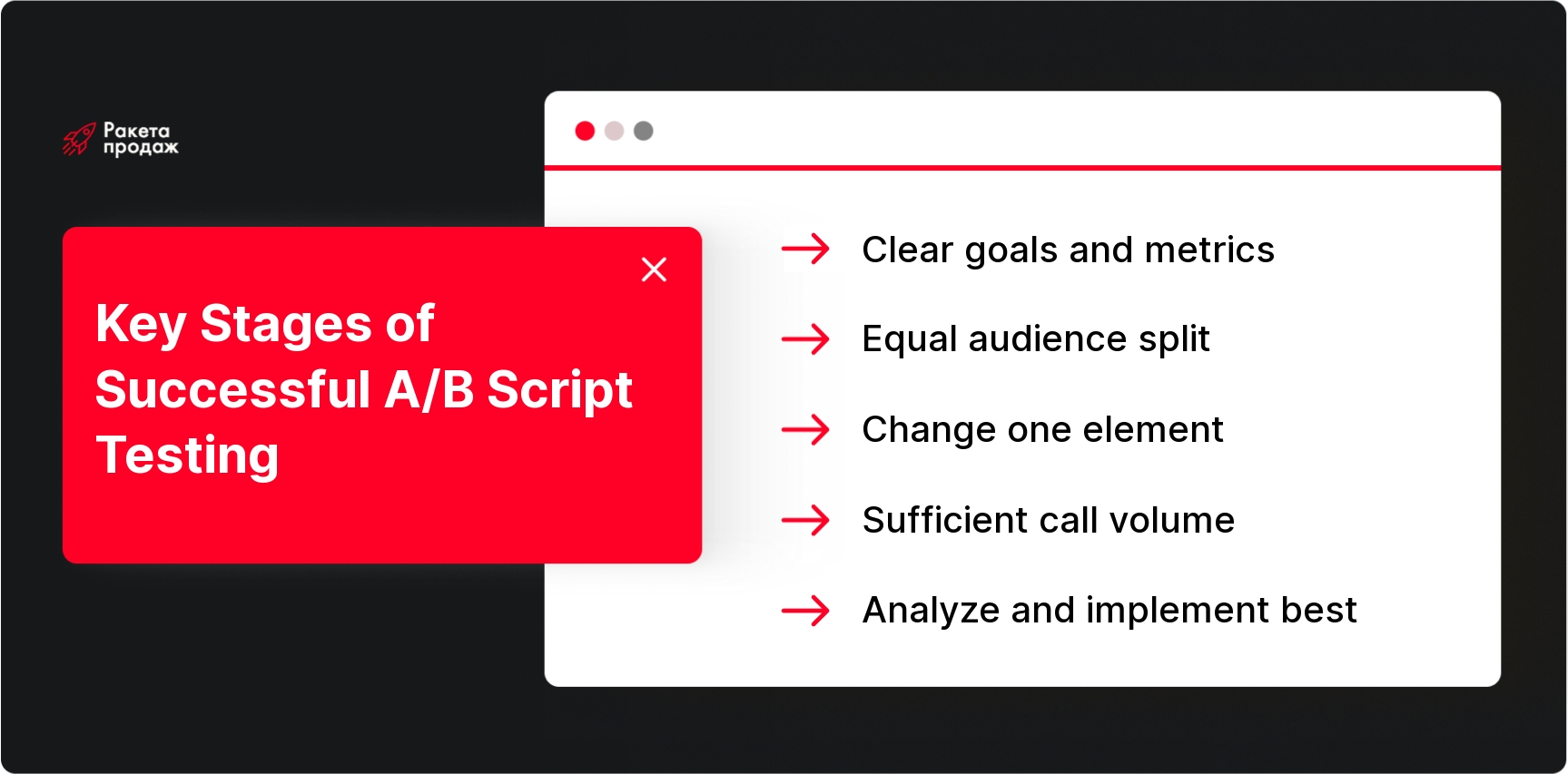
Key Stages of A/B Testing Scripts

Conducting A/B testing of sales scripts is not a chaotic process of “let’s try different options,” but a sequential methodology requiring a systematic approach. Let’s break down the main stages that will help you organize effective testing and get reliable results.

image

Setting Goals and Defining Metrics

Before starting to create alternative script variants, you need to clearly define what exactly you want to improve. Your goal should be specific, measurable, and tied to business results. For example: “Increase cold call conversion to scheduled meetings from 5% to 7%” or “Reduce the rejection rate in the first 30 seconds of conversation from 40% to 25%.”

It’s important not only to formulate a goal but also to select primary and secondary metrics for tracking it. The primary metric is directly related to the goal (conversion to the next step), while secondary metrics help control that improving one indicator doesn’t lead to a critical deterioration of others (such as average conversation length or customer satisfaction).

A typical mistake at this stage is choosing a too vague goal like “improve the script.” Such a formulation doesn’t provide an opportunity to objectively evaluate the experiment result.

Selecting and Segmenting the Audience

To get reliable results, it’s necessary to ensure that both script variants are tested on comparable groups of clients. If variant A will be used only for large corporate clients, and variant B for small business, the results will be distorted due to differences in the audience itself.

The optimal solution is random distribution of incoming contacts between script variants, for example, using a CRM system. Alternatively, you can divide the database of potential clients into segments based on relevant characteristics (business size, industry, geographic region), and then evenly distribute calls in each segment between variants A and B.

Remember that the sample size must be sufficient for statistical significance of the results. For most businesses, the minimum number of contacts per variant is 50 to 100, depending on the current conversion and expected effect of changes.

Developing Script Alternatives

When creating variant B, follow the principle of “one change at a time.” If you simultaneously change the greeting, question structure, and offer at the end, you won’t be able to determine which element influenced the result.

Best practices when developing alternative versions:

  • Maintain readability and naturalness of speech – the script should sound organic coming from the manager
  • Don’t complicate wording – short, clear phrases work better than elaborate constructions
  • Focus on a specific change that is logically connected to your hypothesis
  • Make sure both variants are convenient for managers to use and don’t require complex context switching

Additionally, when working on changes, expertise in sales script development will be useful, which will help avoid common mistakes and take into account modern trends in commercial dialogue structure.

Testing and Data Collection

At this stage, it’s important to provide technical and organizational support for the experiment. Set up the CRM system to mark each contact according to the script variant used. Organize call recording for subsequent analysis (in compliance with personal data legislation and notifying clients about recording).

Conduct a briefing with the sales team, explain the purpose of the experiment and the importance of accurately following the script. Managers should understand that deviation from the prescribed scenario can distort the results.

The test duration should be sufficient to neutralize temporary factors (day of the week, time of day), but not so long that other changes (in the product, market, competitive environment) affect the results. For most companies, the optimal period is 2-4 weeks.

Analysis and Interpretation of Results

After completing the testing period, it’s time for analysis. Compare key metrics for variants A and B, using statistical methods to assess the significance of differences. For simple tests, you can use online calculators of statistical significance.

When analyzing, pay attention not only to the primary metric but also to the segmentation of results. Perhaps variant B showed better results for a certain type of client but works worse with other segments. This is valuable information for further script personalization.

If the results are ambiguous (no statistically significant difference), that’s also a result! It shows that the tested change doesn’t have a significant impact on conversion, and you should focus on other script elements. In the next section, we’ll look at which script elements usually give the greatest effect when testing. Such analysis of script effectiveness helps identify not only the best variant but also understand which elements influence customer behavior.

Which Script Elements to Test: Ideas and Examples

A sales script consists of many components, and each of them can potentially affect the final result. Let’s look at the key elements that give the greatest return in A/B testing, with examples of specific changes.

Greeting and Introduction

The first 10-15 seconds of conversation are critical – during this time, the client decides whether to continue the conversation or end it as soon as possible. Therefore, the greeting often becomes the first candidate for testing.

Formal vs. Friendly Greeting:

  • Variant A: “Good day, Alexander Petrovich. You’re being contacted by ‘TechnoSoft’ company, we develop CRM systems.”
  • Variant B: “Hi, Alexander! Calling from ‘TechnoSoft’. Many executives say we have the best CRM for small business.”

Personal vs. Expert Positioning:

  • Variant A: “My name is Anna, I’m a sales manager at the company…”
  • Variant B: “My name is Anna, I’m a marketing efficiency specialist at the company…”

Practice shows that a more informal greeting focused on customer value usually works better than traditional formal introduction, especially when calling small and medium businesses. However, for large corporations, a formal tone may be more appropriate.

If you’re making cold calls, apply effective cold calling techniques that will help increase engagement from the first seconds of dialogue and pass the contact establishment stage faster.

Formulation and Presentation of Product or Service Value

How you present the value of your offer directly affects the client’s interest. Here you can test different emphases and approaches.

Focus on Savings vs. Focus on Opportunities:

  • Variant A: “Our system allows you to reduce administration costs by up to 30% by automating routine processes.”
  • Variant B: “Our system opens new growth opportunities, allowing your employees to focus on strategic tasks instead of routine.”

Specifics vs. General Statements:

  • Variant A: “Our solution increases work efficiency.”
  • Variant B: “Clients who have implemented our solution save an average of 12 hours of working time per week per manager.”

Research shows that specific figures and references to the experience of other clients (social proof) usually increase trust and conversion. However, it’s important that these data are realistic and applicable to the business of the interlocutor.

Questions for Identifying Needs

Correctly formulated questions help not only collect information but also direct the client’s thinking in the right direction, helping them become aware of the problem that your product solves.

Open vs. Closed Questions:

  • Variant A: “Do you use a CRM system in the company?”
  • Variant B: “How do you currently track interaction with clients?”

Diagnostic vs. Leading Questions:

  • Variant A: “What are the main difficulties you encounter when working with your client database?”
  • Variant B: “Do your managers often spend time searching for information about past contacts with clients?”

Practice shows it’s better to start with open questions that give the client an opportunity to talk about their situation. This creates a more trusting atmosphere and gives you information for further personalization of the offer.

Handling Objections

The way you respond to client doubts and objections often determines whether a deal will happen. It’s especially important to test different approaches here.

Straightforward Answer vs. Empathy:

  • Variant A: “Yes, our solution costs more than some competitors, but it includes more features and better support.”
  • Variant B: “I understand your concern about the cost. Many of our current clients initially had the same doubts until they saw how quickly the system pays for itself.”

Logic vs. Emotions:

  • Variant A: “Our system pays for itself in 6 months, here’s the calculation…”
  • Variant B: “Imagine how your managers’ work will change when they spend 30% less time on administrative tasks.”

Testing often shows that a combination of empathy with specific data works best: first acknowledge the validity of the client’s objection, then offer a rational counterargument. For a deeper understanding of the nuances of handling client doubts, study modern methods of handling objections in sales, which increase the probability of moving through the funnel.

Calls to Action

The final part of the conversation is no less important than the beginning. A clear and confident proposal for the next step significantly increases the probability of moving the client through the sales funnel.

Direct Offer vs. Optional Approach:

  • Variant A: “Let’s schedule a system demonstration next week. Is Tuesday or Thursday more convenient for you?”
  • Variant B: “If you’re interested in learning more, we can organize a demonstration. What do you think about that?”

Specific Action vs. General Agreement:

  • Variant A: “I’ll send you a commercial proposal, and we’ll call back in a few days.”
  • Variant B: “I’ll prepare a personalized offer for you and send it tomorrow before noon. Let’s call on Thursday at 3:00 PM to discuss the details.”

Research shows that specific proposals with limited choice (“Tuesday or Thursday” rather than “when is convenient for you”) usually give a higher conversion to scheduled meetings or next steps.

Script Element Variant A (Traditional) Variant B (Alternative) Typical Effect
Greeting Formal, focusing on company Informal, focusing on value +15-20% dialogue continuation
Value Proposition General statements about benefits Specific figures and examples +10-25% interest
Questions Closed, product-oriented Open, problem-oriented +15-30% dialogue quality
Handling Objections Direct counterarguments Empathy + logical justification +20-35% overcoming objections
Call to Action General, vague proposals Specific, with limited choice +25-40% conversion to next step

When choosing elements for priority testing, it’s recommended to start with greeting and call to action – they usually give the fastest and most noticeable result. Then you can move on to testing the formulation of value and questions for identifying needs. Working with objections often requires more detailed analysis and preparation, so its testing is usually conducted at later stages.

How to Interpret A/B Testing Results for Sales Scripts

After completing the testing, a critically important stage arrives – analyzing the obtained data. Proper interpretation of results will help not only choose the best script variant but also reveal valuable insights about your audience and product. At this stage, it’s especially important to conduct a correct comparison of sales scripts to understand which variant truly affects the result and is not a random deviation.

The first step in analysis is comparing the main metrics for variants A and B. For sales scripts, these metrics usually are:

  1. Conversion to the target action (scheduling a meeting, application, sale)
  2. Average conversation duration
  3. Percentage of positive reactions to key questions
  4. Average check or deal amount
  5. Customer satisfaction index (if measured)

When evaluating results, it’s important not to rush to conclusions. Differences between variants should be statistically significant to be considered non-random. For a simple verification, you can use online calculators of statistical significance, where you specify the number of contacts and conversion for each variant, and the system calculates how reliable the difference is.

Let’s say your variant B showed a conversion to scheduled meetings of 7.5% with 200 calls (15 meetings), and variant A – 5% with the same number of calls (10 meetings). A statistical significance calculator will show whether this 2.5 percentage point improvement can be considered a reliable result or it might be a random fluctuation.

What to do if the results are close, with no clear winner? In this case, you should:

  1. Analyze secondary metrics – perhaps one of the variants demonstrates an advantage in average deal amount or customer satisfaction
  2. Conduct segment analysis – sometimes variant B works significantly better with a certain client segment (such as small business) but worse with others
  3. Consider a combined variant that takes the best elements from both scripts
  4. Plan a new test with a more pronounced difference between variants

Special attention should be paid to “hidden insights” – client reactions that aren’t reflected in the main figures. For example, analysis of conversation recordings may show that in variant B, clients more often ask clarifying questions about product functionality, which indicates increased interest, even if conversion hasn’t grown significantly yet.

When making the final decision, consider the long-term perspective. A script that aggressively “pushes” clients and shows high short-term conversion may worsen the company’s image and lead to rejections at later stages of the funnel. Therefore, it’s important to track the full customer journey from first contact to deal completion.

In case of a convincing victory of variant B, it should become the new standard and used as a base for further experiments. If the advantage is not obvious, additional testing should be conducted with an increased sample size or other script changes. Remember: even the absence of clear differences is useful information that helps focus on more promising areas of optimization.

Implementing Final Changes and the Cycle of Continuous Improvement

A/B testing of sales scripts brings maximum benefit when it becomes not a one-time action, but part of a continuous improvement process. Implementing successful changes is just the beginning of a cycle that should be repeated regularly, allowing the company to continuously improve interaction with clients.

When you’ve determined the winning script variant, the first step is to make it the new standard for all corresponding communications. This includes not only updating the text in the CRM or knowledge base but also working with the sales team. Conduct a training session, explain why the new variant works better, show the testing results. This will help managers not only mechanically use the new script but also understand the logic of the changes.

It’s important to establish monitoring of the new script’s effectiveness in “combat conditions.” Sometimes the results of an A/B test don’t fully transfer to daily practice. Track key metrics and collect feedback from managers about how clients react to the new approach.

After implementing changes and confirming their effectiveness, it’s time for the next round of improvements. Now the winning variant becomes the new base script (variant A), and the next change is prepared for testing (variant B). Such a cyclical approach allows gradual optimization of all key script elements:

  1. Selecting the focus for the next test
  2. Formulating a hypothesis and creating variant B
  3. Conducting an A/B test
  4. Analyzing results and making a decision
  5. Implementing changes (if variant B won)
  6. Monitoring and collecting feedback
  7. Moving to a new test

For successful functioning of this cycle, sales team involvement is critically important. Managers working directly with clients can offer valuable ideas for testing based on their communication experience. Create a simple system for collecting and processing such proposals – for example, regular briefings or a special form in the CRM.

Serious support for the implementation process and communication management can be provided by CRM system implementation, allowing automation of script distribution, recording dialogue parameters, and analyzing the effectiveness of each tested element.

Automation of processes through integration with CRM and telephony significantly simplifies conducting tests and collecting data. Modern systems allow automatically distributing calls between script variants, recording conversations, analyzing key phrases, and collecting statistics. This reduces the load on analysts and increases the accuracy of results.

In the long term, a systematic approach to testing and improving scripts creates a significant competitive advantage. While competitors rely on intuition and random changes, your company accumulates structured knowledge about its audience and gradually optimizes every aspect of communication. The result is not only growth in conversion and sales but also an increase in brand value through more relevant and quality interaction with clients.

Limitations and Common Errors in A/B Testing Scripts

Despite the obvious benefits, A/B testing of sales scripts comes with a number of limitations and common mistakes that can lead to incorrect conclusions and ineffective decisions. Understanding these pitfalls will help you conduct higher quality experiments and get reliable results.

One of the most common problems is insufficient sample size. Companies, especially small ones, often rush to conclusions after testing on several dozen calls. This approach can lead to false conclusions when random fluctuations are taken for significant results. For most tests, the minimum required volume is 100-200 calls for each script variant, depending on the expected effect size and current conversion.

For example, if your current conversion is 5%, and you want to reliably determine if a new script gives an improvement to 7%, you’ll need at least 400-500 calls in total for both variants. For smaller companies, this means the need to conduct testing over a longer period to accumulate sufficient statistics.

Another common problem is significant differences between the test groups. If variant A is used by a more experienced group of managers, and variant B by newcomers, the results will be distorted regardless of the quality of the scripts themselves. Similarly, if the quality of leads changes during the testing period (for example, a new advertising campaign is launched), the comparison becomes incorrect.

The solution is careful planning of the experiment with even distribution of managers, time of day, days of the week, and lead sources between variants. If complete equalization is impossible, these variables should at least be recorded for subsequent analysis.

Another limitation is “noise” variables that are difficult to control. The client’s mood, external news, random technical problems can affect the result of an individual call. In ideal laboratory experiment conditions, such factors can be minimized, but in real sales, they’re inevitable. The only solution is increasing the sample size so that random fluctuations mutually neutralize each other.

Incorrect choice of metrics can also lead to wrong decisions. For example, by focusing exclusively on short-term conversion, a company might choose a script that “pushes” clients but worsens long-term relationships. A comprehensive system of metrics, including both immediate indicators (conversion) and delayed ones (lead quality, satisfaction, repeat sales), gives a more complete picture.

Companies often ignore feedback from managers, relying exclusively on numbers. However, employees directly using the script may notice nuances not reflected in statistics – for example, that clients often ask to clarify a certain phrase or that the script sounds unnatural in a specific situation. Combining quantitative analysis with qualitative feedback gives the most complete understanding of how scripts work.

Remember that even perfectly organized A/B testing has limitations. It shows which of two variants is better but doesn’t guarantee there isn’t a third, even more effective approach. Therefore, it’s important not to rest on your laurels but to continue the cycle of experiments, gradually covering all aspects of communication with clients.

Technologies and Tools for Testing Sales Scripts

Modern technological solutions significantly simplify the process of A/B testing scripts, making it more accurate, convenient, and informative. Let’s look at the main tools that help companies effectively organize and automate this process.

CRM systems are the foundation for conducting A/B testing of scripts. Modern CRMs allow not only storing script variants but also automatically distributing them among managers, recording call results, and generating statistics for each variant. Market leaders such as Salesforce, Uspacy, Pipedrive, and Bitrix24 offer functionality for working with scripts and the possibility of integration with telephony.

Auto-dialer systems are especially useful for companies that make a large number of outbound calls. These solutions allow not only automating the dialing process but also evenly distributing calls between script variants, ensuring statistical purity of the experiment. More advanced systems integrate with CRM and automatically classify call results, eliminating the need for manual data entry.

Call tracking and analysis tools provide invaluable data for evaluating script effectiveness. Platforms like CallTracking or Ringostat allow not only recording conversations but also analyzing their content – for example, identifying key phrases, pauses, emotional coloring of dialogue. Some systems use artificial intelligence to automatically identify successful and problematic moments in conversations, which helps improve scripts based on real data.

AI assistants for sales managers are a relatively new but rapidly developing direction. Such solutions suggest optimal phrases and strategies to the operator in real-time depending on the conversation context, and also record which suggestions were effective. This allows not only testing ready-made scripts but also dynamically adapting them to a specific situation.

Specialized solutions for automatic reports and data visualization help visually present A/B testing results and identify trends. Tools like Google Data Studio, Tableau, or PowerBI allow creating interactive dashboards displaying key metrics for each script variant, client segment, or manager.

Call centers and outsourcing operators can also be an important resource for scaling and accelerating tests. Professional call centers have not only the technological infrastructure to make thousands of calls in a short time but also methodological expertise in A/B testing. This is especially valuable for companies that need to quickly verify a hypothesis or don’t have sufficient call volume for statistically significant testing on their own.

Voice bots are becoming an increasingly popular tool for initial contacts with clients. Their advantage in the context of A/B testing lies in the absolute stability of script execution – the bot always says the same phrases with the same intonation, which eliminates the influence of the human factor on test results.

When choosing technologies for script testing, it’s important to consider the specifics of your business, call volume, and budget. For small companies, it may be optimal to start with a basic CRM with call recording capability and gradually add more advanced tools as sales processes grow and become more complex. Large organizations with developed sales departments should consider comprehensive solutions that provide a full testing cycle – from creating script variants to detailed analysis of results.

Script Performance Analysis: Turning Data into Strategy

When conducting sales script testing, the ultimate goal is not just to collect data, but to transform it into actionable insights that drive business growth. Script performance analysis is the critical bridge between raw testing results and strategic decision-making. This process involves examining how each script variant performs across different customer segments and sales situations.

For comprehensive script performance analysis, begin by mapping each script element to specific customer responses. Are prospects hanging up during particular sections? Which phrases consistently lead to positive engagement? By breaking down the conversation flow, you can identify exactly where your A/B script testing shows the greatest differences in effectiveness.

Advanced analytics platforms can now track keyword usage, tone, and even emotional responses during calls. These tools help quantify what historically relied on sales manager intuition. For example, you might discover that using specific industry terminology early in the call significantly increases attention and engagement from C-level executives but alienates operational managers.

How to increase script conversion often comes down to identifying these micro-moments in conversations. The sales script comparison data might reveal that sharing customer success stories in the first minute increases call duration by 40%, while technical specifications mentioned early tend to shorten calls. This granular understanding allows for precise script optimization rather than wholesale changes.

Comprehensive analysis should include both quantitative metrics (conversion rates, call duration) and qualitative feedback (customer sentiment, objection frequency). When these data points align, you can confidently implement changes knowing they’re supported by multiple evidence sources.

Remember that script performance analysis is not a one-time event but an ongoing process of refinement. The most successful sales organizations implement continuous testing cycles, where insights from one test immediately inform the next iteration. This approach creates a compounding effect where small improvements accumulate into significant conversion advantages over competitors still using static scripts.

Proper A/B testing of sales scripts is not just an experiment, but a systematic process requiring expertise, analytics, and specialized tools. Trying to implement it yourself means spending months studying methodology, setting up systems, and training personnel, while risking not getting reliable results. “Rocket Sales” offers a ready solution: our team of experts will take on the full cycle of optimizing your scripts – from auditing the current state to implementing proven templates and a system of continuous improvement.

We work with 14+ industries and have built more than 208 systematic sales departments for companies of different scales. Our approach includes not only development and testing of scripts but also comprehensive automation of processes through CRM implementation, personnel training, and setting up analytical dashboards. Among our clients are companies such as Mitsubishi, Naftogaz, Ford, and Mazda, who trust us with their sales and get measurable results: the maximum recorded revenue increase was +$10,907,403 over 4 months of work.

Transform your sales scripts from static documents into a powerful business growth tool – trust professionals and get guaranteed sales growth in just 6 weeks!

Transform your sales scripts from static documents into a powerful business growth tool - trust professionals and get guaranteed sales growth in just 6 weeks!

Conclusion

A/B testing of sales scripts is a strategic tool that transforms the effectiveness of communications with clients from the realm of subjective assessments into the sphere of objective data. Instead of relying on intuition or the opinion of the loudest voice in the room, companies get the opportunity to make decisions based on real indicators and client reactions.

A systematic approach to script testing creates a continuous improvement cycle that gradually increases conversion, average order value, and customer satisfaction. Even small changes in wording or script structure can lead to significant growth in key business indicators – and A/B tests help identify these “golden” elements.

Using modern technologies and following the methodology described in this article, you can transform sales scripts from static documents into dynamic, constantly improving tools. This will give your team a significant competitive advantage and ensure sustainable growth even in highly competitive markets. Start by testing one element, follow the data rather than assumptions – and you’ll see how even small changes in words can lead to big changes in results.

If you want to deeper understand the causes of failures or successes at each sales stage, use sales funnel analysis, and also regularly evaluate sales department KPI analysis for a comprehensive picture of your department’s effectiveness.

In this article:
See more
Book a FREE sales funnel audit
CONTACT US
FAQ
What is A/B testing of sales scripts and why is it needed?

A/B testing of scripts is a method of comparing two versions of a sales scenario to determine which one is more effective. Only one element is changed in one variant (greeting, question, objection handling), and the results are measured by objective metrics. This approach allows making decisions based on data, not intuition, and gradually increasing the conversion of calls to sales.

Which script elements should be tested first?

The greatest effect usually comes from testing the greeting (first 10-15 seconds of conversation) and call to action (closing for the next step). These elements directly affect client engagement and conversion. After optimizing these parts, you should move on to formulating the value proposition, questions for identifying needs, and handling objections.

How many script variants can be compared simultaneously?

For most companies, it’s optimal to compare only two variants (A and B) per test. This ensures statistical purity of the experiment and simplifies interpretation of results. More complex multivariate tests (A/B/C/D) require a significantly larger volume of calls and complex data analysis, which is justified only for large call centers with thousands of contacts.

How to understand that changes in the script truly affect the result?

To confirm the statistical significance of results, it’s important to ensure a sufficient sample size (usually from 100 calls per variant) and use tools to calculate the statistical reliability of differences. If the difference in conversion between variants exceeds statistical error and is consistently observed throughout the testing period, we can talk about a real impact of changes.

What indicators should be tracked in A/B testing of scripts?

Main metrics: conversion of call to target action (meeting, application, sale), rejection rate in the first seconds of conversation, average call duration. Auxiliary indicators: average order value, customer satisfaction index (if measured), number of objections, percentage of repeat contacts. It’s also important to record qualitative feedback from managers about client reactions.

What volume of calls or dialogues is needed for a reliable test?

The minimum volume depends on the current conversion and expected effect size. For most companies, at least 100-200 calls for each script variant are recommended. With low base conversion (less than 3-5%) or expectation of small improvements (1-2 percentage points), the volume should be increased to 300-500 calls per variant to obtain statistically significant results.

How long should A/B testing of a script last?

The optimal test duration is 2-4 weeks. This period is sufficient to neutralize the influence of days of the week and other cyclical factors, but not so long that other changes (in product, market, team) could distort the results. Companies with a small volume of calls may need a longer period to accumulate the necessary statistics.

How to compare two sales scripts to determine the best variant?

To compare sales scripts, it’s important to use a systematic approach. You need to establish clear effectiveness metrics (conversion, average order value), ensure comparable testing conditions for both variants, collect enough data for statistically significant results, and carefully analyze not only the final figures but also feedback from managers. The optimal method is A/B testing with one changed element.

How to increase sales script conversion through testing?

To increase sales script conversion, it’s necessary to conduct sequential A/B tests, focusing on key elements: greeting, value formulation, questions for identifying needs, handling objections, and call to action. Each test should be based on a specific hypothesis and check only one change at a time. Successful variants become the new standard and base for further improvements. It’s important to analyze not only quantitative indicators but also qualitative feedback.

SUBSCRIBE TO MY TELEGRAM CHANNEL
The most valuable sales information right on your phone!
icon

LOTS OF USEFUL INFORMATION, FREE TEMPLATES, AND CHECKLISTS ON MY INSTAGRAM

Materials and practical advice on sales growth in our blog: