icon

How to track which ads brought the customer


For modern Ukrainian businesses, the question “which ads brought the customer” has become critically important. When every dollar of advertising budget counts and competition for customers grows, companies can’t afford to work blindly. Without clear understanding of which channels actually bring orders, marketers risk wasting money, and sales departments lose potential buyers due to chaotic lead management.


Want a high-performing sales team without the hassle?
We’ll build it for you.
Contact Us

Key Takeaways

  • Your Google Ads might generate 40% of leads but only 15% of revenue, while Facebook produces fewer leads with higher value. Without channel breakdown, budget reallocation becomes a lottery.
  • Call tracking closes the blind spot: for B2B and services, up to 70% of inquiries come by phone, which standard web analytics can’t see.
  • Chaotic UTM work (facebook, Facebook, fb in different campaigns) splits one channel into dozens of report lines and makes performance comparison impossible.
  • CRM becomes the central hub where data from all channels meet: website, calls, email, messengers. Without sales integration, analytics remains pretty numbers without business meaning.
  • Lead quantity is deceptive: 100 cheap leads with 5% conversion lose to 20 expensive ones with 15% conversion. Evaluate channels by CAC, ROI and revenue connection, not traffic volume.

In the full article below, you’ll find a step-by-step algorithm for setting up UTM tags, call tracking and integrations to connect every ad click with a paid deal 👇

Today you have all the tools to build a transparent system: from UTM tags and Google Analytics to call tracking and CRM integrations. However, many companies use these solutions separately, getting a fragmented picture instead of full end-to-end analytics. In this article, we’ll show how to connect all elements into a unified system – from first click to paid deal. And we’ll demonstrate how to turn this data into specific decisions for profit growth.

Why it's important to know which ads brought the customer

Understanding customer sources isn’t just analytics for pretty reports. It’s the foundation for making any strategic decisions in marketing and sales. Effective lead sources management allows you to understand that Google Ads brings 40% of leads but only 15% of total revenue, while Facebook gives fewer leads but with higher average order value – you can consciously redistribute budget. Without such breakdown, any advertising changes become a lottery.

Source tracking helps identify “holes” in the sales funnel at the earliest stages. Imagine: you launch a new TikTok campaign, get many clicks and leads, rejoice at low cost per lead. A month later you discover that conversion of these leads to deals is three times lower than other channels. Without linking analytics to CRM, you’d continue “draining” budget for several more months.

Moreover, transparent source analytics removes internal conflicts between marketing and sales. Sales managers stop complaining about “bad leads” when they see the problem isn’t lead quality but processing speed. Marketers get clear data about which campaigns actually affect revenue, not just inquiry volume. This creates a foundation for constructive team work on common KPIs.

Do you know the feeling when advertising budget is spent, leads come, but understanding real return from each channel is impossible? Many Ukrainian companies face situations where Google Analytics shows some numbers, managers tell about other customer sources, and CRM has complete chaos with lead attribution. As a result, marketing decisions are made intuitively, not data-driven.

At “Sales Rocket” we’ve created a systematic approach to end-to-end sales analytics over 8+ years: from setting up correct source tracking to building comprehensive ROI reports for each channel.

Our experts implement integrations between CRM, call tracking and web analytics so you see the complete picture – from ad click to paid deal.

Thanks to properly configured analytics, our clients increase conversion from 5% to 86% and get average revenue growth of +35%, optimizing advertising expenses based on real data.

Turn chaos in marketing analytics into a clear ROI control system - get free consultation on end-to-end analytics setup!

Main tools for analyzing advertising sources

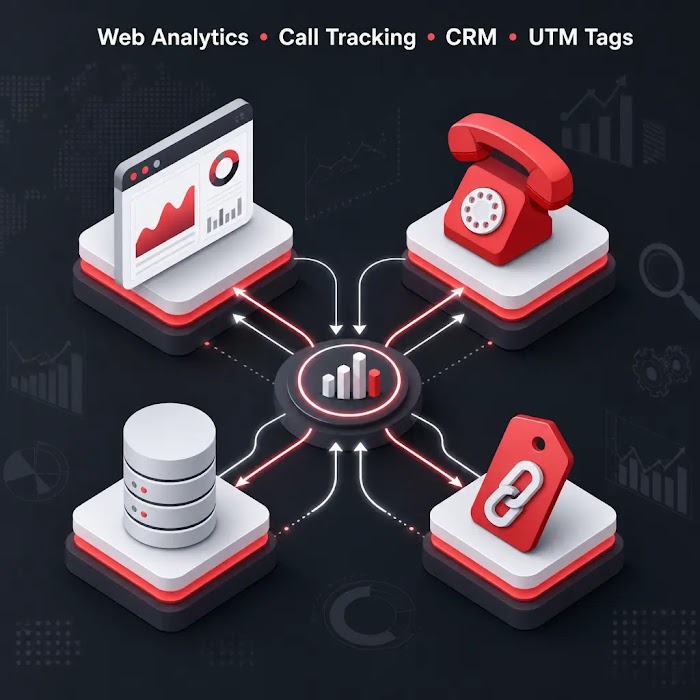
The modern analytics ecosystem is built around four main components that should work as a unified whole. Each tool solves its own task, but their power lies in integration and ability to get a complete picture of customer journey from first touch to repeat purchase.

Web analytics (Google Analytics 4) tracks user behavior on the website: where they came from, what they viewed, how much time they spent, what actions they took. This is your “X-ray” of digital customer interaction. Call tracking closes the critical “blind zone” – phone calls that standard web analytics can’t see. For many Ukrainian companies, calls constitute 50-70% of all inquiries, especially in B2B segment, services and complex sales. You can learn more about what is call tracking and how it helps business in a separate article.

CRM systems become the central hub where all data meets: website leads, calls, emails, messenger communications. Modern Ukrainian CRMs like KeepinCRM, KeyCRM or SalesDrive offer ready integrations with main communication channels. UTM tags work as a “passport” for each advertising activity – they transmit detailed information about source, campaign and even specific ad to all connected systems. Properly configured connection of these tools enables tracking the path from ad click to paid order with kopeck precision.

analytics tools — Four core tools for tracking advertising sources

How to use UTM tags for channel tracking

UTM tags are your universal “barcode” for each advertising channel and campaign. When you need to track which ad a customer came from, UTM parameters become essential for accurate attribution. Technically, they’re just additional parameters in the link, but they transform chaotic traffic into structured data. When a user follows a link with UTM tags, source information automatically goes to Google Analytics and can be passed further – to CRM, contact forms, call tracking systems.

Basic UTM structure includes five parameters: source (utm_source), medium (utm_medium), campaign (utm_campaign), term (utm_term) and content (utm_content). For example, for New Year promotion advertising on Facebook, your link might look like site.com/?utm_source=facebook&utm_medium=social&utm_campaign=new_year_2025&utm_content=video_promo. Such markup allows not only seeing that traffic came from social networks, but understanding specific creative effectiveness.

The key principle of UTM work is consistency and discipline. If today you name the source “facebook”, tomorrow “Facebook”, and the day after “fb”, you’ll have three different channels in reports. Therefore, create a naming standards document and use UTM link generators – this minimizes errors and saves time. For automation, both built-in Google Analytics tools and third-party services like UTM.io or Esputnik generator work well.

Practical setup and analysis of advertising sources in analytical systems

Google Analytics 4 has become the de facto standard for traffic and conversion analysis in the Ukrainian market. For tracking advertising effectiveness, key reports will be “Traffic acquisition”, “Conversions” and customizable reports by UTM parameters. In the “Traffic acquisition” section, you’ll see how many users came from each channel, but without additional setup, this will be surface data.

GA4’s real power is revealed when setting up events and conversions. Create events for key actions: form submission, call, price download, adding product to cart. Each such event can be marked as conversion and tracked by traffic sources. This way you’ll understand that YouTube brings many views but few leads, while LinkedIn gives less traffic but high conversion to target actions.

For detailed analysis, create custom reports with UTM parameter grouping. In the “Explorations” section, you can build a table where rows are utm_source and utm_campaign, and metrics are sessions, conversions and revenue (if e-commerce is configured). Such reports show not only traffic volume but audience quality from each campaign. Add filters by geography, devices and time periods – this helps find hidden insights for optimization.

Don’t forget about attribution models in GA4. By default, the system attributes conversion to last click, but the customer might have learned about you from Facebook and bought after Google search. Data Driven Attribution model better accounts for each touchpoint’s contribution in customer journey, which is especially important for multi-step B2B funnels or expensive products.

Call tracking: how to connect a call with advertising campaign

For most Ukrainian companies, phone calls remain a critically important conversion channel. Services, B2B sales, medicine, real estate – in all these spheres, customers prefer talking to a manager rather than filling forms. Call tracking solves the task of connecting each call with specific advertising source through number substitution technology and session parameter fixation.

Call tracking principle is simple: code is installed on the website that substitutes the main phone with tracking numbers depending on traffic source. A user who came from Google Ads sees one number, a Facebook visitor sees another. When a call comes to any tracking number, the system automatically determines the source and can pass this information to CRM along with call recording, duration and other parameters.

The Ukrainian call tracking market is represented by several strong players. Ringostat specializes specifically in call tracking and end-to-end analytics, offering detailed attribution setup and event transmission to Google Analytics. Binotel develops a broader IP telephony ecosystem with powerful call tracking capabilities and 70+ CRM integrations. UniTalk and Zadarma also offer call tracking within virtual PBX.

Key call tracking metrics go far beyond call quantity. Track target calls by duration (conversations shorter than 30 seconds rarely lead to deals), cost per call lead by channels, call conversion to meetings and sales. Special attention to missed calls: each unanswered call might be a lost deal. Set up manager notifications and automatic callbacks to minimize losses at this funnel stage.

call tracking — Connecting phone calls with advertising channels

Data integration with CRM and end-to-end analytics automation

CRM becomes the central link of end-to-end analytics where data from all communication channels meets: website, telephony, email, messengers, social networks. Modern Ukrainian CRM systems offer ready integrations that allow automatically creating leads with source indication, passing UTM parameters and connecting online activity with offline conversions.

Basic integration scheme looks like this: user fills a form on the website or calls a tracking number, system automatically creates a lead in CRM with utm_source, utm_medium, utm_campaign and other parameter fields. Manager processes the inquiry, moves lead to deal status, indicates order amount. As a result, you have a complete chain from ad click to revenue with channel and campaign breakdown.

Advanced setup includes passing deal data back to advertising systems (offline conversions) and building BI dashboards based on combined data. Google Ads and Facebook allow uploading information about completed purchases, which improves targeting algorithms and automatic bid optimization. BI tools like Power BI or Google Looker Studio help create comprehensive reports where advertising costs are compared with revenue, and ROI is calculated considering full sales cycle.

Automation is critically important for scaling: when you have hundreds of leads per month, manual processing and data matching become impossible. Set up webhooks, API integrations and automatic rules so data transfers between systems without human participation. This not only saves time but minimizes errors that are inevitable with manual work on large information volumes.

Sometimes for successful start, it’s important not only to implement analytics but also engage in comprehensive CRM implementation for sales increase to have all lead and deal data at hand.

Key metrics for evaluating advertising sources

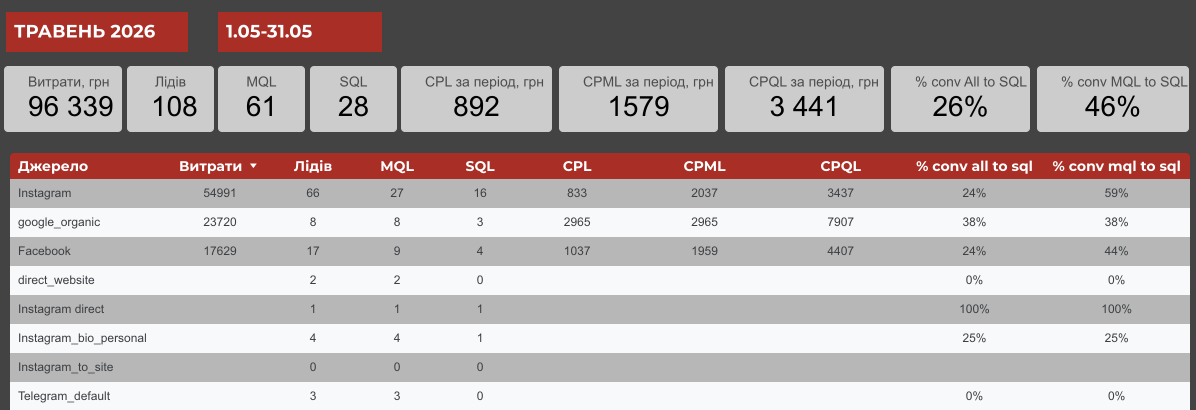
Lead quantity is important but not the only metric for evaluating advertising channels. A channel generating 100 cheap low-quality leads might be less profitable than a source with 20 expensive leads but high sales conversion. For objective evaluation, use a complex of interconnected indicators that show real value of each channel for business.

Lead-to-deal conversion is the basic traffic quality metric. If 15% of Google Ads leads convert while only 5% from Instagram do, this might indicate different audience motivation or creative-expectation mismatch. Key sales department metrics will help evaluate more deeply how your channels work and what needs changing for increased effectiveness.

Cost per lead (CPL) and customer acquisition cost (CAC) show channel economic efficiency. CPL is calculated as advertising spend divided by lead quantity. CAC is spend divided by paying customers. CAC is always higher than CPL, but it shows real customer acquisition cost. Compare CAC with customer lifetime value (LTV) – if CAC exceeds LTV, the channel is unprofitable.

ROI (return on investment) is the final advertising effectiveness metric. Calculated as (revenue minus advertising costs) / advertising costs * 100%. Positive ROI means the channel pays off, but for sustainable business, ROI should cover not only advertising expenses but other operational costs. Track missed calls and unassigned leads – they directly affect conversions and distort channel metrics.

For systematic improvement, use sales channel effectiveness analysis, which helps adjust budget and choose truly effective customer acquisition tools.

performance metrics — Quality versus quantity of leads in advertising channels

Common mistakes in tracking advertising sources

Chaotic UTM tag work is the most common mistake of Ukrainian companies. Different source spellings (facebook, Facebook, fb), inconsistency in campaign names, skipping UTM in individual channels lead to fragmented reports. As a result, Google Analytics shows dozens of “sources” that are essentially one channel, and campaign effectiveness comparison becomes impossible.

Incomplete channel coverage is the second critical problem. Companies carefully mark links in Google Ads and Facebook but forget UTM in email newsletters, Telegram messages, LinkedIn posts or marketplace announcements. This traffic falls into “direct visits” or “unknown source” categories, distorting real channel effectiveness picture.

Lack of connection between leads and sales turns analytics into “pretty numbers” without business meaning. Many companies stop at counting leads and calls without connecting them to actual CRM deals. As a result, channels are evaluated only by inquiry quantity, not revenue and profit contribution.

Ignoring phone calls is an especially painful mistake for B2B and services where up to 70% of inquiries come by phone. Without call tracking, these conversions remain “invisible” to web analytics, leading to advertising effectiveness underestimation and incorrect budget distribution. Manual source filling by sales managers creates additional distortions due to human factor and different understanding of channel classification.

Regular error analysis and prompt correction are important conditions for successful optimization. This can be helped by practical advertising optimization cases, which provide visual scenarios for working with data and sales funnel.

Building a customer source tracking system isn’t a one-time setup but a comprehensive process requiring deep expertise in analytics, CRM and system integrations. Proper implementation of all described tools will allow you to make informed decisions about advertising budget distribution and scaling effective channels. “Sales Rocket” offers a complete “turnkey” solution: from current process audit to implementing modern CRM systems with configured end-to-end analytics. We don’t just install tools – we create a working ecosystem where every lead is tracked from source to deal, and ROI is calculated with precision to specific advertising campaign. Our methodology includes CRM setup and integration, automatic report building and team training on data work. In 8 years of work, we’ve built 208 sales departments in 14+ industries, helping clients get revenue growth up to $10,907,403 in 4 months of work. Among our partners are companies like Mitsubishi, Yamaha and Naftogaz.

Create an analytics system that turns every advertising dollar into measurable results!

Conclusion

image

Modern analytics tools have transformed the question “which ads brought the customer” from a mystery into a solvable technical task. UTM tags, web analytics, call tracking and CRM integrations enable tracking each buyer’s path from first click to repeat purchase with precision to specific ad and keyword. Learning how to determine the source of a request becomes critical for business success in today’s competitive landscape. The Ukrainian market offers mature local solutions that match international analogs in functionality but are better adapted to local business specifics. Investments in building end-to-end analytics pay off in the first months through advertising budget optimization and conversion growth, and in the long term create sustainable competitive advantage and foundation for business scaling.

In this article:
See more
Book a FREE sales funnel audit
CONTACT US
FAQ
Can you understand customer source without CRM?

Partially yes – web analytics will show lead sources from the website, but without CRM you won’t see connection to actual sales and revenue. For complete picture, you need integration of all systems.

Why might lead source data be inaccurate?

Main reasons: incorrect UTM tags, incomplete channel coverage, integration problems between systems, manual manager errors and technical failures in data transmission.

What's more important to track: leads or sales?

Sales are critically more important because they show real channel contribution to revenue. Leads are an intermediate metric that can be misleading without considering lead quality and deal conversion.

Which ad did the customer come from?

Use automatic tools: UTM tags in links, call tracking for calls, hidden fields in website forms. These technologies record source without customer participation and exclude subjective factor.

SUBSCRIBE TO MY TELEGRAM CHANNEL
The most valuable sales information right on your phone!
icon

LOTS OF USEFUL INFORMATION, FREE TEMPLATES, AND CHECKLISTS ON MY INSTAGRAM

Materials and practical advice on sales growth in our blog: