icon

What to Do When Strong Salespeople Don't Listen to Their Sales Manager

Your sales department has several stars who are truly effective as they bring in the company’s main revenue. They’re strong specialists who are valued, but… they categorically refuse to follow the sales manager’s instructions. These top performers don’t listen to the manager, ignore meetings, sabotage new procedures, openly object, and do everything their own way. “I bring in profits – so I decide how I work” – that’s their main argument.

Want a high-performing sales team without the hassle?
We’ll build it for you.
Contact Us

Key Takeaways

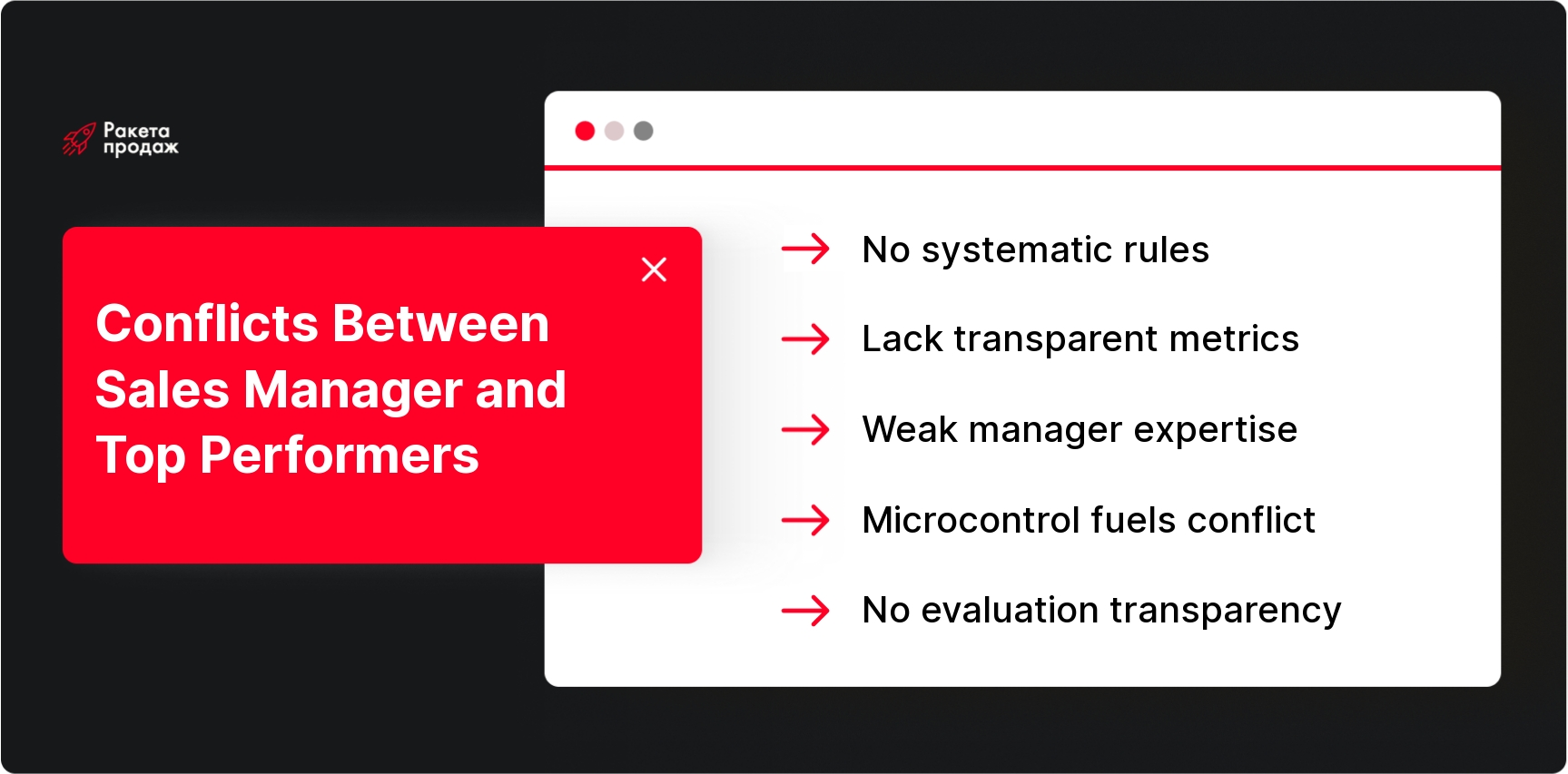
  • Top salespeople ignore managers not due to personality issues, but because of the absence of systematic rules, transparent metrics, and objective evaluation criteria.
  • Strong salespeople quickly assess a sales manager’s expertise level; if the manager can’t provide valuable advice on deals or doesn’t know product specifics, their authority diminishes.
  • Conflict between the Head of Sales and top performers destroys the atmosphere, triggers valuable employee departures, and makes business scaling impossible.
  • Management through microcontrol and reports creates a vicious cycle: the stronger the pressure, the greater the resistance from top salespeople.
  • Sales managers must transition from personal authority to systemic authority: rely on KPIs, sales funnel data and CRM information, clearly delineate zones of freedom and mandatory rules for everyone.

In the full article, you’ll see what mistakes transform a leader into a dictator, how to engage sales stars without losing control, and which boundaries should never be crossed regardless of results. Read the article below 👇

Why Strong Salespeople Stop Listening to Their Sales Manager

When a salesperson ignores a manager’s instructions, it’s rarely about a “difficult personality” or “star syndrome.” The authority of a manager doesn’t automatically come with the job title. It’s formed through systematic management decisions, transparent rules, and the ability to influence team results. The true cause usually lies in the management system itself. The authority of the Head of Sales doesn’t automatically come with appointment to the position. It’s built through properly structured management tools, consistent actions, and clear rules of the game.

Often, managers try to lead only through their personality and charisma or, even worse, pressure through administrative resources. But with experienced salespeople, this approach doesn’t work. They need good reasons and understandable rules to follow directions. Without these, top managers quickly start “playing by their own rules,” especially when their results make them feel irreplaceable.

Let’s examine the main reasons why strong salespeople begin to ignore their manager.

A familiar situation, isn’t it? A non-systematic approach to managing strong salespeople is one of the most common causes of business stagnation, when a company becomes hostage to a few “stars.” According to our research, more than 70% of business owners face the problem of unmanageable top salespeople, which leads to serious losses in the efficiency of the entire department. At “Rocket Sales,” we’ve developed a comprehensive system that solves this problem: we conduct detailed department audits, analyze manager conversations and CRM data, and identify “gaps” in the work of even the most successful salespeople. Based on analysis, we implement clear work standards, create a transparent KPI system, and provide an individual approach to motivating top employees. Our methodology allows you to maintain the autonomy of strong salespeople while integrating them into the systematic work of the entire department, transforming them from “lone stars” into drivers of team results. On average, our clients see turnover growth of 35% due to the balance between freedom of action for strong salespeople and their integration into the overall system.

Create a department where strong salespeople become your advantage, not your headache - order a comprehensive sales department diagnosis right now!

The "I bring money - so I'm right" syndrome

This is a classic situation: a salesperson consistently shows high results and gradually comes to believe that their approach is the only correct one. They begin to think that since they bring in the most money, they have the right to set their own rules. And any standards, regulations, or requirements are viewed through the lens of “this prevents me from earning.”

The result is logic that’s dangerous for the company: results are more important than processes. A strong salesperson begins to ignore CRM updates, skip meetings, disregard corporate standards for client communication, and independently decide discount issues. They’re confident that as long as their personal indicators are high, the company will turn a blind eye to everything else.

The problem is that this approach destroys the very possibility of building a sales system. Other employees see that you can disregard the rules and still be honored if you bring in enough money. As a result, manageability drops, and business scaling becomes impossible. After all, a business dependent on a few stars is extremely vulnerable and unstable in the long term.

To learn more about what other tasks complicate team development and how to systematically eliminate them, check out our article on problems in the sales department.

Expertise conflict: the salesperson is more experienced than the manager

Another common reason is the situation where the top salesperson actually has more sales expertise than their manager. This often happens if the sales manager is appointed from outside (came from another company or industry) or when a talented salesperson is promoted to a management position but still lacks management experience.

Experienced salespeople very quickly gauge their boss’s level of professionalism. If they see that the sales manager can’t give them valuable advice on deals, doesn’t understand product specifics, or doesn’t know how to work with difficult clients – their authority drops sharply. In the eyes of top managers, they become just an “administrative layer” that needs to be tolerated but not necessarily listened to.

In such situations, sales managers often feel insecure and try to compensate for their lack of expertise with strict control or formal requirements, which only exacerbates the conflict. Strong salespeople begin to bypass them, resolve important issues directly with the business owner, or simply act at their own discretion. This creates an atmosphere of distrust and undermines the entire management vertical.

To learn how to objectively conduct evaluation of manager effectiveness, read our material – it will allow you to seriously raise the management level and reduce the toxicity of expertise conflicts.

Lack of management rules and boundaries

When a sales department has no clear regulations, metrics, and rules of the game, each experienced salesperson begins to work as they see fit. One focuses on major clients, another prefers volume, a third pays more attention to service – and they’re all sure their approach is the most correct.

In the absence of a system, the sales manager cannot objectively evaluate work and is forced to rely on subjective criteria: who they like more, who speaks louder, or who is friends with management. This leads to a situation where the manager’s authority is based solely on personal relationships, not on professional expertise and transparent rules.

Strong salespeople in such an environment begin to form their mini-empires with their own rules. They may hide information about clients, withhold knowledge about the product or sales technologies, or not share useful contacts. They know the company can’t control them because there are no objective evaluation criteria – there’s only the result, and theirs is good.

In the absence of a system, every decision by the sales manager is perceived as arbitrary, not as part of an overall strategy. And any attempts to introduce rules are met with hostility, because “everything worked before without these bureaucratic things.” Now let’s look at how the manager themselves exacerbates the situation.

You can read more about building a normative and managerial base in our article on sales department management.

Sales manager mistake: trying to manage through control

Faced with resistance from strong salespeople, many managers choose the most obvious but most destructive path – increased control. The sales manager begins to demand more reports, check CRM activity more frequently, introduce additional meetings, and increase the number of approvals needed for decision-making.

For experienced salespeople, such micromanagement is a nightmare and a direct path to burnout. They perceive it as distrust and an attempt to limit their freedom of action, which, as they believe, is the source of their high results. The stronger the pressure, the more active the resistance – explicit or hidden.

The paradox is that this approach creates a vicious cycle: the sales manager sees resistance and increases control, salespeople feel pressure and resist even more. As a result, talented people either leave for competitors or stay but work with minimal engagement, “doing the bare minimum,” without initiative and desire to develop.

Successful managers know that how to manage strong salespeople requires understanding they cannot be managed through coercion – only through engagement, motivation, and creating conditions where following common rules becomes beneficial for the salespeople themselves. That’s why the conflict between a sales manager and top salespeople isn’t just personal dislike, but a systemic problem requiring a systemic solution.

A key role here is played by properly configured sales department motivation, as well as transparent areas of responsibility and leadership recognition mechanisms.

Conflict Between Sales Manager and Top Salespeople: Why It's Dangerous for Business

The confrontation between a sales department manager and key salespeople is not just an internal department problem. It’s a serious threat to the entire business, and the consequences can be much more extensive than they seem at first glance.

When top sales managers and their leader are in constant conflict, it inevitably affects the entire company. First and foremost, the atmosphere in the team suffers. Constant tension, mutual reproaches, open confrontation at meetings – all this destroys team spirit and demotivates other employees. People begin to choose sides, informal groups form that are loyal either to the sales manager or to strong salespeople. Instead of working together for results, the team becomes immersed in internal intrigue.

Toxicity quickly spreads beyond the sales department. Production, logistics, marketing – all begin to feel the consequences of the split. Some salespeople follow regulations, others demand special conditions, and others refuse to interact with certain departments altogether. As a result, business processes are disrupted, and the number of errors and missed deadlines increases.

An inevitable consequence of prolonged conflict is the loss of valuable employees. And it’s not just those directly involved in the confrontation who leave, but also those who are simply tired of working in a toxic environment. If the sales manager leaves, the company loses management continuity and is forced to start building a system from scratch. If top salespeople leave, the company risks losing not only their revenue but also clients who are accustomed to working with specific managers and might follow them.

Internal conflicts inevitably affect interactions with clients. When salespeople are in a state of constant tension, their energy goes not into working with clients but into confrontation within the company. Service quality decreases, the number of complaints grows, and brand reputation suffers. Clients feel that something is wrong, even if they’re not told directly.

All these factors directly affect financial indicators. Sales plans fall through, quarterly and annual KPIs aren’t met, and margins decrease due to uncontrolled discounts given by top salespeople to retain “their” clients. In the long term, the impact of the Head of Sales on experienced employees who resist can lead to a loss of market share and yielding positions to competitors.

Perhaps the most dangerous consequence of such a conflict is the impossibility of business development and scaling. A company dependent on several sales “stars” who don’t play by common rules remains hostage to their personal relationships with management. Such a business cannot be systematized, replicated, or transferred. It will always depend on specific people and their moods. And in today’s world, that’s a direct path to losing in competitive battles.

To understand how team structure affects turnover and business sustainability, look at the experience in staff rotation in the sales department – there are many practical tips for reducing the risks of valuable employees leaving.

Now, understanding the seriousness of the problem, let’s look at how a sales manager can work with strong salespeople to maintain and strengthen their authority.

How to Manage Strong Salespeople and Maintain Sales Manager Authority

Successfully managing top salespeople requires a fundamentally different approach than working with newcomers or average employees. A sales manager must stop being just a “boss” and become a system leader who creates conditions for maximizing the potential of each team member.

The first and most important thing is to transfer your authority from personal to systemic. This means that as a manager, you should rely not on the phrase “I said so,” but on objective indicators: KPIs, sales funnel, customer service standards, and CRM data. When decisions are made based on numbers and facts, not personal preferences, even the most experienced salespeople are forced to recognize their validity.

For example, instead of simply criticizing a top salesperson’s approach to working with clients, show them the data: conversion at different funnel stages, retention rates, average deal margins. Compare these figures with market benchmarks or the indicators of other successful salespeople. This approach moves the conversation from the emotional plane to the rational and demonstrates your managerial expertise.

The second key point is to manage through numbers, not opinions. Set clear metrics for activity and effectiveness: number of calls, meetings, presentations, conversion at each stage, average check, customer retention percentage. Regularly track plan vs. actual on these indicators and discuss results with each salesperson individually.

It’s important that the metrics are truly significant for the business, not formal. Top salespeople quickly identify artificial indicators and lose respect for a manager who imposes them. If you require 10 cold calls a day, be prepared to explain how this affects the funnel and the end result.

The third principle is a clear separation between zones of freedom and mandatory rules. Strong salespeople critically need a certain autonomy, the ability to act at their discretion within their expertise. But there should also be inviolable rules, mandatory for everyone without exceptions.

For example, a salesperson can choose their own style of communication with a client, the sequence of presenting product benefits, decide when to schedule a meeting. But they cannot independently change pricing policy, ignore entering data into the CRM, or skip weekly planning meetings. Such a division allows maintaining the creative freedom of top performers while ensuring system manageability and transparency.

The fourth key aspect is using an individual management style for different types of salespeople. Newcomers need more directiveness and training, average performers need motivation and control of key indicators, but top performers require a completely different approach. Recognition of their status and expertise, involvement in strategic decision-making, and the ability to influence the product and processes are important to them.

The impact of the Head of Sales on experienced employees should be more subtle and thoughtful than on newcomers. With strong salespeople, it’s worth practicing joint goal setting: “What indicators can we achieve this quarter?”, “What do you need from the company for this?”, “What barriers should we remove?” This collaborative approach increases the top salesperson’s responsibility and engagement in the overall result.

It’s also important to give top performers special tasks that emphasize their status: mentoring newcomers, participating in developing training programs, testing new products, or entering new markets. This satisfies their need for growth and recognition, and also strengthens their loyalty to the company.

Another important aspect of leadership in the sales department is creating a transparent system for career and financial growth. A top salesperson should clearly understand how their career can develop: possibly becoming a department head, a sales trainer, reaching the level of partnership with the company. When there’s a clear perspective, the temptation to oppose management or look for opportunities elsewhere is reduced.

Finally, it’s extremely important to build a culture of open and honest communication. Regular individual meetings with top salespeople, where not only numbers but also feelings, ambitions, difficulties are discussed, are a necessary element of management. The sales manager must be ready to listen to criticism, admit their mistakes, and together look for solutions to problems. This doesn’t undermine authority but, on the contrary, strengthens it, demonstrating the manager’s confidence and openness.

Now let’s move on to what a manager who faces disobedience from strong salespeople should absolutely not do.

What Not to Do if Top Salespeople Don't Listen

When working with strong but difficult-to-manage salespeople, many managers make typical mistakes that only worsen the situation. Let’s look at the main anti-practices that should be avoided at all costs.

The first and most dangerous mistake is to press exclusively with position and administrative resources. Phrases like “I’m the boss here, so do as I say” or “if you don’t like it – quit” may give short-term compliance but destroy true leadership in the sales department. Top performers don’t listen to the manager when they operate using this approach, as these salespeople typically have a high sense of self-worth and good prospects in the job market. They don’t fear threats and don’t respect managers who use power instead of authority.

Such pressure leads to employees fulfilling requirements formally, without engagement and initiative. They may comply with the letter of the rules but violate their spirit, which is critically important in sales. Additionally, top salespeople often have direct access to the business owner or top management and can use these connections to undermine the position of an overly authoritarian sales manager.

The second common mistake is trying to equate strong salespeople with everyone else under the banner of “fairness.” The same approach to newcomers and department stars looks democratic but in practice demotivates the best employees. The authority of a manager is weakened when they fail to recognize the special contributions of top performers. These salespeople need recognition of their special status, greater freedom of action, and individual conditions corresponding to their contribution.

If a company doesn’t differentiate stars from average performers, the best people feel undervalued and begin either to ignore management requirements or look for a place where their value will be recognized. Don’t be afraid to create different conditions for different levels of employees – this isn’t unfair, but motivation for growth.

The third critical mistake is becoming a hostage to “sales stars.” When a company is completely dependent on a few key salespeople who hold the main clients and bring in the lion’s share of revenue, the manager finds themselves in an extremely vulnerable position. Such salespeople realize their power and may dictate terms, blackmail management with threats of leaving, or demand exceptional privileges.

To avoid such a trap, it’s necessary to build a system where clients are attached to the company, not to a specific manager, and where sales knowledge and technologies are institutionalized, not stored in one person’s head. This doesn’t mean deliberately limiting the success of the best salespeople – on the contrary, their growth should be encouraged, but mechanisms should be created that protect the business from critical dependence.

The fourth mistake is avoiding conflicts at any cost. Many managers are so afraid of losing top salespeople that they’re ready to turn a blind eye to any of their misconduct: violation of corporate rules, disrespect for colleagues, ignoring quality standards. However, such a position not only undermines the authority of the Head of Sales in the eyes of the entire team but also sends a destructive signal: rules exist only for the weak.

Successful managers understand that conflict isn’t always bad. The ability to constructively discuss difficult issues, clearly define the boundaries of what’s acceptable, and uphold company principles are necessary qualities of a leader. It’s important that conflict never becomes personal and is always directed at finding a solution, not figuring out who’s right.

Finally, you can’t allow a conflict with a top salesperson to turn into a public confrontation. Sorting out relationships at general meetings, mutual accusations in the presence of the team or clients is a direct path to loss of authority by both sides. All difficult conversations should be one-on-one, in a respectful tone, focusing on facts and solutions, not emotions and past grievances.

The ability to properly manage strong but difficult salespeople is the highest management skill. It requires a balanced approach: respect for their achievements and expertise, but at the same time a clear delineation of boundaries and company expectations. Now let’s summarize and formulate the key principles of interaction between a sales manager and top salespeople.

Conflict between a sales department manager and strong salespeople is not just a relationship problem, but a serious risk to the entire business. As our experience working with more than 200 companies shows, such a situation can reduce the effectiveness of the sales department by up to 40% and lead to the loss of key clients. At “Rocket Sales,” we’ve built a proven methodology for transitioning from personality-oriented management to systemic leadership. Our experts conduct a comprehensive audit of the current situation, implement clear and transparent work standards through scripts and checklists, set up a quality control system and regular reporting. We don’t just give recommendations, but fully accompany the transformation process: conduct training, create individual development programs for top salespeople, and help the sales manager build the right model of interaction with the team. Thanks to this approach, our clients not only settle conflicts but also create sales departments that consistently achieve 150% of the plan monthly with highly efficient managers.

Turn conflict in the sales department into an opportunity for growth - sign up for a consultation with sales management experts!

Conclusion

image

Conflict between the Head of Sales and top performers is not a sentence but an opportunity to take the department to a new level of efficiency. Experienced employees, when properly managed, become not a problem but a powerful resource for the company, a source of innovation and a driver of growth. The sustainable authority of a sales manager is built not on position but on consistency, predictability of decisions, and the ability to manage through data, not pressure.

The key to success is the transition from personality-oriented authority to systemic leadership, where the manager’s power is based not on position but on expertise, transparent rules, and the ability to create conditions for maximizing the potential of each employee. The sales manager must become an architect of processes and culture where it’s beneficial and comfortable for strong salespeople to work within the overall system.

It’s necessary to remember that the real goal is not to achieve blind obedience but to build mutually beneficial relationships where both the company and top salespeople achieve their goals. Maintaining the authority of the Head of Sales requires an individual approach, readiness to hear feedback, and flexibility in tactical decisions while being firm in strategic principles. This way, you’ll create a sales department that doesn’t depend on the mood of individual stars but works as a single well-coordinated mechanism capable of scaling and developing along with the business.

In this article:
See more
Book a FREE sales funnel audit
CONTACT US
FAQ
Why don't strong salespeople listen to their sales manager?

The main reasons are confidence in their rightness due to high results, a real gap in expertise (the salesperson knows the product or clients better than the sales manager), the absence of clear rules of the game and metrics, as well as the wrong management style of the leader who tries to control instead of guiding and engaging.

How to manage strong salespeople without conflict?

Build systemic rather than personal authority, rely on figures and facts, not opinion. Clearly separate zones of freedom and mandatory rules. Use an individual approach to top performers – involve them in decision-making, give special tasks, recognize their status and expertise. Create a transparent system for career and financial growth.

What to do if a top salesperson argues with a sales manager?

Move the argument from the emotional plane to the rational – rely on facts, figures, and business logic. Conduct an individual conversation to understand the true needs and motivation of the salesperson. Be ready to admit your mistakes and together find a compromise solution. Clearly indicate where there’s room for discussion and where your decision as a manager is final.

How can a sales manager build authority among experienced employees?

Demonstrate managerial expertise – the ability to analyze processes, build systems, see development opportunities. Be consistent and fair – apply the same standards to everyone. Protect team interests before management and other departments. Invest in people development, help them grow and achieve goals. Don’t be afraid to admit mistakes and openly discuss difficult issues.

SUBSCRIBE TO MY TELEGRAM CHANNEL
The most valuable sales information right on your phone!
icon

LOTS OF USEFUL INFORMATION, FREE TEMPLATES, AND CHECKLISTS ON MY INSTAGRAM

Materials and practical advice on sales growth in our blog: