icon

Step-by-Step Guide to Adapting Scripts for Different Types of Clients

Every buyer is unique, yet most managers use the same script for all clients. The result of this approach? Low conversion rates and disappointed customers. When you talk to an analyst about feelings or to an emotional client only about numbers – you lose their attention and, consequently, the sale. Modern sales require flexibility and understanding the psychology of different types of people. In this article, you’ll learn how to adapt a sales script, identify the client type within the first minutes of conversation, what changes to make to your scripts, and how to avoid common mistakes when adapting sales scenarios for different psychological types.

Want a high-performing sales team without the hassle?
We’ll build it for you.
Contact Us

Key Takeaways

  • Universal scripts reduce conversion by 30-40% because analysts need numbers, emotional clients need stories, practical clients need quick benefits, and social clients need trust and relationships.
  • A manager who identifies the client type in the first minutes of conversation by speech pace, questions, and non-verbal cues, chooses the right strategy and doesn’t lose the interlocutor’s attention.
  • Your script should contain adapted blocks for each psychological type: greeting, questions, arguments, objection handling, and closing change depending on the client type.
  • Excessive adherence to the script makes the manager robotic, the client loses interest, and the deal falls through.
  • Scripts become outdated without regular updates to match market changes, new competitors, and real feedback from clients and team.

In the article below, you’ll see a step-by-step algorithm for adapting scripts, specific examples of phrasing for each psychological type, and common mistakes to avoid 👇

Why adapt sales scripts: main arguments

A universal sales script is like a standard-size suit. It seemingly fits everyone, but doesn’t fit anyone perfectly. When a manager uses a personalized approach for different types of clients, they create the impression that they truly understand the person and their needs. It is precisely the adaptation of the sales script that allows a transition from template communication to personalized communication that takes into account the characteristics of a specific client and their behavior.

Personalizing scripts is not just a fashion trend, but a real tool for increasing sales effectiveness. When your speech and arguments precisely match the psychological characteristics of the client, you establish contact faster, better understand their needs, and can offer a solution in the form that is most relatable and understandable to this type of buyer. The client feels heard and understood, not just being sold to.

Adapting a sales script allows you to manage the pace of conversation, level of detail, and emotional coloring of communication. For one type of client, quick benefits will be important, for others – reliability and long-term perspective, while others will want to hear success stories and social proof.

Here are the main benefits of adapting a sales script:

  • Increased conversion and sales volume by precisely meeting segment needs.
  • Reduced negative reactions and conflict situations when communicating with clients.
  • Building a positive brand image as attentive and customer-oriented.

According to research, properly adapted scripts can increase the probability of a successful deal by 30-40%. This is because clients feel more comfortable when communicated with in “their language.” Now let’s understand what types of clients exist and how they differ.

Familiar situation – you have a universal sales script, but it only works with some clients, while other potential buyers leave? In reality, using the same template for all client psychological types is like shooting sparrows with a cannon: lots of effort, but low efficiency. At “Sales Rocket” we create personalized scripts that take into account the psychological characteristics of different types of clients and significantly increase conversion at every stage of the funnel. Our experts don’t just develop communication templates, but implement a holistic system that includes processing incoming leads, conducting meetings, and handling objections – all adapted to the specifics of your business. Our clients’ results speak for themselves: an increase in sales volume by an average of 15-30%, and conversion growth reaches an impressive 86% thanks to the personalized approach.

Turn scripts from a formality into a powerful sales tool with conversion growth up to 86% – order a free consultation!

Types of clients and approach features

The ability to quickly identify a client type is a kind of superpower in sales. By carefully observing speech, communication pace, and non-verbal signals, you can understand what type of interlocutor you’re dealing with and choose the right communication strategy.

Psychologists and sales experts typically identify four main psychological types of buyers. Each has their own decision-making style, priorities and fears, and communication pace. By identifying your client’s type in the first minutes of conversation, you can significantly increase the chances of a successful deal.

For a deeper understanding, it’s worth familiarizing yourself with materials devoted to the topic of client types and buyer psychology, since psychology determines how to build effective communication with different segments.

Let’s look at these types and key approach features for each:

  • Analysts: value facts, logic, argumentation. Expect clear answers and evidence.
  • Emotional clients: make decisions based on feelings and impressions; love stories, engagement.
  • Practical clients: seek short-term benefits, quick results, and simplicity.
  • Social clients: focused on relationships, communication, value care and attention.

Analysts speak slowly, in a structured manner, and ask many clarifying questions. They don’t trust emotional arguments and general phrases. Detailed information, the ability to compare options, and specific figures are important to them. When communicating with them, be prepared to provide research, comparison tables, and technical specifications.

Emotional clients, in contrast, speak quickly, often change topics, and use figurative expressions. Impressions of the product and success stories of other clients are more important to them than dry facts. They make decisions intuitively and may buy an expensive product just because “it’s cool” or “I like how it looks.”

Practical clients value their time and don’t like lengthy discussions. They are focused on specific results and quick benefits. When talking to them, it’s important to get straight to the point, show simple solutions to their problems, and specific advantages.

Social clients build relationships before purchasing. Trust in the seller, company reputation, and the feeling that they are cared for are important to them. They value communication, can discuss topics not related to business for a long time, and make decisions based on recommendations from acquaintances and experts. An effective strategy for these clients would be to talk about your company, reviews from other clients, and personal recommendations. But how do you properly adapt a script for all these types?

Steps for adapting a sales script

image

Creating an adaptive sales script is not a one-time event, but an entire process that includes analysis, testing, and constant improvement. You need to start with understanding your target audience and identifying the main psychological types of clients you work with. At this stage, it’s important to understand how to customize a script for a client considering their psychological type, funnel stage, and communication context to increase the probability of a successful deal.

The first step is a detailed analysis of your clients. Collect data about who they are, what their needs, pain points, and objections are. Use information from CRM, conversation recordings, client surveys, and feedback from managers. For in-depth diagnostics, you can consider a sales department audit, which will reveal non-obvious communication patterns in your organization. This will help you understand what types of clients you most often deal with and which approaches work best.

The next stage is developing a basic script that will be the foundation for all adaptations. It should outline the key stages of the sale: greeting, identifying needs, presenting the solution, handling objections, and closing the deal. It’s important that the basic script is logical, sequential, and contains all the necessary elements of a successful sale.

Let’s look at the step-by-step process of creating an adaptive script:

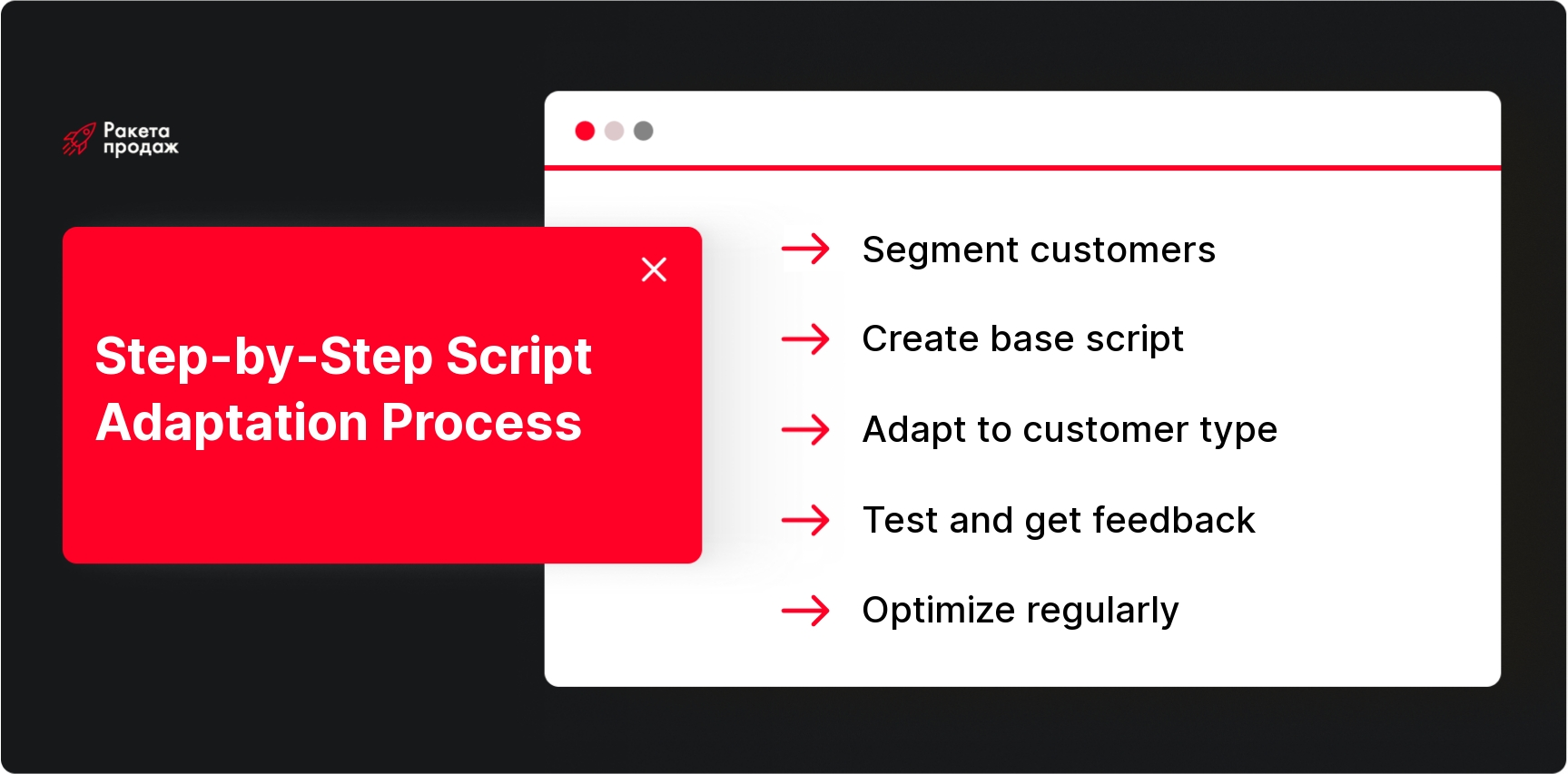
  1. Analysis and audience segmentation. Collection and interpretation of client information: demographics, psychographics, communication history. Learn more about client segmentation for sales to properly distribute team efforts.
  2. Identifying typical scenarios and sales stages. Formulation of goals, sequence of steps, possible client questions, working through objections.
  3. Adaptation of script blocks for segments. Individual refinement of wording, emphases, and choice of arguments.
  4. Testing and feedback. A/B tests, client surveys, analysis of sales dynamics after implementing scripts.
  5. Optimization and scaling of successful models.

After creating the basic script, it’s necessary to adapt it for each type of client. Modify key blocks for this: greeting, questions to identify needs, presentation of benefits, handling objections, and closing. Each client type should have their own wording, examples, and evidence.

An equally important stage is testing scripts in real conditions. Start with a small group of managers who will use the new adapted scripts, and compare their results with a control group. Collect feedback from both managers and clients. This will help identify the strengths and weaknesses of your scripts and make necessary adjustments. Now let’s look at specific examples of how this works in practice. To strengthen client communication skills, it’s also important to study effective cold calls, as the first contact often determines the success of the entire deal.

Examples of script adaptation for different segments and situations

Let’s look at how the same product can be presented to different types of clients by adapting the sales script for different types of clients. As an example, let’s take a business automation program.

In a conversation with an analytical client, your script should be structured and contain precise figures and facts. Start with a detailed description of functionality: “Our solution increases productivity by 27%, according to research by an independent laboratory. Additionally, you get a reduction in operational expenses by 15-20% in the first year of use.” Provide the client with a comparative table of your product against competitors, test results, and technical specifications.

With an emotional client, the same product needs to be presented completely differently: “Imagine how your workday will change when all routine is automated. You’ll be able to focus on truly important tasks, while the system will handle all the paperwork.” Tell a success story: “Company X implemented our system last year, and after just a month, the sales department head reported that his team was spending 40% more time with clients, not with reports.”

For a practical client, concrete, quick benefits will be key: “Our solution pays for itself in 3-4 months and doesn’t require lengthy implementation. Within a week, you’ll see the first results: reduced time for report compilation and automatic task distribution among employees.” Emphasize ease of use and quick start: “The system is intuitive and doesn’t require special training – your employees will figure out basic functions in 15-20 minutes.”

For a social client, it’s important to show that your product is not just technology, but a way to improve relationships within the team and with clients: “Our system creates a unified information space for the entire team. You’ll always know who’s working on what, can easily exchange data, and collaboratively solve tasks.” Talk about the user community, support, and how you care for each client. The customer matrix and scripts help systematize the approach to different types of clients and build more precise communication. This matrix helps visually represent which key messages, arguments, and communication style work best for each segment of your audience.

Sales Stage For Analyst For Emotional Client For Practical Client For Social Client
Greeting Introduce yourself, state the purpose of conversation Show enthusiasm, create emotional connection Brief and to the point Show personal interest in client
Identifying needs Ask specific, detailed questions Open questions about impressions and feelings Direct questions about current problems Questions about team, relationships with partners
Presentation Numbers, facts, technical details Success stories, vivid images Specific benefits, quick results Impact on team and relationships
Handling objections Logical arguments, research Emotional stories of overcoming difficulties Concrete problem solutions Experience of other clients, social proof
Closing the deal Step-by-step action plan Emotional reinforcement of impressions Quick and simple process Prospects for long-term cooperation

An effective script is not just a set of phrases, but a flexible sales script that allows the manager to adapt to the client in real time. For script formation, it’s important to use objection handling templates to be prepared for typical client questions in advance. But what can go wrong when adapting scripts?

Critical errors and difficulties in script adaptation

When implementing adapted scripts, companies often face a number of typical problems and mistakes. Understanding these difficulties will help you avoid common traps and make the transition to personalized scripts as smooth as possible.

One of the most common mistakes is incorrectly identifying the client type. Sometimes managers make hasty conclusions based on first impressions or stereotypes. For example, a young, energetic person might be taken for an emotional client, when in fact they are an analytical type. This leads to choosing the wrong communication strategy and, consequently, loss of trust and deal failure.

Another problem is excessive adherence to the script. When a manager follows the scenario too literally, not responding to changes in the client’s mood and behavior, the conversation becomes mechanical and unnatural. The client feels they’re communicating with a robot, not a real person, and loses interest in the offer.

Many companies also face difficulties when training employees to work with adapted scripts. Managers may find it hard to switch from a universal scenario to a flexible approach, especially if they’ve already formed certain habits in client communication. It takes time and practice to learn to freely switch between different communication styles.

Here are the main difficulties companies face:

  • Difficulties identifying the interlocutor type and adapting in real time.
  • Excessive standardization of samples, when an employee sounds “like a robot.”
  • Lack of feedback and testing of new scenarios.

Another common mistake is creating overly complex or overloaded scripts. When a manager has dozens of pages with variations for different situations before them, they start to get confused and lose naturalness in communication. The script should be simple enough for the manager to easily navigate it, yet flexible enough to adapt to the specific client’s characteristics.

The process of adapting a sales script requires attention to detail and understanding the psychology of different client types. To effectively customize a script for a client, it’s necessary to regularly analyze results and make adjustments. Sales scripts for different clients should contain wording options suitable for specific audiences.

Lack of regular script updates is another common problem. The market changes, new products and competitors appear, and client needs and pain points change. If scripts aren’t updated to account for these changes, they quickly become outdated and lose effectiveness. It’s necessary to regularly analyze sales results, collect feedback, and make adjustments to communication scenarios.

The right approach to script adaptation requires a balance between standardization and flexibility, between structure and creative approach. Managers should understand that a script is not a rigid algorithm, but rather a guiding tool that helps lead the conversation in the right direction while adapting to the specific client’s characteristics. Let’s summarize.

Adapting scripts for different types of clients is not just a theoretical concept, but a proven tool for increasing sales that requires a professional approach and expertise. “Sales Rocket” offers a comprehensive solution: from diagnosing current processes and identifying strengths and weaknesses of your sales department to developing personalized scripts and training your team to use them effectively. We not only create scripts but also integrate them into your CRM system, develop a sales book that becomes the basis for training new employees, and support implementation until specific results are achieved. Our clients receive not just documents, but a working tool that reduces deal cycle, increases average check, and provides stable growth of the client base. Our approach to communication personalization allows increasing business profitability by 30-40% without additional costs and makes the work of the sales department predictable and systematic.

Create a sales department where every manager knows exactly how to work with any type of client – order a comprehensive sales systematization today!

Conclusions

Adapting a sales script for different types of clients is not just a fashionable trend, but a necessary condition for increasing sales effectiveness in modern business. A personalized approach allows speaking to the client in their language, considering their psychological characteristics and preferences, which significantly increases chances for a successful deal.

The key point in this process is the ability to quickly identify the client type and choose the right communication strategy. Using knowledge about psychological types (analysts, emotional clients, practical clients, social clients), you can adapt your script at all sales stages: from greeting to closing the deal.

Remember that an effective script is not a rigid scenario, but a flexible tool that helps the manager lead the conversation in the right direction. It’s important to find balance between structure and natural communication, between following the script and reacting to changes in the client’s mood and behavior.

How to adapt a sales script for different types of clients is a skill that comes with practice. Flexible sales scripts allow your team to adapt to the client faster, respond to market changes, and increase communication effectiveness at every stage of the deal.

If your company requires a full cycle of sales script creation or you want to update existing solutions, it’s worth contacting specialized experts to get modern and effective tools for business growth.

In this article:
See more
Book a FREE sales funnel audit
CONTACT US
FAQ
Why do universal sales scripts work worse?

Universal scripts don’t account for the psychological characteristics of different client types. What’s effective for one type may not work at all for another. For example, an analyst needs facts and figures, while an emotional client needs stories and impressions. When you use one approach for everyone, you lose a significant portion of potential clients.

How to quickly identify a client type during conversation?

Pay attention to speech pace, word choice, and non-verbal signals. Analysts speak slowly, in a structured manner, and ask clarifying questions. Emotional clients speak quickly, figuratively, and often change topics. Practical clients are brief and specific, focused on results. Social clients talk a lot about people, relationships, and value communication.

How to adapt a sales script for an analytical client?

Emphasize facts, figures, and research. Provide detailed information about the product, comparison tables, and technical specifications. Be ready to answer many clarifying questions. Avoid emotional arguments and general phrases.

What works better with emotional clients?

Success stories, vivid images, and emotional arguments. Show how your product will change the client’s life for the better, what impressions they’ll get. Use visual materials, real-life examples, and testimonials from other clients. Be energetic and emotional in communication.

Do I need to make a separate script for each client type?

It’s not necessary to create completely separate scripts. It’s more effective to develop a basic script with variations of key blocks for different client types. This approach allows maintaining the sales structure while adapting wording, examples, and arguments to the specific client type’s characteristics.

How to understand if an adapted script really works?

Track key indicators: conversion, average check, number of objections, sales cycle duration. Compare results before and after implementing adapted scripts. Collect feedback from managers and clients. Conduct A/B testing of different script variations to identify the most effective approaches.

SUBSCRIBE TO MY TELEGRAM CHANNEL
The most valuable sales information right on your phone!
icon

LOTS OF USEFUL INFORMATION, FREE TEMPLATES, AND CHECKLISTS ON MY INSTAGRAM

Materials and practical advice on sales growth in our blog: