icon

Why Sales Scripts That Worked a Year Ago Aren't Selling Today

Have you noticed that old sales script doesn’t work in conversations with clients anymore? If your managers call through databases, use standard text, and receive only objections and rejections in response – the problem might be an outdated sales script. What brought results a year ago may only cause irritation today. The market is changing, competition is growing, and customers are becoming smarter and recognizing template approaches. Many companies continue to use the same sales scenarios for years, not realizing that this not only reduces sales but also burns out employees. The reason isn’t in scripts as a tool, but in their unchanging nature. Let’s figure out why sales scripts don’t work and how to restore their effectiveness.

Key Takeaways

  • Customers block template phrases at the subconscious level because they hear dozens of identical conversation openings every day.
  • A script built around the product loses to needs diagnostics: strong managers start with questions, not presentations.
  • One scenario for cold and warm leads reduces conversion: the client receives either an overly aggressive offer or unnecessary stages.
  • Arguments like “cheap, fast, quality” no longer convince; today ROI, data security, and implementation speed work better.
  • Declining conversion month after month, increasing objections, and managers abandoning the script signal that the scenario is outdated.

In the article below, you’ll find a step-by-step system for updating scripts: what to check in call recordings, which blocks to rewrite, and how to make the scenario flexible.
👇

Just a few years ago, a good sales scenario could work for years without significant changes. Today, even a well-developed script loses effectiveness within months. This is due to fundamental changes in the business environment and buyer behavior.

First of all, we live in an era of information overload. Customers don’t respond to scripts like they used to because they receive dozens of advertising messages daily through different communication channels. Their brain automatically filters typical appeals. When a manager starts a conversation with a template phrase that the client has already heard dozens of times, a defense mechanism activates – the conversation is blocked at the subconscious level.

Why Sales Scripts Are Becoming Outdated Faster Than Before

Just a few years ago, a good sales scenario could work for years without significant changes. Today, even a well-developed script loses effectiveness within months. This is due to fundamental changes in the business environment and buyer behavior.

First of all, we live in an era of information overload. Customers don’t respond to scripts like they used to because they receive dozens of advertising messages daily through different communication channels. Their brain automatically filters typical appeals. When a manager starts a conversation with a template phrase that the client has already heard dozens of times, a defense mechanism activates – the conversation is blocked at the subconscious level.

Familiar situation – sales scripts are becoming outdated, and your team can’t adapt them quickly enough to the changing market? You notice that managers increasingly deviate from scenarios, and clients raise new objections with no ready answers? At “Rocket Sales,” we’ve encountered this problem with dozens of companies and developed a comprehensive methodology for updating and adapting sales scripts to modern market realities. Our approach includes a complete audit of existing communications, identifying “weak spots,” developing personalized scripts, and implementing them through team training. We don’t just create documents – we build a flexible system that constantly adapts to market changes and customer behavior. The result? Our clients receive an average increase in conversion of 35%, with a record monthly turnover increase of more than $10 million over 4 months of work.

Turn outdated sales script into a modern sales growth tool - order a free audit of your sales scenario effectiveness!

The second reason is the rapid growth of competition. In most niches today, dozens of companies operate with similar offers. They all use roughly the same sales approaches, so customers quickly learn to recognize standard techniques and resist them. When every second call begins with the same phrases, naturally, their effectiveness decreases.

Communication channels have also changed. Previously, telephone calls and face-to-face meetings were the main tools. Today, sales are moving to messengers, email, and social networks. Each channel has its specifics, and a script effective in a phone conversation may not work in correspondence. Companies that don’t adapt their scenarios to new channels lose potential customers.

If you don’t fully understand what a sales script is, we recommend clarifying this issue to build more effective communication with clients.

It’s important to understand that an outdated sales scenario gradually reduces your conversion. The longer you use an outdated sales script, the more effectiveness drops. The problem isn’t with the tool itself, but with its relevance to current market realities.

6 Reasons Why Your Old Sales Script Doesn't Work

An outdated sales script isn’t just a document with an old creation date. It’s an approach that doesn’t account for market changes, new customer expectations, and modern communication channels. Even if your scenario was developed just a year ago, it might be morally outdated. Let’s examine the main reasons why your sales script has stopped delivering results.

Reason 1. The Script Is Built Around the Product, Not the Client

Many outdated scripts start with a company and product presentation. “Hello, my name is Ivan, I represent company X. We’ve been producing Y for 10 years and are the market leader…” Such an opening immediately makes the client want to end the conversation.

Modern sales are built around the client’s problem, not product features. The client isn’t interested in how many years you’ve been in the market – they care about how you can solve their problem. An outdated sales scenario focuses on one-sided presentation, while the current approach involves diagnosing needs through questions and active listening.

When your script starts with talking about you rather than asking about the client, it’s doomed to low effectiveness. Modern clients expect their needs to be the center of attention.

Reason 2. The Script Doesn't Account for the Client's Readiness Level

A serious problem with many scenarios is using the same approach for different types of leads. A cold client who is hearing about your product for the first time requires a completely different approach than a warm lead already familiar with your offer.

An outdated sales scenario applies the same logic to all contacts. As a result, cold leads receive overly aggressive offers and refuse further communication, while warm leads go through unnecessary introductory stages when they’re already ready for the next step.

If you’re still planning to develop a sales script, it’s important to immediately consider different scenarios for various stages of customer interaction.

A modern sales scenario should be adaptive – including different branches and modules depending on the client’s familiarity with your offer, their position in the sales funnel, and contact source. Without such flexibility, the script quickly becomes irrelevant.

Reason 3. The Script Contains Outdated Arguments

Customer values change, and with them, the arguments that persuade them to make a purchase. If your script still relies on the outdated triad of “cheap, fast, quality,” it’s unlikely to be effective today.

The modern client has heard these promises hundreds of times from different companies. For them, it’s just noise. Today, other arguments are much more significant: measurable return on investment, data security, automation of routine processes, implementation and adaptation speed.

If your script relies on value propositions from three years ago, it doesn’t resonate with current customer priorities. The market and requests are changing, but your arguments remain the same – effectiveness inevitably decreases.

Reason 4. The Script Doesn't Account for New Customer Objections

Types of customer objections change along with the market. If price used to be the main barrier, today other objections come to the forefront: “I’m comparing several solutions,” “we’re still thinking and gathering information,” “we already have a similar solution.”

An outdated sales script contains templates for overcoming objections that were relevant a year or two ago. It doesn’t offer effective answers to modern barriers that your managers face daily.

To stay one step ahead, it’s extremely important to regularly review approaches to handling customer objections and supplement the script with fresh and relevant answers.

When the script doesn’t contain current methods for handling objections, managers are left defenseless against new types of rejections. They either improvise or use ineffective templates – in both cases, the chances of a successful sale decrease.

Reason 5. The Script Is Too Rigid

Excessive rigidity is another common problem with outdated scenarios. When the script prescribes pronouncing each phrase verbatim, following a strict sequence of steps without considering the client’s reaction, it becomes an obstacle rather than a helper.

Managers quickly understand the limitations of such an approach and begin to deviate from the prescribed scenario. They see that customers don’t respond to scripts, recognize template phrases, and lose interest in the conversation. As a result, employees either completely abandon the script or use it formally, which reduces sales effectiveness.

A modern script should be flexible, giving the manager freedom to choose wording and sequence of steps depending on the situation. It should be a support tool, not a rigid algorithm.

Reason 6. The Script Isn't Adapted for New Sales Channels

Most old sales script doesn’t work for today’s diverse communication channels – they were created for one specific channel, usually phone calls. Today, sales are conducted through multiple channels: messengers, Zoom meetings, social networks, website chats, email newsletters.

Attempting to use the same script for all channels is doomed to fail. Formulations effective in a phone conversation look inappropriate in correspondence. The structure of a presentation for a Zoom demonstration should differ from a cold call scenario.

If your script doesn’t take into account the specifics of different communication channels, it quickly becomes irrelevant. Modern sales require different scenarios for different customer contact points.

Signs That Your Sales Scenario Is Outdated

image

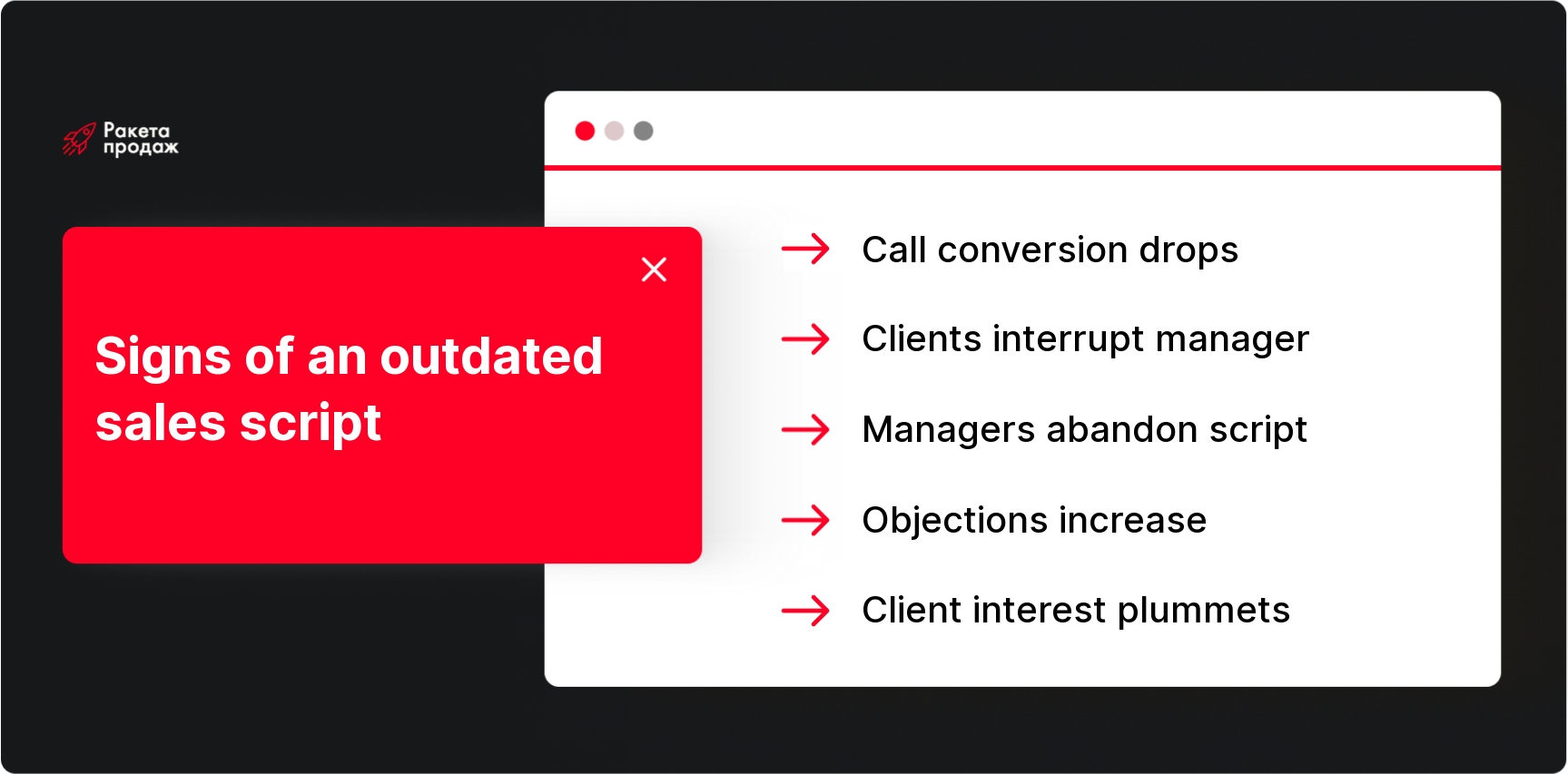
It’s not always obvious that a script is outdated and needs updating. Often the problem is attributed to manager incompetence, poor lead quality, or seasonal demand fluctuations. However, there are clear signs that indicate problems with the sales scenario.

Declining conversion from call to meeting or sale is the first and most important signal. If you notice that fewer calls are turning into the next funnel stage with an unchanged lead flow, you should pay attention to the script. It’s especially indicative if the decline happens gradually, month after month. This is the classic picture of a scenario becoming outdated – it doesn’t stop working overnight but slowly loses effectiveness.

Also monitor the dynamics of average conversation time. If clients start ending conversations earlier than before, this may indicate that your script no longer holds their attention and doesn’t generate interest.

Pay attention to seller mistakes that may arise from outdated or inflexible communication scenarios. Often managers start voluntarily deviating from the script to increase their own effectiveness and maintain contact with the client.

Another important sign – clients increasingly interrupt the manager during presentations. When a manager tries to follow the script, but the client constantly intervenes with questions or objections, this shows that the conversation structure doesn’t meet the interlocutor’s expectations. The modern client doesn’t want to listen to a long presentation; they expect dialogue and the opportunity to ask questions. If your script involves a lengthy monologue at the beginning of the conversation, it’s almost certainly outdated.

Also pay attention to your managers’ behavior. If they begin systematically deviating from the script, it’s a signal that the scenario doesn’t correspond to the real situations they face. Experienced sellers intuitively feel which approaches work and which don’t, and modify the script on the go. If most of the team ignores certain parts of the scenario or refuses to use it altogether, the document doesn’t meet market needs.

An increase in objections also indicates that the script is becoming outdated. When clients increasingly respond “we don’t need this,” “we’re already working with another supplier,” “it’s too expensive,” this suggests that your scenario doesn’t address key doubts or offer convincing arguments. A modern script should anticipate typical objections and include effective methods for handling them.

Finally, another sign is negative feedback from clients. If you receive complaints about intrusiveness, lack of individual approach, or misunderstanding of needs, this directly indicates problems with the script.

How to Update a Sales Script So It Starts Selling Again

Updating a sales script isn’t just a cosmetic repair but systematic work that should be based on analyzing real dialogues with clients and market changes. This task requires time and effort, but the results are worth the investment.

The first step is to analyze your managers’ successful conversations. Record and listen to calls that ended in a sale or progression to the next funnel stage. Pay attention to formulations that elicit positive client reactions, questions that help identify needs, and arguments that overcome typical objections. These findings should become the foundation for the updated script.

An important part of a modern script is the client needs diagnostic block. Instead of starting with a presentation of your company and product, the scenario should include a series of questions that help understand the client’s situation. “What tasks are you currently solving?”, “What problems are you facing?”, “What exactly dissatisfies you with the current solution?” – such questions shift the conversation to dialogue mode and show the client that you’re interested in their needs.

The next step is to rewrite arguments according to current client values. General phrases about “high quality” and “affordable prices” no longer work. The modern client expects specifics: how exactly your product will help them save time and money, increase sales, reduce risks. Use numbers, percentages, examples of successful implementations. The updated script should include a clear value proposition formulated in terms of benefits for the client.

It’s also important to make the script flexible and adaptive. Instead of rigid text, it’s better to create a structure with main blocks and several options for each conversation stage. This format allows the manager to choose the most appropriate wording and sequence of steps depending on the client’s reaction.

Don’t forget about regular testing of the updated scenario. After implementing the new script version, track key metrics: conversion from call to meeting, number of objections, average conversation time. Analyze which scenario elements work best and constantly make adjustments.

Achieving stable results is impossible without continuous work on team competencies. Training for managers aimed at developing skills for adapting scenarios to real dialogues can be an effective tool.

Remember that updating a sales script isn’t a one-time action but a continuous process. The market continues to change, and your sales scenario must change with it. Regular analysis of conversation recordings, feedback from managers, and conversion data helps keep the script up-to-date.

Updating sales scripts isn’t just cosmetic changes to wording, but systematic work to adapt the entire communication process to modern market realities. “Rocket Sales” offers a comprehensive approach to solving this task: we analyze recordings of your managers’ conversations, identify typical objections and problem points, develop flexible and adaptive scripts, and then train your team to use them effectively. Our methodology includes creating modular scenarios for different communication channels and sales funnel stages, regular testing and updating of formulations, as well as control and reporting tools. The work doesn’t end with implementation – we support your team until the first results are achieved, adjusting the approach as needed. Over 8+ years, we’ve helped more than 208 companies from 14+ industries build effective sales processes that ensure stable turnover growth even in a changing market.

Create a sales department where scripts really work and increase conversion up to 86% - order a comprehensive update your sales script!

Conclusion

Outdated sales scripts are one of the main reasons for declining sales department effectiveness. What worked a year ago may be completely ineffective today due to market changes, evolution of buying behavior, and new communication channels. Rigid, product-oriented scenarios with outdated arguments not only fail to deliver results but also demotivate the team. Recognizing the problem is the first step to solving it. If you observe decreasing conversion, increasing objections, and managers deviating from the script, it’s time to update sales script for your team. Switching to a client-centric, flexible, and modular script with regular testing and updating will help restore effectiveness and increase sales again. In today’s rapidly changing world, a script should be a living tool that constantly adapts to new market realities.

Regular sales department motivation, training, and creation of relevant, truly working scenarios will ensure stable growth of any commercial indicators.

In this article:
See more
Book a FREE sales funnel audit
CONTACT US
FAQ
Why doesn't an old sales script work?

An old sales script doesn’t work due to market changes, evolution of buying behavior, and emergence of new communication channels. Clients become more informed, recognize template approaches, and expect personalized dialogue instead of standard presentations.

How can I tell that sales scripts aren't working?

Main signs: declining conversion, increasing objections, clients frequently interrupting the manager, employees systematically deviating from the script, increasing rejections and negative reviews.

How often should a sales script be updated?

A sales script should be reviewed at least quarterly, as well as with any significant market changes, new product launches, or emergence of new typical client objections.

Why don't clients respond to sales scripts?

Clients don’t respond to scripts because they recognize memorized text and typical techniques. Modern clients expect an individual approach, understanding of their needs, and dialogue instead of a one-sided monologue about product benefits.

Why does an old sales script stop working?

An outdated sales script doesn’t work because it can’t keep up with changes in the market and client behavior. Over time, the audience begins to recognize template phrases, decision-making criteria change, new objections and communication channels emerge. If the scenario isn’t updated, it fails to meet client needs, causes resistance, and reduces conversion, even if it previously showed good results.

SUBSCRIBE TO MY TELEGRAM CHANNEL
The most valuable sales information right on your phone!
icon

LOTS OF USEFUL INFORMATION, FREE TEMPLATES, AND CHECKLISTS ON MY INSTAGRAM

Materials and practical advice on sales growth in our blog: