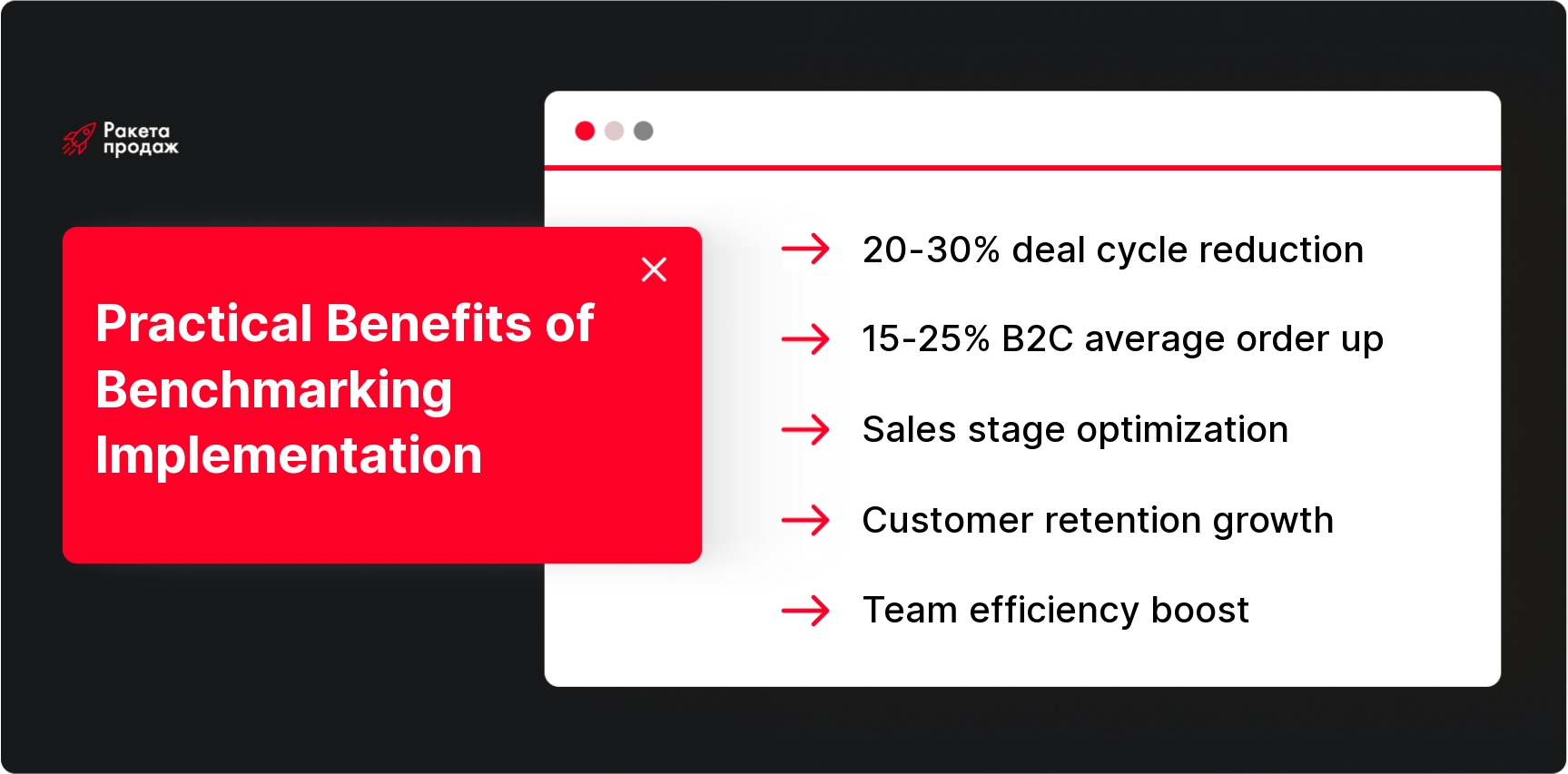
Effective benchmarking doesn’t happen by chance – it’s the result of a systematic approach adapted to the specifics of the business model. Let’s consider practical steps for implementing benchmarking in B2B and B2C companies.
For B2B companies, the process should start with a clear definition of strategic goals and related KPIs. For more details on which sales department KPIs truly illuminate business dynamics, check out the specialized article. Focus on indicators that truly impact business results: conversion by funnel stages, average sales cycle duration, LTV to CAC ratio, percentage of business expansion with existing clients. It’s important not just to collect data, but to segment it: by client size, industry, geography.
Tools for B2B benchmarking should include both quantitative analysis (CRM systems, sales analytics) and qualitative methods (client interviews, satisfaction analysis). It’s useful to create an internal benchmarking committee including representatives from different departments to ensure a comprehensive view of processes. If you’re looking for proven solutions to improve efficiency, we recommend exploring effective B2B strategies that have established themselves with large companies.
In B2C benchmarking, the emphasis is different. Key metrics here are channel conversion, acquisition cost breakdown by source, average check, purchase frequency, customer churn. It’s important to set up analytics systems to track the entire customer journey – from the first brand touch to repeat purchases. B2C tools include web analytics, marketing campaign analysis, A/B testing, social media monitoring, and systematic satisfaction surveys.
Regardless of business type, it’s important to follow several universal principles. First, regularity: benchmarking should not be a one-time action, but a constant process. Second, effectiveness: results should transform into specific initiatives and changes. Third, comprehensiveness: it’s not enough to compare only financial indicators; processes, technologies, and human factors must also be analyzed.
A good practice is to create a benchmarking “roadmap” with a clear implementation plan for changes based on analysis results. This helps transform insights into concrete actions. It’s also useful to conduct regular experience exchange sessions between teams and departments to spread best practices within the organization.
Remember that the goal of benchmarking is not to copy competitors, but to discover opportunities for unique improvements that correspond to your business model and customer needs. Benchmarking should help not only catch up with the market but also define directions for innovation and differentiation. To understand sales benchmarks and set realistic goals, it’s necessary to regularly conduct comparative analysis with both competitors and best practices in your industry.


 Time to read: 10 min.
 01 April 2026