Key Takeaways
- A manager who only monitors the plan creates chaos; real value comes from strategy, systems, and team development.
- Strong sales managers assign tasks through meaning, not commands. Weak ones simply demand numbers without explaining context.
- Your motivation management works if people stay not just for money, but for interest, meaning, and growth.
- Mentoring and call reviews yield better results than constant control. A manager who teaches grows the team; a controller only applies pressure.
- A sales manager’s personal discipline sets the standard for the entire team. If you’re late and don’t fulfill promises, the team does the same.
In the article below, you’ll find specific management skills to develop and a step-by-step plan to improve each competency. Read the full article 👇
It is the Head of Sales who determines the department’s strategy, builds processes, recruits and develops the team. The department’s ability to consistently meet targets or constantly “put out fires” depends on their managerial competence.
In this article, we’ll explore the key skills of a sales manager that are essential for effective sales leadership. These professional competencies of a sales manager will help you transition from the role of “senior salesperson” to a true leader capable of building a system that works even in your absence.
Strategic Thinking and Systems Vision
Strategic thinking is a fundamental skill for a head of sales department. It’s the ability to see beyond today’s plan to a long-term goal and the path to achieve it. A sales manager with developed strategic thinking looks beyond monthly KPIs and understands how today’s decisions will affect results in a quarter or a year.
Systems vision allows the sales manager to combine disparate elements into a unified mechanism. They understand how marketing affects lead quality, how sales processes are connected to service, how employee training is reflected in conversion rates. Such a leader doesn’t just solve problems as they arise but builds a system that prevents their occurrence.
A typical mistake of beginning managers is managing by inertia, “from month to month.” This approach leads to a constant race to meet the plan, without the opportunity to implement improvements and grow. A manager with systems thinking, on the contrary, works with perspective: analyzes data, identifies patterns, tests new approaches.
As an example, we can look at how a strategically thinking sales manager builds a growth plan for the quarter. They don’t simply increase the plan by a certain percentage but analyze the market, seasonality, and team capabilities. Then they determine what process improvements need to be implemented, what competencies to develop in the team, what tools to introduce. They break down the quarterly plan into monthly and weekly goals so the team moves consistently. Systems thinking helps anticipate obstacles and prepare solutions in advance. Let’s look at what other professional skills of a sales manager are necessary for an effective leader.
Key Professional and Personal Skills
One of the main causes of failures in sales departments is unclear task setting. Statistics show that about 70% of problems with plan fulfillment arise because employees misunderstand what is required of them. The ability to clearly formulate goals and tasks is a key skill of a sales manager that directly affects the results of the entire team.
Proper task setting begins with a clear understanding of the desired result. The management skills of a sales manager include mastery of various goal-setting methodologies: SMART (specific, measurable, achievable, relevant, time-bound), OKR (objectives and key results), KPI (key performance indicators). But even more important is understanding the difference between “assigning a task” and “conveying meaning.” When an employee understands not only what needs to be done but why, their motivation and effectiveness increase significantly.
A professional manager doesn’t just say “we need to increase sales by 20%,” but explains why it’s important, how it relates to the company’s strategy, what resources will be allocated, and what benefits it will bring to the employees themselves.
Here are five signs of a properly assigned task:
- The task is formulated in terms of results, not process
- Clear success criteria and measurement methods are defined
- Specific deadlines are established
- Necessary resources and authority are allocated
- The employee understands the meaning and context of the task
The ability to clearly formulate tasks is inextricably linked to communication skills. After all, even the clearest task is useless if the manager cannot properly convey it to the team.
Have you ever wondered why 80% of sales departments fail to achieve their goals despite having experienced managers? The issue isn’t a lack of talent, but a systematic approach to management. This is where the “Rocket Sales” team comes in with over 7 years of experience building effective sales departments. We help leaders develop key management competencies through comprehensive process audits, implementing structured control systems, and training teams in modern sales methodologies.
Our approach isn’t limited to theory – we offer ready-made tools for developing all critical skills of a head of sales department: from strategic thinking to emotional intelligence. We create a personalized “sales book” with regulations, scripts, and checklists that free you from the need to control every step your managers take. The result? Our clients achieve an average of +35% growth in turnover, with our best case being a $1.6 million increase in sales in just 4 months.
Transform your sales department into a transparent and scalable system that works even in your absence – request a free consultation with our experts!
Communication Competence and Listening Skills
Communication is the foundation of people management. A head of sales department communicates daily with different people: subordinates, management, clients, related departments. The quality of this communication directly affects their work efficiency and team results.
Listening skills are perhaps the most underrated communication skill. Many managers perceive communication as a one-way transfer of information: they speak, subordinates listen. But a true leader knows that active listening and empathy are powerful tools of influence. When a manager genuinely shows interest in employees’ opinions, delves into their problems, and asks clarifying questions, they not only receive valuable information but also earn the team’s trust.
Constructive dialogue skills help managers resolve difficult situations. For example, when a manager fails to meet the plan, instead of criticism and pressure, an effective sales manager begins with questions: “What difficulties are you facing?”, “What prevents you from achieving your goal?”, “What support do you need?” This approach not only identifies real problems but also shows the employee that the manager is on their side.
A common mistake for managers is talking more than listening. Many sales leaders believe their main task is to give instructions and control their implementation. But in modern management, a more effective approach is when the manager asks the right questions and listens carefully to the answers, helping employees find solutions themselves. This management style not only develops the team but also frees up the sales manager’s time for strategic tasks. Effective communication is closely linked to the next key skill – development and mentoring.
In the process of adapting new employees, it’s worth applying modern staff adaptation practices, which include training meetings, constructive feedback, and establishing transparent expectations for the team.
Skill of Development and Mentorship
A strong head of sales department understands that their main task is not just to meet the plan today, but to form a team capable of achieving increasingly higher results tomorrow. It is through employee development that the sales manager creates a “selling culture” – an environment where high results become the norm, not the exception.
Mentoring, coaching, and support are not “additional work” for a manager, but their basic function. Many beginning sales managers make the mistake of thinking their main task is to control plan execution. But control without development leads only to temporary results. A true leader invests time in developing their people, understanding that this is the most profitable investment.
There are many formats for employee development. One of the most effective is the regular review of calls and meetings. The sales manager listens to recordings of the manager’s conversations with clients, analyzes strengths and weaknesses, and provides specific feedback. Another useful format is individual development plans, where growth areas and concrete steps for skills development are determined for each employee. The shadowing method is also effective – when a manager observes the work of a more experienced colleague or leader, and then they analyze what was observed together.
In addition to these tools, managers should explore modern approaches such as coaching for team management to support continuous growth for each employee and build a strong professional culture.
How to distinguish a manager who is a “teacher” from one who is a “controller”? The “controller” focuses on mistakes and punishments, speaks predominantly about what was done wrong. The “teacher,” on the contrary, looks for potential for growth, asks developmental questions, helps the employee find their own solutions. The “controller” believes that development is the employee’s personal business; the “teacher” sees team development as their direct responsibility. Employee development is inextricably linked to their motivation, which we’ll discuss next.
Managing Motivation and Engagement
Sales department motivation and stimulation are different concepts, although many managers use them as synonyms. Stimulation is external influence, most often material (bonuses, rewards, penalties). Motivation is a person’s internal desire to do something. An effective sales manager understands that long-term results can be achieved only through internal motivation.
To manage motivation, a manager must understand the internal motivators of each team member. Some strive for financial independence, others for professional recognition, some want interesting tasks, while for others stability and comfort are more important. The sales manager should talk with each employee, identify their personal goals, and show how working in the company will help achieve them.
In practice, there are many tools for non-material motivation. These include public recognition of achievements, opportunities for professional growth, new interesting tasks, flexible scheduling, a comfortable work environment, and corporate events. It’s important to remember that different people are motivated by different factors, so the approach should be individualized.
You can learn more about the best non-material motivation strategies and tangible business benefits in the article about sales department motivation.
A common mistake by managers is managing “only through money.” Of course, fair compensation is necessary, but research shows that after reaching a certain income level, additional money doesn’t motivate as strongly. Moreover, if a person works only for money, they will easily leave for a competitor offering more. A sales manager who can create an environment where people work not only for compensation but also because they find it interesting, see meaning and prospects, gets a more stable and loyal team. To effectively manage motivation, it’s necessary to regularly analyze work results, which we’ll discuss in the next section.
Control and Analytical Thinking
Managing sales “by eye” is a sure path to chaos and unpredictable results. A modern head of sales department must possess developed analytical thinking and be able to make decisions based on data, not intuition or personal preferences.
A crucial skill for a sales manager is the ability to “read numbers”: analyze conversion by funnel stages, track LTV (lifetime customer value) indicators, study sales dynamics by various parameters (products, managers, acquisition channels), identify deviations from the norm. This allows the manager to promptly identify problems and make informed decisions.
An effective sales manager forms a culture of regular analytics in the team. This means that not only the manager, but also each salesperson understands their key indicators, knows how to analyze them, and takes corrective actions. At weekly team meetings, not only results are discussed, but also insights gained from data analysis: which approaches work better, where customers are lost, which segments are more promising.
Consider this example: an experienced sales manager, analyzing CRM data, notices that conversion at the stage of transition from commercial proposal to deal has decreased by 15%. Another manager might simply not notice the problem or see it only a month later when the plan is already unfulfilled. But an analytically thinking sales manager identifies the problem immediately, conducts additional analysis (perhaps the lead structure has changed or competitors’ pricing policies?), and takes corrective actions (for example, revising the commercial proposal template or conducting additional training for managers). This approach allows problems to be solved before they negatively impact results. Analytical thinking is closely related to the ability to manage change, which we’ll discuss next.
One of the key tools for building transparent control and quality analytics is CRM system implementation. Modern solutions allow not only automating routine but also seeing dynamics across each employee and deal stage.
Modern sales departments operate in constantly changing conditions: new products appear, customer needs change, new technologies are implemented, competition intensifies. All this requires a special skill from the manager – change management.
The main difficulty with changes is that people naturally resist them. Even beneficial innovations often meet sabotage, obvious or hidden. Managers get used to working in certain ways and don’t want to change familiar schemes, even if they’re no longer effective. A sales manager must be able to overcome this resistance, implement new approaches and tools without destroying working processes and demotivating the team.
A manager’s flexibility is manifested in the ability to adapt their style to the situation. With some employees, a directive approach is effective; with others, a coaching approach. In some situations, a quick centralized decision is needed; in others, collective discussion. A flexible manager can see which management style will be most effective in a specific situation.
As an example of change management, we can consider implementing a new CRM system. This is a complex process that affects the entire team and can cause significant resistance. An experienced sales manager begins by explaining the meaning of the changes: what problems the new system will solve, what advantages it will give the team, how it will make managers’ work easier. Then they involve the most influential team members as “ambassadors” of change, organize quality training, gradually implement the system starting with the least painful functions, constantly collect feedback, and adjust the process. This approach minimizes resistance and accelerates the team’s adaptation to new conditions. You can learn more about the benefits, stages, and typical mistakes of such a project in the material on CRM system implementation.
Emotional Intelligence and Stress Resistance
A manager’s emotional maturity directly affects the atmosphere in the team. A sales department is a high-stress environment: plans, deadlines, difficult clients, competition. In such conditions, the emotional stability of the sales manager becomes a critically important quality.
Emotional intelligence is the ability to recognize one’s own and others’ emotions, manage them, and use them to solve problems. A sales manager with developed EI can maintain calm in stressful situations, doesn’t “explode” with failures, doesn’t infect the team with anxiety or panic. They are aware of their emotional states and their impact on others, can choose constructive reactions even in difficult situations.
The ability to manage one’s reactions is especially important when things don’t go according to plan. If a sales manager falls into panic or aggression at the first signs of problems, this instantly transfers to the team and only worsens the situation. Conversely, a calm, confident manager who maintains clear thinking and a constructive attitude even in a crisis helps the team maintain productivity under pressure.
Here are 5 signs of an emotionally mature manager:
- Can express criticism constructively, without personal attacks and humiliation
- Acknowledges their mistakes and takes responsibility for them
- Can listen to unpleasant feedback without defensive reactions
- Doesn’t make important decisions in a state of strong emotions
- Notices and takes into account the emotional state of team members
Emotional intelligence is a skill that can and should be developed. It begins with awareness: observe your reactions, learn to recognize triggers that cause unwanted emotions. Then practice managing reactions: between stimulus and response, there is always a pause; learn to use it to choose a constructive response. Emotional stability is closely related to a manager’s personal effectiveness, which we’ll discuss next.
Personal Effectiveness of a Head of Sales Department
Time and priority management is the foundation of managerial stability. A sales manager daily faces a huge number of tasks: controlling results, training employees, negotiating with clients, interacting with other departments, reporting, planning. Without self-organization skills, a manager risks drowning in routine without reaching truly important strategic tasks.
Effective managers use various self-organization tools. They carefully plan their time, separating tasks into urgent and important, and concentrate primarily on tasks that are important but not urgent (for example, team development, process improvement). They skillfully delegate tasks that subordinates can perform, freeing up time for truly leadership functions. They use various task tracking systems to ensure nothing is missed.
The personal discipline of a sales manager has an enormous impact on team performance. When a manager comes to meetings prepared and on time, submits reports on schedule, fulfills promises – this sets the standard for the entire team. Conversely, if the manager consistently arrives late and doesn’t fulfill promises, it’s difficult to expect discipline from subordinates.
A common mistake is trying to control everything personally. Many managers, especially those who grew from the best salespeople, try to delve into all details and participate in all processes. This quickly leads to burnout and a paradoxical effect: the more the manager controls, the less responsibility subordinates take. An effective sales manager creates systems and processes that work without their constant intervention, which allows them to focus on strategic tasks and team development. Now let’s consider how to purposefully develop the management skills of a head of sales department.
It’s important for managers to periodically conduct effectiveness evaluation of a manager to understand their strengths and weaknesses, adjust their management style, and improve work processes to achieve better team results.
How to Develop Management Skills: A Step-by-Step Approach
The first step in developing management skills is diagnosing your own strengths and weaknesses. Start with self-analysis: in which aspects of management do you feel confident, and where do you experience difficulties? Supplement self-assessment with external feedback: ask your subordinates, colleagues, and supervisor which of your management qualities they consider strong and which need development. To become a successful leader, you must constantly work on your skills of a successful leader and qualities.
After identifying growth areas, create an individual development plan. It may include various formats: professional coaching (working with an experienced coach who will help develop specific management skills), training (courses, books, webinars on sales management), practice (conscious application of new approaches in daily work), regular feedback (tracking progress and adjusting the development plan).
It’s important to understand that “management training” is not a one-time story, but a continuous process. Even the most experienced managers constantly learn, adapt to new conditions, master new tools and approaches. The world of sales changes quickly, and to remain effective, a sales manager must constantly develop. Soft skills of a sales manager require the same training as hard skills.
Here’s an example of a development program for a head of sales department:
- Monthly read one book on management or sales and implement at least one idea in practice
- Quarterly take a specialized training or course on developing a specific management skill
- Weekly allocate time to analyze your work and identify growth areas
- Find a mentor among more experienced managers or work with a professional coach
- Regularly request feedback from the team on the effectiveness of your management
Developing management skills is an investment that pays off many times over. A more effective manager creates a more effective team that achieves better results with less effort.
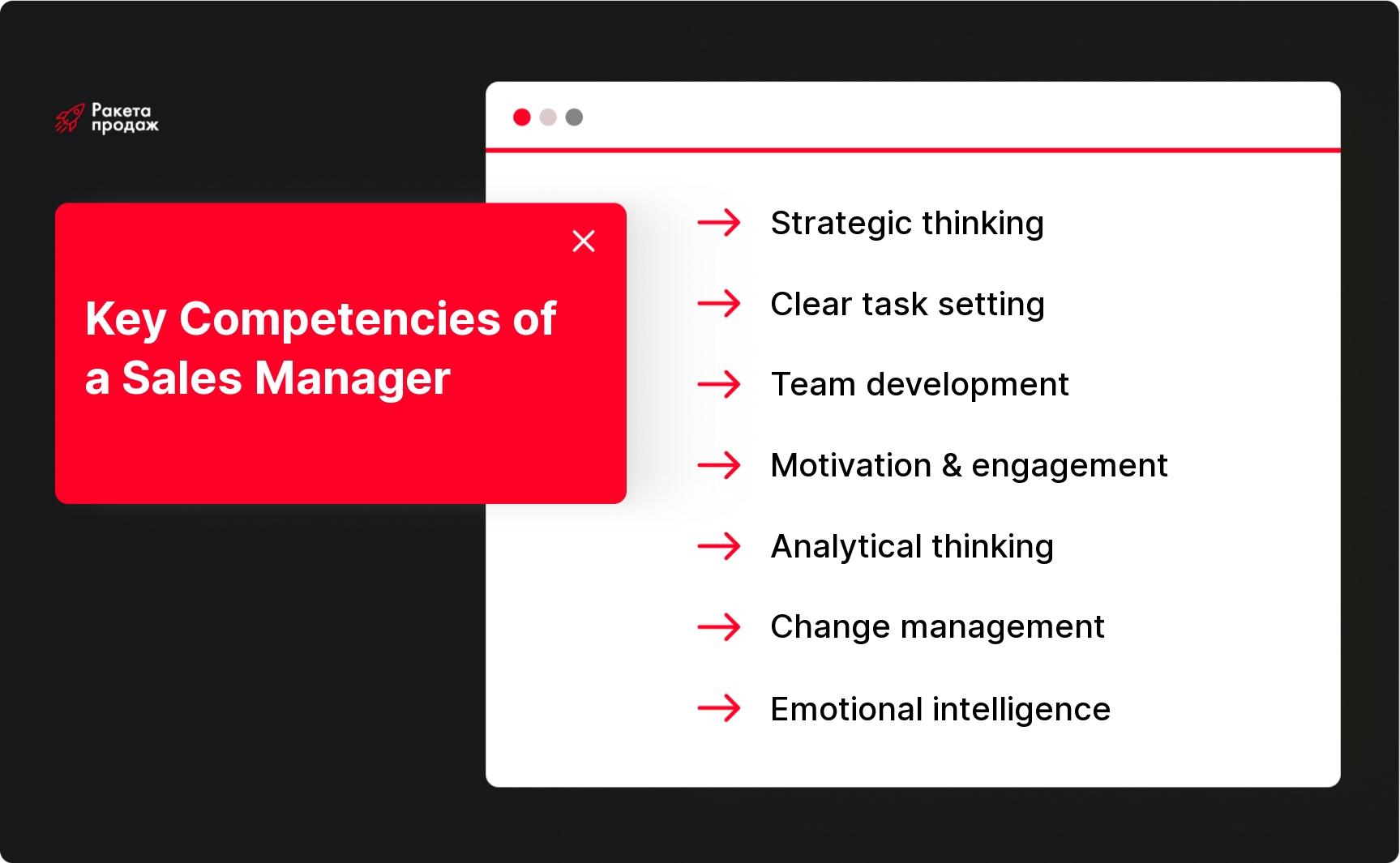
A strong head of sales department is not just a position, but a whole complex of management competencies. Strategic thinking, the ability to clearly set tasks, developed communication skills, the ability to develop a team, manage motivation, analyze data, and implement changes – all these competencies of a sales manager together create the leadership qualities of a sales manager capable of taking the sales department to a new level of effectiveness.
Who is an effective leader? It’s a specialist who possesses not only professional knowledge in sales but also leadership qualities, capable of inspiring the team and creating systematic processes. Emotional intelligence, stress resistance, and personal effectiveness complement this portrait, making the manager not only effective but also sustainable in the long term.
The sales manager portrait includes both professional and personal qualities. What qualities should a manager develop? The systematic development of the skills of an effective leader allows creating a department that works like a well-tuned mechanism, without constant “manual control.” Remember: team effectiveness is a direct reflection of the managerial maturity of its leader. By investing in your development as a manager, you’re investing in the success of the entire department and company.
A sales manager’s job description may list duties, but successful managers go beyond formal frameworks, understanding that their role is much broader. The competencies of a sales manager must constantly develop to meet the changing requirements of the market and business.
Developing management skills is a continuous process that requires not only time but also a proven methodology. However, most managers try to improve through trial and error, which takes months or even years. “Rocket Sales” offers to accelerate this journey through a systematic approach to building a sales department where all management competencies are integrated into a unified methodology.
We don’t just consult but take on full project support: from diagnosing current processes to developing individual development plans for each employee. Our experts create a ready-made system for you with transparent analytics, automated reporting, and team motivation tools. This allows you to focus on strategic tasks while the system works like clockwork.
Over 7 years, we’ve helped 187 companies in 14+ industries create sales departments that consistently achieve 150% of the plan monthly. Among our clients are brands like Mitsubishi, Yamaha, and Naftogaz, who have entrusted us with optimizing their business processes. Don’t postpone building an effec
Create a sales department that generates stable growth of up to 86% – order a comprehensive audit today!


 Time to read: 9 min.
 31 December 2025